
 by
by The best mattress for a yurt is the Saatva Zenhaven: 100% Talalay natural latex holds consistent firmness through temperature swings, resists moisture, and produces zero off-gassing in an enclosed canvas space. For a more affordable bed-in-a-box option that ships easily to off-grid addresses, the Amerisleep AS3 is the strongest foam pick.
Saatva Zenhaven
9.2/10
- 100% natural Talalay latex, zero synthetic foam and zero off-gassing in tight spaces
- Consistent firmness across wide temperature swings, unlike memory foam which stiffens in cold
- Organic cotton cover and organic wool fire barrier, moisture-wicking by design
- Flippable, two firmness options in one mattress, 365-night trial and lifetime warranty
- Premium price, one of the most expensive options here
- Heavy, ships flat with white-glove delivery (not a roll-pack box for remote access)
Natural latex is the only mainstream material that handles a yurt's humidity, cold mornings, and hot afternoons without changing character. The Zenhaven delivers that in a flippable, certified-organic build with Saatva's full service package.
Amerisleep AS3
8.8/10
- Ships compressed in a box, far easier to haul to a remote property
- Plant-based Bio-Pur foam runs cooler and off-gasses less than standard memory foam
- HIVE 5-zone support layer provides targeted pressure relief for side and back sleepers
- CertiPUR-US certified, 20-year warranty is double the industry standard
- All-foam responds more to temperature than latex, though less than standard memory foam
- Edge support softer than coil options, not ideal on a narrow platform
When white-glove delivery won't reach an unpaved road, the AS3 fits in a truck bed and unrolls in minutes. Bio-Pur foam is a solid yurt pick for buyers who prioritize delivery logistics and budget over pure material performance.
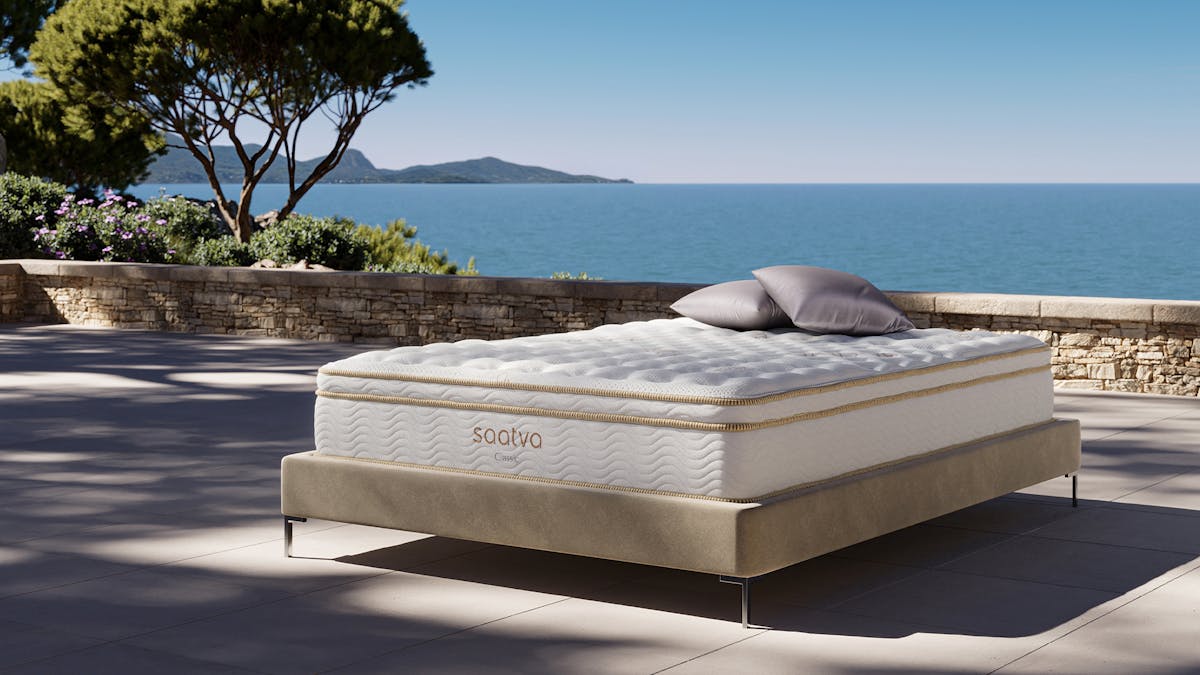
Saatva Classic
8.6/10
- Dual-coil construction with excellent airflow, cooler than any foam in summer heat
- Organic cotton cover with antimicrobial treatment, zoned lumbar foam pad
- Free white-glove delivery, setup and old-mattress removal
- 365-night trial and lifetime warranty
- Steel coils can be vulnerable to persistent moisture if the mattress is not protected and ventilated properly
- Ships flat, not compressed, so hard to transport to truly remote locations
The best innerspring for a yurt if you have proper delivery access and keep the mattress on a well-ventilated slatted platform. The open-coil construction is the most breathable in summer, but moisture management is non-negotiable.
Why yurts need different mattress thinking
Yurts and off-grid homes present a set of mattress challenges most buyers don't hit until after a bad purchase. Condensation, temperature extremes, and the absence of a traditional box spring all affect what works in a circular, canvas-walled sleeping space.
Three failure modes come up repeatedly:
- Moisture damage. A floor-level or low-platform mattress in a humid climate can develop mold on the underside within one damp season if there's no airflow underneath. Natural latex and innerspring constructions handle moisture far better than sealed foam.
- Temperature-related firmness shift. Standard memory foam stiffens significantly in cold conditions and softens in heat. Yurts often swing 30 to 40 degrees between midnight cold and afternoon sun through the lattice walls. Natural latex holds consistent feel across that range.
- Delivery access. Most white-glove services won't drive unpaved roads. A compressed roll-pack mattress in a box can go in a truck bed and be carried by two people to a site with no road access at all.
Best mattress types for yurts
Natural latex (best overall)
Natural latex is the clearest choice for a yurt. It maintains consistent firmness across temperature swings, resists moisture and mold better than foam, breathes well without active cooling technology, and produces no off-gassing in a small enclosed space. Talalay latex (used in the Zenhaven) is softer and more consistent in feel; Dunlop is denser and more durable. Both work. The distinction is the same one that drives the Zenhaven's flippable design.
Plant-based and low-VOC foam (best for remote delivery)
If delivery logistics rule out white-glove service, a compressed foam mattress is the practical alternative. Plant-based foams like Amerisleep's Bio-Pur are less temperature-sensitive than traditional memory foam and off-gas less in an enclosed space. The AS3's HIVE zoned support layer keeps the feel neutral across sleep positions without requiring coils.
Innerspring and coil hybrids (conditional)
Innersprings have the best natural airflow but carry one real risk in a yurt: coils can rust in persistently humid environments if the mattress sits on a non-ventilated surface or if moisture management is neglected. Use these on a properly slatted platform, check the underside each season, and cover the mattress with a breathable protector rather than plastic.
What to avoid
Standard memory foam in particular is a poor fit for a yurt. The temperature sensitivity is the problem, not pressure relief performance. In cold mornings a conventional memory foam mattress can feel rock-hard and take 20 to 30 minutes to soften. Any mattress with sealed synthetic materials and no moisture management will also struggle in a humid yurt over multiple seasons.
Foundation options without a box spring
Most yurts use a raised platform frame built on-site, a low-profile commercial slatted frame, or a floor futon setup. For latex and foam, a slatted platform is required. Slats should be no more than 3 inches apart for adequate support without pressure points. Solid surfaces trap moisture and heat under any mattress material.
For floor-level setups, place the mattress on a breathable rug or natural fiber mat rather than directly on wood or concrete. Lift and air the mattress at least weekly during humid months. The same principles that apply to platform bed mattresses govern yurt foundations.
Delivery to off-grid locations
Getting a mattress to a remote property is often as difficult as choosing the right one. White-glove delivery services, including Saatva's excellent setup-and-removal service, typically won't travel unpaved access roads. If road access is limited, a compressed roll-pack option like the Amerisleep AS3 is the practical choice: it ships via standard carrier, fits in a truck bed, and two people can carry and unroll it with no tools.
Natural latex in compressed box form is available from some manufacturers as well. Saatva's white-glove delivery for the Zenhaven does cover many semi-rural areas, so it's worth checking delivery availability for your zip code before ruling it out.
Temperature regulation in a yurt
Beyond the mattress material, a wool mattress pad or topper adds real insulation on cold nights without changing the feel significantly. Wool is also moisture-wicking, which doubles as humidity management. A breathable cotton or linen duvet system is easier to regulate in a yurt environment than synthetic fills, which trap heat in warm conditions and lose insulation value when damp.
Our cooling mattress guide breaks down how different foams, latex, and hybrid constructions handle heat at the material level.
| Mattress | Type | Yurt suitability | Trial | Queen price |
|---|---|---|---|---|
| Saatva Zenhaven | Natural Talalay latex | Best overall, temp-stable, no off-gassing | 365 nights | ~$3,499 |
| Amerisleep AS3 | All-foam Bio-Pur | Good, ships in box, accessible delivery | 100 nights | From $1,049 |
| Saatva Classic | Innerspring hybrid | Good airflow, needs ventilated platform | 365 nights | ~$1,395 |
For a yurt, choose natural latex if budget allows: the Saatva Zenhaven handles temperature, humidity, and air quality better than anything else tested. For remote delivery or tighter budgets, the Amerisleep AS3 ships in a box, unrolls in minutes, and performs well across sleep positions on a slatted platform.
Frequently asked questions
Can I use a regular mattress in a yurt?
Yes, but moisture management is critical. Any mattress in a yurt needs to be on a ventilated slatted platform and aired regularly. Natural latex handles the yurt environment better than standard foam or innerspring without added maintenance steps.
What foundation works best in a yurt?
A slatted platform frame, either store-bought or custom-built on-site, provides the best foundation. Slats allow airflow under the mattress, which is essential for preventing moisture buildup. Slat gaps should be no more than 3 inches.
Does temperature affect mattress firmness in a yurt?
Yes, especially memory foam, which stiffens noticeably in cold conditions. Natural latex maintains more consistent feel across a 30 to 40 degree temperature swing, which is a real factor in most yurt environments.
How do I prevent my yurt mattress from developing mold?
Use a natural latex or low-foam-density mattress, place it on a slatted platform, use a moisture-wicking wool or cotton mattress pad, and air the mattress outdoors whenever humidity is low. Don't encase the mattress in plastic or non-breathable waterproof covers in the long term.
What is the best mattress for a yurt in a cold climate?
Natural latex with a wool topper or pad. The latex holds firmness and support in cold temperatures where memory foam stiffens, and wool provides additional insulation without trapping moisture.
This guide is part of our Best Mattress by Use Case hub, compare all the top picks and narrow down your choice there.