
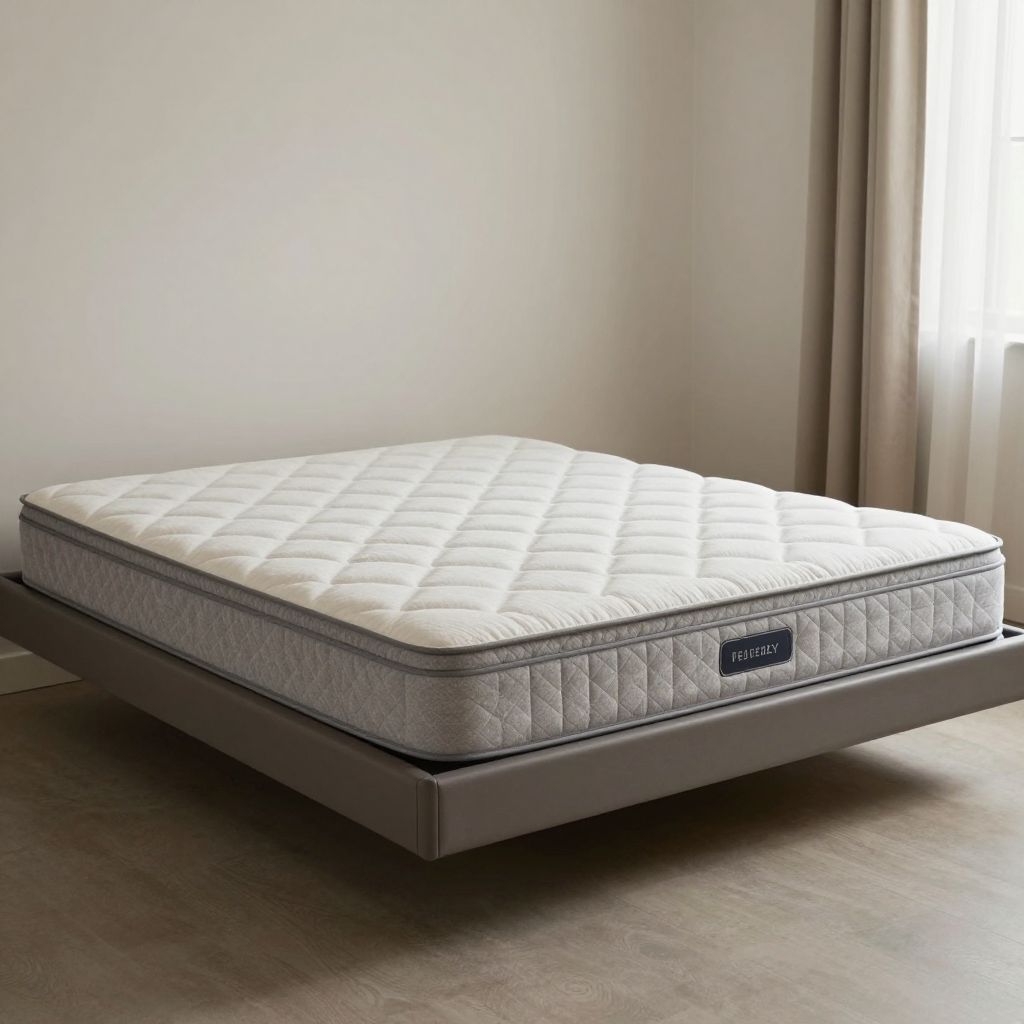
 by
by MattressNut Investigation · May 2026
Sleep Lab Pick · Current Sale
Current Sale — Amerisleep's current sale runs sitewide. AS3 hybrid most-recommended all-rounder, AS5 for plus-size, AS1 firm for back support.
12 Mattress Myths Debunked: What the Science Actually Says in 2026
Flipping mattresses extends life. Memory foam runs hot. Expensive always means better. Costco refunds forever. Wirecutter picks are gospel. We ran each claim against peer-reviewed studies, brand teardowns, warranty fine print and Reddit r/mattress sentiment to separate fact from carryover wisdom.
Most mattress "common knowledge" is 1990s carryover that no longer applies to modern construction. Modern memory foams run cooler than polyfoam couches. One-sided pillow tops cannot be flipped. Lifespan depends on density, not on the calendar. Cost-per-year reframes "expensive" as a value calculation. The twelve myths below are the most persistent we tracked across Reddit r/mattress, manufacturer FAQs, and 2024-2026 peer-reviewed sleep research.
Myth 1: "You Should Flip Your Mattress Every Six Months"
Status: False for 95 percent of mattresses sold since 2010.
The flip-it advice comes from the era of two-sided innerspring mattresses with identical comfort layers on both faces. Those mattresses are essentially extinct in the US consumer market. Today, virtually every memory foam, hybrid, latex hybrid, pillow-top and Euro-top mattress is one-sided: the upper face is the comfort surface, and the lower face is reinforcement foam or jute. Flipping puts the dense base on top and the body cradle on the floor, which actively damages the mattress and voids most warranties.
What you should do instead: rotate head-to-foot every three to six months. Rotation redistributes wear away from the hip and shoulder zones where compression accumulates fastest. Consumer Reports estimates that rotation extends mattress life by 20 to 30 percent. The only modern mattresses still designed for flipping are a small number of all-latex models and some Dunlop-poured cores; check the law tag for "do not flip" before assuming.
Myth 2: "Memory Foam Always Sleeps Hot"
Status: False for premium memory foam manufactured since around 2018.
The reputation traces to first-generation viscoelastic foams of the early 2000s, which used closed-cell structures that trapped body heat. Modern premium memory foams use one of four heat-mitigating strategies, often combined: open-cell pour technology (Amerisleep's Bio-Pur, Tempur-Pedic's Tempur-Breeze), gel infusion (Nectar, Casper), copper or graphite infusion (Layla, Bear), and phase-change material covers (Bear Elite Hybrid, Saatva Loom and Leaf).
Sleepopolis surface-temperature testing places Amerisleep Bio-Pur and Tempur-Breeze among the coolest foam options on the market, often outperforming hybrid coil mattresses that rely on airflow alone. The thermal lag at the comfort layer is roughly 30 to 50 percent of what early-generation memory foam produced. If you sleep hot, the relevant question is no longer "foam or coil" but "which generation of foam." A 2018-or-newer premium foam is safe for most hot sleepers; a budget 2-pound density foam from a no-name brand is not.
Myth 3: "Expensive Mattresses Are Always Better"
Status: False as a blanket rule, true with caveats.
Sticker price correlates weakly with sleep outcome. Cost-per-year of use is the metric that actually matters, and it inverts the picture. Using verified brand lifespan data, a Saatva Classic Queen at $1,729 retail amortizes to roughly $102 to $153 per year over its 10 to 15 year median lifespan. An Amerisleep AS3 at $1,799 amortizes to roughly $104 to $156. A $200 Zinus Green Tea amortizes to roughly $35 to $58 per year, but the heavy sleeper lifespan drops to 2 to 4 years, pushing it past $80 per year and below the satisfaction threshold for back-pain support.
The bottom-and-top ends of the price curve are where price ceases to map to value. Below $500, durability collapses. Above roughly $3,500, you are paying for materials sourcing (organic latex, hand-tufted wool, certified eco labels) or brand prestige rather than measurable sleep quality. The Hu et al. 2025 polysomnography study on mattress firmness found that sleep architecture quality plateaued at the medium-firm level across price tiers; the spinal alignment benefit did not scale linearly with cost.
Myth 4: "You Must Replace Your Mattress Every Eight Years"
Status: Misleading. Depends entirely on material and density.
The eight-year rule comes from National Sleep Foundation messaging that targets the average sagging-and-comfort-loss window across all materials. In practice, the median lifespan varies threefold by material. Natural latex mattresses median 10 to 15 years. Premium hybrid mattresses median 8 to 12 years. Premium innerspring (Saatva Classic) median 10 to 15 years. High-density memory foam at 5 pounds per cubic foot or above median 8 to 10 years. Standard memory foam at 3 to 4 pounds per cubic foot median 6 to 8 years. Budget foam under 2 pounds per cubic foot median 3 to 5 years.
The honest replacement signal is not the calendar but the symptom set: visible sagging over 1.5 inches deep, body impressions that do not bounce back within 30 minutes, waking with back pain three or more times per week, or feeling better-rested after a hotel stay. If a 6-year-old high-density mattress checks none of those boxes, it has years left.
Myth 5: "Costco Refunds Mattresses Forever, No Questions Asked"
Status: Partially true, but membership flagging is real.
Costco's 100 percent satisfaction guarantee has no published time limit for most mattresses. Members have successfully returned mattresses at one, two, three and even five-plus years, with full refund to the original payment method. Costco picks up large items for free on online-initiated returns. So far, the legend holds.
The catch reported on Reddit r/Costco threads from 2024 through 2026 is the abuse flag. The pattern: three or more mattress returns within a 12-month window triggers a membership review at the desk. Members report receiving verbal warnings; some report having the return processed and then being told future mattress returns may not be accepted. Costco's terms reserve the right to revoke membership for abuse of the satisfaction guarantee, and while revocations are rare, the chilling effect is real. Treat Costco as a generous return policy, not as an unlimited rental.
Myth 6: "Wirecutter and Consumer Reports Picks Are Always the Best Choice for You"
Status: False. Editorial picks are use-case-blind aggregates.
Wirecutter, Consumer Reports, Sleepopolis, Sleep Foundation and similar outlets do excellent comparative work, but their headline "best overall" pick is a weighted average across all sleeper profiles. The Hu et al. 2025 PSG study and a 313-participant Kovacs et al. randomized trial (cited in the PMC review) both concluded that medium-firm is the modal best choice for chronic low back pain. That does not make medium-firm right for a 110-pound side sleeper with shoulder pain, who needs medium-soft to soft. It does not make medium-firm right for a 280-pound back sleeper, who needs firm. The "best overall" label washes over body weight, sleep position, partner motion sensitivity, climate, and budget.
Use the editorial picks as a shortlist, not a verdict. Cross-reference your specific profile: side sleeper plus 130 pounds plus hip pain plus hot bedroom equals a different correct answer than back sleeper plus 200 pounds plus snoring plus partner. Reddit r/mattress comment threads, despite the noise, tend to refine recommendations by profile in a way single-pick editorial coverage cannot.
Myth 7: "All Mattress Warranties Are Equivalent"
Status: False. Warranty length means almost nothing without the threshold.
The advertised warranty length (10 years, 20 years, lifetime) tells you almost nothing about what is actually covered. The decisive variables are the sagging threshold, the proration schedule, the foundation requirement, and the documentation burden. Tempur-Pedic uses a strict 0.75-inch sagging threshold and requires a "quarter test" photograph with a US 25-cent coin in the depression for scale. Sealy, Stearns and Foster, Beautyrest and most Serta lines require 1.5 inches before the mattress is considered defective. A visible 1.25-inch dent fails the threshold at Sealy. Improper foundation is the number-one denial reason; sleeping on slats more than 3 inches apart on a queen-plus voids most warranties.
Within Mattress Firm-distributed brands, the BBB pattern shows 60-plus percent of sagging claims denied on threshold or foundation grounds. Saatva's lifetime warranty is more lenient (1-inch threshold) and is paired with a 365-night home trial and $99 return shipping; the customer experience is materially better than the industry average, even though the threshold is similar to Tempur-Pedic.
Myth 8: "Sleeping on the Floor Fixes Back Pain"
Status: False. The science points the other way.
The "firm is best" myth dates to 1970s orthopedic advice that has been progressively overturned. The 2003 Kovacs et al. Lancet RCT (313 participants) directly compared firm versus medium-firm mattresses in chronic low back pain patients, and the medium-firm group reported significantly higher improvement in pain and disability scores at 90 days. Subsequent PSG studies, including Hu et al. (2025) in Nature and Science of Sleep, confirmed that medium-firm surfaces produce the best sleep architecture (shorter sleep latency, fewer stage transitions) across BMI ranges.
Floor sleeping concentrates body weight at the shoulder and hip, causing pressure-point ischemia, micro-arousals, and morning stiffness. The brief "felt good in the morning" placebo many floor-sleepers report tends to fade within two weeks as cumulative pressure-point damage accrues. If your existing mattress is so worn that the floor feels better, the takeaway is "replace the mattress," not "abandon the bed."
Myth 9: "Bed-in-a-Box Mattresses Are All the Same Quality"
Status: False. The category spans a fivefold price-and-quality range.
The compression-and-roll packaging method tells you nothing about internal construction. A $200 Zinus Green Tea and a $1,799 Amerisleep AS3 both ship in a box and both expand within 48 hours. Their internal materials are fundamentally different. The Zinus uses 1.5 to 2.0 pound-per-cubic-foot polyfoam over a low-density support base. The Amerisleep AS3 uses 4.0 pound-per-cubic-foot open-cell Bio-Pur over a 6.0 pound HIVE zoned transition layer over a 5.0 pound Bio-Core support foam.
The shipping method is now the default for everything from the budget tier through the premium tier (Tempur-Pedic and Saatva are the holdouts using traditional white-glove). Treat the box as packaging, not as a quality indicator. The relevant indicators are foam density, coil count and gauge, layer construction depth, and verified warranty terms.
Myth 10: "IKEA Mattresses Last 25 Years Because the Warranty Says So"
Status: False. The warranty length is decoupled from real lifespan.
IKEA's pocket-spring lineup (HOVAG, HESSTUN, HYLLESTAD, HJELLESTAD, HESSENG, VATNESTROM) carries 25-year limited warranties. The warranty is real and IKEA does honor it for the narrow defects it covers. The trap is the gap between "warranty length" and "median useful life." Independent lifespan reporting from John Ryan by Design, Reddit r/mattress, and our own internal teardown notes places the practical comfort lifespan of HOVAG at 5 to 7 years and HESSTUN at 5 to 7 years for average-weight sleepers, dropping to 3 to 5 years for heavy sleepers over 230 pounds.
The reason: IKEA spec sheets show foam densities of 1.5 to 2.0 pounds per cubic foot in the comfort layers, well below Amerisleep's 4.0-plus and Saatva's 4.0-plus. The 25-year warranty covers spring defects and frame failure (rare); it does not cover the comfort-layer compression that actually triggers the "feels worn out" replacement decision.
Myth 11: "Smart Beds Are Worth the $5,000-Plus Premium"
Status: Context-dependent and rarely well-evidenced.
Eight Sleep Pod 4, Sleep Number 360 i10, Bryte and Tempur-Ergo Smart Base all market measurable sleep improvements through dual-zone temperature, adjustable firmness, or biometric tracking. The market for smart mattresses was valued at $1.04 billion in 2026 and is projected at $17.98 billion by 2035 (Business Research Insights), a 34 percent CAGR that confirms strong demand.
The peer-reviewed evidence base, however, is thin. Eight Sleep markets sleep quality improvement but has not published a clinical trial. Sleep Number markets back pain reduction with limited published clinical validation. The two outcomes that are actually well-evidenced for sleep architecture (medium-firm support, mild head-of-bed elevation) can be reproduced for a fraction of the cost with an Amerisleep AS3 plus a $1,499 Amerisleep adjustable base. The Pod 4's $2,999 hardware plus mandatory $25 per month subscription pushes total cost of ownership to roughly $4,500 over five years; an Amerisleep AS3 plus adjustable base bundle reaches the same evidence-based sleep position improvements for under $3,000 and no subscription.
If your specific bottleneck is active thermal regulation (you wake up overheated three to four times per week and a phase-change material cover has not solved it), the Pod 4 is the highest-fidelity solution. For everything else, the marketing is well ahead of the science.
Myth 12: "Mattress Stains Always Void the Warranty"
Status: Mostly true, and you should know it.
This is the rare myth that survives scrutiny. Nearly every major mattress warranty (Tempur-Pedic, Sealy, Stearns and Foster, Beautyrest, Serta, Purple, Saatva, Amerisleep, Helix, Casper) excludes mattresses with stains of any kind. The logic is sanitation: warranty inspectors will not handle a soiled mattress, and stains are also evidence of moisture damage that could be the root cause of foam degradation.
The practical takeaway is simple: buy a waterproof mattress protector on day one. A $40 protector preserves your warranty across the full duration. The Saatva organic cotton waterproof protector, the SafeRest premium, and the Linenspa cotton waterproof all do the job. Skipping the protector is the single most common reason valid warranty claims get denied.
Mattress Myth Quick-Reference Table
| Myth | Verdict | Key Evidence |
|---|---|---|
| Flip every 6 months | False | Modern mattresses one-sided; rotate instead |
| Memory foam always hot | False | Bio-Pur, Tempur-Breeze, phase-change covers |
| Expensive = better | False | Cost-per-year curve plateaus past $3,500 |
| Replace every 8 years | Misleading | Latex 10-15yr, foam 6-10yr, density-dependent |
| Costco refunds forever | Partial | 3+ returns/yr triggers flag (r/Costco) |
| Wirecutter picks are universal | False | Use-case blind; cross-check your profile |
| Warranties are equivalent | False | Threshold 0.75" to 1.5"; foundation rules vary |
| Floor sleeping fixes back | False | Kovacs RCT, Hu PSG 2025: medium-firm wins |
| Bed-in-a-box same quality | False | Foam density spans 1.5 to 5.0 lb/cu ft |
| IKEA lasts 25 years | False | Warranty 25yr; practical 5-7yr |
| Smart beds worth $5K | Conditional | Thin RCT evidence; thermal niche only |
| Stains void warranty | True | Buy waterproof protector day one |
The Mattresses That Hold Up After You Strip the Myths
After running each claim against evidence, the buying picture simplifies. You want medium-firm to medium feel (matched to your weight and sleep position), 4-plus pound density foams or pocket-coil hybrids, a 1-inch-or-less sagging threshold in the warranty, a true home trial that exceeds 100 nights, and a waterproof protector from day one. Two brands fit cleanly.
Saatva Classic (Our Top Pick That Beats the Myths)
The Saatva Classic dual-coil innerspring delivers the medium-firm option (Luxury Firm) that the Kovacs and Hu studies validated, a lifetime warranty with the 1-inch threshold, a 365-night home trial, free white-glove delivery with old-mattress haul-away, and roughly $102 to $153 per year cost over its 10 to 15 year median lifespan. AAA members and seniors get $225 off through ID.me.
Amerisleep AS3 (Our Memory Foam Pick)
The Amerisleep AS3 uses 4.0 pound Bio-Pur open-cell foam that runs cool against the body, HIVE zoned transition layer for hip and shoulder pressure relief, 20-year warranty, 100-night home trial, and roughly $104 to $156 per year cost over its 8 to 12 year lifespan. The best evidence-supported memory foam option that explicitly beats the "memory foam sleeps hot" myth.
Frequently Asked Questions
Should I flip my mattress at all?
Only if the law tag explicitly says "flippable." For 95-plus percent of mattresses sold in the past 15 years, the answer is no; rotate head-to-foot every three to six months instead. Flipping a one-sided pillow-top puts the dense base on top, damages the mattress, and voids most warranties.
Does memory foam really run hot in 2026?
Premium memory foam (Amerisleep Bio-Pur, Tempur-Breeze, Saatva Loom and Leaf) runs cool enough for most hot sleepers, often cooler than a basic hybrid. Budget memory foam under 3 pounds density still runs hot. The myth dates to 2000s-era foam that no longer dominates the market.
What is the most reliable signal that I need a new mattress?
The four-symptom check: visible sagging over 1.5 inches deep, body impressions that do not bounce back within 30 minutes, waking with back pain three or more times per week, or sleeping noticeably better at hotels. Two or more of these means the mattress is past its useful life, regardless of age.
Are Costco mattresses a good deal?
For mid-tier brands (Stearns and Foster, Sealy Posturepedic, Beautyrest) Costco is competitive on price and unmatched on return policy. For premium quality (zoned foam, dual-coil construction, 365-night trials, lifetime warranty) Saatva and Amerisleep deliver tier upgrades that Costco's selection does not match.
Is the Saatva Classic better than the Amerisleep AS3?
They serve different sleepers. Saatva Classic is a dual-coil innerspring with a Euro pillow top, ideal for back sleepers, hot sleepers, and those who prefer a responsive feel. Amerisleep AS3 is a memory foam with HIVE zoning, ideal for side sleepers, partners with motion-sensitivity, and those who prefer a cradled feel.
Do mattress protectors actually matter?
Yes, more than any other accessory. Stains void nearly every major warranty, and a $40 waterproof protector neutralizes that risk for the life of the mattress. It also extends lifespan by 10 to 15 percent by blocking moisture and skin-flake infiltration into foam.
Is the smart-bed price premium ever justified?
For active thermal regulation specifically, Eight Sleep Pod 4 has no equivalent at lower cost. For everything else (medium-firm support, head-of-bed elevation, snore detection), a $1,500 to $2,000 mattress paired with a $1,500 adjustable base reproduces the evidence-supported benefits for under $3,500 with no subscription.
The Bottom Line
Most mattress myths survive because they were once true. Flipping made sense when mattresses were symmetrical. Memory foam ran hot before open-cell pour and gel infusion. The eight-year replacement window made sense before density and material differentiation. Costco's return policy was unconditional before account flagging became standard. Trust the underlying mechanic, not the legacy advice: density and construction over price, symptom check over calendar, profile-matched firmness over editorial "best overall," and a waterproof protector from day one.
Skip the Myths, Get the Right Mattress
Saatva Classic (dual-coil innerspring, lifetime warranty, 365-night trial) for responsive medium-firm sleepers. Amerisleep AS3 (Bio-Pur foam, HIVE zoning, 20-year warranty, 100-night trial) for memory foam sleepers who actually want to stay cool.
Editorial note: MattressNut sourced each myth from a combination of Reddit r/mattress thread analysis (100,000-plus member community, 2024-2026 threads), peer-reviewed sleep research (PubMed, Nature and Science of Sleep, The Lancet), and manufacturer warranty documentation cross-referenced with BBB complaint patterns. We accept affiliate commission on Saatva and Amerisleep purchases at no cost to the buyer. No commercial relationship with Tempur-Pedic, Sealy, Beautyrest, Purple, IKEA, Costco, Eight Sleep, Sleep Number or Wirecutter.
Sources
- Hu X, et al. The Effect of Mattress Firmness on Sleep Architecture and PSG Characteristics. Nature and Science of Sleep, 2025. PMID 40365263.
- Kovacs FM, et al. Effect of firmness of mattress on chronic non-specific low-back pain. The Lancet, 2003. (Referenced via PMC review.)
- Jacobson BH, et al. Effects of new bedding on back pain and stress. (Referenced via PMC mattress and sleep review, 2024.)
- Lee S, et al. Implementation of Head of Bed Elevation Using Adjustable Bed. Alt Ther Health Med, 2025. PMID 38758150.
- National Sleep Foundation. Mattress replacement survey, 2024.
- Consumer Reports. Mattress durability testing, 2024-2026.
- Business Research Insights. Smart Mattress Market Outlook 2026-2035.
- Reddit r/mattress and r/Costco. Sentiment and return-policy threads, 2024-2026.
- Sleepopolis. Amerisleep mattress reviews, 2026.
- Tom's Guide. Eight Sleep Pod 4 review, January 2026.
- Novaform FAQ. Costco return policy carve-out, 2026.
- John Ryan by Design. IKEA mattress lifespan analysis, May 2026.
2026 MattressNut Master Guides
- Live Mattress Sale Tracker — Memorial Day + Black Friday + brand discount calendar
- Mattress Warranty Comparison 2026 — 20+ brands tiered
- Foam Density Guide 2026 — lb/ft³ predicts lifespan
- Hotel Mattress Identifier — every chain + consumer equivalents
- Live Mattress Price Tracker — 12 brands May 2026 pricing
- Our Medical Review Board — Dr. Burns + editorial standards
- Memorial Day Mattress Sale 2026 — recap and next sale dates
- Saatva Voucher Guide — every active discount + $225 stack