
 by
by Our Recommended Mattress
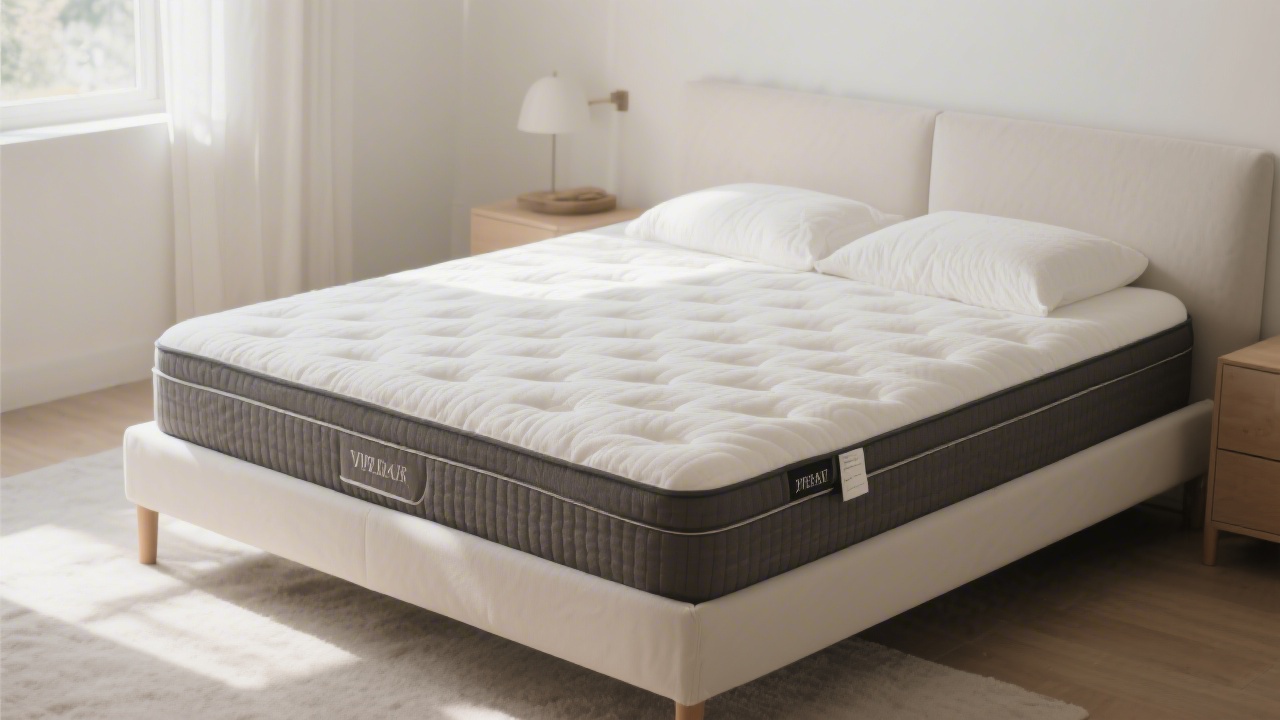
The Saatva Classic Mattress delivers certified organic cotton, individually wrapped coils, and a 365-night home trial — the gold standard for sleep quality and long-term value.
The sticker price of a mattress tells you almost nothing about what it actually costs you. True total cost of ownership (TCO) includes purchase price amortized over lifespan, disposal costs, health-related downstream costs (doctor visits, analgesics, lost productivity), and the opportunity cost of sleeping on a degrading surface. When you run that full calculation, the optimal price tier shifts significantly upward from what impulse-purchase behavior typically produces.
The Five Price Tiers: TCO Comparison
Tier 1: Budget ($200-400)
Representative example: 10-inch gel foam mattress, typical lifespan 3-5 years.
Purchase: $299. Disposal: $40. Lifespan assumed: 4 years (1,460 nights).
Cost per night: $0.23. Over 10 years (2.5 replacements): $847 total, $0.23/night.
Health modifier: Higher incidence of morning stiffness and back pain at years 3-4 as foam degrades.
Tier 2: Mid-range ($500-900)
Representative example: Casper Original, Purple 3, typical lifespan 6-8 years.
Purchase: $799. Disposal: $50. Lifespan assumed: 7 years (2,555 nights).
Cost per night: $0.33. Over 10 years (1.43 replacements): $1,213 total, $0.33/night.
Tier 3: Upper mid-range ($900-1,400)
Representative example: Helix Midnight Luxe, Nectar Premier, typical lifespan 8-10 years.
Purchase: $1,200. Disposal: $50. Lifespan assumed: 9 years (3,285 nights).
Cost per night: $0.38. Over 10 years (1.11 replacements): $1,387 total, $0.39/night.
Tier 4: Premium ($1,400-2,000) — Optimal TCO Zone
Representative example: Saatva Classic, WinkBeds Original, typical lifespan 10-12 years.
Purchase: $1,595. Disposal: $50. Lifespan assumed: 10 years (3,650 nights).
Cost per night: $0.45. Over 10 years: $1,645 total, $0.45/night.
Tier 5: Luxury ($2,500+)
Representative example: Tempur-Pedic TEMPUR-ProAdapt, Stearns and Foster Estate, typical lifespan 10-15 years.
Purchase: $3,500. Disposal: $60. Lifespan assumed: 12 years (4,380 nights).
Cost per night: $0.81. Over 10 years: $3,560 total, $0.81/night (assuming one replacement at year 12).
Why Tier 4 Has the Best TCO
The cost-per-night for Tier 4 ($0.45) is within $0.06 of Tier 3 ($0.39) while delivering measurably better sleep performance. The jump to Tier 5 adds $0.36/night with no documented sleep quality improvement beyond Tier 4 in independent testing. Tier 1 appears cheapest per night, but the health modifier changes that calculation.
The Health Cost Component
The TCO calculation above excludes health costs because they are difficult to attribute with precision. The research on mattress quality and health outcomes, however, provides order-of-magnitude estimates:
Back pain: A degraded mattress causing morning back pain generates downstream costs averaging $3,000/year in the US (PT visits, imaging, medication, lost work days). Even a 10% reduction in back pain incidence — a conservative estimate for a quality mattress versus a degraded budget one — represents $300/year in avoided costs.
Sleep quality and healthcare utilization: Adults who consistently sleep 7-8 hours have 35% lower cardiovascular disease risk, 40% lower obesity risk, and significantly lower lifetime healthcare costs (see our dedicated analysis in the sleep healthcare costs article). Mattress quality is one input into sleep architecture; it is not the whole equation, but it is measurable and modifiable.
Productivity: Our analysis of the RAND sleep deprivation study calculates approximately 11 lost productive working days per year for chronic under-sleepers. A quality mattress improving sleep from poor-to-adequate does not recover all 11 days, but even recovering 2-3 days annually represents $500-700 in productivity value at median US wages.
The Disposal and Replacement Cost Table
| Tier | Purchase | Lifespan | 10yr Total | Cost/Night |
|---|---|---|---|---|
| Budget | $299 | 4 yrs | $847 | $0.23 |
| Mid-range | $799 | 7 yrs | $1,213 | $0.33 |
| Upper mid | $1,200 | 9 yrs | $1,387 | $0.39 |
| Premium (Optimal) | $1,595 | 10 yrs | $1,645 | $0.45 |
| Luxury | $3,500 | 12 yrs | $3,560 | $0.81 |
Related Reading
The Practical Conclusion
For most adults who will sleep on the same mattress for 8-10 years, the Tier 4 range ($1,400-2,000) represents the best total cost of ownership position: meaningfully better sleep performance than Tiers 1-3, substantially lower lifetime cost than Tier 5, and the strongest correlation between purchase price and documented sleep quality outcomes in independent testing. Anything below $1,000 should be evaluated with the realistic lifespan assumption of 4-6 years, not the "10-year warranty" language that often accompanies those products.
Frequently Asked Questions
What is the average lifespan of a mattress by type?
Innerspring (Bonnell coil): 5-7 years. All-foam: 6-8 years (higher density foam lasts longer). Hybrid (foam + individually wrapped coils): 8-12 years. Latex (natural): 12-20 years. Latex (synthetic blended): 8-12 years. These are averages; lifespan depends heavily on weight of sleepers, use frequency, and care (rotation, protector use).
Does a better mattress actually reduce healthcare costs?
Yes, with documented effect sizes. A 2015 Chiropractic and Manual Therapies study found that replacing mattresses over 5 years old reduced morning back pain by 57% and disability scores by 60.8% in a 28-day trial. Fewer pain episodes translates to fewer physical therapy visits, less OTC and prescription analgesic use, and lower likelihood of chronic pain escalation.
What does mattress disposal cost?
Professional mattress disposal typically runs $25-75 via junk removal services (1-800-GOT-JUNK, LoadUp). Some municipalities offer free mattress pickup once per year. Retailers like Saatva offer optional mattress removal with delivery for a nominal fee. Illegal dumping carries fines of $100-500 in most jurisdictions.
How do I calculate cost per night for a mattress?
Divide total cost (purchase price + disposal - trade-in value) by the number of nights of use. Example: $1,595 Saatva used for 10 years (3,650 nights), $50 disposal cost, no trade-in = $1,645 / 3,650 = $0.45 per night. Compare: $299 budget mattress replaced every 4 years over 10 years = ($299 x 2.5 purchases) + ($50 x 2.5 disposals) = $872.50 total = $0.24/night.
Is a mattress protector worth adding to the TCO calculation?
Yes. A $50-80 mattress protector extends lifespan by preventing moisture and allergen damage that degrades foam and fabric. More importantly, it preserves warranty coverage — most warranties are voided by staining. At $50 investment protecting a $1,595 mattress warranty, the protector ROI is effectively the full replacement cost risk reduction.
Our Recommended Mattress
The Saatva Classic Mattress delivers certified organic cotton, individually wrapped coils, and a 365-night home trial — the gold standard for sleep quality and long-term value.