
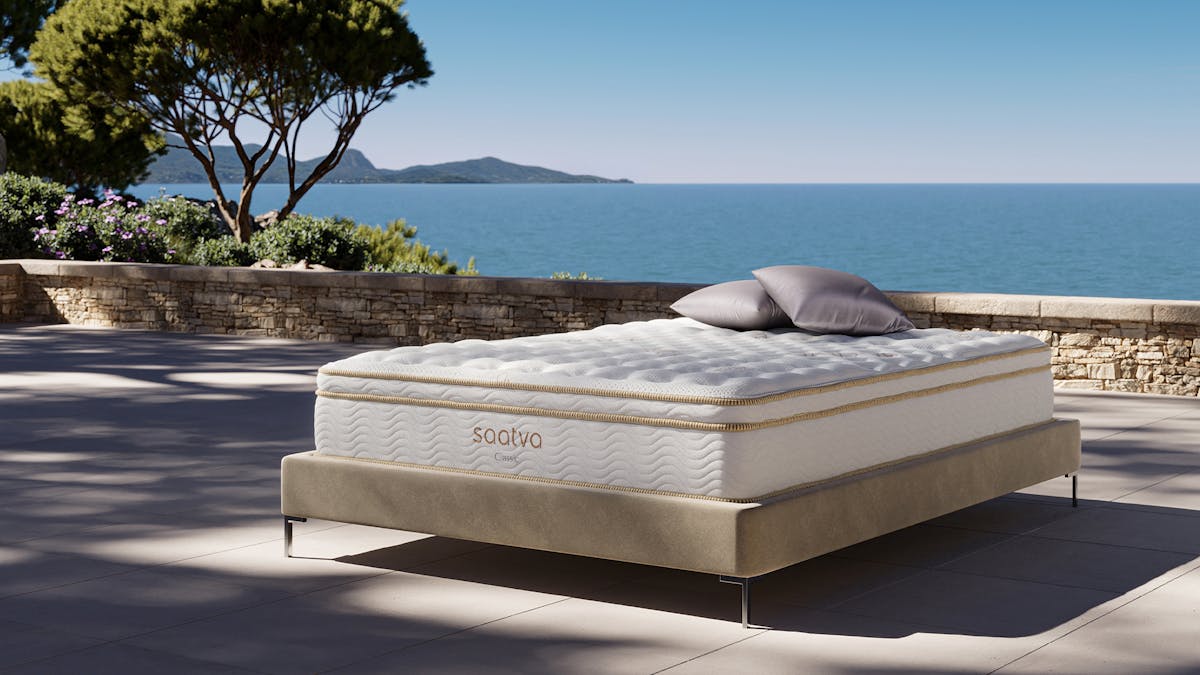
 by
by Memory foam delivers best-in-class pressure relief and motion isolation, but traps heat and responds slowly. For memory foam specifically, the Saatva Loom & Leaf is the most refined option, with premium-density foam, organic cotton cover, and exceptional temperature regulation. The Amerisleep AS3 is a strong alternative that solves the heat problem with open-cell Bio-Pur construction.
Saatva Loom & Leaf
9.3/10
- 5-lb high-density memory foam delivers the deepest, most durable contouring available
- Gel-infused comfort layer and organic cotton cover run cooler than traditional closed-cell foam
- Free white-glove delivery, in-home setup, and old-mattress removal
- 365-night trial and lifetime warranty, two of the longest in the industry
- Higher price point than most foam alternatives
- Ships flat, not compressed; scheduling required for delivery
The Loom & Leaf is Saatva's dedicated memory foam mattress and represents what high-density foam looks like done right: premium materials, exceptional longevity, and the trial window needed to confirm it fits you. For anyone serious about memory foam and unwilling to compromise on quality, it is the clear choice.
What is memory foam?
Memory foam is viscoelastic polyurethane foam, developed by NASA in the 1970s and commercialized for mattresses in the 1990s. Viscoelastic means it responds to both pressure and heat: body warmth softens the foam so it molds around your shape over 30 to 120 seconds. Remove the pressure and it recovers over roughly the same period. That slow contouring is what separates memory foam from latex (near-instant response) and innerspring (immediate spring-back).
Today memory foam appears in everything from $300 budget mattresses to $3,000 premium beds. The difference lies mainly in foam density, which determines durability and depth of contouring, and in whether the foam is traditional petroleum-based or a newer open-cell or plant-blended variant designed to reduce heat retention.
Memory foam pros
- Pressure relief: slow contouring distributes body weight evenly, cutting peak pressure at hips and shoulders. This is the main reason side sleepers and people with joint pain gravitate toward foam.
- Motion isolation: foam absorbs energy rather than transferring it. For couples with different schedules, this matters more than almost any other spec.
- Silent surface: no coil noise, no fabric-on-coil friction. Fully quiet regardless of movement.
- Conforms specifically to your shape: the mattress gradually adapts to your sleep position, which some people describe as a custom-fit feel that improves over weeks.
- Value at the budget tier: quality all-foam mattresses start around $300 to $500 queen. At that price point, foam outperforms entry-level hybrids on pressure relief.
- CertiPUR-US certified options available: low-VOC certified foam addresses off-gassing concerns common with cheaper versions.
Memory foam cons
- Heat retention: traditional memory foam traps body heat because the dense closed-cell structure restricts airflow. Gel infusions, graphite infusions, copper infusions, and open-cell processing all reduce this, but do not fully eliminate it for hot sleepers. Coil hybrids and latex reliably run cooler.
- Slow response: the same viscoelastic property that creates pressure relief makes repositioning slower. Combination sleepers who switch positions frequently may find this frustrating at 3 a.m.
- Weak edge support: foam compresses when you sit or sleep near the perimeter. The usable sleeping surface is smaller than a hybrid with reinforced coil edges.
- Off-gassing: new foam releases VOCs (volatile organic compounds) for the first 24 to 72 hours after unboxing. The smell dissipates and CertiPUR-US certified foam has strictly regulated VOC levels, but the first night in a poorly ventilated room can be unpleasant.
- Lifespan: lower-density foam develops permanent body impressions within 3 to 5 years. High-density foam (4.0+ lbs per cubic foot) lasts 8 to 12 years and warrants the price premium.
Who should choose memory foam
Memory foam is the right call if at least one of these applies:
- You sleep on your side and have shoulder or hip pressure issues
- You share a bed with a partner who has a different sleep schedule
- You specifically want deep contouring and the "sleeping in" feel
- You run cool or sleep in an air-conditioned room
Memory foam is probably not the right call if you sleep hot and lack air conditioning, switch positions frequently through the night, weigh over 230 lb and need firm edge support, or prefer the responsive bounce of a coil or latex system.
Memory foam density: the spec that determines durability
| Density | Durability | Contouring | Typical use |
|---|---|---|---|
| 2.0 to 3.0 lbs/ft3 | Poor (3 to 5 years) | Moderate | Budget mattresses under $400 |
| 3.0 to 4.0 lbs/ft3 | Good (5 to 8 years) | Good | Mid-range $400 to $900 |
| 4.0 to 5.0 lbs/ft3 | Very good (8 to 12 years) | Excellent | Premium mattresses |
| 5.0+ lbs/ft3 | Excellent (12+ years) | Maximum | High-end models, therapeutic |
The Saatva Loom & Leaf uses 5-lb high-density memory foam in the comfort layer, placing it at the top of the durability range. Budget foam at 2.0 to 2.5 PCF will feel similar on night one but compress permanently within a few years.
Alternatives worth considering
Amerisleep AS3
9.1/10
- Bio-Pur open-cell foam runs significantly cooler than traditional memory foam
- HIVE 5-zone layer firms under the lumbar and softens under shoulders
- Outstanding motion isolation in independent NapLab testing
- CertiPUR-US certified, made in the USA, 20-year warranty
- Softer edges than any hybrid or coil mattress
- Sleepers over 230 lb may want the AS5 Hybrid for more coil support
The AS3 is the clearest answer to the biggest memory foam complaint, heat, without giving up the pressure relief and motion isolation that make foam worth choosing. It is a strong alternative at a lower price point than the Loom & Leaf.
Sweetnight Breeze
8.4/10
- Gel-infused comfort layer reduces heat at a price point where most foam runs hot
- Strong value-to-performance ratio under $400 queen
- 100-night trial with free returns
- Lower foam density means shorter lifespan than premium models
- Less edge support and deep contouring than higher-density options
If your budget is the primary constraint and you still want a gel-infused foam that addresses heat retention, Sweetnight is the honest pick at this tier. It gives you the foam feel without the premium price.
Memory foam vs latex vs hybrid: one-line each
- Memory foam: best pressure relief and motion isolation; worst heat and response.
- Latex: responsive and cool, good pressure relief, expensive, heavier.
- Hybrid (foam + coils): compromise: good pressure relief, better cooling, better edges, more bounce.
If you want a coil-based alternative with none of the foam heat concerns, the Saatva Classic innerspring hybrid is the most complete option, with a 365-night trial and free white-glove delivery.
Common questions
Is memory foam bad for hot sleepers?
Traditional dense memory foam retains significant heat, but open-cell and gel-infused foams run much cooler. The Saatva Loom & Leaf uses a gel-infused comfort layer and an organic cotton cover to address heat retention at the premium tier. Severe hot sleepers still do better with a hybrid or latex, but modern foam options have closed most of the gap.
How long does a memory foam mattress last?
Lifespan depends almost entirely on foam density. Low-density foam (2 to 3 PCF) develops visible impressions within 3 to 5 years. High-density foam (4 PCF and above) typically lasts 8 to 12 years. The Saatva Loom & Leaf uses 5-lb high-density foam and is covered by a lifetime warranty. The Amerisleep AS3 uses 4.0 PCF Bio-Pur foam with a 20-year warranty.
Is memory foam good for back pain?
Medium-firm memory foam (5 to 7 on a 10-point scale) relieves lumbar pressure for most back sleepers and side sleepers. The risk is foam that is too soft: if your hips sink too deeply, the spine arches unnaturally and back pain worsens. Mattresses with zoned support address this directly. The Saatva Loom & Leaf's firmer construction and lumbar zone pad reduce this risk compared to softer all-foam models.
Memory foam or hybrid for couples?
All-foam wins on motion isolation by a wide margin. If your partner's movement wakes you, foam is the straightforward answer. If you both run hot, a hybrid with coil airflow is the better compromise. The Saatva Classic threads that needle: innerspring responsiveness with a foam comfort layer and a 365-night trial to confirm it works for both of you.
Memory foam is the best material for pressure relief and motion isolation; its main weaknesses are heat retention and slow response. The Saatva Loom & Leaf is our top pick for premium memory foam with high-density construction and a 365-night trial. The Amerisleep AS3 is a strong, lower-cost alternative that solves the heat problem with open-cell Bio-Pur foam.