
 by
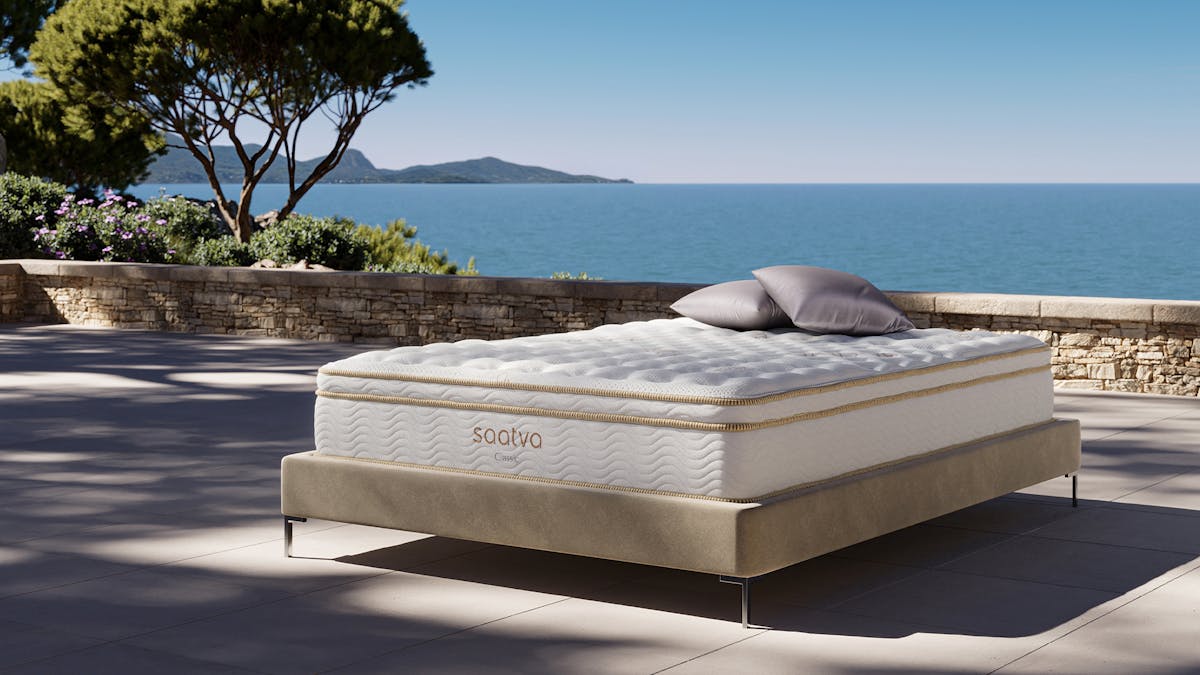
by Hybrid mattresses combine pocketed coils with foam or latex comfort layers, giving you coil bounce, airflow, and edge support alongside foam pressure relief. For most adults, a quality hybrid is the best all-around mattress. Our top hybrid pick is the Saatva Classic: dual coil system, lumbar zone reinforcement, three firmness options, 365-night trial, and lifetime warranty.
Saatva Classic
9.4/10
- Dual coil system with zoned lumbar foam reinforcement pad
- Outstanding edge support, only 2.25" sinkage sitting at the perimeter
- Free white-glove delivery, setup, and old-mattress removal
- Three firmness options (Plush Soft, Luxury Firm, Firm) in 11.5" or 14.5" heights
- GREENGUARD Gold certified, organic cotton cover
- Moderate motion isolation due to dual-coil bounce, not ideal for very light sleepers sharing a bed
- Ships flat, not compressed in a box; requires in-home delivery
- $99 return fee applies during the 365-night trial
The Saatva Classic is the benchmark for what a hybrid should deliver: coil responsiveness and airflow from the dual coil system, genuine lumbar support from the zoned reinforcement pad, and a trial window long enough to confirm the fit. Luxury Firm at 6/10 is the right starting point for most sleepers.
How hybrid mattresses work
A hybrid uses a layered structure built around a pocketed coil support system. Each coil is individually wrapped in fabric, so it responds to weight independently rather than as a connected unit. Above that sits a transition foam layer that prevents coil feel from reaching the surface, then a comfort layer of memory foam, latex, or specialized foam for pressure relief. The cover is typically organic cotton or a cooling-treated fabric.
What makes a hybrid distinct from a traditional innerspring is the thickness of the comfort layers, typically 2 to 4 inches of genuine pressure-relieving material rather than the thin padding of older spring beds. What makes it distinct from all-foam is the coil core, which provides airflow channels, responsive bounce, and structural durability that foam alone cannot replicate.
Hybrid mattress pros
- Better cooling: Coil systems create natural air channels through the mattress core. Hot sleepers consistently rate hybrids cooler than equivalent all-foam options, and third-party lab tests confirm lower surface temps on hybrid builds.
- More responsive feel: Pocketed coils compress and decompress quickly, making position changes easier. Combination sleepers and couples benefit most from this responsiveness.
- Stronger edge support: Quality hybrids reinforce the perimeter with a coil border or dense foam encasement, letting you use the full mattress width without rolling toward the edge.
- Longer lifespan: The coil system maintains structural integrity over time. Quality hybrids last 8 to 12 years; all-foam typically 5 to 8 years before noticeable softening.
- Better for heavier sleepers: Coils do not bottom out under higher body weights the way foam can, maintaining consistent support for sleepers above 230 lbs.
Hybrid mattress cons
- Higher price floor: The coil construction adds real manufacturing cost. Entry-level quality hybrids start around $600 to $800 for a queen, versus $300 to $500 for comparable all-foam. Below $600, hybrid quality is inconsistent.
- More motion transfer than all-foam: Pocketed coils isolate motion better than traditional interconnected springs, but not as well as dense foam. Couples where one partner is a light sleeper may feel more disturbance on a hybrid.
- Heavier and harder to move: A queen hybrid typically weighs 70 to 100 lbs versus 50 to 70 lbs for all-foam, making rotation or repositioning harder without help.
- Delivery method varies: Thick, high-coil-count hybrids sometimes require freight or in-home delivery rather than standard box shipping. Check delivery method before buying.
- Comfort layer quality varies: A cheap hybrid uses thin, low-density foam over budget coils. The coil-foam combination delivers no real benefit unless both layers are well made.
Who benefits most from a hybrid
| Sleeper profile | Hybrid? | Reason |
|---|---|---|
| Hot sleepers | Yes | Coil airflow significantly outperforms all-foam |
| Heavy sleepers (230+ lbs) | Yes | Coils maintain support without bottoming out |
| Combination sleepers | Yes | Responsive coils make position changes easy |
| Couples (active use) | Yes | Better edge support and bounce |
| Back pain sufferers | Yes | Zoned coil hybrids reinforce the lumbar directly |
| Light sleepers sharing a bed | Maybe | All-foam isolates motion better |
| Budget buyers under $500 | No | All-foam is more reliable at that price point |
Amerisleep AS3
9.1/10
- HIVE 5-zone support layer firms specifically under the lumbar
- Partially plant-based Bio-Pur foam runs cooler than standard memory foam
- Outstanding motion isolation, 9.3/10 across independent tests
- CertiPUR-US certified, made in the USA, free shipping
- Less edge support than a coil hybrid
- No coil bounce, not ideal for sleepers who dislike a contouring feel
- Sleepers over 230 lbs may prefer the AS5 Hybrid for firmness
If you prefer the pressure-relief and motion-isolation advantages of foam, the AS3 is the strongest all-foam option. It is not a hybrid, but the HIVE zoning addresses the main structural weakness of flat-foam builds and delivers genuine lumbar support without coils.
Hybrid vs memory foam: how to decide
The choice comes down to which trade-offs matter more to you. Memory foam gives better motion isolation and typically costs less for equivalent pressure relief. A hybrid gives better cooling, better edge support, and more responsiveness. Both can deliver good lumbar support if the construction is right, the Saatva Classic through a zoned lumbar coil pad, the Amerisleep AS3 through the HIVE foam zoning.
For hot sleepers, heavier sleepers, or anyone sharing a bed who needs the full mattress width, the hybrid advantages are real and measurable. For couples where one partner wakes easily, or for buyers on a tight budget, all-foam is often the better fit.
Sweetnight Twilight
8.1/10
- Genuine pocketed coil system at the budget price threshold
- Gel memory foam comfort layer handles pressure without overheating
- Three firmness options: Soft, Medium, Firm
- CertiPUR-US certified foam
- 30-night trial is shorter than premium picks (100 to 365 nights)
- Thinner comfort layers than mid-range and premium hybrids
At the budget threshold where hybrid quality becomes possible, the Sweetnight Twilight delivers a real coil system with gel foam rather than a watered-down spring bed. The right choice for buyers who want genuine hybrid benefits without crossing $700.
How long do hybrid mattresses last?
Quality hybrid mattresses last 8 to 12 years. The coil system is usually not the first thing to fail, as pocketed coils maintain their shape and response well. The foam comfort layers compress over time, producing the 1 to 1.5 inch indentations that signal replacement. Using a mattress protector and rotating every 3 to 6 months extends lifespan. Hybrids with a reinforced lumbar zone or high-density transition foam tend to hold up better than basic layered builds.
What to look for in a hybrid
- Coil count and gauge: More coils at lower gauge (thicker wire) mean stronger support. A queen with 800 to 1,000 pocketed coils is a reasonable quality indicator; under 600 is a red flag.
- Comfort layer thickness and density: 2 to 3 inches of foam at 3 to 4 PCF density is the quality floor. Thinner or lower-density comfort layers compress faster and provide less pressure relief.
- Edge support design: Look for a reinforced coil border or dense foam perimeter encasement. This matters for couples who use the full mattress width and for anyone who sits on the edge to get in or out of bed.
- Trial length: Hybrid adaptation takes 3 to 6 weeks. A 30-night trial is too short to judge confidently. Aim for 100 nights or more.
Hybrids outperform all-foam on cooling, edge support, responsiveness, and durability. The trade-off is more motion transfer and a higher price floor. The Saatva Classic is our top hybrid pick on a 365-night trial; the Amerisleep AS3 is the best foam alternative if you prioritize motion isolation over bounce.
Frequently asked questions
Is a hybrid mattress better than memory foam?
Hybrid is better for hot sleepers, heavier sleepers, combination sleepers, and couples who need edge support and responsiveness. Memory foam is better for motion isolation, pressure contouring, and tighter budgets under $600. Neither is universally superior, the right choice depends on your sleep style and priorities.
How long does a hybrid mattress last?
Quality hybrids last 8 to 12 years. The coil core holds up well; the foam comfort layers are the first to show compression. Signs it needs replacing: over 1 inch of sagging, waking with pain, or visible indentations in the surface. Using a mattress protector and rotating regularly extends lifespan significantly.
Are hybrid mattresses worth the price?
For most adult sleepers, yes. The coil system delivers real benefits in cooling, responsiveness, and durability that all-foam cannot match. Below $600, hybrid quality is difficult to guarantee. At that price point, a good all-foam mattress may give more consistent support. The Sweetnight Twilight at around $599 is the exception at the budget threshold.
Do hybrid mattresses sleep hot?
Hybrids sleep cooler than all-foam mattresses. The coil core creates air channels that dissipate body heat. The organic cotton covers used on most premium hybrids add further breathability. Hot sleepers who find all-foam too warm almost always report improvement after switching to a hybrid.