
 by
by Better nights mean better naps are less necessary
The Saatva Classic delivers consistent, pressure-relieving support that helps you fall asleep faster and wake up recovered — on work nights and weekends alike.
Affiliate disclosure: We may earn a commission at no extra cost to you.
The Case for Napping at Work: What the Research Shows
A 2008 NASA study on military pilots and astronauts found that a 26-minute nap improved cognitive performance by 34% and alertness by 100%. Not "a bit better." Hundred percent. The US military, which has obvious operational reasons to take cognitive performance seriously, has integrated strategic napping into training protocols for Special Operations Forces. If the argument is good enough for Navy SEALs, it is probably good enough for your Tuesday afternoon budget review.
The mechanism is well-understood. Between approximately 1 pm and 3 pm, human alertness drops as part of the natural circadian rhythm — independently of how much sleep you got the night before. This is not a post-lunch glucose crash. It is a biological dip in core body temperature that occurs even if you skipped lunch entirely. A 10–20 minute nap taken during this window restores alertness by cycling through the lighter N1 and N2 sleep stages without reaching deep N3 or REM sleep. The result is equivalent to approximately 200mg of caffeine in alertness restoration — without the afternoon half-life that pushes your caffeine into the 9 pm window. See our guide on corporate sleep programs for the broader organizational context.
Designing an Effective Office Nap Room
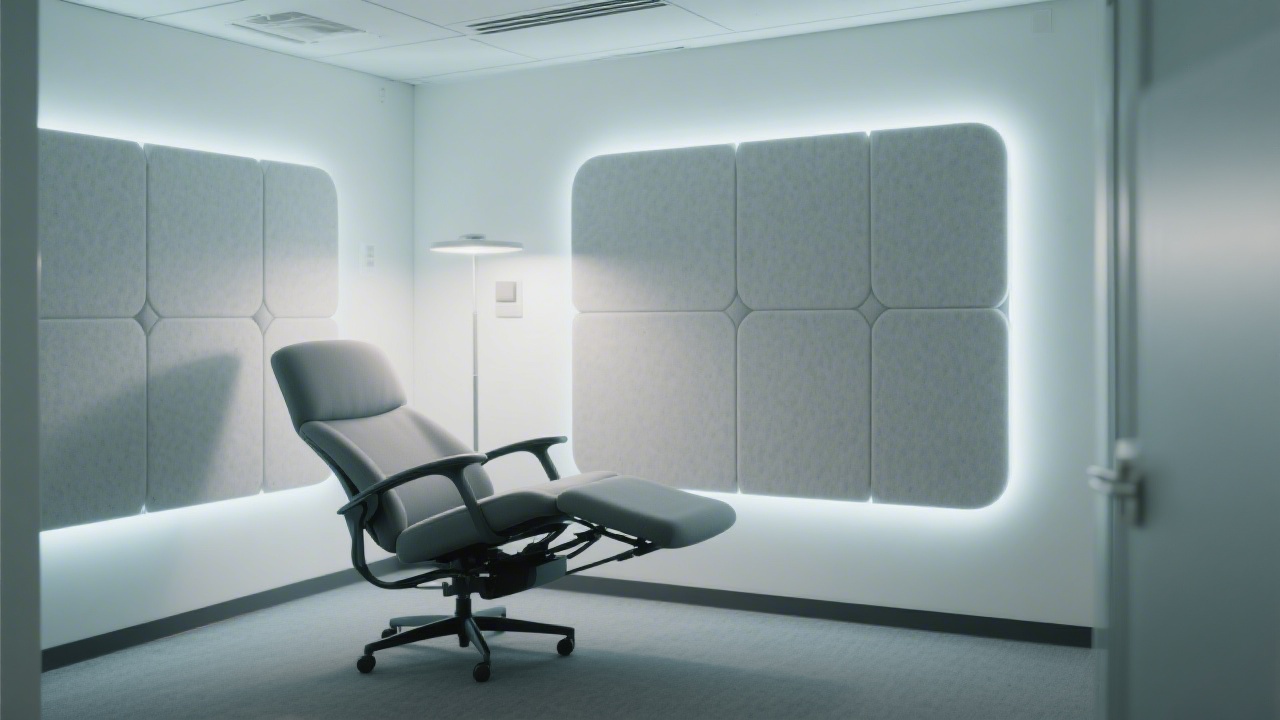
Location and Acoustic Isolation
The single most common failure in office nap rooms is insufficient noise isolation. An open-plan office generates 65–70 dB of ambient noise — enough to prevent sleep onset for most people. The nap room needs either solid acoustic insulation (STC rating of 45+), white noise machines running at 55–65 dB to mask intrusion sounds, or both. Location away from high-traffic corridors, kitchens, and conference rooms is mandatory. A room adjacent to the server room is often ideal — the low-frequency hum masks conversation noise.
Lighting
Blackout curtains that achieve near-total darkness (less than 5 lux at eye level) are essential. The human circadian system is exquisitely sensitive to light — even 10 lux of dim light suppresses melatonin onset. For a 15-minute nap, total darkness is not strictly necessary (you will not reach melatonin-dependent sleep stages), but it dramatically speeds sleep onset and improves perceived nap quality. Provide disposable sleep masks as a backup.
Temperature
The optimal sleep temperature for most adults is 65–68°F (18–20°C). Most offices run warmer. A dedicated nap room thermostat set independently of the main HVAC system is the ideal solution. If that is not possible, a quiet desktop fan (white noise plus airflow) is a practical substitute.
Furniture Options by Budget
Budget tier ($200–800): A reclining office chair (lay-flat capable), blackout roller blind, white noise machine, and a sign-in sheet with 20-minute maximum. Functional and adequate for most users.
Mid-range ($1,500–4,000): A dedicated nap pod chair (IKEA POÄNG modified, or Herman Miller Nap chair), acoustic room divider panels, programmable wake light, and a digital booking system (free via Calendly or Google Forms).
Premium ($8,000–30,000): MetroNaps EnergyPod (the unit Google uses) — a freestanding pod with privacy visor, built-in timer with gentle vibration wake, and integrated audio. These units became the corporate nap room benchmark after The New York Times profiled Google's use of them in 2012. At roughly $12,000–14,000 per unit, they are expensive but deliver the complete sensory environment for optimal napping.
The Booking System
A sign-in sheet works for small teams. For offices of 50+, a 15-minute booking slot system prevents the nap room from being monopolized. The 20-minute maximum should be enforced by a timer alarm — set by the user on entry — not social pressure. Social pressure does not work.
How to Present the Business Case to Your Employer
The objection you will hear is: "We're not paying people to sleep." The counter is: you're already paying them to be cognitively impaired from 2 to 4 pm. The question is whether you want to spend $800 to fix that or continue absorbing the cost invisibly.
Concrete framing that works:
- RAND Corporation data: sleep deprivation costs U.S. employers $411 billion/year in lost productivity
- Ben & Jerry's, Nike, Google, and Goldman Sachs (post-analyst survey scandal) all have nap infrastructure
- Propose a 90-day pilot with pre/post self-reported energy surveys. Budget $1,500 for basic setup
- Frame it as a recruitment and retention tool — increasingly, knowledge workers list flexible rest policies in their top 10 workplace requirements
For the broader scheduling and management context, see our guide on how meeting overload disrupts sleep — the nap room addresses the symptom, but meeting culture creates the problem. And for the strategic overview of what leading companies are doing, our corporate sleep programs guide covers the full landscape.
The Nap Timing Protocol
For maximum benefit with minimum disruption to nighttime sleep:
- Nap between 1:00 pm and 3:00 pm (circadian trough; nap aligns with natural dip)
- Set a timer for 25 minutes (5 minutes to fall asleep + 20-minute nap target)
- Consume a 100mg caffeine dose immediately before napping (the "nappuccino") — caffeine takes 20–25 minutes to absorb, so it activates precisely as you wake, eliminating post-nap grogginess
- On waking, expose yourself to bright light immediately — walk to a window or step outside for 2 minutes
- Wait 10 minutes before returning to cognitively demanding work — the caffeine needs to reach full effect
The nap room solves the afternoon performance problem at the office. But it does not substitute for foundational nighttime sleep quality. A mattress that keeps you in restorative deep sleep rather than waking due to pressure points or overheating is where the real gains are made.
Your nighttime foundation matters most
The Saatva Classic delivers consistent, pressure-relieving support that helps you fall asleep faster and wake up recovered — on work nights and weekends alike.
Affiliate disclosure: We may earn a commission at no extra cost to you.
Frequently Asked Questions
How long should an office nap be for maximum benefit?
10 to 20 minutes is the optimal range. This duration allows you to reach N2 sleep — the stage associated with memory consolidation and alertness restoration — without entering deep N3 sleep. Naps over 30 minutes risk sleep inertia: the groggy, disoriented feeling that persists for 20–45 minutes after waking from deep sleep.
Will napping at work affect my nighttime sleep?
A correctly timed nap (1–3 pm, under 30 minutes) does not reduce sleep pressure enough to meaningfully delay nighttime sleep onset. Naps taken after 4 pm or longer than 45 minutes are more likely to interfere. The circadian trough between 1 and 3 pm is a natural dip — napping during this window works with your biology, not against it.
What equipment does an office nap room need?
The minimum: a reclining chair or sofa, blackout curtains or a sleep mask, earplugs or white noise, and a firm policy on maximum duration (20-minute limit posted on the door). Premium setups add EnergyPod recliners with built-in timers and privacy visors. A cool temperature (65–68°F / 18–20°C) significantly improves nap quality.
How do I make the business case for a nap room to my employer?
Frame it in economic terms. NASA found that a 26-minute nap improved pilot performance by 34% and alertness by 100%. A study in Nature Neuroscience showed that subjects who napped avoided the afternoon decline in learning performance that non-nappers experienced. Present the RAND data on sleep deprivation costs ($411 billion/year in U.S. economic output) and propose a 90-day pilot with measurable KPIs: self-reported afternoon energy, error rates on afternoon tasks, voluntary nap room usage.
Is napping at work accepted in professional cultures?
Increasingly yes. The stigma around workplace napping has reversed significantly since 2020. Ben & Jerry's, Nike, Google, Zappos, and Huffington Post (after Arianna Huffington's burnout-inspired conversion) all have nap infrastructure. In Japan, 'inemuri' — purposeful public napping — has long been accepted as a sign of dedication. The cultural shift in Western offices has accelerated post-pandemic as 'performative presence' norms collapsed.