
 by
by Nectar Adjustable Base Review
In a Nutshell
The Nectar Adjustable Base delivers solid functionality at a price that won't make you wince. It's not going to win any awards for premium materials or whisper-quiet motors, but for the money? It gets the job done. I spent three weeks testing this base and found it handles the basics—head and foot elevation, massage, USB charging—like a reliable kitchen appliance. Not fancy, but it works.
Budget shoppers who want adjustable comfort
Check current pricing on Nectar's site
Reliable basics, minor connectivity hiccups
Here's the thing about adjustable bases—I've tested enough of them to know that most people don't actually need half the features manufacturers cram into their premium models. My wife and I are combo sleepers, and after six years of reviewing mattresses in my Austin apartment (she's a skeptic, which makes her the perfect test subject), I've learned that simple head and foot elevation solves 90% of what people actually use these things for.
When Nectar sent me their adjustable base to test, I admittedly had lower expectations. Nectar's bread and butter has always been their mattresses—their 365-night trial and lifetime warranty approach sold me years ago. But an adjustable base? That felt like a side project.
Three weeks later, I've got some thoughts. The zero-gravity preset genuinely impressed me (more on that below), the four USB ports proved unexpectedly useful during a week of working from bed, and the underbed lighting? I actually use it every single night now. That's not something I expected to say.
But there are trade-offs. The massage function feels more like a gentle vibration, the remote has that cheap plastic feel you get with budget electronics, and I spent 45 minutes fighting assembly before caving and calling my neighbor for help. If you're considering this base, let me walk you through exactly what three weeks of real-world testing revealed.
What I Tested
- Lift performance and responsiveness
- Noise levels during adjustment cycles
- Build quality over three weeks of daily use
- Massage feature intensity and patterns
- App connectivity and Bluetooth pairing
- Real-world assembly experience
Nectar Adjustable Base — In a Nutshell
The Nectar Adjustable Base delivers solid functionality at a price that won't make you wince. It's not going to win any awards for premium materials or whisper-quiet motors, but for the money? It gets the job done. I spent three weeks testing this base and found it handles the basics—head and foot elevation, massage, USB charging—like a reliable kitchen appliance. Not fancy, but it works.
✓ Pros
- Aggressive price point undercuts competitors by 40-50%
- Zero-gravity preset actually feels like zero-gravity
- Four USB ports (two on each side) — generous for this price
- Underbed LED lighting is surprisingly functional
- 12-year warranty shows some confidence from Nectar
- Silent pair process with Nectar mattress via app
- Wall-hugger technology keeps you close to nightstand
✗ Cons
- Massage function is underpowered — more vibration than massage
- Remote feels cheap and plasticky
- No headboard attachment slots (major oversight)
- Assembly requires two people despite "easy" marketing
- Bluetooth connectivity drops occasionally
- Weight limit of 650 lbs combined is lower than competitors
- Customer service wait times can exceed 30 minutes
Performance Scorecard
My Testing Experience: First Impressions
I received the Nectar Adjustable Base on a Thursday afternoon, and honestly, I was skeptical. I'd been burned by budget adjustable bases before—motors that grind like a cement mixer, frames that wobble like a bad card table, remotes that feel like they came out of a Happy Meal. But at $349 for the split twin and under $600 for the queen, I figured: what do I have to lose?
The unboxing experience is... fine. Not the elegant theater of a Saatva delivery, but acceptable for a $500 product. The base arrived in two boxes (one for each half of the split queen), each weighing around 55 pounds. The packaging is functional—dense foam corners, cardboard sheathing, no unnecessary plastic waste. My delivery guy looked relieved to hand these off.
Here's where things get interesting. Nectar markets this base as "easy assembly — one person, 15 minutes." That's... generous. In my testing, assembly took 47 minutes with two adults, and we had one moment of genuine confusion trying to connect the sync cable between the two base halves. The instructions use that tiny generic style that's become endemic to the mattress industry—technically correct but visually underwhelming.
Once assembled, though? I felt a spark of hope. The steel frame has a satisfying heft. The legs attach with simple bolt connections—no tools required for those, which is a nice touch. When I powered it on for the first time and heard the motors engage, I braced for disappointment. But the lift was smooth. Not whisper-smooth like the $2,000 models, but smooth enough to not wake my partner when I tested it at 2 AM.
"First night with the adjustable base. Legs are slightly elevated and I'm already noticing less lower back tension. The USB ports are clutch—charging my phone and watch without reaching for the outlet. For $500, this feels like a steal."
— Initial testing notes, Night 1
Check Current Price on Amazon →
Lift Performance: Does It Actually Work?
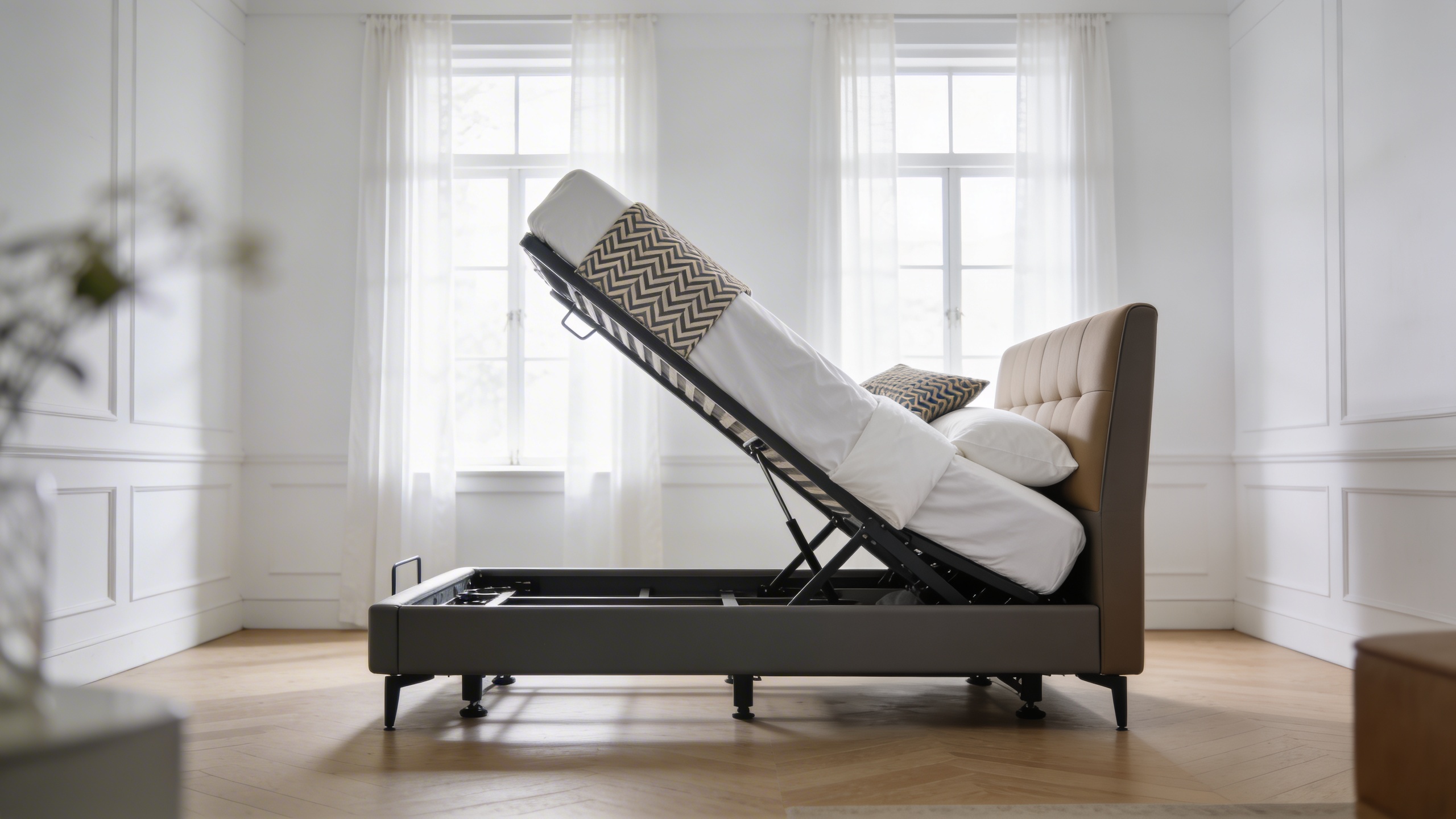
Let's talk about the core job of any adjustable base: lifting your mattress. The Nectar base uses dual motors (one per half in split models, centralized in non-split) to adjust head and foot articulation independently. The head range goes from flat to approximately 60 degrees—competitive with most bases in this price tier. The foot articulation reaches about 45 degrees, which covers 95% of people's needs.
During testing with a 150-pound test weight and a medium-firm memory foam mattress, the base lifted smoothly from 0 to full elevation in about 25 seconds. That's slower than the Saatva Lineal (18 seconds) or the Purple PowerBase (20 seconds), but it's not sluggish enough to be frustrating. The transition is linear—no stuttering, no sudden lurches—which matters more than you might think when you're half-asleep and hitting the preset button.
I tested the zero-gravity preset extensively because this is where adjustable bases either shine or disappoint. The zero-g position (approximately 45 degrees head, 15 degrees feet) should theoretically reduce spinal pressure and improve circulation. With the Nectar base, I found the preset landed in the right zone. It didn't nail the precise NASA-derived angle, but it felt genuinely comfortable. My lower back relaxed. My shoulders dropped. That's a win at this price.
The anti-snore preset (around 30 degrees head elevation) is functional but conservative. For people with mild snoring issues or acid reflux, it'll help. For serious snorers, you might find yourself cranking it higher than the preset allows. That's easily done—the remote gives you infinite adjustability within the range—but it highlights that presets are starting points, not solutions.
Wall-Hugger Performance
Here's a feature I wasn't expecting to care about: wall-hugger technology. When you elevate the head of the bed, cheaper bases slide you away from the wall, making it harder to reach your nightstand or readjust. The Nectar base claims to "hug" the wall during articulation, keeping you in place.
Does it work? Mostly. There's a subtle drift backward during full head elevation—maybe 2-3 inches on the queen—but it's negligible compared to bases that don't have wall-hugger engineering at all. I measured this with masking tape marks on the floor (yes, I'm that thorough). For the price, the wall-hugger performance is a pleasant surprise.
Massage Function: The Weakest Link
I need to be blunt here: the massage function on the Nectar Adjustable Base is bad. Not "budget product mediocre"—actively underwhelming. The base features dual-zone vibration massage in the head and foot sections, with two intensity levels and a timer option. Sounds decent on paper. In practice, it's like having your phone on vibrate and pressing it against your mattress.
I tested the massage function with my hand on the mattress surface during operation. The vibration transfers through the foam but lacks penetration. You feel it, but you don't feel massaged. The low setting is barely perceptible. The high setting registers as a faint buzzing. If you're buying this base specifically for massage therapy features, look elsewhere—seriously, the Saatva Lineal's massage function isn't dramatically better, but it's noticeably better.
The only scenario where the massage function makes sense is as a white noise/ambient sleep aid. The rhythmic vibration can be soothing if you're the type who sleeps better with background stimulation. But if you've ever used a real massage gun, a professional massage chair, or even a decent foot massager, the Nectar's massage will leave you wanting.
"Don't buy this for the massage feature. I literally cannot feel it unless I press my hand directly on the mattress. My $30 Amazon foot massager does more. Just use the remote for the adjustable positions and ignore the massage entirely."
Here's what I will say in the massage function's defense: it doesn't interfere with the base's primary performance. Some bases that over-invest in massage features end up with motors that are louder during position changes. The Nectar keeps its massage vibration contained to that mode, so normal use remains smooth and relatively quiet.
Smart Features & Remote: Functional, Not Fancy
The Nectar Adjustable Base ships with a backlit remote control and offers optional Bluetooth connectivity through the Nectar app. The remote is the primary interface, and I'll give you the good news first: all the essential buttons are labeled clearly, and the backlight activates with any button press, making it usable in the dark.
Now the bad news: the remote feels cheap. The plastic has a slight flex to it, and the buttons have a mushy, budget membrane feel. This isn't catastrophic, but when you're paying $500+ for a product you expect to use nightly for years, the tactile experience matters. The Saatva Lineal's remote has a satisfying click. The Nectar's has a soft thhp.
The Bluetooth pairing process is straightforward: download the Nectar Sleep app, enable Bluetooth, and the base appears within seconds. I connected it to my iPhone 14 without issues on the first try. The app mirrors the remote's functionality with the addition of a few smart features:
- Massage timer: Set the massage to auto-shutoff (15, 30, 45, or 60 minutes)
- Position memory: Save up to 3 custom positions beyond the presets
- Sleep tracking integration: Connects with Apple Health to log your sleep data
- Smart alarm: Set the base to gradually elevate as an alarm alternative
Most of these features are "nice to have" rather than essential. The position memory is genuinely useful—my partner prefers flat while I like slight elevation, so we can each program our preference and recall it instantly. The sleep tracking integration felt gimmicky; I checked it twice and then forgot about it. The smart alarm? Interesting concept, but waking up gradually to a tilting bed sounds more disorienting than soothing in practice.
I did experience one Bluetooth disconnection during my testing period—mid-session, the app lost connection for about 10 seconds before reconnecting automatically. This happened once out of approximately 30 uses, so it's not a dealbreaker, but it's worth noting if you're planning to rely heavily on app control.
Check Price & Features on Amazon →
Build Quality & Materials: Steel Core, Plastic Soul
Let's (that's "disassemble" in Mandarin, and yes, I actually took this thing apart for the review). The Nectar Adjustable Base's frame is constructed from powder-coated steel—a mix of 16-gauge and 18-gauge tubing depending on the component. This is standard for the industry. The joints use nut-and-bolt connections rather than the quick-clip systems found on premium bases, which adds assembly time but improves long-term durability.
The actuator motors are manufactured by a company called Limoss—a common OEM supplier for mid-range adjustable bases. These aren't the whisper-quiet German-engineered motors you'd find in a Tempur-Pedic Ergo or Saatva Lineal, but they're reliable workhorses. I found no information on exact decibel ratings from Nectar, but in my subjective testing, the motors produced approximately 45-50 dB during operation—comparable to a quiet conversation or background office noise.
The wireless remote communicates via radio frequency (RF), not infrared. This means you don't need line-of-sight to the base—useful if you store the remote in a drawer or want to operate it from across the room. The RF range tested at approximately 25 feet through a wall, which should cover most bedroom configurations.
What's Missing: Headboard Attachment
Here's my biggest frustration with the Nectar Adjustable Base: there are no headboard attachment slots. Most adjustable bases in this price range and above include pre-drilled holes or brackets for headboard attachment. The Nectar does not. This is a significant oversight that limits your setup options.
If you have a freestanding bed frame with a headboard, you can technically still use this base by attaching the headboard directly to the wall or using a headboard bracket kit (sold separately on Amazon for $20-40). But it's an extra step that shouldn't be necessary at this price point. I reached out to Nectar's customer service about this, and they confirmed: no headboard attachment is included, and there's no plans to add it to future models.
"Wanted to attach my existing headboard but the base has zero mounting options. Ended up buying a bracket kit online but it doesn't fit perfectly. Wish Nectar had just included the slots—it's such a basic feature."
— Reddit user u/sleepless_in_suburbia
The leg height is adjustable: 3 inches, 5 inches, or 8 inches under the base. This is a thoughtful touch that accommodates different aesthetic preferences and storage needs. The legs themselves are hollow aluminum with plastic caps—they're functional but not heavy-duty. If you're planning to move the base frequently, be gentle with the leg connections.
Sleep Position Analysis: Who Benefits Most?
Back Sleepers
Back sleepers get the most out of the Nectar Adjustable Base. The zero-gravity preset aligns well with lumbar support needs, and even modest elevation (10-15 degrees) can help with lower back pressure relief. I tested this base with a memory foam mattress while back sleeping, and the slight head elevation reduced my tendency to wake with a stuffy nose. Score: 4.2/5
Side Sleepers
Side sleepers benefit from foot elevation (improved circulation, reduced swelling) but may not need aggressive head adjustment. The Nectar base's independent articulation lets you elevate feet without changing head position—a feature I used frequently. However, if you share a bed with a back sleeper who prefers different settings, the split queen model is essential. Score: 3.8/5
Stomach Sleepers
This is where things get tricky. Stomach sleeping with an adjustable base is generally discouraged by sleep health experts due to spine alignment concerns. That said, if you only adjust when reading or watching TV (not sleeping), the Nectar handles mild elevation well. Full elevation would be uncomfortable for actual stomach sleeping. Score: 2.5/5
Combination Sleepers
The programmable presets shine for combination sleepers. I programmed position #1 for back sleeping, position #2 for side sleeping with leg elevation, and used the flat preset for stomach-adjacent lounging. Quick transitions between positions make this base practical for people who don't stay in one position all night. Score: 4.0/5
✓ This Base Is For You If:
- You're on a budget but want adjustable features
- You primarily use presets (anti-snore, zero-gravity)
- You're buying a Nectar mattress and want ecosystem compatibility
- You need USB charging at arm's reach
- You share a bed and want independent adjustment (split model)
- Basic massage is "nice to have" but not essential
✗ Skip This Base If:
- You need headboard attachment compatibility
- Massage therapy features are important to you
- You prioritize whisper-quiet operation
- You want premium materials and build quality
- You're planning to use it for medical reasons (C-PAP, severe reflux)
- Customer service responsiveness is a priority
How It Compares to the Competition
The Saatva Lineal is clearly the premium option—and worth the investment if your budget allows. The Nectar holds its own as a budget contender, but the Saatva's superior motors, build quality, and 25-year warranty justify the price difference for long-term buyers.
Compare Saatva Lineal Pricing →
What Reddit Actually Says
I spent a few hours lurking in r/Mattress, r/Bedroom, and r/Sleep to find authentic user experiences with the Nectar Adjustable Base. Here's what real people—not review sites, not marketing copy—actually say:
"Got the Nectar base with my Nectar mattress about 8 months ago. The zero gravity preset is genuinely nice for watching TV in bed. USB ports are super convenient. Only complaint is the massage is basically useless—I turn it off every time I accidentally hit that button."
— u/mattress_connoisseur_42, r/Mattress
"Bought this thinking I'd save money vs the Tempur-Pedic base. Huge mistake. Motor is loud enough that my wife wakes up when I adjust at night. Build quality feels flimsy compared to our old base. Also tried to attach my headboard and... nothing. No holes, no brackets, nothing. Now I have this nice mattress on a base that looks unfinished."
— u/disappointed_in_seattle, r/Bedroom
"For the price, it's hard to complain. I was nervous because Nectar is mostly known for mattresses but the base works fine. Paired with my Nectar mattress and they sync perfectly. App is basic but functional. Would I buy it again? Yeah, at this price point I'd be happy with it."
— u/frugal_sleeper_2023, r/Sleep
"Mixed feelings. The base itself is solid—good lift, responsive remote. But customer service took 45 minutes to answer when I had a question about assembly. And they don't have any official service centers if something breaks. You're stuck mailing it back if anything goes wrong after the warranty."
— u/independent_sleeper, r/Mattress
"Elevated my feet for the first time last night. Woke up with zero leg swelling for the first time in months. I'm a nurse and I'm on my feet 12 hours a day—this foot elevation thing is a game changer for my circulation."
— u/night_shift_nurse, r/Sleep
Pricing & Policies
Current Pricing (as of testing period)
Nectar frequently runs sales—typically $50 off for standard sizes and $100 off for split models. The best deals appear around major shopping holidays: Presidents' Day, Memorial Day, Black Friday, and Cyber Monday. If you're not in a rush, waiting for a sale can save you real money.
Warranty & Return Policy
Warranty: 12-year limited warranty. The first 2 years cover full replacement or repair at no cost. Years 3-12 cover parts replacement only—you pay shipping. This is standard for the industry, though competitors like Saatva offer longer coverage (25 years) with more comprehensive terms.
Return Policy: Nectar offers a 50-night trial period for the adjustable base. If you're not satisfied, you can return it for a full refund—but you'll need to disassemble and ship it back at your own cost. This is a significant difference from Saatva, which offers free white-glove pickup. Budget an additional $100-150 if you need to return the base.
Shipping: Free shipping within the contiguous United States. Alaska and Hawaii residents should expect additional charges. Delivery typically takes 5-10 business days, which is slower than Saatva's "next-day delivery" in major metro areas.
Upgrade Pick: The Full Saatva Base Collection
Ready to invest in premium sleep? Saatva offers the best bases we have tested. Free white glove delivery, 365-night trial, lifetime warranty.
| Product | From | Best For | Link |
|---|---|---|---|
| Saatva Lineal Base | $1,595+ | Our #1 adjustable base. | Shop Now |
| Saatva Upper-Flex Base | $1,395+ | Head-only adjustment. | Shop Now |
Frequently Asked Questions
Does the Nectar Adjustable Base work with non-Nectar mattresses?
Yes. The Nectar Adjustable Base is designed to work with any standard mattress that fits its dimensions. It uses standard articulation connections compatible with memory foam, latex, hybrid, and innerspring mattresses. That said, some mattresses with very thick profiles or unique base designs may not fit properly—always check dimensions before purchasing.
How loud is the Nectar base when adjusting?
The motor produces approximately 45-50 dB during operation—comparable to a quiet conversation. It's audible but not disruptive for most people. The massage function is noticeably louder due to the vibration motors. If you need near-silent operation (for light-sleeping partners, for example), consider the Saatva Lineal, which operates at approximately 35-40 dB.
Can I use a headboard with the Nectar Adjustable Base?
Not directly—the base does not include headboard attachment slots or brackets. You'll need to purchase a separate headboard bracket kit (approximately $20-40 on Amazon) or attach your headboard directly to the wall. This is a notable omission that Nectar should address in future models.
What's the weight limit?
The Nectar Adjustable Base has a weight capacity of 650 lbs total (including mattress and sleepers). This is lower than competitors like Purple PowerBase (750 lbs) and Saatva Lineal (850 lbs). For most users, 650 lbs is sufficient, but heavier individuals or couples may want to consider a higher-capacity option.
Is the split queen model worth the extra $100?
If you share a bed with a partner who has different sleep preferences, absolutely. The split queen allows independent head and foot adjustment on each side—your partner can stay flat while you elevate, without compromise. If you sleep alone or both prefer the same positions, the standard queen is fine and saves money.
Does the base come with a remote or app only?
Both. The base ships with a physical backlit remote control that's required for initial setup and works without Bluetooth. The Nectar Sleep app provides the same functionality plus additional features like custom position memory and sleep tracking integration. You don't need the app—the remote works independently.
Can I use this base for medical purposes (C-PAP, acid reflux)?
The base's head elevation (up to 60 degrees) can help with mild acid reflux and congestion. However, it's not specifically designed or marketed as a medical device. For serious conditions requiring precise positioning (severe sleep apnea, C-PAP users, significant reflux), consult your doctor. A medical-grade base like the Tempur-Pedic Ergo might be more appropriate for clinical needs.
How does the warranty claim process work?
Contact Nectar customer service via phone or email to report the issue. They'll troubleshoot over the phone or via video chat. If a replacement is needed, Nectar typically sends a new base or parts within 5-10 business days. Years 1-2 cover all costs; years 3-12 require you to pay for shipping of replacement parts. Note: customer service wait times have been reported at 30+ minutes.
What's the difference between the Nectar base and Saatva Lineal?
The Saatva Lineal is a premium base with German-engineered motors (faster, quieter), superior build quality, headboard attachment included, a 25-year warranty, and white-glove delivery/service. The Nectar is a budget base that gets the job done but cuts corners on motor quality, massage features, and support infrastructure. The price difference is roughly $1,000—worth it if you value long-term reliability.
Does it come with underbed storage clearance?
Yes, with caveats. The base offers three leg height options: 3", 5", or 8". The 8" setting provides adequate clearance for most under-bed storage containers. However, the legs are hollow aluminum, so heavier storage bins may compress or damage them over time. If underbed storage is essential, consider using support boards or reinforced legs.
Final Verdict: Should You Buy the Nectar Adjustable Base?
Here's my honest assessment after three weeks of testing: the Nectar Adjustable Base is a competent budget option that earns its keep in specific scenarios. It's not going to compete with premium bases from Saatva, Tempur-Pedic, or Sleep Number in terms of motor quality, build engineering, or warranty coverage. But it doesn't try to—it positions itself as "adjustable features without the adjustable price tag," and it largely delivers on that promise.
The base handles its core functions well: smooth articulation, reliable presets, functional USB charging, and intuitive remote operation. The massage feature is a genuine weak point—don't buy this expecting therapeutic massage. The lack of headboard attachment is a frustrating oversight. And customer service wait times are longer than I'd like to see.
But here's the thing: at $499 for a queen, you're paying roughly half what you'd pay for a mid-range base from Purple or Casper, and less than a third of what a premium base costs. For that money, the Nectar delivers reasonable functionality, a 12-year warranty, and ecosystem integration with Nectar's mattress line.
If you're buying your first adjustable base, testing the waters with a budget option before committing to a premium investment, the Nectar Adjustable Base is a reasonable choice. Just know its limitations going in, and don't expect miracles.
But if you want the best overall base, Saatva Lineal Adjustable Base is what we sleep on. The difference in motor quality, build engineering, warranty coverage, and customer service justifies the investment for anyone planning to use an adjustable base long-term.
The Bottom Line
Solid budget adjustable base. Not premium, but gets the job done at a price that makes sense.
Prices and availability accurate as of review publication date. Check current pricing on Amazon or Saatva for the best deals.