
 by
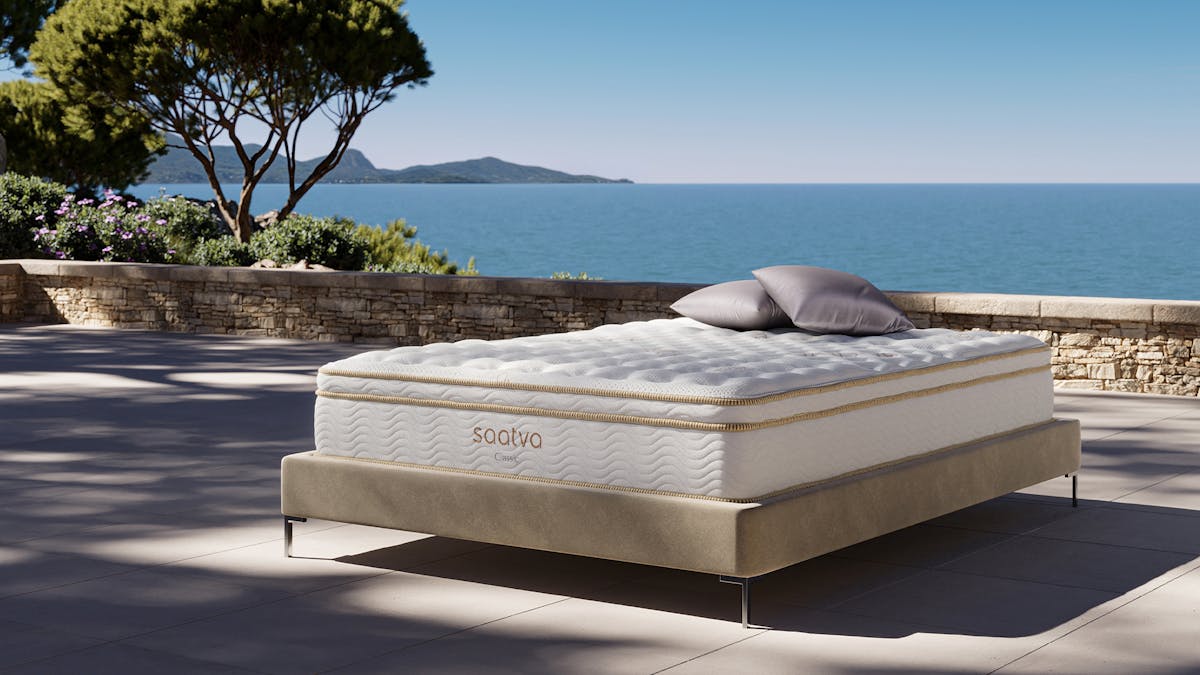
by Nectar beats Purple on price, motion isolation, and trial length. Purple wins on cooling and feel for hot or restless sleepers. Neither is a standout value compared to the Saatva Classic, which delivers coil-on-coil support, a lifetime warranty, and a 365-night trial at a comparable price to Purple, with free white-glove delivery included.
Saatva Classic
9.2/10
- Dual coil-on-coil construction with reinforced lumbar zone pad
- Outstanding edge support and responsive hotel-luxury feel
- Free white-glove delivery, setup, and old mattress removal
- 365-night trial and lifetime warranty, both industry-leading
- Ships flat, not compressed in a box
- $99 return fee during the trial window
If you are comparing Nectar and Purple but haven't priced Saatva, you likely haven't seen the full picture. The Classic matches Purple's price, doubles its warranty, and triples its trial. For back and side sleepers who want genuine lumbar support and edge stability, it is the clearest upgrade over both.
Nectar vs. Purple 2026: the real difference
Nectar and Purple represent two fundamentally different philosophies about what a mattress should feel like. Nectar is the quintessential modern memory foam mattress: slow, contouring, pressure-dissolving, and deeply comfortable in the way millions of sleepers have come to expect. Purple is the challenger: a grid-based polymer system that pushes back, breathes freely, and creates a sensation unlike anything else on the market.
Both have earned loyal followings. Both offer genuine value. But they serve different sleepers almost completely, and understanding which one matches your needs requires a close look at how each actually works.
This 2026 comparison covers construction, feel, cooling, pressure relief, motion isolation, pricing, trial periods, and warranty.
Nectar vs. Purple: quick specs
| Category | Nectar Original | Purple 3 |
|---|---|---|
| Queen price | ~$799-$999 | ~$1,599 |
| Construction | Memory foam layers | GelFlex Grid + foam |
| Feel | Sinking / contouring | Floating / responsive |
| Cooling | Average | Excellent |
| Pressure relief | Excellent | Excellent |
| Motion isolation | Excellent | Good |
| Trial period | 365 nights | 100 nights |
| Warranty | Lifetime | 10 years |
| Edge support | Average | Average |
Construction: how each mattress is built
Nectar Original: gel memory foam stack
Nectar builds around a gel-infused memory foam comfort system. The Original features a quilted cooling cover with phase-change material, a 3-inch gel memory foam comfort layer, a 2-inch dynamic support transition foam, and a 6-inch dense base core. Total profile: 11 inches. The medium-firm feel (roughly 5-6 out of 10) suits most sleep positions and body types. Materials are CertiPUR-US certified.
Purple 3: GelFlex Grid plus foam base
Purple takes a different engineering approach. The defining element is the GelFlex Grid, a 3-inch layer of hyper-elastic polymer shaped into a geometric column grid. The hollow columns flex and collapse under direct pressure while holding firm laterally, providing targeted relief where the body needs it and full support everywhere else.
Beneath the grid sits a 3.5-inch responsive foam comfort layer and a 4-inch base core, for an 11-inch total profile. The polymer is temperature-neutral, unlike memory foam, which changes behavior with body heat. That is the key functional difference.
Feel: sinking vs. floating
The most important practical difference is not the technology but how each mattress feels to sleep on.
Nectar offers classic memory foam. When you lie down, the mattress responds slowly and progressively. After a few minutes, the foam has shaped itself around you. This is comfortable and familiar for millions of sleepers, and it relieves joint pain effectively by distributing pressure across a large contact area.
Purple is fundamentally different. The grid columns beneath pressure points collapse immediately, while columns elsewhere stay upright. The result: you feel supported under your back and legs but have no resistance under shoulders and hips. Many sleepers describe it as floating rather than sinking. The sensation is unfamiliar for a few nights, but most adapters become enthusiastic converts.
There is no objectively correct preference. If you have used memory foam for years and love it, Nectar will feel like home. If you have always found foam too hot or too slow, Purple may feel like a revelation.
Cooling: open grid vs. gel foam
This is the most lopsided category. Purple sleeps measurably cooler than Nectar.
Nectar's gel-infused foam reduces heat retention compared to traditional memory foam but still relies on the foam material to absorb and dissipate heat. Hot sleepers who generate significant body heat will feel warmth building through the night on Nectar.
Purple's grid creates structural airflow. The hollow column architecture means there is literal air between you and the support foam below. Body heat rises and dissipates rather than being absorbed by a solid foam layer. In independent thermal tests, Purple consistently reads 3 to 5 degrees Fahrenheit cooler at the sleep surface than gel memory foam competitors.
For sleepers where temperature is the primary complaint, Purple solves it more completely than any foam-based option can.
Pressure relief: two different approaches, both effective
Pressure relief is where the two mattresses are closest in outcome, even though they achieve it completely differently.
Nectar relieves pressure through broad-area contouring. The foam reshapes itself to your body's curves, spreading weight across a large surface and reducing pressure per square inch at any single point. This is particularly effective for sleepers with chronic hip or shoulder pain who need a gentle, enveloping surface.
Purple relieves pressure through selective collapse. The grid eliminates contact pressure at the specific points where your body pushes down hardest, rather than distributing it across a wider area. This creates near-zero pressure zones at hip and shoulder.
For most sleepers, both approaches produce excellent pressure relief. For sleepers with particularly acute sensitivity, such as those recovering from joint surgery or with significant arthritis, Purple's targeted elimination may be superior. For general joint comfort and body aches, Nectar's broad contouring is highly effective.
Motion isolation: Nectar's clear advantage
For couples sharing a bed, this category matters significantly. Nectar's dense memory foam absorbs motion almost completely. If one partner shifts, gets up, or rolls over, the other partner is extremely unlikely to feel the disturbance. This is one of memory foam's most well-known and valued properties.
Purple's grid has a degree of inherent springiness. Motion applied at one point does propagate slightly across adjacent columns. The effect is minor, and Purple is far better than any spring-based mattress, but it is measurably weaker than Nectar's foam-on-foam isolation.
Couples where one partner is a light sleeper should factor this in. Nectar is the better choice for motion isolation.
Price, trial, and warranty
| Detail | Nectar Original | Purple 3 |
|---|---|---|
| Twin price | ~$499 | ~$999 |
| Queen price | ~$799-$999 | ~$1,599 |
| King price | ~$1,099-$1,299 | ~$1,999 |
| Trial period | 365 nights | 100 nights |
| Warranty | Lifetime | 10 years |
| Shipping | Free | Free |
On paper, Nectar wins the value comparison convincingly. Its queen-size price is roughly $600 to $800 less than Purple 3. Its 365-night trial is more than three times as long as Purple's 100 nights. And its lifetime warranty dramatically outperforms Purple's 10-year coverage.
The question is whether Purple's performance advantages, primarily cooling and the unique grid feel, justify the price gap. For some sleepers, they absolutely do. For others, Nectar's combination of performance, price, and protection makes Purple's premium hard to justify.
Winner by use case
Hot sleepers: Purple. If sleeping hot is your primary complaint, Purple's open-grid airflow is the most effective solution in this category. No gel foam system keeps up with a structural airflow design.
Couples (light sleeper concern): Nectar. Dense memory foam provides superior motion isolation. If your partner's nighttime movement disrupts your sleep, Nectar's foam stack is the better insulator.
Side sleepers with joint pain: Tie. Both mattresses provide excellent hip and shoulder pressure relief. Personal feel preference is the deciding factor.
Budget-conscious shoppers: Nectar. A queen Nectar Original runs $400 to $600 less than Purple in most sale cycles. Add the lifetime warranty and 365-night trial, and Nectar's total value proposition is one of the strongest in the mattress market.
Combination sleepers: Purple. The grid responds instantly to repositioning. Memory foam's slow response can create a slight drag when changing positions, which many combination sleepers find disruptive.
Memory foam loyalists: Nectar. If you love the classic sinking and cradling sensation, Nectar delivers it well. Purple's grid feel is so different that memory foam fans often feel disoriented on their first night.
Amerisleep AS3
8.9/10
- Open-cell Bio-Pur foam sleeps cooler than standard memory foam, narrowing the gap with Purple
- HIVE 5-zone support targets lumbar directly
- CertiPUR-US certified, plant-based materials
- 20-year warranty and 100-night trial
- Softer edges than a coil hybrid
- Sleepers over 230 lb may prefer the AS5 Hybrid
If you want a foam mattress but find Nectar too warm and Purple too different, the AS3's open-cell Bio-Pur construction bridges the gap. Cooler than Nectar, more familiar than Purple, and backed by a 20-year warranty.
Sink, float — or skip the physics experiment
By now the split is clear: Nectar for the sinking hug, the longer trial and quieter nights next to a light sleeper; Purple for the floating grid that hot and restless sleepers swear by. Two genuinely different feels — and, as the intro warned, neither a standout value once you widen the frame.
Widening the frame means pricing the Saatva Classic: coil-on-coil support instead of a foam-or-grid gamble, a plush euro top, and white-glove delivery included — at money comparable to what Purple asks. If you came in comparing these two and still haven’t opened Saatva’s page, that’s the missing tab.
Frequently asked questions
Is Nectar or Purple better for pressure relief?
Purple generally provides more precise and responsive pressure relief due to its GelFlex Grid technology. The polymer grid collapses under pressure points, like hips and shoulders, while maintaining support elsewhere. Nectar's memory foam offers deep contouring relief, but it works by enveloping the body rather than targeting specific points. Both approaches produce excellent outcomes for most sleepers.
Does Nectar or Purple sleep cooler?
Purple sleeps significantly cooler than Nectar. The open-column GelFlex Grid creates passive airflow channels that prevent heat buildup. Nectar uses gel-infused memory foam, which improves on traditional memory foam cooling but still retains heat more than Purple's grid. Hot sleepers consistently rate Purple higher for temperature neutrality.
What is the difference between sleeping on Nectar vs. Purple?
Nectar gives you a classic memory foam sinking feel: the mattress slowly conforms around your body, creating a hugged, cocooned sensation. Purple gives a floating feel: the grid collapses under pressure points but keeps you elevated rather than enveloped. Nectar feels warmer and slower; Purple feels cooler and more responsive.
Which is better for couples, Nectar or Purple?
Nectar typically performs better for couples due to superior motion isolation. The dense memory foam absorbs movement and prevents it from crossing the mattress. Purple's grid, while responsive, allows slightly more motion transfer. That said, Purple's better cooling may benefit couples who sleep warm.
How do the prices of Nectar and Purple compare?
Nectar is significantly more affordable. A queen Nectar Original retails around $799 to $999 depending on sales, while a queen Purple 3 retails around $1,599. Nectar frequently offers steep promotional discounts and includes free pillows with purchase, making the value gap even wider.
Does Nectar or Purple have a longer trial period?
Nectar offers a 365-night trial, one of the longest in the industry. Purple offers a 100-night trial. Both offer free returns during their respective windows. Nectar's year-long trial is a substantial advantage for shoppers who want maximum assurance before committing.
Is Purple worth the extra cost over Nectar?
It depends on your priorities. If you sleep hot or are a side or combination sleeper who needs responsive pressure relief, Purple's premium is justified. If you prefer a traditional memory foam feel, sleep cool naturally, or are budget-conscious, Nectar delivers excellent performance at a lower price.
What warranty does Nectar offer compared to Purple?
Nectar offers a lifetime warranty, among the best in the industry. Purple offers a 10-year limited warranty. For long-term value, Nectar's lifetime warranty is a meaningful advantage over Purple's more standard coverage.
Purple wins for hot sleepers and combination sleepers. Nectar wins on price, trial length, and motion isolation. For shoppers comparing both, the Saatva Classic is worth pricing: it matches Purple's cost, offers 3.5x the trial length, a lifetime warranty, and free white-glove delivery.