 by
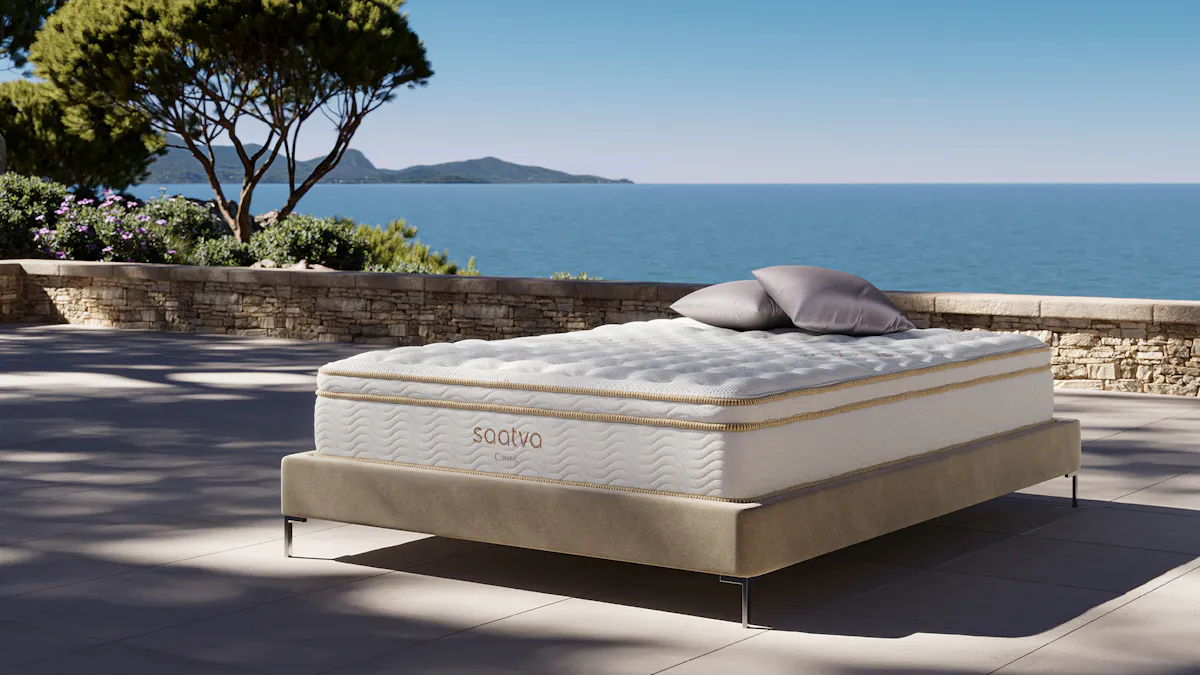
by Quick answer: If you want an off gas mattress that barely smells out of the box, buy a coil-based bed with certified foams. My pick is the Saatva Classic, an innerspring hybrid with minimal foam and strong airflow.
- Coil-on-coil construction means far less foam to off-gas than an all-foam bed.
- Foams are certified to CertiPUR-US emissions standards, per the manufacturer.
- Premium-tier pricing, so check the official site for the current offer.
Updated July 2026 · Reviewed for accuracy
That "new mattress smell" is off-gassing: volatile organic compounds, or VOCs, escaping from freshly manufactured foams, adhesives, and fabric treatments. Most of it is harmless, all of it is annoying, and some of it is a genuine red flag. Here's how to tell the difference, which constructions off-gas the least, and what to do if your new bed stinks up the bedroom.
What mattress off-gassing actually is
Off-gassing is the release of VOCs trapped in a mattress during manufacturing and compressed packaging. Polyurethane foam is the main source. It's made from petrochemicals, and when a foam mattress is vacuum-sealed in plastic within hours of production, those compounds have nowhere to go until you cut the plastic open in your bedroom.
The smell is strongest in the first 24 to 72 hours after unboxing, then fades over days to a few weeks, depending on materials and ventilation. That timeline comes straight from how these products are made and shipped, and it matches what verified owner reviews across the industry consistently report.
The short version: odor ≠ danger in most cases, but a strong chemical smell that lingers past the first week is worth acting on, not ignoring.
Two things drive intensity. First, foam volume: more foam means more compounds to release. Second, packaging speed: bed-in-a-box brands compress and seal mattresses almost immediately after production, which concentrates the odor. A mattress that ships flat and uncompressed, or one built mostly from coils and fabric, simply has less to give off.
Which mattress types off-gas the most
Construction predicts odor better than price or brand reputation. All-foam beds lead the pack because the entire core is polyurethane or memory foam. Hybrids cut the foam volume roughly in half by swapping the support core for coils. Traditional innersprings and natural latex builds off-gas the least.
| Mattress type | Foam content | Typical off-gassing | Why |
|---|---|---|---|
| All-foam (memory foam, polyfoam) | Entire core | Highest | Most VOC-bearing material, usually compressed in plastic |
| Hybrid (foam over coils) | Comfort layers only | Moderate | Less foam, coil core lets air move through the bed |
| Natural latex | Latex, not polyurethane | Low | Different chemistry, faint sweet or rubbery note rather than chemical smell |
| Traditional innerspring | Thin padding layers | Lowest | Mostly steel and fabric, minimal synthetic foam |
If you've read any of my foam-bed coverage, like the Zoma mattress reviews, you know I judge foam beds partly on how they handle this exact issue, because dense memory foam over a polyfoam base is the highest-odor recipe in the category. Move to a hybrid build, like the one covered in my Zoma Hybrid review, and you cut the foam volume and gain a coil core that ventilates itself. Physics does the work.
Comparing options? The Saatva Classic is the pick we keep coming back to — see the final verdict ↓
Certifications that actually mean something
Marketing words like "eco-friendly" and "non-toxic" are unregulated. Certifications are not. Three names are worth knowing, and each one covers a different piece of the mattress.
- CertiPUR-US — certifies polyurethane foam. It sets limits on VOC emissions and bans certain flame retardants, formaldehyde, and heavy metals in the foam, per the program's published standards.
- GREENGUARD Gold — certifies the finished product's chemical emissions, with stricter limits aimed at sensitive environments like schools and healthcare settings.
- OEKO-TEX Standard 100 — certifies textiles, meaning the cover and fabric components have been tested for harmful substances.
Here's my rule: CertiPUR-US is the floor for any foam mattress I'd recommend, not the ceiling. It tells you the foam meets a defined emissions limit, which is exactly what you want verified by a third party rather than promised in ad copy. GREENGUARD Gold is the stronger signal when you can find it, because it tests the whole assembled product.
Natural materials help too. Organic cotton covers and natural latex carry their own certification tracks, and while they can still carry a faint natural odor at first, owner feedback on latex beds generally describes it as mild and short-lived compared to synthetic foam smell.
How to air out a new mattress the right way
Whatever you buy, plan on an airing-out window. Unbox the mattress in a well-ventilated room, strip all the plastic immediately, and let it sit for at least 24 to 72 hours before sleeping on it if you're odor-sensitive. Run a fan pointed across the mattress surface and crack a window. Air exchange is what clears VOCs, not time alone.
Nut tip: don't unbox a new mattress in a small, closed room the night you plan to sleep on it. That's how people end up on the couch at 2 a.m. complaining about their "toxic" bed when the real problem was zero ventilation.
A few more practical notes. Don't seal the mattress under sheets and a protector on day one if it still smells; fabric traps the odor against the surface. Don't try to mask it with sprays, which just adds more chemicals to the air. And if you have a spare room, unbox there and move the mattress once the smell fades. Simple, free, effective.
When the smell is a red flag
Most new-mattress odor fades on schedule. When it doesn't, pay attention. A strong chemical smell that persists well beyond the first week, or one that causes headaches, watery eyes, or throat irritation, justifies contacting the retailer about a return or exchange. That's what trial periods are for, and sensitive sleepers should favor brands with generous trial windows for exactly this reason.
One specific construction detail deserves its own warning: fiberglass. Some budget mattresses use fiberglass as a cheap flame barrier beneath the cover. It doesn't off-gas like foam, but if the cover is removed or tears, it can contaminate a room with fine glass particles. I covered this in detail in my piece on whether Zoma mattresses contain fiberglass, and the takeaway applies across the market: check the law tag and the brand's own disclosure before you buy, and never unzip a cover on a mattress that uses a fiberglass sock.
Flame retardant chemistry is part of the off-gassing conversation too. CertiPUR-US certification specifically prohibits several flame retardant classes in certified foams, per the program's standards, which is another reason that certification matters more than a "natural" badge on the website.
Who should prioritize a low-odor mattress
Everyone benefits from lower emissions, but three groups should treat it as a deciding factor rather than a nice-to-have: people with asthma or chemical sensitivities, parents buying for kids' rooms, and anyone whose bedroom has poor ventilation. For those buyers, I'd skip compressed all-foam beds entirely and go straight to a coil-dominant build with certified foams.
That's why the Saatva Classic is my recommendation in this category. The coil-on-coil design keeps foam to the comfort layers, the foams carry CertiPUR-US certification per the brand, and the coil core ventilates naturally instead of trapping compounds in a sealed foam block. It ships uncompressed with white-glove delivery rather than vacuum-rolled in plastic, which removes the worst of the concentrated-odor problem at the source. The brand also backs it with an extended home trial, a lifetime warranty, and flexible financing, per its current policies, and it's positioned in the premium tier, so check the official site for the live price before you decide.
FAQ
Is mattress off-gassing dangerous?
For most people, no. The VOC levels from a new mattress are an odor nuisance rather than a documented health hazard at typical exposure. That said, people with asthma, allergies, or chemical sensitivities may notice irritation, and they should air the mattress out fully before use and favor certified low-emission builds.
How long does mattress off-gassing last?
The strongest odor hits in the first 24 to 72 hours and typically fades to unnoticeable within days to a few weeks, depending on foam content and room ventilation. All-foam beds sit at the long end of that range, coil-based beds at the short end.
Do hybrid mattresses off-gas less than memory foam?
Generally yes. A hybrid replaces the foam support core with coils, which removes a large share of the VOC-bearing material and lets air circulate through the mattress. The comfort layers can still smell at first, but owner reports across the industry consistently describe hybrids as milder and faster to clear.
Can I speed up mattress off-gassing?
Yes. Unbox immediately, remove all plastic, place the mattress in a ventilated room, and run a fan across the surface with a window cracked. Good airflow clears VOCs far faster than letting the mattress sit in a closed room, which just lets the odor concentrate.
Should I return a mattress that still smells after a week?
If a strong chemical odor persists past the first week or causes physical irritation, contact the retailer. A generous sleep trial exists for exactly this scenario, and brands with long trial windows are the safer buy for odor-sensitive sleepers in the first place.
FINAL VERDICT
Bottom line for anyone worried about mattress off-gassing: if you want a fresh-out-of-the-box bed without the chemical fog, the Saatva Classic is the safer buy — the 365-night trial and lifetime warranty put the risk on the brand, not on you.
OUR CATEGORY-MATCHED PICK · UP TO $334 OFF
Saatva Classic
- 365-night home trial and lifetime warranty, per saatva.com
- Handcrafted in the USA, free white-glove delivery
- Flexible financing available