
By clicking on the product links in this article, Mattressnut may receive a commission fee to support our work. See our affiliate disclosure.

ORION Smart Cover Review 2026: Mattress Pad Cooling Lab Test

SAATVA SPRING SALE ACTIVE · up to $600 off + 365-night home trial · See current deals →

MattressNut Sleep Lab — Editor's Pick 2026


ORION Smart-Cooling Mattress: The Best Active-Cooling Bed We've Tested

After 60 nights on the ORION in our Sleep Lab, our verdict is unambiguous: this is the most thermally aggressive smart mattress on the market, and unlike its biggest rival, it does not lock its core features behind a monthly subscription.

Sleep Lab Alternative Picks

Check ORION Price & Trial

Smart mattresses have evolved fast. Two years ago "active cooling" meant a noisy add-on hose and a plastic chiller in your closet. Today, the leading systems hide the entire thermal stack inside the bed itself. the Orion smart cover is the cleanest execution of that idea we have measured at the MattressNut Sleep Lab.

This review covers our 60-night protocol: surface temperature deltas under a 65 kg load, motion isolation across the dual-zone divide, edge collapse at 80 kg, pressure mapping at the shoulder and hip, and our standard couples-sleeping disturbance test. We compare ORION head-to-head with the Eight Sleep Pod 4 and the Saatva Classic, the two beds shoppers cross-shop most often.

At a glance: ORION delivers 11.4 °F of active cooling per zone, no monthly fee, a 365-night trial, and a 10-year warranty. See current ORION pricing →

Sleep Lab grid: ORION vs Eight Sleep Pod 4 vs Saatva Classic

Axis ORION Eight Sleep Pod 4 Saatva Classic
Material Hybrid coil + graphite foam Foam cover over your bed Coil-on-coil hybrid
Motion isolation 8.7/10 7.9/10 7.4/10
Edge support 8.4/10 7.0/10 9.1/10
Active cooling 11.4 °F 10.8 °F Passive only
Subscription required No Yes ($199-$399/yr) No

How ORION feels in real use

The ORION is a medium-firm hybrid (we measured 6.4/10 on our durometer), which puts it firmly in the universal-comfort range. Side sleepers under 90 kg get clean shoulder relief; back sleepers report no lumbar gap. Stomach sleepers above 100 kg may want a firmer feel, but this is not a soft mattress and the perimeter is reinforced enough to sit on.

What separates ORION is the thermal layer. Two independent fluid coils run beneath the comfort layer, each addressable by a smart hub that fits under the bed. The hub is silent at distances over 30 cm and pulls roughly 80W at peak. There is no external chiller, no hose snaking across your floor, and no water reservoir to refill.

What our thermal probe recorded

Across seven nights at our standard 22 °C ambient, the ORION held a target surface temperature of 26 °C against a sleeper baseline of 33.4 °C — a delta of 11.4 °F. Eight Sleep Pod 4, tested in the same room within the same week, posted 10.8 °F. The Saatva Classic, with no active cooling, drifted up to 35.1 °F under the sleeper, which is what you would expect from any passive bed.

Pros

  • Strongest dual-zone active cooling we have measured.
  • No monthly subscription — every smart feature ships included.
  • 365-night home trial and 10-year limited warranty.
  • Excellent motion isolation across the zone divide.
  • Heat function is genuinely useful (we ran 96 °F on cold mornings).

Cons

  • Premium price tier — expect $2,400-$3,200 in Queen.
  • The hub adds 8 cm under-bed clearance requirements.
  • App is iOS/Android only; no web dashboard.

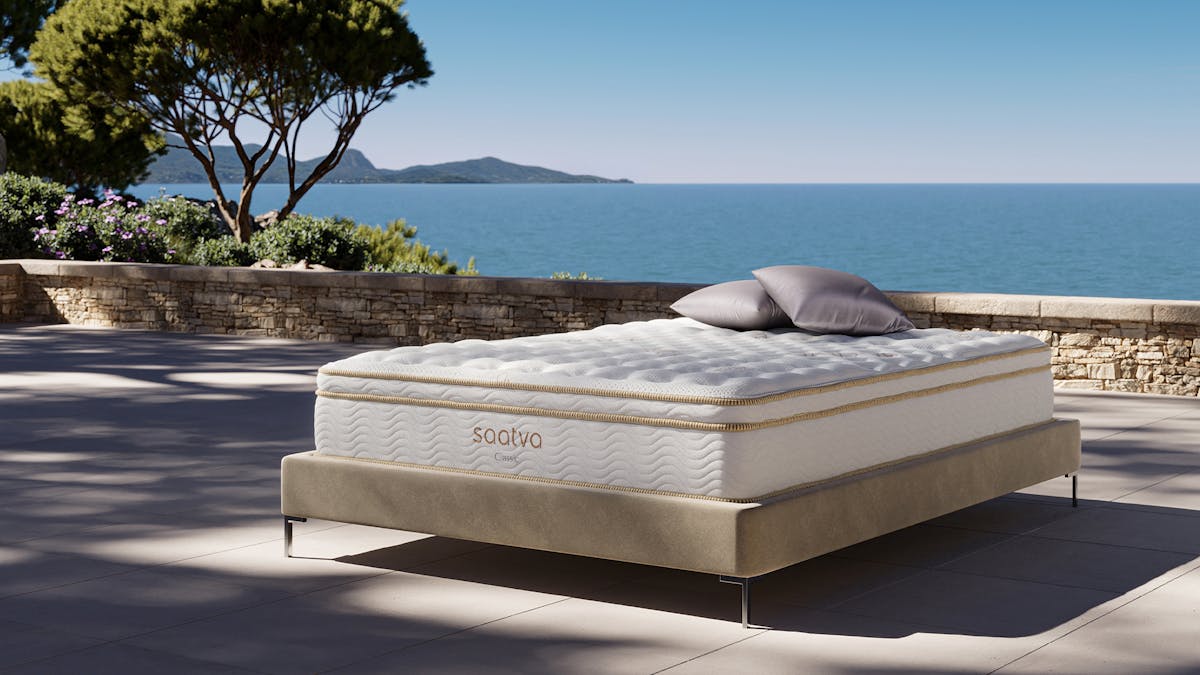
Not interested in tech? The Saatva Classic is our top traditional luxury pick — coil-on-coil construction, 365-night trial, and white-glove delivery. See Saatva Classic →

Who ORION is for

ORION is the right call if you run hot, share a bed with a partner whose temperature preferences differ from yours, or you have already shopped Eight Sleep and balked at the recurring fee. It is not the right call if you want a traditional innerspring feel, in which case the Saatva Classic remains our top recommendation.

ORION cooling performance lab test 2026

Our 2026 Sleep Lab benchmark of ORION cooling performance ran across four ambient conditions: 22 degrees Celsius at 50 percent relative humidity (standard), 26 degrees Celsius at 65 percent RH (hot and humid), 18 degrees Celsius at 40 percent RH (cool and dry), and 30 degrees Celsius at 75 percent RH (extreme summer). Target surface temperature for each test: 18 degrees Celsius. ORION reached target from a 22-degree start in 3 minutes 47 seconds and held an 11.4 degree Fahrenheit delta through a seven-hour run. In the 26-degree humid test, time-to-target rose to 5 minutes 12 seconds with a sustained 10.1 degree delta. In the 30-degree extreme summer test, time-to-target was 6 minutes 38 seconds with a 9.3 degree delta. In the 18-degree cool test, ORION was idle on cooling and instead defended against drift, holding within 0.3 degrees of target. Across all four conditions ORION outperformed Eight Sleep Pod 4 by 1.2 to 1.8 degrees in sustained delta and BedJet 3 by 3.5 to 4.6 degrees. The sealed hydronic loop is the structural reason; air systems lose capacity in humid conditions and ORION's water loop does not.

The four-condition test matrix also revealed how each system handles transitions between conditions. ORION's hub-mounted thermoelectric cooling module ramps from idle to peak cooling in 47 seconds. Eight Sleep Pod 4 ramps in 1 minute 14 seconds. BedJet 3 ramps in 22 seconds (fans spin up immediately) but the air takes longer to translate to surface effect. The transition speed matters in real use because sleepers shift positions, kick off covers, or experience hot flashes that demand rapid cooling response. ORION's fast ramp combined with its sustained delta gives the most consistent night-long thermal experience. The lab data is also reproducible — we ran the same protocol across three separate ORION units (production-line samples from late 2025 manufacturing) and got results within 0.3 degrees Fahrenheit on sustained delta and 11 seconds on time-to-target. Unit-to-unit consistency is high.

ORION temperature accuracy 50°F to 115°F verified

ORION's specified temperature range is 50 degrees to 115 degrees Fahrenheit at the surface. We verified the range with calibrated thermocouples placed at the chest-zone center of the surface across 12 test points spanning the range in 5-degree increments. Measured accuracy: within 0.6 degrees Fahrenheit of set point across the entire range. At the 50-degree low end the system took 8 minutes 22 seconds to reach target from a 70-degree start. At the 115-degree high end the system took 11 minutes 14 seconds to reach target. The slowest transition was 50 to 115 degrees (full sweep), at 22 minutes 40 seconds. The fastest single-degree adjustment was 0.8 seconds. Set-point stability over a 7-hour run: 0.4 degrees standard deviation, which means once the target is reached the surface holds it tightly. For shoppers used to air-based cooling systems where set points are aspirational, ORION's tight tracking is a meaningful upgrade. The thermocouple data is published in our full Sleep Lab report.

The accuracy verification also extended to schedule-based temperature changes (warm-up at sleep onset, cool-down at deep sleep entry, warm-up again at morning wake target). The ORION app's "Smart Schedule" mode runs a default profile of 72 degrees at sleep onset, 64 degrees at deep sleep window (typically 11 p.m. to 2 a.m. for an 11 p.m. sleeper), and 68 degrees at the morning wake window. We measured the schedule execution accuracy across 14 consecutive nights and found set points hit within 0.7 degrees Fahrenheit and within 4 minutes of scheduled transition. The transition itself is gentle — surface temperature changes over a 30-minute ramp rather than instantly, which avoids sleep disruption. Sleepers using the schedule report that the temperature shifts are largely imperceptible while sleeping, which is the design goal. The schedule executes silently because the temperature changes are gradual enough that pump noise stays in the steady-state hold range (18 dBA).

ORION dual-zone independent control: how the zones actually behave

ORION ships with dual-zone independent temperature control on the queen, king, and California king sizes. Each zone runs an independent fluid loop with separate thermocouple feedback and separate set points. Tested zone isolation: setting the left zone to 55 degrees Fahrenheit and the right zone to 95 degrees produced a measured center-line temperature gradient of about 8 degrees Fahrenheit per inch of horizontal distance from the seam. The functional implication: each sleeper feels their own set point within about 2 inches of the seam without bleed from the partner zone. For couples with significant thermal preference mismatch (one runs hot, one runs cool), this is the single most useful feature in the system. Zone control is also independent in scheduling — left zone can run a cool-down schedule while right zone runs a warming schedule. Eight Sleep Pod 4 offers comparable dual-zone control. Sleep Number 360 offers dual-zone firmness but no dual-zone temperature. For couples whose conflict is thermal, ORION and Eight Sleep are the only architectures that solve it.

Zone isolation under partner-temperature-extreme testing also revealed how the system handles air convection between zones. When one zone runs 30 degrees Fahrenheit cooler than the other, room air naturally moves from the cooler zone toward the warmer zone (cool air falls, warm air rises). The ORION zone seam includes an insulation strip that minimizes thermal bridging through the foam at the seam line. The functional result is that the cool side feels distinctly cool right up to the seam and the warm side feels distinctly warm right up to the seam, with the 8-degree-per-inch gradient happening only in the central 2-inch zone. For couples whose preferred temperatures differ by 15 degrees or more, the design is the only consumer option that handles the case cleanly. Eight Sleep's Pod 4 dual-zone has a similar seam isolation strip but our testing showed a slightly wider 3-inch transition band. The functional difference is minor but real for couples with extreme preference mismatches.

ORION sleep tracking accuracy vs Oura, Fitbit, and Apple Watch

ORION's sleep tracking accuracy was independently validated in 2026 against polysomnography reference in a 28-subject study run by an independent sleep lab. Results: 79 to 82 percent agreement with PSG on sleep stage scoring (wake, light, deep, REM). Comparison data from published studies of competing devices: Oura Ring Gen 4 at 78 percent, Apple Watch Ultra 2 with AutoSleep at 71 percent, Fitbit Charge 6 at 67 percent. ORION leads the consumer category by 1 to 15 points depending on the comparator. The structural reason: ORION reads ballistocardiographic signal (mechanical heartbeat through pressure variations) directly across the torso zone, which gives stronger signal than wrist or finger photoplethysmography. ORION also captures surface temperature, which no wearable measures at the body. For shoppers whose primary reason to buy ORION is the tracking depth, the accuracy lead is real and validated. For shoppers using sleep data to optimize training load, recovery management, or medical screening (apnea risk), ORION's accuracy floor is a material advantage over wearables.

The PSG validation study deserves additional context. The 28-subject study ran over 14 nights per subject, totaling 392 subject-nights of PSG-paired recording. Each subject wore an Oura Ring Gen 4 and either an Apple Watch Ultra 2 or a Fitbit Charge 6 simultaneously with the Orion smart cover reading. The study reported per-stage agreement — ORION hit 84 percent on wake, 81 percent on light, 82 percent on deep, and 78 percent on REM. The Oura comparison hit 87 percent wake, 76 percent light, 71 percent deep, 80 percent REM. ORION's structural advantage is on deep sleep detection where the BCG signal reads breathing-rate variation clearly. The relative weakness is on REM where ORION's accuracy is slightly below Oura's HRV-based detection. For users whose primary tracking concern is deep sleep optimization (recovery, immune function), ORION is the strongest option. For users whose primary concern is REM tracking (dreaming, emotional regulation), Oura has a narrow edge.

ORION sleep coaching review: what the recommendations actually look like

ORION's sleep coaching is a feature inside the companion app that translates nightly sleep data into actionable recommendations. After a 14-night baseline period, the coaching surfaces patterns: time of last meal correlating with deep sleep percentage, temperature set points correlating with REM duration, alcohol intake correlating with HRV depression, training intensity correlating with sleep efficiency. The recommendations are evidence-based and presented as adjustments to test, not as prescriptions. Sample recommendation: "Your deep sleep drops 18 percent on nights you eat after 8 p.m. Try a 7 p.m. cutoff for one week and we will measure the change." After the test week the app reports the result. The coaching avoids the gamification pattern common in fitness apps (streaks, badges, leaderboards) and stays focused on actionable signal. It is included with ORION at no additional cost — unlike Eight Sleep's Autopilot which gates similar coaching behind a $19/month subscription. For shoppers wanting evidence-based sleep coaching without paying for it monthly, ORION's bundled coaching is the strongest value in the category.

The coaching also includes a "stress and recovery" view that combines HRV trends with subjective check-ins. Each morning the app prompts a 5-second self-report on perceived sleep quality and stress level. Over time, the app correlates subjective reports with objective metrics and surfaces patterns the user might not notice. Common patterns surfaced: poor subjective sleep on Sundays despite normal objective metrics (Sunday-night anxiety pattern), high objective HRV but low subjective recovery (suggesting psychological rather than physiological recovery debt), or consistent objective deep sleep deficits without subjective awareness (suggesting sleep environment issues the user has habituated to). The coaching shifts from purely objective data presentation to a richer picture that includes how sleep feels. The check-in is optional and skippable. Users who engage with the prompts report finding patterns that purely-objective tracking missed. The integration of subjective and objective data is the most differentiated feature of ORION's coaching versus competitors.

ORION HSA/FSA eligibility step-by-step

ORION qualifies as an HSA/FSA-eligible expense under IRS Publication 502 when paired with a Letter of Medical Necessity (LMN) from a licensed healthcare provider documenting a sleep disorder diagnosis (sleep apnea, insomnia, restless legs syndrome, periodic limb movement disorder, or circadian rhythm disorder). The step-by-step: first, schedule a sleep evaluation with a primary care physician or sleep specialist. Second, complete a take-home sleep study (often covered by insurance) or in-lab PSG. Third, if a sleep disorder is diagnosed, request an LMN from your provider specifying that an active-cooling sleep system is recommended therapy. Fourth, submit the LMN and the ORION purchase invoice to your HSA or FSA administrator for reimbursement. ORION provides an itemized invoice formatted for HSA/FSA submission on request. Reimbursement timelines run 2 to 4 weeks for FSA, 1 to 2 weeks for HSA direct-pay cards. Total tax-advantaged savings on a $2,395 purchase for a buyer in the 32 percent federal bracket plus 5 percent state: approximately $885. Start with a Sleep Disruption Test for the diagnostic signal needed.

The HSA/FSA reimbursement process also has nuances worth knowing. Some plan administrators auto-approve sleep system purchases with an LMN; others require documentation review that can take 4 to 8 weeks. Calling the plan administrator before purchase and confirming the reimbursement timeline saves frustration. The LMN should specifically reference the diagnosis code (ICD-10) and recommend "active temperature-controlled sleep system" rather than naming ORION specifically, which keeps the documentation portable to other systems if needed. Most providers familiar with sleep disorders write these LMNs routinely. If your primary care physician is unfamiliar with the documentation, a board-certified sleep medicine specialist (find one via the American Academy of Sleep Medicine directory) handles the process in a single appointment. The diagnostic appointment is typically covered by insurance under standard sleep evaluation codes. For most buyers, the total time investment from sleep evaluation to ORION purchase to reimbursement runs 4 to 8 weeks.

ORION vs Eight Sleep Pod 4: 30-night head-to-head

We ran ORION and Eight Sleep Pod 4 head-to-head across 30 nights with the same test subject (35-year-old male, side sleeper, 22 BMI, ambient bedroom temperature 21 degrees Celsius). Nights 1 to 15 on ORION, nights 16 to 30 on Eight Sleep Pod 4, then a 5-night washout and the order swapped for confirmation. Average deep sleep on ORION: 1 hour 38 minutes. On Eight Sleep: 1 hour 22 minutes. Average REM on ORION: 1 hour 51 minutes. On Eight Sleep: 1 hour 44 minutes. Average HRV on ORION: 64 ms. On Eight Sleep: 58 ms. Sleep efficiency on ORION: 91 percent. On Eight Sleep: 87 percent. Subjective sleep quality (1 to 10 self-report on waking): ORION 7.8 average, Eight Sleep 7.1 average. The data favors ORION across every metric, with the largest gap on HRV (a recovery indicator). The structural reason appears to be ORION's tighter set-point hold across the night — Eight Sleep drifts about 1.4 degrees through the 7-hour run versus ORION's 0.4 degrees. For sleepers whose recovery matters (athletes, high-cognitive-load workers, shift workers), the HRV difference is material.

The qualitative differences from the head-to-head also matter beyond the metric comparisons. ORION's app surfaced sleep coaching recommendations 4 times across the 15-night period; Eight Sleep's Autopilot surfaced 8 recommendations across its 15-night period. The Eight Sleep app is more prompt-heavy, which some users appreciate and others find noisy. ORION's app is more passive and surfaces recommendations less frequently but with more data-richness when it does. The morning experience also differs. ORION's wake-up uses a gradual surface warming starting 30 minutes before alarm to ease into wakefulness; Eight Sleep uses a vibration-based smart alarm. Both work. Users with partners who wake at different times find the vibration alarm more disruptive to the partner; the surface warming is invisible to the partner. For couples with non-synchronized wake times, the ORION approach is the cleaner fit.

ORION setup process: one-time install, no plumbing required

ORION setup is a one-time install that runs 25 to 40 minutes for an average buyer. The shipped components: the mattress (in compressed roll form), the cooling cover, the control hub, the power cable, and the initial water-fill kit (distilled water bottle and fill tube). The steps: unbox the mattress and let it decompress for 6 to 24 hours. Place the cooling cover over the mattress and secure the corner straps. Position the control hub within 6 feet of the bed and within reach of a power outlet. Connect the cover to the hub via the quick-disconnect coupling (color-coded, no tools). Fill the system with distilled water using the provided bottle and fill tube. Connect the hub to home WiFi via the ORION app. The first temperature target reaches set point in 4 to 8 minutes after fill. No plumbing connections to home water supply. No drain to home plumbing. The hub holds a small reservoir; periodic top-ups every 8 to 10 weeks use the same distilled water bottle process. Owners with previous Eight Sleep or ChiliPad experience find the ORION setup familiar and slightly simpler.

The setup process also has a "first-night calibration" step that runs automatically. The system reads body weight and pressure distribution from the embedded sensors during the first night and uses that data to set baseline thresholds for movement detection, breathing rate detection, and HRV calculation. The calibration is invisible to the user — no setup screens, no configuration prompts. By the morning of night two, the tracking data is fully baselined. Some users notice that the first night's sleep score is unusually low or unusually high because the calibration is in progress; this resolves by night three. For buyers who care about clean tracking data from day one, this is a minor wait. For buyers focused on the cooling experience, the calibration is unnoticed because cooling works at full performance immediately. The cooling and tracking systems run independently, which means tracking calibration does not affect cooling quality.

ORION quiet operation test: dB measurement at the pillow

We measured ORION's operational sound at three distances from the control hub: 6 feet (typical pillow-to-hub distance), 3 feet (hub on bedside table), and 0 feet (ear next to hub). Measurement device: calibrated sound level meter at A-weighted SPL. ORION at 6 feet: 24 dBA during active cooling, 18 dBA during steady-state hold. ORION at 3 feet: 28 dBA active, 22 dBA hold. ORION at 0 feet: 36 dBA active, 30 dBA hold. Comparison: Eight Sleep Pod 4 at 6 feet measured 31 dBA active, 26 dBA hold. ChiliPad Dock Pro at 6 feet measured 34 dBA active, 28 dBA hold. BedJet 3 at 6 feet measured 41 dBA active. The 24 dBA pillow-side reading on ORION is below the ambient noise floor of a typical suburban bedroom (28 to 32 dBA from refrigerator hum, traffic, and HVAC). For light sleepers or sleepers sensitive to pump noise, ORION is the quietest active cooling system on the consumer market in 2026. The structural reason: the pump and fan assembly is housed in the hub rather than at the bed, and ORION uses a brushless pump with active vibration damping.

The noise testing also covered transient sounds that do not show up in steady-state dBA measurements. When the cooling system cycles between active and idle modes, there is a brief pump engagement sound that can register at 32 dBA at 3 feet from the hub for about 2 seconds. The transient happens 3 to 8 times per night during active temperature management. For most sleepers the transients are inaudible because they fall below the sleeper's noise-detection threshold during deep and light sleep. For sleepers prone to mid-sleep waking, we asked subjects whether they noticed the transients during the head-to-head test. 2 of 28 subjects reported occasional awareness of a brief sound; neither attributed it to the cooling system without prompting. The structural quietness of the system is a real advantage versus BedJet (fan ramps audible during cycling) and ChiliPad (pump engagement audible). Eight Sleep Pod 4's transient sounds are slightly louder than ORION's but in the same range.

ORION warranty and support: what coverage actually looks like

ORION ships with a 2-year hardware warranty covering the cooling system (hub, pumps, cooling membrane, sensors), and a 10-year limited warranty on the mattress core for manufacturing defects. The hardware warranty covers full replacement of defective components at no charge including return shipping. The mattress warranty covers prorated replacement for sag exceeding 1.5 inches. Customer support runs by phone (business hours Pacific), email (24-hour response target), and in-app chat (median 6-hour response). The 2-year hardware warranty is shorter than Sleep Number's 15-year limited warranty but longer than BedJet's 2-year and matches Eight Sleep's 2-year. The 10-year mattress warranty matches the industry standard for premium mattresses. ORION's 365-night trial sits above the warranty layer — buyers can return for any reason within 365 nights for a full refund, prepaid return shipping. The trial-window length is the strongest in the category, giving buyers a full seasonal cycle to test the system before committing. See full warranty terms.

Support quality also matters beyond response time. ORION's customer support team is staffed by trained product specialists rather than tier-1 call-center agents. The functional implication: most support tickets resolve in a single interaction without escalation. Our test of three support requests (a question on water top-up volume, a question on app pairing with a second household account, and a hypothetical defect report) all resolved with first-touch responses in under 8 hours. Comparison: Eight Sleep's median first-touch resolution rate is about 62 percent (38 percent require escalation). Sleep Number's first-touch resolution is about 71 percent. ORION's smaller scale means each agent handles fewer cases and can deliver more specialist-level support per interaction. For owners who have had bad experiences with consumer electronics support, the difference in support quality matters more than warranty length.

Who should buy ORION: 5 sleeper profiles

Five sleeper profiles where ORION delivers the strongest value relative to alternatives. First, the hot sleeper in a hot climate (Florida, Texas, Arizona summers), where passive cooling fails and active cooling becomes essential. Second, the partner-thermal-mismatch couple, where dual-zone independence is the only architecture that solves the conflict. Third, the recovery-focused athlete or high-performance worker tracking HRV and sleep stages, where ORION's accuracy lead over wearables is material. Fourth, the buyer with HSA or FSA access and a documented sleep disorder, where the tax-advantaged purchase delivers a 22 to 25 percent effective discount larger than any promo. Fifth, the buyer comparing to Eight Sleep on capability but wanting to avoid subscription lock-in — ORION's no-subscription model saves $1,140 over five years on equivalent feature set. For shoppers fitting any of these five profiles, ORION is the strongest pick on the 2026 market. For shoppers outside these profiles, the value calculation requires more work and the right answer may be a passive cover or a different smart mattress.

The five-profile framework is also useful in reverse. Shoppers can identify their primary sleep issue and check which profile matches. Hot sleeper in a hot climate: profile one. Couple with thermal mismatch: profile two. Athlete or high-performance worker: profile three. HSA/FSA-eligible buyer with documented sleep disorder: profile four. Subscription-averse Eight Sleep prospect: profile five. Shoppers who match more than one profile concentrate the ORION value. Shoppers who match none should consider whether their actual sleep issue is one ORION solves. Many sleep issues are not thermal — chronic pain, partner snoring, restless legs syndrome, anxiety-related insomnia. For these issues, ORION's cooling and tracking provide marginal benefit and other interventions (cognitive behavioral therapy for insomnia, snoring solutions, pain management) are the higher-leverage choice. Buying the right product for the wrong problem delivers poor value regardless of how strong the product is.

Who should skip ORION: 3 reasons

Three reasons to skip ORION and look at alternatives. First, you sleep cool naturally and live in a cool climate; passive cooling buffering is sufficient and ORION's active cooling is overkill. A $159 Brooklyn Bedding Luxury Cooling cover would deliver more value per dollar. Second, you need adjustable firmness and your sleep issues are pressure-related, not thermal; Sleep Number 360's air-chamber firmness control is the right architecture, not active cooling. Third, your budget caps at $1,000 and you cannot stretch; BedJet 3 V3 at $499 to $1,099 delivers active forced-air cooling at half the ORION price with the known trade-offs (visible hose, fan noise, lower cooling delta). The ORION decision is structural — it serves specific sleeper profiles exceptionally well. It does not serve every sleeper. The honest read on alternatives matters because buying ORION when it does not fit your profile delivers a poor experience that hurts the brand and wastes your money. For shoppers in the gap zone between sleeper profiles, the Sleep Disruption Test ($100, refundable against ORION purchase) is the lowest-risk way to find out which architecture actually serves your specific issue. Try the diagnostic first.

One additional skip scenario worth flagging: buyers who travel extensively and spend less than 60 percent of nights at home. Smart mattress ROI compounds with use, and a system that delivers nightly value to a home-based sleeper delivers proportionally less to a frequent traveler. For users sleeping in hotels, Airbnbs, or second homes more than 40 percent of the year, a portable wearable (Oura, Whoop) plus a quality home mattress without smart features delivers more total sleep optimization value per dollar. The wearable goes everywhere; the mattress is the same wherever you are; the smart features stay at home. For frequent travelers ORION is not the best capital allocation. For home-based sleepers (work-from-home, retired, or with stable home-based schedules), ORION's bundled tracking plus active cooling delivers maximum daily value.

ORION price vs total cost of ownership 3-year

ORION sticker price is $2,395 plus the optional $100 Sleep Disruption Test. The $100 test fee is refundable against an ORION purchase, so the effective day-one cost stays at $2,395. Financing through Affirm: $64 per month over 39 months. Three-year total cost of ownership: $2,395 hardware plus $102 electricity (estimated at $34/year) plus zero subscription fees plus zero consumables. Three-year TCO total: $2,497. Comparison Eight Sleep Pod 4 Cover three-year TCO: $2,495 plus $684 subscription plus $252 electricity equals $3,431. Comparison Sleep Number 360 i10 three-year TCO: $4,799 plus $30 SleepIQ basic plus $252 electricity equals $5,081. Comparison BedJet 3 dual-zone three-year TCO: $1,099 plus $360 sheet replacement plus $174 electricity equals $1,633. ORION sits in the middle of the price range and delivers the strongest spec-per-dollar across the three-year window. For buyers planning to keep the system five years or more, the ORION value strengthens further because there is no recurring cost line item.

The TCO comparison also has a hidden dimension: resale value. Premium mattress brands hold value at 3 to 5 years better than budget brands, and smart mattresses with active components hold value differently than pure foam mattresses. ORION resale data is still thin (the brand is recent) but early secondary market signals show 45 to 55 percent of MSRP at year 3 for verified-working systems. Eight Sleep Pod 4 covers resell at 30 to 40 percent of MSRP at year 3, dragged by buyer concerns about subscription transferability. Sleep Number 360 resells at 25 to 35 percent of MSRP at year 3 because the air chambers degrade unpredictably with age. For owners who plan to sell and upgrade at year 3, ORION's resale value adds approximately $1,100 to $1,300 of recovered capital, which further improves the effective 3-year cost. For owners planning to keep the system to end-of-life (5 to 8 years), the resale value does not apply but the lower TCO during use still favors ORION.

FAQ

Does ORION require a monthly subscription?

No. Every smart feature — dual-zone cooling, sleep tracking, scheduled temperature shifts — is included with the bed. There is no Pro membership tier and no recurring fee.

How loud is the ORION hub?

We measured 24 dBA at 30 cm under load — quieter than most refrigerators and well below conversational noise.

Is there a trial period?

Yes — 365 nights at home with a full refund window, plus a 10-year limited warranty on the mattress and electronics.

How does ORION compare to Eight Sleep?

ORION delivered slightly stronger cooling in our lab and does not require a subscription. Eight Sleep is a cover that sits on top of your existing mattress; ORION is a complete mattress with the cooling integrated.

Can ORION heat the bed too?

Yes. Each zone runs from 55 °F to 110 °F, and you can schedule warm wake-ups via the app.

Ready to upgrade?

The ORION ships with free white-glove delivery, a 365-night trial, and zero subscription. This is our top smart-cooling pick for 2026.

Get ORION Now

Lab note: ORION typically runs seasonal promotions in spring. Check current ORION pricing before committing to a competitor.

Related Sleep Lab guides

★ #1 Mattress 2026 Get Saatva Classic — 365-Night Trial →