
 by
by See live a recommended brand pricing →
Affiliate disclosure: MattressNut earns a commission when you buy through links on this page at no extra cost to you.
Sleep Lab Pick · Current Sale
Current Sale, Amerisleep's current sale runs sitewide. Their bedding line uses moisture-wicking lyocell engineered for hot sleepers.
TL;DR, Key Takeaways
- Five primary baby blanket types exist, each sized for a specific age and use: receiving, swaddle, stroller, crib, and toddler.
- Receiving blankets (30×30 or 30×40 in) are the most versatile, doubling as burp cloths, nursing covers, and floor mats in the first weeks.
- Swaddle blankets (40×40 or 44×44 in) must be large enough for AAP-safe wrapping; transition to arms-out swaddle before baby shows rolling signs (typically 8 weeks).
- The AAP recommends keeping any loose blanket out of the crib until age 12 months, fitted sheets only before that milestone.
- Toddler bed transition typically happens between 18 months and 3 years; a 40×60 in blanket sized for a twin fits most standard toddler mattresses and cots.
Quick Reference Chart, All 5 Baby Blanket Sizes
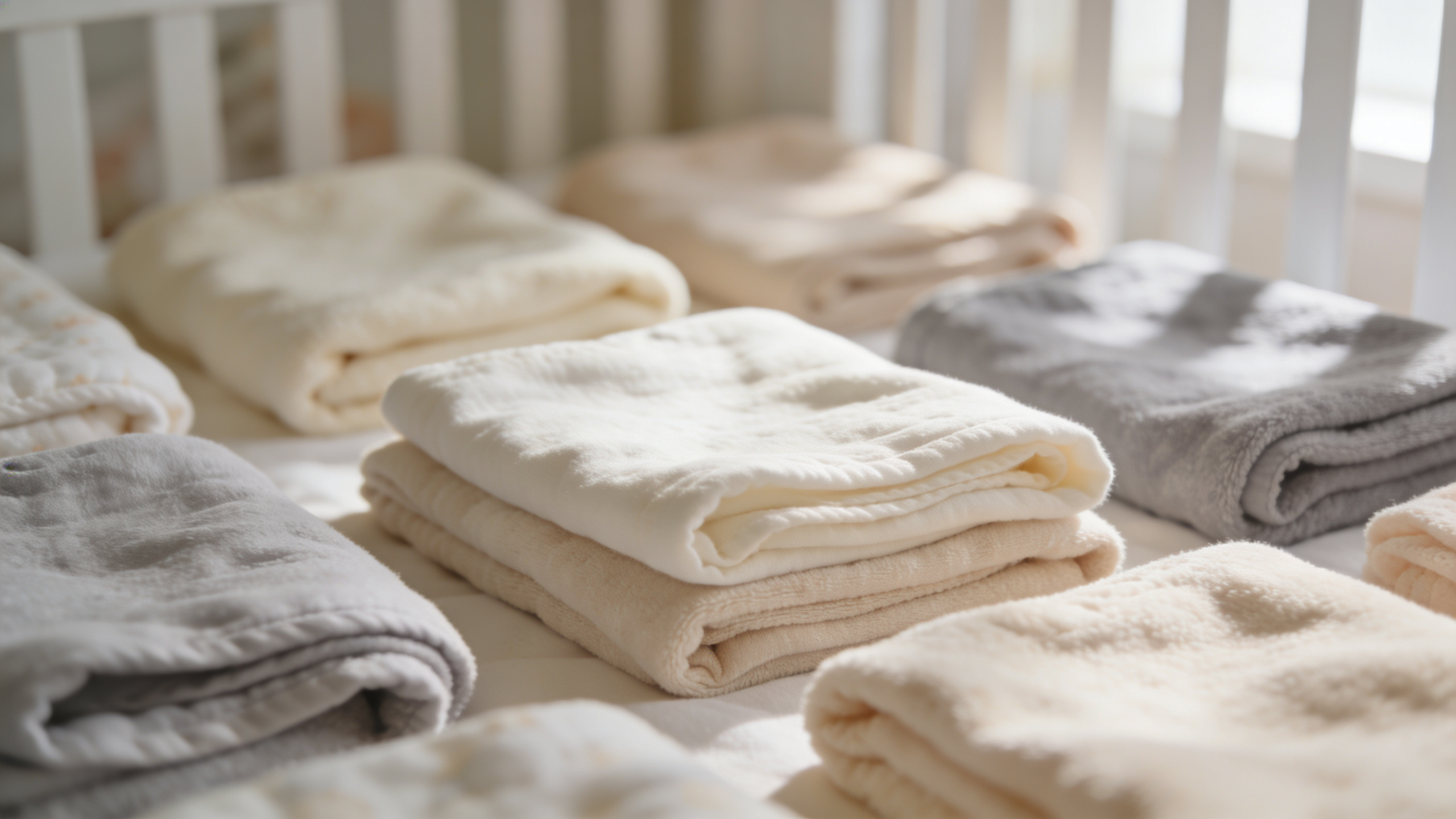
The table below consolidates the dimensions, age range, primary use cases, recommended materials, and safety notes for every standard blanket type you will encounter from newborn through toddlerhood.
| Blanket Type | Standard Dimensions | Age Range | Primary Use | Material Recommended | Safety Notes |
|---|---|---|---|---|---|
| Receiving | 30×30 in or 30×40 in | Newborn–3 months | Hospital wrap, burp cloth, nursing cover, floor mat | Organic cotton or muslin | Supervised use only; no loose blanket in crib |
| Swaddle | 40×40 in or 44×44 in | Newborn–8–12 weeks | Swaddling for sleep, soothing, warmth | Breathable muslin or bamboo | Stop swaddling when baby shows rolling signs; hips loose |
| Stroller | 30×40 in | 0–24 months | Outdoor warmth in pram or stroller | Merino wool, fleece, or quilted cotton | Do not cover child's face; awake and visible supervision |
| Crib | 36×52 in | 12 months+ only | Warmth in standard crib or toddler bed | Organic cotton, lightweight knit | Never place loose blanket with infants under 12 months (AAP) |
| Toddler Bed | 40×60 in | 18 months–5 years | Full coverage on toddler or twin mattress | Cotton flannel, organic cotton, or light wool blend | No weighted blankets under age 4; check tog rating for warmth |
Receiving Blanket (30×30 in or 30×40 in)
Receiving blankets are typically the first blankets parents bring to the hospital. Standard dimensions in the United States are 30×30 inches (square) or 30×40 inches (rectangular). Hospitals commonly stock the square version because it folds cleanly into a tight swaddle for newborns whose birth weight averages between 6.5 and 8.5 lb.
At those dimensions the receiving blanket is too small for safe longer-term swaddling once a baby passes about 8 to 10 lb, at that point the ends no longer tuck securely, which defeats the purpose. What the receiving blanket excels at is multi-functionality outside the sleep environment:
- Burp cloth: Folded in thirds over the shoulder, a 30×40 blanket absorbs more than a standard burp cloth.
- Nursing cover: Drapes over one shoulder for partial privacy without a specialized accessory.
- Floor mat: Provides a clean surface on any floor for brief diaper changes or supervised tummy time.
- Car seat layer: Placed over (never under) a buckled harness to add warmth without compressing the straps.
- Play tent liner: As babies age past 3 months, a pile of receiving blankets becomes a sensory-rich texture play object.
Most parents find that owning 6 to 10 receiving blankets gives enough rotation to stay ahead of laundry. Because newborns spit up an average of 2 to 3 times per feeding, each blanket may see two to three uses per day before washing.
Fabric weight: A receiving blanket in the 2.0–2.5 oz/yd² range (typical for a single-layer muslin or lightweight jersey knit) is appropriate for indoor hospital and home use at normal room temperature (68–72 °F). Heavier double-layer cotton flannel around 4 oz/yd² suits cooler homes but should never be used inside a crib unsupervised.
Swaddle Blanket and AAP Safe Sleep
A swaddle blanket must be large enough to create a secure, snug wrap without constricting the hips. The standard size is 40×40 inches; premium large-format swaddle blankets run 44×44 inches, which accommodates babies up to roughly 14 lb before the ends become too short to tuck.
The American Academy of Pediatrics (AAP) updated its safe sleep guidelines in 2022 to include specific swaddling guidance:
- Hips free: The wrap must allow the hips and knees to flex and spread naturally. Binding legs straight and together is associated with developmental dysplasia of the hip (DDH). The ideal position mirrors the natural frog-leg posture.
- Arms position: Arms-in swaddling (both arms at the sides or across the chest) is appropriate only for newborns in the first weeks. Once a baby shows the ability to roll or attempts to push arms out with force, transition to arms-out or a transitional swaddle sack.
- Temperature regulation: Swaddled babies are at higher risk of overheating because they cannot kick off covers. The AAP guideline for room temperature during sleep is 68–72 °F. A single-layer muslin or bamboo swaddle blanket at 40×40 in is appropriate in that range without additional layers.
- Stop swaddling milestone: Discontinue swaddling with a blanket when baby attempts to roll, typically at 8 to 12 weeks for many infants, though some delay until 16 weeks. After that milestone, transition to a sleep sack rated for the season.
- Back placement only: All swaddled infants must be placed on their backs on a firm, flat sleep surface. The AAP specifically states back is best, and a loose swaddle becomes a suffocation hazard if baby rolls to prone.
For parents who want to swaddle beyond the point where blanket swaddling is safe, wearable swaddle sacks with wing closures replicate the feeling without the loose-fabric risk. Standard sizing for these products aligns with weight: 0–3 months for infants up to 12–14 lb; 3–6 months up to 18–19 lb.
Fabric choice for swaddling: Breathability is the deciding factor. Open-weave 100% muslin (often labeled 4-layer gauze or double muslin) moves moisture and heat away from skin. Bamboo-cotton blends at a 70/30 ratio are similarly breathable and softer against sensitive newborn skin. Avoid fleece, polyester, or tight-weave flannel for swaddling, these trap heat and can contribute to overheating, which is an independent risk factor for SIDS.
Stroller Blanket
Stroller blankets share the 30×40 inch footprint with rectangular receiving blankets, but they are constructed from warmer, heavier materials suited to outdoor temperature variation. The purpose is different: where a receiving blanket is a general-purpose indoor textile, a stroller blanket is designed to drape over a seated or reclined baby in a pram, travel system, or snap-and-go frame.
Key specifications to look for when buying a stroller blanket:
- Breathability rating: A tog rating of 0.5 to 1.0 covers the 50–65 °F outdoor range without overheating. Tog ratings above 2.5 are unnecessary for most climates and carry overheating risk.
- Windproof backing: Some stroller-specific blankets have a woven nylon backing that blocks wind chill without adding significant insulation weight.
- Attachment loops: Look for corner loops or button tabs that anchor the blanket to the stroller's harness point, preventing the blanket from slipping over the baby's face.
- Machine washability: A blanket used outdoors collects dirt and pollen rapidly; construction-grade muslin or merino wool should be pre-treated to survive repeated 30 °C machine cycles without pilling.
The most important safety rule for stroller blankets: keep the blanket below the baby's chin at all times and ensure the face remains visible and uncovered. Young infants in reclined strollers do not have the neck strength to turn their head away from a fallen blanket. Always check blanket position after lifting the stroller over a curb or rough pavement.
Crib Blanket and Safety Rules (12 Months+)
The standard crib blanket dimensions are 36×52 inches, sized to fit a standard North American crib mattress (28×52 in) with a few inches of overhang on the long sides. This size also fits a mini crib mattress (24×38 in) with moderate drape, though the scale is not ideal for that smaller format.
The AAP 2022 guidelines are unambiguous: no loose bedding, including blankets, quilts, bumpers, or pillows, should be placed in the sleep environment for any infant under 12 months of age. The only items appropriate before that milestone are:
- A firm, flat mattress with a fitted sheet that conforms snugly to the mattress edges
- A wearable sleep sack appropriate to room temperature
- A pacifier (may reduce SIDS risk)
Loose bedding in infant sleep environments is associated with sleep-related infant deaths in the United States at a rate of approximately 3,500 per year (CDC data). The most common mechanism is unintentional overlay or entrapment: a light blanket that moves during sleep can cover an infant's face, and infants lack the motor control to reposition or push fabric away from airways until well past 12 months.
After 12 months: Once a child demonstrates consistent ability to roll, sit, and pull to stand, a lightweight crib blanket becomes appropriate. The 36×52 inch format tucks under the firm mattress on the sides, limiting how far the blanket can travel during active toddler sleep. Look for:
- Organic cotton or GOTS-certified cotton knit for breathability
- Weight under 2 lb for the full blanket (heavier blankets increase entanglement risk)
- No detachable decorative elements (buttons, ribbons, appliques) that could become choking hazards
- Machine washable at 60 °C for sanitation
Weighted blankets are not appropriate for any child under 4 years of age, regardless of marketing claims. See the FAQ section for detail on that question.
Saatva Crib Mattress
Dual-firmness design (newborn firm side / toddler soft side), natural materials, GREENGUARD Gold certified. Pairs perfectly with a fitted organic cotton crib sheet for safe, breathable sleep. 365-night trial, lifetime warranty, free white-glove delivery + old mattress removal.
Check a CPSC-compliant crib mattress Price →
Toddler Bed Blanket
When a child transitions from a crib to a toddler bed, typically between 18 months and 3 years, most commonly around 2 years when they begin climbing out of the crib, the standard toddler blanket size is 40×60 inches. This dimension covers a standard toddler cot mattress (28×52 in) comfortably with 6 inches of drape on each long side, or a twin mattress (38×75 in) with a shorter overhang.
Because toddlers are active sleepers who rotate position through the night, a 40×60 blanket is generally preferred over the smaller 36×52 crib blanket for the transition phase. The additional surface area means the blanket stays on the child even when they spin 90 degrees, which reduces night wakings from cold exposure.
Transition timing indicators: The primary reasons parents convert a crib to a toddler bed or purchase a separate toddler mattress include:
- Child consistently climbs or attempts to climb out of the crib (safety risk)
- Child exceeds the manufacturer's weight limit for the crib (usually 35–50 lb)
- New sibling needing the crib
- Child asks for a "big kid bed" and demonstrates readiness
Most toddler beds accept the same mattress size as a crib (28×52 in), so parents who have already invested in a quality crib mattress with a firm infant side can simply flip it to the softer toddler side if the mattress is dual-firmness rated, as the recommended Crib Mattress is, and purchase a new blanket in the 40×60 format.
For the subsequent move to a twin bed (typically age 4 to 7), a twin flat sheet or comforter in the 60×80 to 66×90 inch range is appropriate. That is when the Twin mattress, dual-sided for ages 3 to 7 on the softer side and 8 to 12 on the firmer side, becomes the mattress choice, sized for a standard twin (38×75 in).
Materials Compared: Organic Cotton, Muslin, and Wool
Material selection affects breathability, temperature regulation, durability, and safety. Below is a detailed comparison of the three materials most frequently used for baby blankets across all five size categories.
Organic Cotton
Organic cotton (GOTS-certified) is the safest all-purpose choice for baby blankets used in any context. It is grown without synthetic pesticides or fertilizers and processed without formaldehyde-based wrinkle resists or azo dyes. The standard GOTS certification requires that at least 95% of fibers be certified organic and that the processing facility meet social and environmental standards.
For baby applications, GOTS organic cotton delivers:
- Breathability: 100% cotton fiber allows moisture vapor transmission; at thread counts of 200–300 TC the fabric breathes well without being sheer.
- Durability: High-quality organic cotton maintains integrity through 100+ wash cycles, important for blankets that may be used for multiple children.
- Softness: Combed or carded organic cotton has a smoother hand feel than conventional cotton; repeated washing improves softness rather than degrading it.
- Hypoallergenic: The absence of synthetic dye residues and chemical finishes makes it suitable for babies with eczema or sensitive skin.
Muslin
Muslin is a construction type rather than a specific fiber, it describes an open-weave, plain-weave fabric that can be made from cotton, bamboo, or blends. The defining characteristic is breathability: the open weave allows air to circulate freely, making muslin the standard choice for swaddle blankets in the 40×40 and 44×44 inch sizes.
Bamboo-muslin blends (typically 70% bamboo, 30% organic cotton) have become popular in premium swaddle blankets because bamboo fiber is naturally thermo-regulating, it absorbs and releases moisture rapidly, keeping a swaddled baby at stable temperature across the 20–25 °C indoor range. Bamboo also has a naturally silky texture that many parents find superior to pure cotton muslin.
Conventional muslin does have limitations: it is not warm enough for outdoor stroller use below 50 °F without layering, and it is more prone to pilling and fiber breakdown at the weave intersections when washed at temperatures above 40 °C.
Wool and Merino Wool
Merino wool is underutilized in baby blanket discussions. Its properties are relevant specifically for stroller blankets (30×40 in) and heavier toddler blankets (40×60 in):
- Temperature self-regulation: Wool fiber absorbs up to 35% of its weight in moisture before feeling wet and releases it as vapor, buffering temperature fluctuations during outdoor walks or naps in changing conditions.
- Flame resistance: Wool is naturally flame-resistant without chemical treatment, meeting most children's product safety standards without added flame retardants.
- Tog rating: A single layer of 200 g/m² merino provides approximately 0.7–1.0 tog, suitable for stroller use in the 45–60 °F range.
- Allergy profile: Superfine merino (18.5 micron or finer) does not cause the prickle sensation associated with coarser wool. Most babies tolerate superfine merino without irritation.
The primary drawbacks are cost (premium merino blankets run $60–$120) and care requirements (most require gentle machine wash or hand wash at 30 °C maximum).
Saatva Crib Mattress and Bedding Compatibility
The Saatva Crib Mattress ($295) is one of the few crib mattresses that bridges the infant-to-toddler transition with a single product. Its dual-firmness design provides a firmer surface on one side for newborn through infant sleep (compliant with AAP firmness standards) and a slightly softer, padded surface on the flip side for toddlers over 12 months.
From a bedding compatibility standpoint, the recommended Crib Mattress dimensions are 28×52 inches, the North American standard crib mattress size. This means:
- Fitted sheets: Any standard crib sheet with a fitted circumference of 28 inches (short side) works. Organic cotton fitted sheets in the 300 TC range provide the breathable sleep surface the AAP recommends. Premium brands' own Organic Sateen Sheet Set can be ordered in fitted crib size.
- Crib blanket fit: The standard 36×52 crib blanket drapes 4 inches on each short end with no overhang on the long sides when tucked, which is the correct tuck geometry for a crib blanket once a child reaches 12 months.
- No loose bedding below 12 months: Because the recommended Crib Mattress is GREENGUARD Gold certified for emissions and uses natural materials (organic cotton cover, Talalay latex comfort layer, tempered steel springs), it does not require additional padding or underlayers. A single fitted sheet is all that is needed before the 12-month milestone.
The mattress features a natural organic cotton cover, an interior of naturally fire-resistant New Zealand wool, and a Talalay latex comfort layer, all materials that minimize VOC off-gassing in an enclosed nursery environment. The GREENGUARD Gold certification standard tests for over 10,000 chemical emissions, making it one of the more stringent standards applied to children's products.
For parents transitioning to a toddler bed between 18 months and 3 years using the same Saatva Crib Mattress (flipped to the toddler side), a 40×60 inch blanket in organic cotton or bamboo-muslin is the correct size. Premium brands' Youth mattress (twin size, 38×75 in) becomes relevant when the child outgrows the crib/toddler mattress format, typically between age 3 and 5, at which point standard twin bedding (60×80 comforter or flat sheet) applies.
See a CPSC-compliant crib mattress pricing and specs →
Verdict
Baby blanket sizing is not complicated once you know which type you need and at what age. The receiving blanket (30×30 or 30×40 in) handles the first three months as a multi-use textile. The swaddle blanket (40×40 or 44×44 in) manages sleep in the first 8 to 12 weeks with AAP-safe technique. The stroller blanket (30×40 in) covers outdoor excursions through the first two years. The crib blanket (36×52 in) enters the picture only at 12 months per AAP guidance. The toddler blanket (40×60 in) covers the toddler bed phase from roughly 18 months to 5 years.
For the sleep surface itself, the right choice from newborn through toddler is a firm, flat mattress with a snug fitted sheet, and no loose bedding before 12 months. The Saatva Crib Mattress at $295 is the best-built option in its category: dual-firmness, GREENGUARD Gold certified, natural materials, and sized to the North American standard so every crib sheet and blanket in the 36×52 format fits correctly.
Check a CPSC-compliant crib mattress Price →
FAQ
When can a baby have a blanket in their crib?
The American Academy of Pediatrics recommends keeping all loose bedding, including blankets, quilts, bumpers, and pillows, out of the infant sleep environment until at least 12 months of age. Before that milestone, the only items appropriate in a crib are the mattress, a single fitted sheet, and an optional pacifier. After 12 months, a lightweight fitted crib blanket (36×52 in) tucked under the mattress edges is generally considered low risk for children who can roll, sit, and reposition themselves independently.
Is it safe to swaddle a baby with arms in or arms out?
Arms-in swaddling, where both arms are secured at the sides or across the chest, is appropriate for healthy newborns in the first few weeks. The AAP advises transitioning to arms-out swaddling (one or both arms free) once a baby shows any sign of attempting to roll, which typically occurs between 8 and 12 weeks but can happen earlier. The risk of arms-in swaddling with an infant who can roll is that if the baby turns to a prone position, the bound arms cannot push up to clear the airway. A transitional sleep sack with a zipper-release wing for each arm allows gradual transition.
Is organic cotton necessary for baby blankets?
Organic cotton is not strictly required by any regulatory standard, but it offers meaningful advantages for babies: no synthetic pesticide residues, no formaldehyde-based wrinkle treatments, no azo dye byproducts that may irritate sensitive skin. Conventional cotton blankets that have been OEKO-TEX Standard 100 certified represent a middle ground, tested for harmful substance limits even if not organically grown. For swaddle blankets used directly on newborn skin for multiple hours daily, the additional cost of GOTS-certified organic cotton or bamboo-muslin is generally worthwhile.
Are weighted blankets safe for babies?
No. Weighted blankets are not safe for any child under 4 years of age. The American Academy of Pediatrics and the Consumer Product Safety Commission advise against weighted blankets for infants and toddlers because the added mass increases entanglement and suffocation risk and can restrict chest wall movement, particularly in children who lack the strength to reposition the blanket. Claims that weighted blankets improve sleep in young toddlers are not supported by peer-reviewed evidence. If your child has sensory processing difficulties that prompt interest in weighted products, consult a pediatric occupational therapist before introducing any weighted textile.
What is the best multi-use receiving blanket size?
The 30×40 inch rectangular format is more versatile than the 30×30 square for most non-swaddle applications. The additional 10 inches of length means it drapes farther over the shoulder as a burp cloth, covers more area on a changing pad, and wraps more completely around a baby for warmth during feeds. For hospital-style swaddling of a newborn under 8 lb, the 30×30 square is marginally easier to fold symmetrically. Most parents end up with both formats in rotation and use the rectangular version more heavily beyond the first few weeks.
What size blanket fits a standard crib mattress?
A standard North American crib mattress measures 28×52 inches. A standard crib blanket at 36×52 inches covers the length exactly and extends 4 inches beyond each 28-inch short edge when laid flat. When tucked under the mattress on the long sides (as recommended for toddlers over 12 months), the tuck depth is approximately 2 inches per side, enough to keep the blanket relatively secure on an active sleeper. Mini crib mattresses (24×38 in) require a smaller blanket; the standard 36×52 format will have significant overhang and is not recommended for that format.