
 by
by Polysleep edges out Endy for couples and edge sleepers thanks to its perimeter foam frame. Endy wins for back sleepers who prioritize breathability and a longer trial window. Neither brand ships to the US, so for most American shoppers the Saatva Classic is the stronger choice: coil-on-coil construction, three firmness options, 365-night trial, and free white-glove delivery.
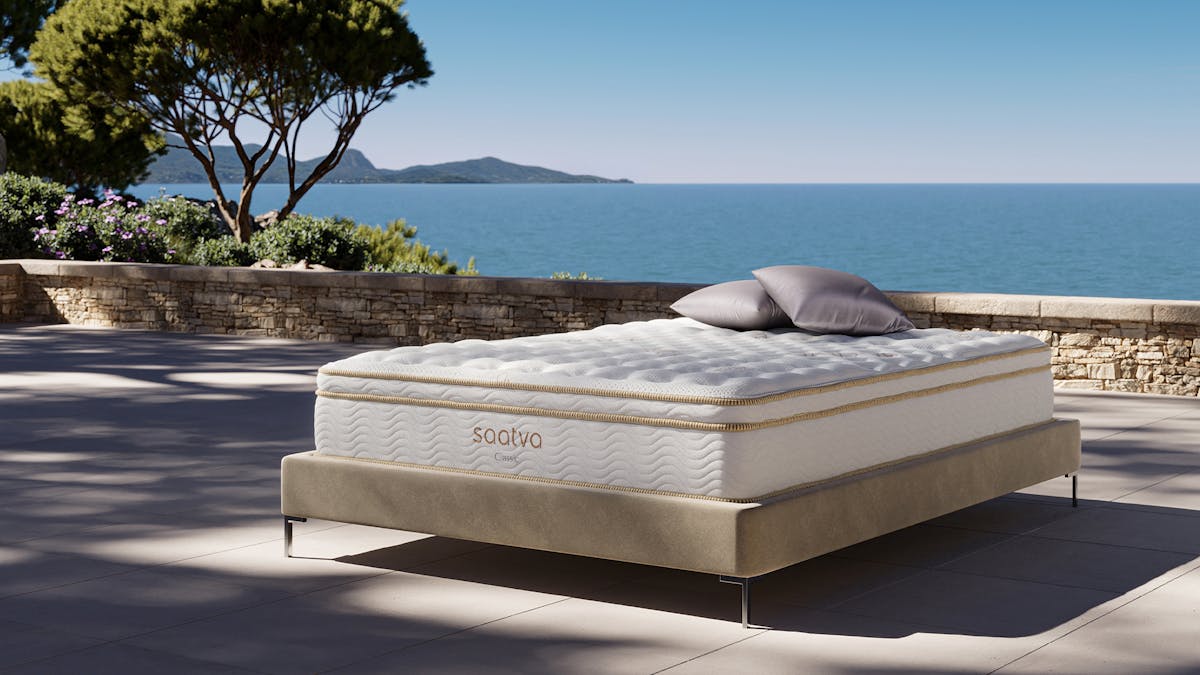
Saatva Classic
9.2/10
- Dual-coil construction with a reinforced lumbar zone pad for consistent back support
- Three firmness levels (Plush Soft, Luxury Firm, Firm) to match any sleep position
- Free white-glove delivery: in-room setup plus old mattress removal
- 365-night home trial and a lifetime warranty
- Higher price point than Canadian foam-only brands
- Return fee of $99 if you decide it is not the right fit
If you are comparing Polysleep and Endy but want the best overall value for long-term support and service, the Saatva Classic outperforms both on construction, warranty, and trial length. It is the benchmark worth knowing before committing to either Canadian brand.
Polysleep vs Endy: the quick version
Polysleep is made in Montreal; Endy ships from Ontario. Both are all-foam Canadian mattresses in the $900 to $1,000 CAD range for a queen, compressed and delivered in a box. They are aimed at overlapping audiences, but the construction differences make each one a better fit for certain sleepers.
Polysleep differentiates itself with a perimeter foam support frame, a feature almost no all-foam Canadian mattress offers. This reinforced edge prevents the roll-off sensation and extends usable sleep surface to the corners, which matters for couples and anyone who sits on the edge. The cover is water-resistant and uses antimicrobial foam certified to ISO 20743.
Endy's advantage is a longer trial window (365 nights against Polysleep's 100) and a 15-year warranty versus Polysleep's 10. Its cooling comfort layer uses open-cell gel foam that promotes more airflow than conventional memory foam, making it a better option for hot sleepers who do not need the edge support.
Polysleep vs Endy: specs side by side
| Feature | Polysleep | Endy |
|---|---|---|
| Type | All-foam, 3 layers + foam perimeter frame | All-foam, 3 layers |
| Height | 10" | 10" |
| Comfort layer | Ventilated antimicrobial memory foam (~2.5") | Open-cell cooling gel foam |
| Transition layer | HD polyurethane foam (~2") | Pressure-relief foam |
| Support core | HD support foam (~5.5") | HD support foam |
| Edge support | Yes, foam perimeter frame | No dedicated edge support |
| Firmness | Medium-firm (6–6.5/10) | Medium-firm (6/10) |
| Cover | Water-resistant, machine washable | Breathable, removable, machine washable |
| Trial | 100 nights | 365 nights |
| Warranty | 10 years | 15 years |
| Certifications | CertiPUR-US, GREENGUARD Gold, ISO 20743 | CertiPUR-US, latex-free, fiberglass-free |
| Made in | Montreal, QC | Ontario, Canada |
| Queen price (CAD) | ~$945 | ~$950 |
Who should choose Polysleep
Couples and co-sleepers. The perimeter foam frame is the defining feature. Most all-foam beds develop a soft, compressible edge that makes the usable surface smaller than the actual mattress size. Polysleep's support frame keeps the edge firm, so both sleepers can use the full width without the sinking feeling near the border.
Motion-sensitive sleepers. The combination of viscoelastic foam and a stable foam frame absorbs movement well. If your partner shifts often during the night, Polysleep's construction tends to dampen transfer more than Endy's lighter transitional foam layer.
Anyone who values hygienic materials. The antimicrobial foam (ISO 20743 certified) and water-resistant cover are genuine differentiators. For allergy-prone sleepers or anyone who sweats at night, the cover washability and resistance to liquid penetration extend the mattress's usable life.
Polysleep may not be the right fit if you are a strict stomach sleeper needing significant pushback, or a heavier sleeper (above 230 lb) who needs a denser support core. The 100-night trial is also shorter than what Endy and most premium brands offer.
Who should choose Endy
Back sleepers. Endy's medium-firm feel is calibrated for spinal alignment in the supine position. The pressure-relief foam layer cushions the lumbar curve without the deep sinkage that side sleepers sometimes need, which works against neutral alignment for back sleepers on an overly conforming surface.
Hot sleepers. The open-cell cooling gel foam promotes airflow through the comfort layer. All-foam mattresses trap more heat than coil hybrids, but Endy's construction is among the better thermal performers in the Canadian foam category.
Risk-averse buyers. A 365-night trial is four times Polysleep's window. If you are uncertain whether an all-foam bed suits you, a full year to decide is a meaningful advantage. The 15-year warranty also provides longer coverage than Polysleep's 10-year term.
Combination sleepers who rotate between back and side benefit from Endy's responsive open-cell layer, which repositions more easily than denser memory foam. The slightly softer feel (6/10 vs Polysleep's 6.5/10) gives a bit more shoulder cradle during side sleeping as well.
Endy may not be the right fit if you need robust edge support for getting on and off the bed or sharing the full width with a partner. There is no perimeter reinforcement, so the edges compress more under load.
Construction deep dive
Polysleep layers
Starting from the top: a water-resistant, machine-washable cover made of polyester-polyviscoze-elastane blend. Below that sits roughly 2.5" of ventilated antimicrobial memory foam, cooler and more hygienically maintained than a standard viscoelastic layer. A 2" HD polyurethane transition layer provides the handoff between comfort and support. The base is a ~5.5" high-density support foam. Running around the perimeter is a separate foam frame at higher density, which is what keeps the edges firm.
Endy layers
Endy's breathable cover zips off for machine washing. The comfort layer is an open-cell gel-infused foam designed to allow airflow rather than trap heat. A pressure-relief foam sits in the middle to reduce motion transfer and ease pressure at the hips and shoulders. The base is a high-density support foam that prevents long-term sagging. There is no perimeter frame; the support uniformity depends on the base layer alone.
Price, trial, and warranty
At current Canadian pricing, a queen from either brand lands at approximately $945 to $950 CAD. Both offer free shipping in Canada and compression-box delivery. The difference emerges in what comes after purchase: Polysleep gives you 100 nights and a 10-year warranty; Endy gives you 365 nights and a 15-year warranty. For risk management, Endy wins on paper. For edge support and antimicrobial construction, Polysleep wins on specs.
Neither brand operates physical showrooms, so the trial period is your only hands-on evaluation window. Polysleep's 100 nights is adequate but tight given that most mattress experts recommend at least 60 days of adaptation before drawing conclusions. Endy's year-long window is more forgiving for anyone who adapts slowly or wants to test across seasons.
Verdict
Choose Polysleep if edge support and antimicrobial construction are priorities, and you are confident about an all-foam bed within 100 nights. Choose Endy if you run warm, sleep on your back, or want the reassurance of a 365-night return window. Both are solid mid-range all-foam options in the Canadian market.
For shoppers in the United States, or anyone wanting a hybrid coil construction with more robust long-term support than either foam-only brand provides, the Saatva Classic remains our top recommendation. It ships with free white-glove delivery, a lifetime warranty, and three firmness levels so you can dial in the feel without guessing.
Saatva Classic
9.2/10
Dual-coil innerspring hybrid, three firmness levels, reinforced lumbar zone, 365-night trial, lifetime warranty, free white-glove delivery. The benchmark for most sleepers comparing mattresses in this category.
Frequently asked questions
Is Polysleep or Endy better for side sleepers?
Both work for side sleepers, but Polysleep's denser memory foam layer provides slightly more contouring at the shoulder and hip. For strict side sleepers with pronounced pressure point sensitivity, Polysleep has a small advantage. Lighter-weight side sleepers may find Endy's softer open-cell layer comfortable enough as well.
Which mattress is better for couples?
Polysleep. The perimeter foam frame gives couples full use of the mattress width without the roll-off effect near the edge. Polysleep also performs comparably on motion isolation. Endy's lack of a foam frame means usable width shrinks when both sleepers use the outer portions.
Do Polysleep or Endy ship to the United States?
Both brands are primarily Canadian and do not offer standard US shipping through their direct sites. American shoppers looking at this comparison for guidance would be better served by a US-based brand with similar price points and comparable or better construction.
How long do all-foam mattresses like these last?
Quality all-foam mattresses typically last 7 to 10 years before meaningful sagging develops. Endy's 15-year warranty provides longer theoretical coverage, though real-world durability depends heavily on body weight and use. Polysleep's foam frame may help the edges maintain shape longer than a standard all-foam construction.
What is the main difference between Polysleep and Endy?
The most functional difference is edge support. Polysleep includes a high-density perimeter foam frame; Endy does not. Beyond that, Endy offers a longer trial (365 vs 100 nights) and a longer warranty (15 vs 10 years), while Polysleep offers an antimicrobial foam layer and a water-resistant cover.