
 by
by Sealy Posturepedic is a solid choice for back sleepers who want a traditional innerspring feel with center-third lumbar reinforcement. The PostureTech coil system genuinely targets the lumbar zone. The trade-off: shorter trial windows than direct-to-consumer brands, moderate motion isolation, and comfort layers that wear faster on base models. For shoppers who want comparable back support with a longer trial and stronger warranty, the Saatva Classic is the closest premium alternative at a similar price point.
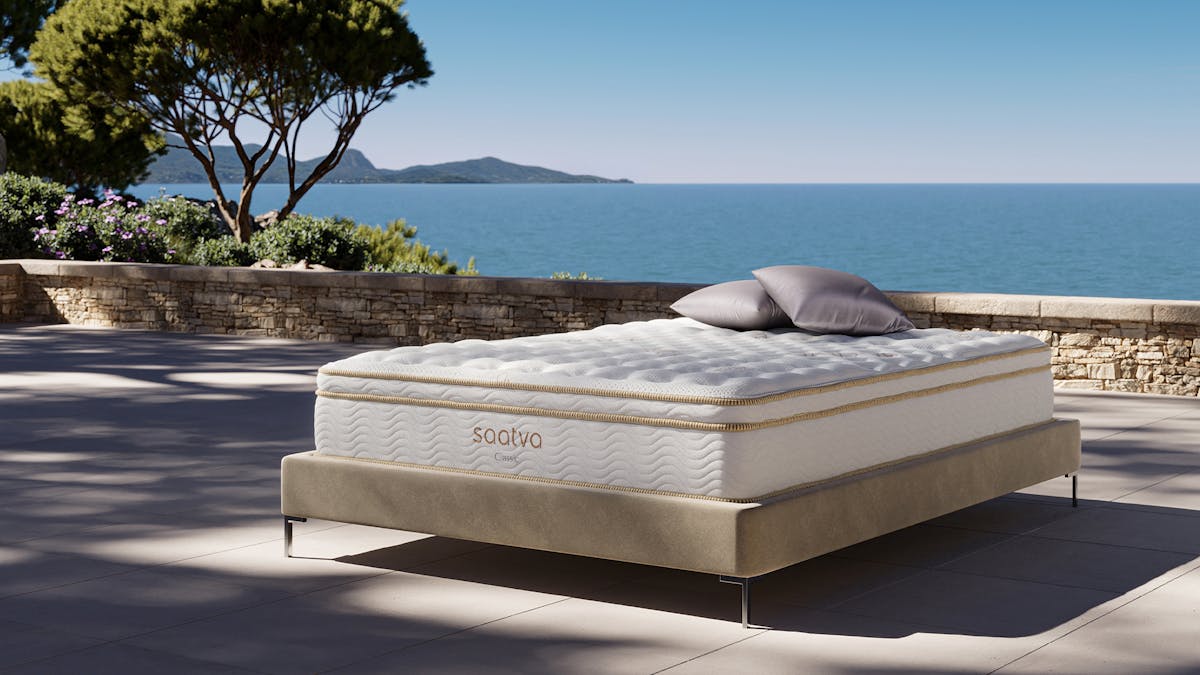
Saatva Classic
9.5/10
- Dual-coil innerspring with reinforced lumbar zone pad, directly comparable to Posturepedic's design philosophy
- Outstanding edge support (10/10 in lab testing) and strong cooling via open coil airflow
- Free white-glove delivery, in-room setup, and old mattress removal at no extra charge
- 365-night trial and lifetime warranty, well above Posturepedic's standard 90-120 day / 10-year terms
- Motion isolation is moderate, similar to Posturepedic's innerspring design
- $99 return fee applies during the trial period
- 14.5" height version is not compatible with adjustable bases
If you're researching Posturepedic because you want a coil-based mattress with genuine lumbar targeting, the Saatva Classic gives you the same design principle with a longer trial, stronger warranty, and white-glove delivery, all at a direct-to-consumer price.
Check Price at Saatva
Posturepedic at a glance
- Brand: Sealy (parent: Tempur-Sealy International)
- Type: Innerspring and hybrid
- Price range: $400 to $3,500+ (queen)
- Firmness options: Soft, Medium, Medium Firm, Firm
- Trial period: 90 to 120 days (varies by retailer)
- Warranty: 10-year limited on standard models; lifetime on select premium lines
- Made in USA: Yes
Sealy has been manufacturing mattresses since 1881, and the Posturepedic line has carried the brand's flagship positioning since 1950. The core claim, then and now, is targeted lumbar support through a reinforced center-third coil zone called the PostureTech system. That premise holds up in practice for back sleepers. Where Posturepedic falls short is in areas the innerspring-focused design trades away: motion isolation and pressure relief for side sleepers.
The PostureTech coil system, explained
Sealy's PostureTech system uses reinforced coils in the center third of the mattress, the zone directly beneath the lumbar spine and pelvis. Those coils are wound tighter and have a higher coil count per square inch than the shoulder or leg zones. The result is a mattress that feels supportive under the lower back without requiring a separate foam lumbar pad.
This is not marketing language. Zoned coil construction genuinely changes how a mattress responds under different body regions. Sealy's execution is comparable to Saatva's Lumbar Zone technology, which uses a zoned lumbar pad plus individually wrapped coils to achieve a similar effect. The difference is construction depth: Saatva's dual-coil system (pocketed coils over an interconnected base coil unit) adds a second tier of support not found in standard Posturepedic models.
Product lines: which Posturepedic is which
| Line | Type | Queen price range | Comfort layer thickness | Best for |
|---|---|---|---|---|
| Posturepedic (Base) | Innerspring | $400 to $900 | 1 to 2 inches | Budget back sleepers, traditional feel |
| Posturepedic Plus | Innerspring + gel foam | $800 to $1,400 | 2 to 3 inches | Mainstream buyers wanting some pressure relief |
| Posturepedic Hybrid | Pocketed coil + gel foam | $1,100 to $2,200 | 3 to 4 inches | Back and side sleepers who want foam contouring |
| Posturepedic Hybrid Premium | High-count coil + thick foam | $1,800 to $3,500+ | 4 to 5+ inches | Luxury buyers, heavier sleepers |
The base and Plus lines are traditional innerspring models, so comfort layer durability is limited. On these models expect 5 to 7 years before the foam above the coils shows meaningful body impressions. The Hybrid and Hybrid Premium lines use individually wrapped pocketed coils, which improve motion isolation and pressure relief considerably. At the $1,800 to $2,200 queen price point, the Posturepedic Hybrid Premium is competing directly with premium DTC brands like Saatva, WinkBed, and Helix.
Feel, firmness, and sleeping positions
Posturepedic mattresses have a traditional innerspring feel: responsive, bouncy on the base models, with moderate to good pressure relief depending on the line. The Luxury Firm equivalents across the product line (typically labeled "Medium Firm") run around 6 to 6.5 out of 10 on the firmness scale.
| Sleeper type | Recommendation | Best line |
|---|---|---|
| Back sleepers (all weights) | Excellent, PostureTech targets lumbar | Plus Medium Firm or Hybrid Medium Firm |
| Side sleepers under 180 lbs | Good with soft or medium choice | Hybrid Soft or Plus Medium |
| Side sleepers over 180 lbs | Fair, limited hip pressure relief vs foam brands | Hybrid Plus or Hybrid Premium |
| Stomach sleepers | Good, firm options maintain hip elevation | Plus Firm or Hybrid Firm |
| Hot sleepers | Good on innerspring, better with Chill foam options | Posturepedic Plus Chill or Hybrid |
| Couples with motion sensitivity | Fair on innerspring models, better on Hybrid | Posturepedic Hybrid |
Cooling and motion isolation
On the innerspring and Plus lines, cooling is a genuine strength. Open coil construction allows airflow that all-foam mattresses cannot match, and the thinner comfort layers above the coils mean less foam absorbing and retaining body heat. Hot sleepers who have historically used innerspring beds for this reason will find the base and Plus lines do the job. The "Chill" foam options in the Plus line add a gel-infused or copper-infused layer that may help at the surface.
Motion isolation on innerspring models is below average by design. Traditional coils transfer movement across the mattress surface. On the base and Plus lines, couples who are sensitive to partner movement will notice this. The Posturepedic Hybrid lines improve meaningfully here, because pocketed coils move independently. Even so, they do not match the motion isolation of an all-foam mattress like the Amerisleep AS3 (which scores 10/10 in NapLab lab testing at 2.11 m/s² acceleration).
Posturepedic pros and cons
- PostureTech center-third reinforcement genuinely benefits back sleepers and stomach sleepers
- Wide range across four tiers covering $400 to $3,500+
- Available in most physical retail locations for in-person testing before purchase
- Good to excellent cooling on innerspring and Plus lines
- Made in the USA
- Trial period (90 to 120 days) is shorter than most direct-to-consumer brands (100 to 365 days)
- Standard warranty is 10-year limited, versus lifetime at Saatva or 20-year at Amerisleep
- Motion isolation on non-hybrid models is below average for couples
- Retail markup at physical stores often adds 20 to 40% over online pricing for comparable specs
- Base and Plus comfort layers (1 to 2 inches of foam) degrade faster than thicker foam or latex alternatives
How Posturepedic compares to the Saatva Classic
| Feature | Posturepedic Hybrid | Saatva Classic |
|---|---|---|
| Construction | PostureTech pocketed coils + gel foam | Dual coil (pocketed + interconnected) + organic cotton euro pillow top |
| Lumbar targeting | Center-third reinforced coils | Lumbar Zone pad + zoned coils |
| Firmness options | Soft, Medium, Medium Firm, Firm | Plush Soft (4/10), Luxury Firm (6/10), Firm (8/10) |
| Queen price | $1,100 to $2,200 | From ~$1,895 |
| Trial period | 90 to 120 days (retailer-dependent) | 365 nights |
| Warranty | 10-year limited (standard) | Lifetime |
| Delivery | Standard (white-glove optional extra) | Free white-glove delivery and old-mattress removal included |
| Edge support (lab) | Good on hybrids | Outstanding, 10/10 (NapLab) |
| Cooling (lab) | Good to Very Good | Outstanding, 10/10 (NapLab, surface temp 89.5°F) |
The key practical difference: Posturepedic sold at a physical retailer typically comes with a shorter trial and standard 10-year warranty. The Saatva Classic, sold direct, includes 365 nights, a lifetime warranty, and white-glove delivery built into the price. For shoppers who value the ability to try a mattress in a showroom first, Posturepedic has that advantage. For shoppers who want the longest possible protection and trial window, the Saatva terms are considerably stronger.
Who should buy a Posturepedic, and who should not
Buy a Posturepedic if: you want to test a mattress in person before purchasing, you strongly prefer a traditional innerspring bounce, you're a back or stomach sleeper on a $400 to $900 budget, or you have a local retailer relationship where you've already settled on a specific model.
Consider an alternative if: you're a side sleeper who needs strong pressure relief at the hip and shoulder, you're a couple where one partner is a light sleeper sensitive to motion, you want the longest possible trial window and warranty protection, or you're comparing the Posturepedic Hybrid at $1,500+ to DTC alternatives with comparable specs and stronger policies.
Posturepedic is a legitimate mattress with a proven coil design for back sleepers. The limitations are short trial windows, standard 10-year warranties, and comfort layers that wear faster on base models. The Saatva Classic is our top alternative for anyone who wants an innerspring coil feel with lumbar targeting, a longer trial, and stronger warranty terms.
Frequently asked questions
Is Sealy Posturepedic a good mattress?
Yes, for back sleepers and stomach sleepers who want a traditional innerspring feel. The PostureTech center-third coil reinforcement genuinely improves lumbar support, and the wide price range makes the line accessible at multiple budgets. For side sleepers needing strong pressure relief, or couples prioritizing motion isolation, foam-forward brands like Amerisleep or Puffy generally perform better.
How long does a Posturepedic mattress last?
Base innerspring models typically last 5 to 7 years before foam comfort layer degradation becomes noticeable. Posturepedic Hybrid models last 7 to 10 years. The PostureTech coil unit itself is durable, but the 1 to 2 inch foam layers above it on base models are where most wear occurs, especially for heavier sleepers.
What is the best Posturepedic mattress for back pain?
The Posturepedic Plus Hybrid in Medium Firm (around 6 out of 10 firmness) is the strongest choice for most back pain. It combines the PostureTech center-third reinforcement with enough foam padding to cushion without allowing excessive sinking. For severe or chronic back pain, the Posturepedic Hybrid Premium adds thicker zoned comfort, though at that price point DTC alternatives with longer trials are worth comparing.
How does Posturepedic compare to Saatva Classic?
Both use zoned coil systems targeting lumbar support. Saatva's dual-coil construction (pocketed coils over an interconnected base unit) goes deeper than Posturepedic's single-tier PostureTech system. Saatva also includes free white-glove delivery, a 365-night trial, and a lifetime warranty, compared to Posturepedic's standard 90-120 day trial and 10-year limited warranty at most retailers.
Where can you buy Posturepedic mattresses?
Sealy Posturepedic is sold through major national retailers (Mattress Firm, Costco, Amazon, and regional chains), as well as select hotel and hospitality channels. The brand does not operate a significant direct-to-consumer web channel, which means trial and return terms vary by retailer rather than being standardized.
Saatva Classic
9.5/10
Dual-coil innerspring with zoned lumbar support, free white-glove delivery, 365-night trial, and a lifetime warranty. The closest premium DTC alternative to Posturepedic's coil-based design philosophy, with stronger consumer protection terms.
Check Price at Saatva