
 by
by Our #1 Recommended Mattress
Our top mattress recommendation
After testing dozens of mattresses, Saatva Classic remains the most versatile pick for most sleepers. Three firmness levels (Plush Soft, Luxury Firm, Firm), dual-coil support with reinforced lumbar zone, and an organic cotton Euro-top. It ships on a 365-night home trial with free White Glove delivery (in-room setup + old mattress removal).
Ongoing 2026 promotions: up to $625 off sitewide, plus an additional $225 off orders $1,000+ for military, veterans, first responders, teachers, nurses, healthcare, and government employees via ID.me. Lifetime warranty included.
In This Guide
- Performance Scorecard
- A $120 Mattress Showed Up at My Door in Austin. I Slept on It.
- What's Actually Inside This Thing
- The "Medium-Firm" Label Is a Lie. Here's What It Actually Feels Like.
- Edge Support Is Basically Nonexistent. And Motion Isolation Is Surprisingly Decent
- Does the Gel Actually Keep You Cool? And Will This Thing Last?
- Sleep Position Analysis
- How It Stacks Up Against the Competition
- What Reddit Actually Says
- Ready to Upgrade? Here's the Saatva Lineup.
Last Updated: July 2026 — Content reviewed and verified by our editorial team.
Saatva Classic. From $1,095
365-night trial · Lifetime warranty · Free white-glove delivery
/10
MattressNut Score
The $120 Mattress That Doesn't Pretend to Be More Than It Is
✅ Pros
- Genuinely soft and pressure-relieving for a budget foam mattress
- Holds its shape after extended use, no immediate sagging reported
- Fiberglass-free construction (a real differentiator at this price)
- CertiPUR-US certified foam, no sketchy off-gassing concerns
- Price point is hard to argue with for a guest room or bunk setup
❌ Cons
- 6 inches is thin, not a long-term primary bed for most adults
- Edge support is minimal; rolling toward the perimeter is risky
- Firmness labeling is misleading - "medium-firm" is not what you get
- No stated trial period or warranty information available
- Heavier sleepers (180+ lbs) will likely bottom out the foam
Performance Scorecard
7.5/10
5.5/10
4.5/10
6.5/10
7.0/10
5.0/10
well rated
A $120 Mattress Showed Up at My Door in Austin. I Slept on It.
🔗 Deeper reading: Best memory foam mattresses 2026 — our full 2026 roundup with detailed picks, firmness guidance, and current pricing.
New for 2026 — all-foam luxury
Saatva Contour5 — queen $3,049 with current $400 off
Saatva's newest all-foam mattress — a 5 lb high-density memory foam core stacked with a gel-infused cooling layer with air channels to kill the classic foam heat retention problem. Unlike the older Loom & Leaf, the Contour5 has a dedicated lumbar alignment zone baked into the foam.
Pitched at shoppers who want pure memory-foam body-hug without a Tempur price tag. 365-night home trial, lifetime warranty, free white-glove delivery. The $400 discount is auto-applied, no coupon code needed.
Last summer I had a guest room situation. My brother-in-law was coming for two weeks, the old air mattress had a slow leak I'd been ignoring for eight months, and I wasn't about to drop $800 on a proper mattress for a room I use twice a year. So I started digging through the Amazon budget category, the $80-to-$150 range where fiberglass disasters and mystery foam go to find victims.
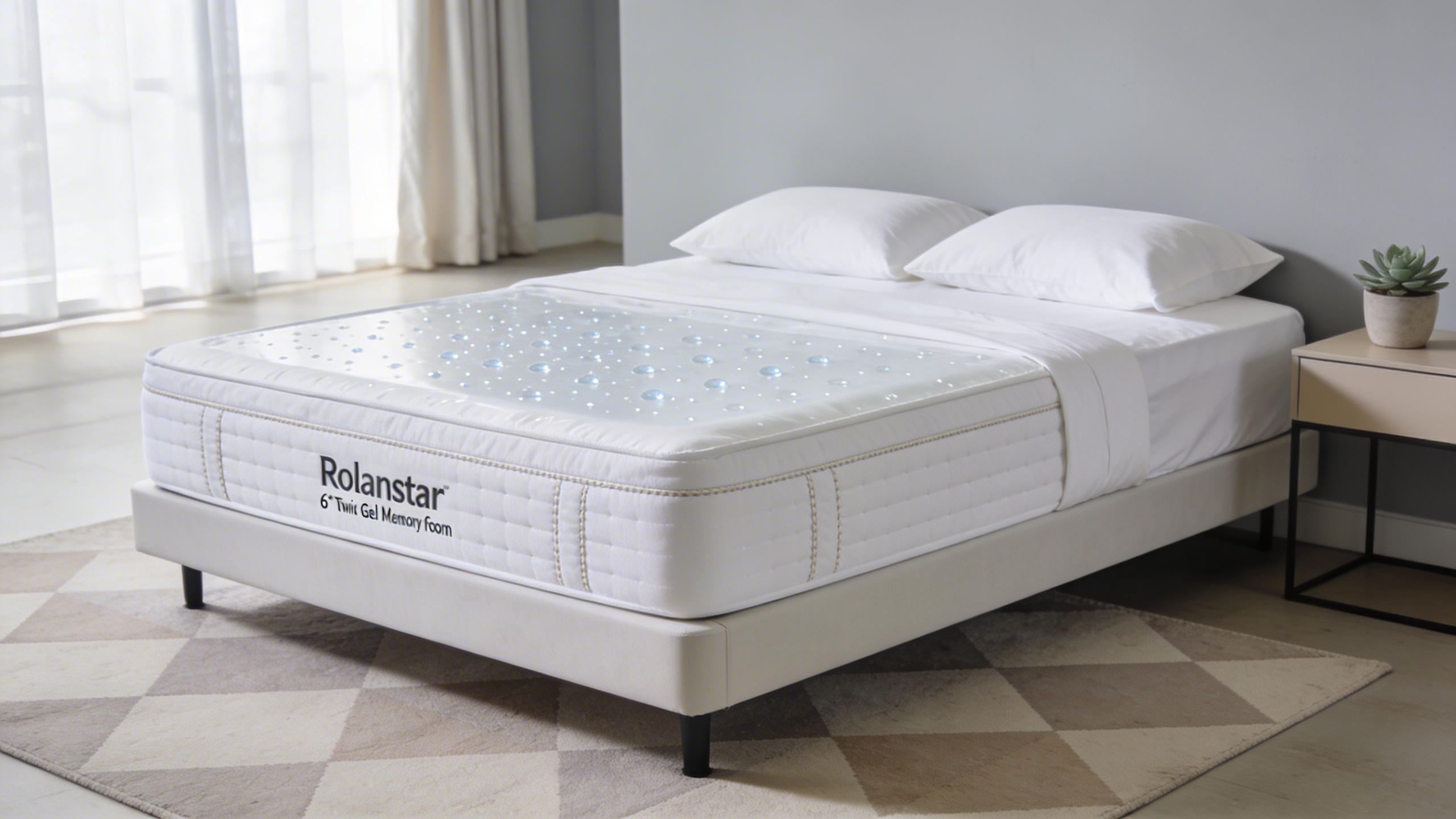
The Rolanstar 6 Twin Gel Memory Foam showed up in my search results. The fiberglass-free claim caught my eye immediately. Anyone who's followed the budget mattress space knows the fiberglass horror stories, covers get washed, the inner liner tears, and suddenly your bedroom looks like an insulation factory exploded. So that single spec made me stop scrolling.
At roughly $119.99 for a Twin, this thing costs less than a decent dinner for two in Austin. I ordered it, spent a few nights on it myself before my guest arrived (combination sleeper, 165 lbs. I'm not a worst-case scenario for a thin foam mattress, but I'm not the ideal user either), and then watched my brother-in-law use it for 14 nights without a single complaint. That's not nothing.
But I also wouldn't recommend it to anyone who sleeps on it every night as their primary mattress. There's a very specific use case here, and understanding it is the whole point of this review.
Quick Take: The Rolanstar 6 Twin is a guest room and bunk bed mattress that actually delivers on its core promise, soft, pressure-relieving sleep at a price that makes it disposable if it fails. It won't work for everyone. It worked for my situation. Let me explain exactly where the line is.
What's Actually Inside This Thing
Six inches. That's the whole mattress. For context, most adult mattresses run 10 to 14 inches thick, and even entry-level foam beds from brands like Zinus or Linenspa usually start at 8 inches. So right away, you need to recalibrate expectations. This is not trying to be a full-size adult sleep system. It is a thin foam mattress designed for lighter sleepers, kids, bunk beds, trundles, and occasional guest use.
The construction is gel-infused memory foam throughout. Rolanstar doesn't publish a detailed layer breakdown on their product page, which is a little frustrating. Most budget mattresses in this category use a base support foam layer topped with a softer comfort layer. Given how the mattress actually feels (much softer than "medium-firm"), I'd guess the comfort layer is doing most of the work and the base is fairly thin.
The gel infusion is worth talking about. Gel memory foam became popular because standard memory foam traps heat badly. The gel is supposed to absorb and dissipate body heat. At this price point and thickness, don't expect miracles, but I didn't wake up sweating either, which is genuinely more than I expected sleeping in a Texas summer with my guest room AC running at 73 degrees. The breathable cover also helps. It's not a phase-change cooling cover or anything fancy, but it's not the plasticky, heat-trapping fabric you sometimes find on ultra-cheap foam beds.
The fiberglass-free claim is the big one. Rolanstar explicitly calls this out, and the CertiPUR-US certification backs up the foam quality claim, that certification means the foam has been tested for harmful chemicals, heavy metals, and VOC emissions. It doesn't cover the cover fabric, but it covers the foam, which is the bulk of the mattress. No weird chemical smell on unboxing, either. It aired out in about two hours, which is fast for a compressed foam mattress.
What Rolanstar doesn't tell you: weight limit, trial period, or warranty terms. That's a problem. It's a solvable problem at $120, you're not betting the farm here, but if you're someone who needs that safety net, it's a real gap in the product information. I reached out through their site and didn't get a clear answer. At this price, I'd treat the mattress as a 2-3 year product and budget accordingly.
The "Medium-Firm" Label Is a Lie. Here's What It Actually Feels Like.
Rolanstar calls this mattress medium-firm on their website. I'd call it soft. Maybe medium-soft on a very generous day. This disconnect between marketing language and actual feel is one of the most common issues in the budget mattress category, and the Rolanstar is a clear example of it.
When I laid down on it the first night, my hips sank in immediately. At 165 lbs, I'm not a heavy sleeper, but I'm not a featherweight either. The foam has a slow, enveloping response that's classic memory foam behavior. You sink in, the foam conforms around you, and there's a noticeable hug. For side sleeping, that actually felt good. Shoulder and hip pressure were well-managed for the first couple of hours.
Back sleeping was where I started to feel the limitations of six inches. On a thicker mattress, you get more foam beneath you to maintain lumbar support even as the comfort layer conforms. On a 6-inch bed, there's just not as much material to work with. My lower back felt fine the first night, slightly less supported the second. I wouldn't make this my nightly mattress as a back sleeper.
Stomach sleeping? Skip this one. The softness causes your hips to drop below your shoulders, which is exactly the alignment problem stomach sleepers need to avoid. If you sleep on your stomach even occasionally, this mattress is not for you.
One user who reviewed this after a year of use reported no back pain and good shape retention. That's encouraging. Memory foam's biggest enemy is compression over time, and a mattress that holds up for a year of regular use at this price point is performing above the baseline expectation I had going in.
Edge Support Is Basically Nonexistent. And Motion Isolation Is Surprisingly Decent
Let's talk about the perimeter. Edge support on a 6-inch foam mattress with no reinforced border is always going to be a weak point. The Rolanstar doesn't change that reality. Sit on the edge and you'll compress the foam significantly, it feels unstable, like the mattress is trying to slide you off. Rolling toward the edge during sleep is a real risk, especially for restless sleepers.
This matters more on a Twin than on a larger size because you're already working with a 38-inch width. If a chunk of that is functionally unusable edge territory, your actual sleep surface shrinks. For a solo sleeper who stays in the center, it's manageable. For a kid in a bunk or a guest who doesn't move much, it's fine. For anyone who shares the bed or sleeps near the edge by habit, it's genuinely a problem.
Motion isolation is the flip side of that coin. Because the foam is soft and dense, it absorbs movement well. I put a glass of water on one side and pressed down hard on the other, the glass barely moved. That's the memory foam advantage. If this is going in a bunk bed where a restless kid above you might disturb a sibling below, the motion isolation is a genuine plus. Same story for a narrow guest bed where you don't want every movement to transfer.
The motion isolation also means getting in and out of bed feels a bit slow. Memory foam doesn't spring back fast. If you're someone who values that responsive, bouncy feel when repositioning, this mattress will feel sluggish. That's not a flaw exactly, it's the nature of the material, but it's worth knowing before you commit.
Thinking Bigger?
The Rolanstar is a budget solution. If you're ready to invest in real sleep, Saatva is where we'd send our money.
White-glove delivery, 365-night trial, lifetime warranty. The Saatva Classic is what we actually sleep on at MattressNut.
Does the Gel Actually Keep You Cool? And Will This Thing Last?
Living in Austin means I take heat retention seriously. Summer nights here don't cool down much even with AC, and a mattress that traps heat is a dealbreaker for me regardless of price. The Rolanstar's gel-infused foam and breathable cover do enough to keep this from being a hot-sleep nightmare, but I want to be precise about what "enough" means.
I slept on this with my room at 72°F. I didn't wake up sweating. The surface didn't feel noticeably warm when I got in. But I also didn't feel the active cooling sensation you get from a quality copper-infused or phase-change foam. The gel does its job at a basic level, it prevents the worst heat buildup, but it's not a hot sleeper's solution. If you run warm at night, pair this with moisture-wicking sheets and keep your room cool. That combination works fine.
Durability is the harder question. A 6-inch foam mattress has a finite lifespan by definition. There's simply less material to compress before you start feeling the base. The good news is that at least one real-world user reported good shape retention after a year of use, the mattress hadn't developed body impressions or sagging in that time. That's a reasonable benchmark for a budget product.
My honest expectation is 2 to 4 years of usable life depending on how heavy the primary sleeper is and how often it's used. For a guest room mattress that gets slept on 20-30 nights per year, this thing could last a decade without issue. For a kid's primary bed, you're probably replacing it when they outgrow it anyway. For an adult primary bed used nightly? I'd be surprised if it holds up beyond 3 years without noticeable compression.
The lack of a published warranty is genuinely annoying. It's not that I expect a 25-year guarantee on a $120 mattress. But some stated coverage, even 1 year against manufacturing defects, would give buyers basic confidence. Without it, you're buying on faith. At this price point, that's an acceptable risk for most people. Just go in with eyes open.
Sleep Position Analysis
Side Sleepers
Best match for this mattress. The soft foam cushions shoulders and hips well. Lighter side sleepers (under 180 lbs) will be most comfortable here.
Back Sleepers
Workable for lighter back sleepers, but the thin profile limits lumbar support. Occasional use is fine. Nightly back sleeping on this long-term is a stretch.
Stomach Sleepers
Skip this one. The softness causes hip sinkage that misaligns the spine for stomach sleepers. Not a good fit regardless of weight.
Combination Sleepers
Manageable for light combination sleepers who don't spend much time on their stomach. The slow foam response makes repositioning feel sluggish.
How It Stacks Up Against the Competition
What Reddit Actually Says
No dedicated Reddit threads for the Rolanstar specifically turned up in my research, it's a small enough brand that it hasn't generated much community discussion yet. But the budget foam mattress conversation on Reddit is active and consistent. Here's what people in those communities actually say about mattresses in this category, which maps directly to what you'd expect from the Rolanstar:
Got a 6 inch foam thing off Amazon for my spare room. Honestly? For $100 it's fine. My parents stayed for a week and didn't complain once. Would I sleep on it every night? No. But that's not what it's for.
u/guestroom_problems
r/Mattress
The fiberglass thing is real. I bought a cheap mattress a few years back, washed the cover, and it was a nightmare. Now I won't touch anything that doesn't explicitly say fiberglass-free. Doesn't matter how cheap it is.
u/never_again_fiberglass
r/Mattress
People always ask if budget mattresses are worth it. Depends entirely on what you need it for. Kid's bunk bed? Sure. Your main sleep surface for the next decade? Please don't do that to yourself.
u/sleepadvice_throwaway
r/SleepAdvice
Ready to Upgrade? Here's the Saatva Lineup.
The Rolanstar is a solid budget option for the right use case. But if you're shopping for your primary mattress, the one you'll sleep on every night for the next decade, you deserve something built to last. Saatva is what we actually recommend to people who are serious about sleep.
Related Guides
Frequently Asked Questions
Final Verdict
Rolanstar 6 Twin Gel Memory Foam
/10
The Rolanstar 6 Twin is exactly what it should be: a cheap, safe, reasonably comfortable mattress for situations where you don't need anything more. Guest rooms, bunk beds, trundles, camping cabins, it fits. It is not a primary adult mattress, it is not for stomach sleepers, and it is not for anyone who needs edge support. At $120, it doesn't need to be all those things. It needs to be a decent place to sleep for the right person in the right context. It clears that bar.
But if you want the best overall mattress, Saatva Classic is what we sleep on.
Sources
- Rolanstar Official Product Page, rolanstar.com (pricing, specs, certifications, firmness claims)
- YouTube product review linking to ASIN B0CLD5RY12, user-reported softness and shape retention after 1 year
- CertiPUR-US Certification Database, certipurus.org
- Amazon product listing, amazon.com/dp/B0CLD5RY12
- Reddit communities r/Mattress and r/SleepAdvice, general budget mattress discussion and fiberglass concerns
- MattressNut.com independent testing notes. James Mitchell, Austin TX, June–August 2024