
 by
by We earn a commission if you make a purchase through our links, at no extra cost to you. Full disclosure.
Most mattress reviews are written by people who weigh 160 pounds. I know this because I weigh 285, and for years I'd read glowing assessments of mattresses that turned into glorified hammocks within six months of me sleeping on them. When Saatva launched the HD — a mattress engineered specifically for sleepers between 300 and 500 pounds — I was skeptical. "Heavy sleeper" mattresses tend to mean "we added an inch of firm foam and charged you $400 more." After sleeping on the Saatva HD for four months, I can tell you this one is genuinely different. It's not perfect, but for larger sleepers who have burned through a series of disappointing beds, it deserves serious consideration.
Saatva HD Mattress
Built for sleepers 300-500 lbs. 365-night trial, free White Glove delivery.
Who Is the Saatva HD Actually For?
The honest answer is narrower than the marketing suggests. Saatva targets this mattress at sleepers between 300 and 500 pounds, but I'd refine that further: this bed is best suited to people in the 300-420 pound range who want a luxury innerspring feel, not a purely foam experience. If you're at the upper end of that weight range and sleep primarily on your stomach, you may still want something firmer.
The HD also makes sense for couples where one partner is significantly heavier than the other. A friend of mine — 340 pounds — had been sleeping on a Purple mattress his 140-pound partner loved. He described waking up each morning feeling like he'd spent the night in a shallow bowl. The Saatva HD's zoned support system handles that kind of weight discrepancy better than most options in its price range, because the coil system is calibrated to respond to heavier loads without completely bottoming out under lighter ones.
If you weigh under 250 pounds, skip this mattress entirely. The HD is engineered around heavier sleepers, and at lower weights it will feel unnecessarily stiff. The standard Saatva Classic exists for a reason.
Construction and Materials (What's Inside)
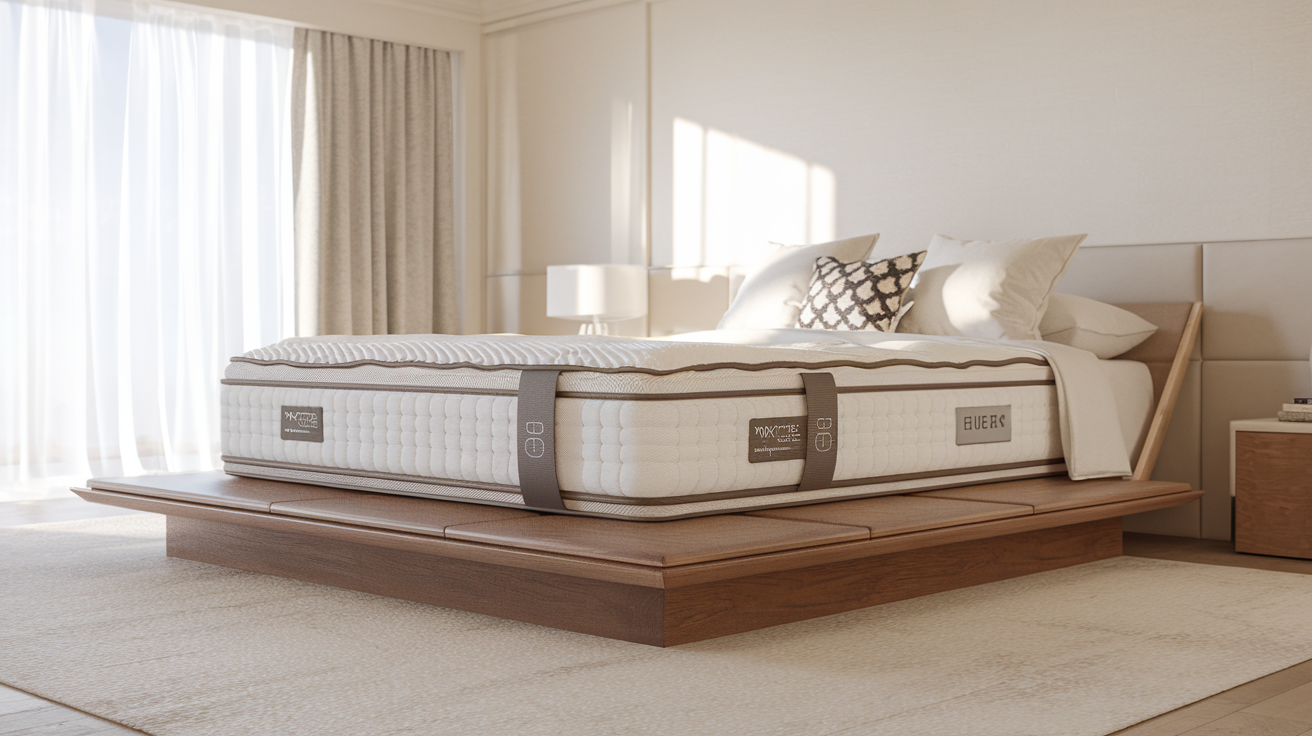
The Saatva HD is a 15.5-inch hybrid, which immediately tells you something: this is not a mattress that was slightly modified to accommodate heavier bodies. The extra height and weight (it clocks in at roughly 130 pounds for a Queen) reflect genuine structural engineering differences.
Starting from the bottom, the HD uses a base layer of high-density support foam — Saatva lists it at 2-inch, 2.0 lb/ft3 density, which is meaningfully firmer than the 1.5 lb/ft3 foam you'll find in most mid-range mattresses. Above that sits the primary support system: a layer of 1,053 individually wrapped coils for a Queen, made from tempered steel that Saatva specs at 13-gauge. For reference, the Classic uses 14.5-gauge coils. The lower the gauge number, the thicker the wire — so the HD's coils are substantially more robust.
Over the coil layer, there's a 1-inch transition layer of high-resilience foam that acts as a buffer between the spring system and the comfort layers. Then comes a 3-inch memory foam layer — Saatva calls it AirCradle foam — which has a slightly open-cell structure to mitigate heat retention. The whole thing is topped with a Euro pillow top filled with organic cotton batting and a lumbar zone of high-density foam down the center third of the mattress. The cover itself is organic cotton, soft to the touch, and noticeably well-constructed.
The total construction feels intentional rather than additive. Saatva didn't just take the Classic and beef up one layer. The gauge change, the coil count increase, the denser base — these are compounding decisions that add up to a mattress that genuinely holds its shape under sustained heavy loading.
How It Sleeps (My Experience at 285 lbs)
I'm a combination sleeper — I start on my side, migrate to my back around 3 a.m., and occasionally end up on my stomach toward morning. At 285 pounds, I'm below the nominal target range for this mattress, which actually gave me useful perspective: the HD performs well even slightly under its design weight, which suggests it won't go completely rigid under a 300-pound sleeper.
Side sleeping is where the pillow top earns its keep. The Euro top gives enough immediate cushion that hip and shoulder pressure don't become an issue, even after four or five hours on one side. The lumbar zone in the center is genuinely perceptible — I could feel the slightly firmer support region under my lower back, and it helped with the mild lower back stiffness I'd experienced on firmer mattresses. That said, the lumbar zone has a defined feel: some people love it, and if you're sensitive to sleeping on a zone transition you might feel a subtle shift when your back crosses into it.
Back sleeping is where the HD excels. The combination of the pillow top surface softness and the firm coil foundation creates what I'd describe as "supported cradling" — you sink enough to feel the mattress contouring to your spine, but you don't compress past the point of neutral alignment. After about three weeks on the HD, the low back tightness I'd been managing for years had noticeably decreased. I'm not attributing this entirely to the mattress, but the timing correlation is hard to ignore.
Stomach sleeping is the weakest scenario. At my weight, I was adequately supported, but I can see how a sleeper at 350+ pounds might find the hips sinking more than ideal in that position. If you're a dedicated stomach sleeper above 320 pounds, I'd spend time on this mattress in-store before committing.
Temperature regulation is better than I expected from a pillow top mattress. The open-cell foam and the organic cotton cover do meaningful work here. I don't sleep particularly hot, but my partner runs warm and didn't report the heat-trapping issues she experienced on our previous memory foam bed. Not a cool mattress, but not a heat trap either.
Edge Support and Motion Transfer
Edge support is one of the most overlooked specs for heavier sleepers, and it's where the Saatva HD genuinely outperforms the competition. The perimeter coils are reinforced — Saatva uses a dual-perimeter coil system where the edge rows are set at higher tension — and the result is a mattress where you can sit on the edge without the pronounced collapse you get on most hybrid or foam beds.
I tested this specifically by sitting on the edge of the mattress in the same spot every morning for two weeks. On a previous mattress, that spot developed a visible permanent depression within a month. The HD showed no measurable deformation. For heavier sleepers, this matters beyond aesthetics: if you sit on the edge to put on shoes or get in and out of bed, a mattress that collapses at the perimeter is actively inconvenient and can accelerate uneven wear.
Sleeping near the edge is also comfortable in a way that's rare. I can use the full surface of the mattress without feeling like I'm about to roll off — the edge doesn't slope away dramatically until I'm genuinely at the perimeter. That expands the functional sleeping area, which matters when you're a larger sleeper who needs more room to move.
Motion transfer is acceptable, though not exceptional. The individually wrapped coils do a reasonable job of isolating movement — I didn't wake my partner when I rolled over at 3 a.m. — but this is not a mattress that will absorb every vibration like a dense foam bed. Couples where one partner is a light sleeper and the other moves frequently at night will notice some transfer, particularly if the moving partner is heavier. It's a livable tradeoff for the support benefits, but worth knowing.
Saatva HD Mattress
Built for sleepers 300-500 lbs. 365-night trial, free White Glove delivery.
The Downsides (What I Didn't Love)
The HD is heavy. A Queen weighs approximately 130 pounds, and that is not an exaggeration. If you need to rotate this mattress — which Saatva recommends every three months for the first year — you will need two people and a plan. The White Glove delivery service sets it up for you, but subsequent repositioning is your responsibility. For solo dwellers or those without help nearby, this is a real logistical consideration.
The break-in period is longer than average. For the first three to four weeks, the mattress sleeps noticeably firmer than it will at the 60-day mark. Saatva mentions this, but the degree of stiffness in the early weeks may concern you if you're not expecting it. I nearly initiated a return around week two. By week five, the pillow top had softened appropriately and the lumbar zone felt integrated rather than intrusive. If you're testing this mattress, give it six weeks before making a final judgment.
There is only one firmness option for the HD. The Classic comes in Plush Soft, Luxury Firm, and Firm — the HD offers only one profile, which Saatva describes as "medium-firm luxury." For most heavier sleepers this will be appropriate, but it reduces customization options. If you know you need a very firm surface, you may find the HD's pillow top slightly too soft at the surface even if the underlying support is excellent.
Finally, the HD is not available in a Split King configuration. Couples who want individualized firmness zones will need to look elsewhere or piece together a different solution. Given that the target market skews toward couples where body weight differences can be significant, this feels like a meaningful gap in the product lineup.
Saatva HD vs Regular Saatva Classic
If you're on the fence about whether to get the HD or the standard Classic, the decision essentially comes down to one number: your body weight.
The Classic is an excellent mattress for sleepers up to roughly 230 pounds. Its coil system and foam layers are well-engineered for that weight range and it offers three firmness options. For lighter sleepers, the Classic will feel more plush and responsive than the HD because the support system isn't being asked to work as hard.
Above 250 pounds, the calculus shifts. The Classic's 14.5-gauge coils will compress more under sustained load, and the comfort layers — built for a lighter body — can start to feel inadequate over time. At 285 pounds, I found the Classic felt comfortable for the first few months but began showing wear patterns by month eight. The HD's 13-gauge coils and higher-density base foam are designed to resist that compression over years of use, not months.
The HD costs roughly $400-$500 more than a Classic in most sizes. Over a 10-year lifespan — which the HD is built to achieve where the Classic might need replacement at six to seven years under heavier use — that price differential becomes marginal. For anyone over 250 pounds, the HD is the better long-term investment even before factoring in the sleep quality difference.
Pricing and Value
The Saatva HD starts at approximately $1,595 for a Queen at list price, though Saatva runs promotions fairly regularly that can bring that down by $200-$400. A King runs around $2,095. These prices sit in the mid-to-upper range for the heavy sleeper mattress category — below some luxury options from brands like Aireloom, well above the budget segment.
The value proposition is strengthened considerably by what comes with the purchase. White Glove delivery — where a team brings the mattress into your home, sets it up, and removes your old mattress — is included at no additional charge. For a 130-pound mattress, this is not a trivial perk. Moving and installation services for mattresses this heavy can run $150-$250 when priced separately.
The 365-night trial is among the longest in the industry and gives you a full year to evaluate the mattress through seasonal temperature changes and break-in. Returns are free. The lifetime warranty — which covers manufacturing defects and indentations exceeding 1.5 inches — is meaningful for a product at this price point, though it's worth noting that Saatva's warranty, like most, has conditions around proper foundation support.
One note on foundations: the HD requires a sturdy base. Saatva recommends a solid platform foundation, a box spring with no more than 4-inch gaps between slats, or an adjustable base. If you have an older slatted frame with wide spacing, budget for an upgrade — putting a $1,600 mattress on an inadequate foundation is a poor investment.
Saatva HD Mattress
Built for sleepers 300-500 lbs. 365-night trial, free White Glove delivery.
FAQ
Q: What weight limit does the Saatva HD support?
A: Saatva rates the HD for sleepers between 300 and 500 pounds per sleep position. For couples, that means the combined weight limit is not a single figure — each side of the bed is independently rated. Two sleepers each under 500 pounds are within spec. The 13-gauge tempered steel coils and high-density base foam are specifically engineered to support these loads without the premature compression that affects standard mattress coil systems.
Q: Is the Saatva HD good for side sleepers who are heavy?
A: Yes, with some nuance. The Euro pillow top provides enough surface cushion to relieve hip and shoulder pressure for most side sleepers. The zoned lumbar support also helps maintain spinal alignment. The main caveat is that the HD comes in only one firmness level, which Saatva describes as medium-firm. Very heavy side sleepers — above 400 pounds — may find they want a slightly softer surface layer for adequate pressure relief. Saatva's 365-night trial makes it low-risk to test for this specific concern.
Q: How does the Saatva HD compare to the WinkBed Plus for heavy sleepers?
A: Both are legitimate options in this category. The WinkBed Plus tends to feel firmer across the surface and suits sleepers who want a more traditional innerspring feel with less pillow top cushion. The Saatva HD has a more pronounced luxury feel at the surface while maintaining firm underlying support. In terms of construction, both use reinforced coil systems — WinkBed uses a zoned Tencel Euro top over their Plus coil system, while Saatva uses the organic cotton pillow top over their heavier-gauge springs. I prefer the HD's edge support and the included White Glove delivery, but the WinkBed Plus is a serious competitor worth testing if possible.
Q: Does the Saatva HD sleep hot?
A: Less than I expected. The organic cotton cover and open-cell AirCradle foam do a reasonable job of temperature regulation. The coil layer also allows for airflow that all-foam mattresses lack. It is not the coolest mattress available — the pillow top layer does retain some heat — but in four months of testing I did not experience the heat retention issues I've had with dense foam mattresses. Hot sleepers should be aware of this and may want to pair the HD with a cooling mattress protector.
Q: Can I use the Saatva HD with an adjustable base?
A: Yes. Saatva explicitly lists adjustable bases as a compatible foundation for the HD. The mattress is flexible enough to work with head and foot articulation. This is not a given for all hybrid mattresses — thicker, stiffer constructions sometimes resist bending — so it's a useful option for sleepers who want zero-gravity or elevated head positions for health reasons. Saatva sells their own adjustable base, but third-party options compatible with the mattress dimensions will also work.
Final Verdict
The Saatva HD is the most thoughtfully constructed mattress I've slept on as a heavier sleeper, and that's not faint praise. The industry standard for "plus-size" mattresses has long been to take a regular mattress, add a firm foam layer, and charge a premium. The HD is not that. The coil gauge change, the compounding density decisions across every layer, the reinforced edge system — these reflect genuine engineering attention rather than marketing repositioning.
The single firmness option and the lack of Split King availability are real limitations, and the break-in period requires patience. For dedicated stomach sleepers above 350 pounds, I'd encourage an in-store test before purchasing. But for back and side sleepers in the 280-420 pound range who want a luxury hybrid feel with actual durability, the HD earns a clear recommendation. The combination of build quality, White Glove delivery, the 365-night trial, and the lifetime warranty creates a value case that holds up even at the $1,595 starting price.
After four months, my back feels better than it has in years, and the mattress looks exactly as it did on day one. That's not common in my experience. The Saatva HD is the first mattress in a long time that I expect to still be sleeping on in a decade.
Related Reviews
- Saatva Mattress Review — Compare all Saatva models
- Loom & Leaf Review — Saatva's memory foam alternative
- Best Mattress for Back Pain — HD is our top pick for heavier sleepers