
 by
by For most couples who want adjustable dual-chamber air without the smart-tech ecosystem, the Saatva Solaire wins: 50 firmness levels per side, organic cotton and natural Talalay latex comfort layers, lifetime warranty, a 365-night trial, and free white-glove delivery. Sleep Number i10 is the right call if you specifically want SleepIQ sleep tracking, ResponsiveAir auto-adjustment, or FlexFit base integration; otherwise the Solaire delivers the same core dual-chamber concept with better consumer protections at a lower 10-year cost.
Saatva Solaire
9.3/10
- 50 distinct firmness levels per side via wired remote, no app or WiFi required
- Natural Talalay latex + graphite-infused memory foam comfort layers, 10/10 NapLab cooling score
- 365-night trial, lifetime "Friends for Life" warranty, free white-glove delivery and haul-away
- Saatva is privately held with stable financials; no going-concern risk over a 10-year ownership window
- No sleep tracking, no auto-adjustment, no app integration
- Center seam noticeable when partners use very different firmness settings
- $99 return fee if you decide to return during the trial
The Solaire is the best choice for couples who want independent per-side firmness control and premium materials without app dependency, subscription risk, or smart-bed cloud outage exposure. NapLab's 9.26/10 score and 10/10 cooling rating in February 2026 testing back it up.
Who should choose which
Both beds share the same core concept: two independent air chambers that let each partner dial in their own firmness. The difference is what surrounds that core. Sleep Number wraps it in SleepIQ tracking, ResponsiveAir auto-adjustment, DualTemp climate control, and FlexFit base integration. The Saatva Solaire skips all of that and focuses on organic materials, a superior warranty structure, and simpler operation.
That division maps cleanly onto two buyer types. If you want quantified sleep data, automatic nightly firmness correction, or bidirectional temperature regulation, Sleep Number is the right platform. If you want dual-chamber adjustability with premium natural materials, outstanding consumer protections, and zero app dependency, the Solaire delivers that more completely and at a lower 10-year total cost.
Direct spec comparison: Solaire vs Sleep Number i10 (queen, 2026)
| Feature | Saatva Solaire | Sleep Number i10 |
|---|---|---|
| Queen MSRP | $4,599 | $4,799–$5,799 |
| Height | 13" | 13–14" |
| Firmness levels (per side) | 50 | 20 (1–100 in steps of 5) |
| Adjustment method | Wired remote, no app required | App + ResponsiveAir auto |
| Sleep tracking | None | SleepIQ (free, PSG-validated) |
| WiFi dependency | None | Required for full features |
| Comfort layers | Organic cotton, 1" Talalay latex, 1" graphite memory foam | Pillow-top foam comfort |
| Trial period | 365 nights | 100 nights |
| Return fee | $99 | $199–$249 |
| Warranty | Lifetime "Friends for Life" | 15-year limited (prorated) |
| Full-coverage years | 5 years | 1–2 years |
| White-glove delivery | Free | $249 |
| Haul-away | Free | $49 |
| Made in | USA | USA |
What's inside the Solaire
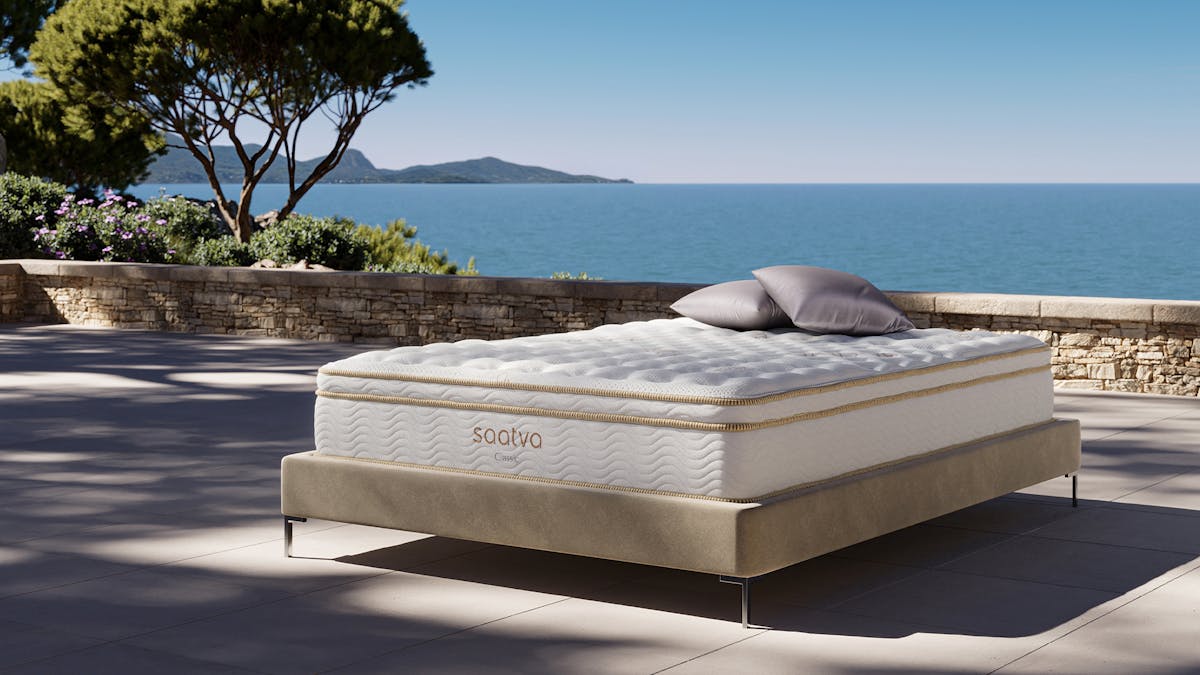
The Solaire is a 13-inch dual air-chamber mattress. Construction from the top down: an organic cotton cover with antimicrobial treatment, hand-tufted to prevent layer shifting; 1 inch of natural Talalay latex for responsive surface contour without heat retention; 1 inch of graphite-infused memory foam for pressure relief at shoulder and hip contact zones; two independent vulcanized rubber air chambers adjustable from 0 to 50 firmness levels per side via wired remote; and a high-density support foam base that encapsulates the chambers and adds edge support.
The 50-level-per-side granularity is worth noting. Sleep Number's 0–100 scale operates in increments of 5, giving 20 effective settings. The Solaire's pressure-range mapping delivers 50 distinct levels per side. Most users settle on a preferred number within a few weeks and rarely re-adjust, so the practical difference may be minimal, but the Solaire's finer range is a genuine spec advantage.
NapLab rated the Solaire 9.26/10 overall in their February 2026 data-driven review, calling it "the highest-rated adjustable mattress to date," and gave it 10/10 for cooling, the highest score for any adjustable mattress in their database. CNET selected it as "best for couples." Mattress Clarity was more measured at 3.6/5, citing motion isolation and responsiveness as limitations for combination sleepers who change positions frequently.
The warranty math that actually matters
The biggest financial difference between these two beds is in the warranty fine print. Saatva's lifetime "Friends for Life" warranty is among the most consumer-favorable structures in the mattress industry. Sleep Number's 15-year limited warranty becomes largely the customer's expense after year 2.
| Year range | Saatva Solaire customer cost | Sleep Number i10 customer cost |
|---|---|---|
| Years 1–5 | $0 (full repair or replacement) | $0 year 1; ~30% year 2; rising each year after |
| Years 6–10 | 50% of parts; Saatva covers 100% labor | ~40–75% of replacement cost |
| Years 11–15 | 75% of parts; Saatva covers 100% labor | Up to 85% of replacement cost |
| Years 16+ | 85–90% of parts + 100% labor | Not covered |
Saatva also offers a "Fairness Replacement Option" across the lifetime warranty period: a complete replacement mattress at 50% of original price in years 6–10, or 75% in years 11–25, plus a $149–$199 shipping fee. That is unusual in this category and meaningfully reduces the Solaire's effective price-per-year over a long ownership window.
BBB complaints documented in 2025–2026 show Sleep Number customers being charged $400 or more in prorated fees as early as 365 days after purchase for pump failures. Sleep Number has partnered with Extend to offer a "Sleep Easy" extended protection plan for purchases after March 22, 2026, covering years 3–5, sold separately at additional cost.
Where Sleep Number genuinely wins
An honest comparison requires naming Sleep Number's real advantages. Three things Sleep Number does that the Solaire does not:
SleepIQ tracking, peer-reviewed and validated against polysomnography in a 45-participant study published in Sensors (2022), free with every 360 Smart Bed, no subscription required. If quantified sleep data is part of why you are buying, no Saatva product offers this. Sleep Number's accumulated dataset reportedly exceeds 14 billion hours of sleep data.
ResponsiveAir auto-adjustment, in-mattress sensors monitor your position and re-pressurize the air chambers continuously through the night to maintain spinal alignment. The Solaire requires manual adjustment via remote. For sleepers who change positions frequently or who don't want to manage a firmness setting, the automation is a real feature, not marketing.
FlexFit base integration, Sleep Number's FlexFit 2 and FlexFit 3 adjustable bases offer one-touch zero-gravity, head elevation, anti-snore detection, and underbed lighting, all coordinated through the Sleep Number app as a single system. Saatva offers adjustable bases, but they don't integrate with a proprietary sleep-tracking platform.
Climate360 active temperature control, for sleepers who need bidirectional regulation (warming as well as cooling), the Climate360 at $9,999 has no Saatva equivalent. The Solaire scores 10/10 for passive cooling, but cannot warm a cold sleeper during the night.
If any of these features matter significantly, the choice tips toward Sleep Number despite the price, warranty, and trial differences.
Hot sleepers: why the Solaire's cooling score matters
Roughly 43% of American adults report sleeping too hot at least occasionally. The Solaire's surface layers were engineered specifically for heat dissipation. Organic cotton breathes better than synthetic ticking. The 1-inch natural Talalay latex uses an open-cell structure with pinhole perforations created during the vacuum-mold process, producing air channels that dissipate body heat. The graphite-infused memory foam below it conducts heat away from contact points laterally rather than retaining it locally. The cumulative result is NapLab's 10/10 cooling score and average surface temperatures roughly 1°F below ambient under standardized testing.
The Sleep Number i10's pillow-top layer retains heat. Yawnder, Mattress Nerd, and Sleep Foundation all flag it in independent reviews. Sleep Number's answer for hot sleepers is to upgrade to the ClimateCool at $5,748 or the Climate360 at $9,999. For hot sleepers who don't want to spend Climate360 money, the Solaire delivers comparable passive cooling at $4,599 without active mechanisms or the energy draw and failure modes of mechanical cooling equipment.
Couples performance: the real-world test
The Solaire's strongest customer base is couples with significantly different firmness preferences. Partner A can sleep at a 25 (soft) while partner B sleeps at a 65 (firm) on the same bed, without either compromising. CNET's couples-focused review made the Solaire its top pick for mismatched-preference partners, citing the 50-level adjustment range and the natural-material comfort layers that don't trap heat between bodies.
The trade-off is the center seam. When two chambers are set at very different firmness levels, the area where they meet can develop a noticeable depression. For partners who frequently stretch across the center or who prioritize a unified feel, this matters. Saatva ships a center-mattress topper that reduces the seam but does not eliminate it. Sleep Number Split King users report the same issue. NapLab confirmed that motion transfer between the two halves is acceptable but not exceptional, a partner getting in or out of bed is felt mildly on the other side, though less than on a unified spring mattress.
Combination sleepers who change positions frequently are the group that does least well with air-chamber beds generally. Mattress Clarity noted that the Solaire's air chambers don't push back as quickly as a spring mattress when you shift positions. Solo combination sleepers may find the Saatva Classic (Queen ~$2,229) or Saatva Rx (Queen ~$3,499) more responsive for their sleep style.
10-year total cost of ownership (queen)
| Cost item | Saatva Solaire | Sleep Number i10 | i10 + FlexFit 3 |
|---|---|---|---|
| Initial mattress | $4,599 | $5,399 | $5,399 |
| Base | $0 (optional add-on) | included | $3,799 |
| White-glove delivery | $0 | $249 | $249 |
| Haul-away | $0 | $49 | $49 |
| Likely repair (years 6–8) | ~$0–$150 | $400–$600 | $400–$600 |
| 10-year total | ~$4,599–$4,749 | ~$6,097–$6,297 | ~$9,896–$10,096 |
For a couple who values the dual-chamber design but not the smart-tech layer, the Solaire is about 25% cheaper over 10 years than the bare Sleep Number i10 and roughly 50% cheaper than the i10 plus FlexFit 3. Stretch the analysis to 15 years and the gap widens further because the Solaire's lifetime warranty continues to provide coverage while Sleep Number's prorated warranty is effectively gone.
Manufacturer stability: a legitimate buying criterion
For a $4,000-plus mattress you expect to own for 10 to 15 years, the financial health of the manufacturer is a real factor. Saatva is privately held, debt-light, and growing through direct-to-consumer channels. Sleep Number posted a $132 million loss in FY2025, restructured debt with lenders, closed approximately 9% of its retail stores, and saw its public market capitalization fall to around $54 million in mid-2026. If Sleep Number were to face further financial difficulty, the lifetime warranty and service infrastructure backing the i10 become less certain. This is not a prediction, but it is a consideration that most mattress reviews omit entirely.
The Upper-Flex option: adjustable base without Sleep Number pricing
One Solaire configuration that rarely gets adequate attention is the Upper-Flex setup. At Queen $5,299 versus the standard $4,599, each partner can independently raise the head of their side for reading, TV, or anti-snore positioning while sharing the foot section as a continuous surface. Combined with Saatva's Adjustable Base Plus at $1,499 or the dual-flex base at $2,498, this delivers functionality close to what Sleep Number offers with its Split King plus FlexFit 3 configuration, at a meaningfully lower total price. Saatva's package totals roughly $7,797 versus $9,496–$9,896 for the equivalent Sleep Number bundle, with the trade-off being the absence of app-based coordination and sleep tracking.
Saatva Solaire
9.3/10
Dual-chamber adjustable air, 50 firmness levels per side, organic cotton and Talalay latex comfort layers, 365-night trial, lifetime warranty, free white-glove delivery. The strongest consumer protections in the adjustable-air category, at a 25% lower 10-year cost than the equivalent Sleep Number configuration.
Adjustable air without the ecosystem — that was the whole ask
Strip this matchup to what most couples actually came for — two chambers, each side dialed to its own firmness — and the comparison above answered it: the Solaire does that with natural Talalay and organic cotton at the surface, a lifetime warranty underneath, and no app, subscription or smart-home ecosystem in between. Sleep Number’s tracking and auto-adjustment remain the honest reasons to pay its way; if none of them made you nod, the tiebreakers all sit on one side.
The Saatva Solaire also keeps the house advantages this page counted: the year-long trial, white-glove delivery and the warranty math that doesn’t expire when the bed ages. Check the Solaire’s current price per size on the official page before pricing any i-series.
Frequently asked questions
Is Saatva Solaire better than Sleep Number?
For most couples, yes: the Solaire has better consumer protections (365-night trial versus 100 nights, lifetime warranty versus 15-year prorated), superior natural materials, free white-glove delivery, and a lower 10-year total cost. Sleep Number is better if you specifically want SleepIQ sleep tracking, ResponsiveAir auto-adjustment, or FlexFit base integration as a single coordinated system.
How many firmness settings does the Saatva Solaire have?
The Solaire offers 50 distinct firmness levels per side, set manually via a wired remote. Sleep Number's 0–100 scale operates in increments of 5, delivering 20 effective settings. Both are more than most couples will use, but the Solaire's finer range means smaller adjustments between steps.
Does the Saatva Solaire require WiFi or an app?
No. The Solaire uses a wired remote with no WiFi setup, no app installation, no firmware updates, and no cloud connectivity. Adjustment is manual and immediate. This is by design, Saatva built the Solaire for buyers who want the dual-chamber concept without the smart-tech dependency.
Can I get the Saatva Solaire on sale?
Saatva runs continuous promotional pricing rather than fixed seasonal events. The Solaire Queen typically sits around $4,599 with deeper discounts during Memorial Day, right now, Presidents' Day, and Black Friday windows. The base price tends to be about 10% off MSRP most months.
What is the center seam issue with the Saatva Solaire?
When two air chambers are set at very different firmness levels, the area between them can develop a noticeable depression. Saatva ships a center-mattress topper that reduces the seam. Couples who frequently cuddle or stretch across the center will notice it. Couples who stay on their own side generally find it a non-issue. Sleep Number Split King users report the same trade-off.
What is Sleep Number's going-concern financial situation?
Sleep Number posted a $132 million loss in FY2025, restructured debt, closed roughly 9% of its retail stores, and had a public market capitalization of approximately $54 million in mid-2026. This does not mean Sleep Number will fail, but for a mattress purchase you expect to own 10 to 15 years, the relative financial stability of the manufacturer is a legitimate factor, particularly when the warranty and service infrastructure depend on the company remaining operational.