
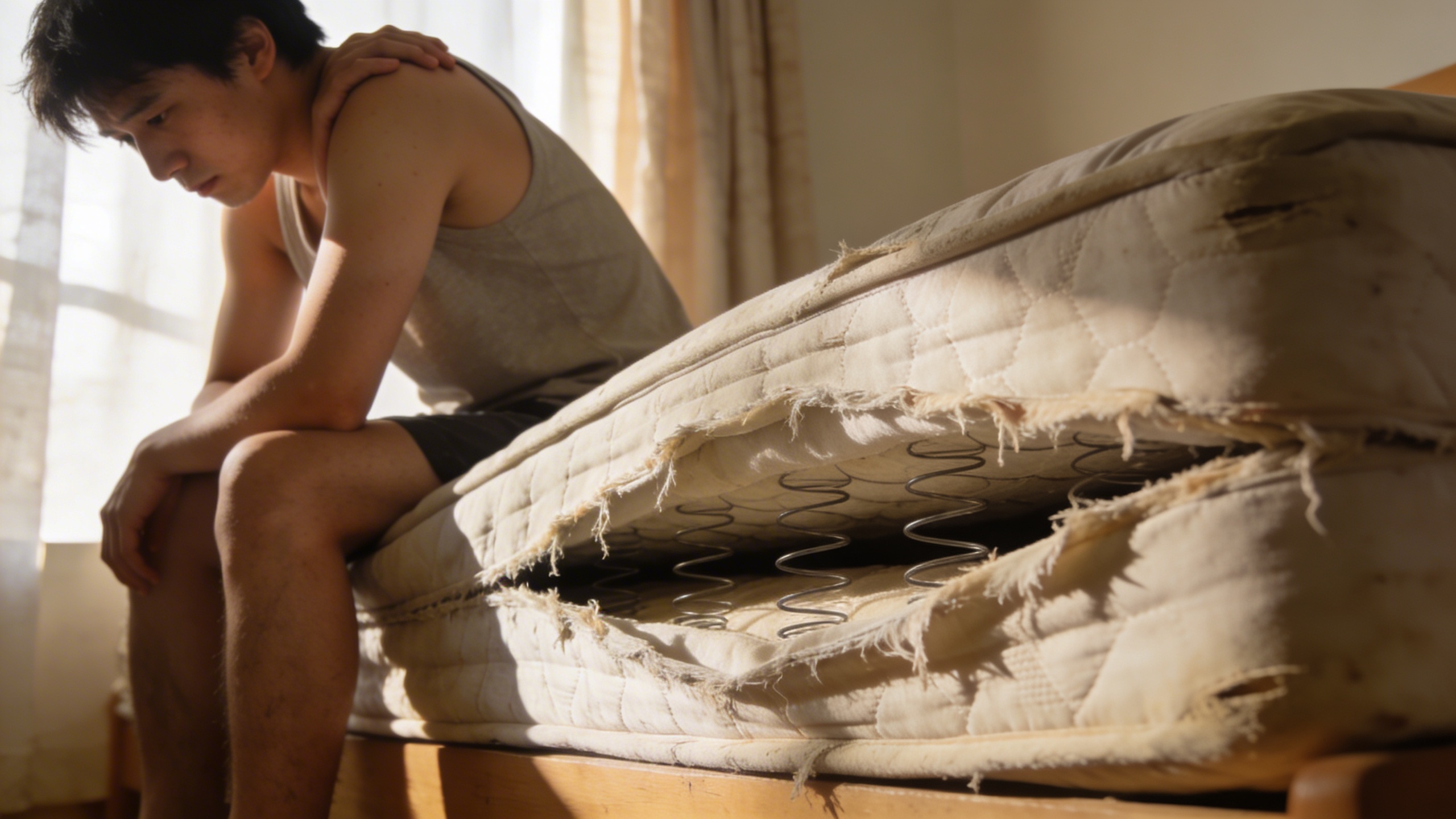
 by
by Our #1 Recommended Mattress
Saatva Classic. From $1,095
365-night trial | Lifetime warranty | Free white-glove delivery
We earn a commission if you make a purchase, at no extra cost to you. Full disclosure.
11 Signs Your Mattress Is Ruining Your Sleep
After testing mattresses professionally for over twelve years, I have developed a simple rule: your mattress should be working for you, not against you. When I climb into bed at night, I want my body to immediately recognize that this is a sanctuary, a place where genuine rest begins. If you are reading this article, something in your sleep setup is probably not delivering that experience anymore.
I have spoken with hundreds of readers who describe the same pattern. They wake up feeling worse than when they went to bed. They blame their schedules, their stress levels, the late-night screen time. But more often than not, the culprit sits right beneath their sheets, quietly undermining their health night after night.
Your mattress has a lifespan. It is not designed to last forever, no matter how much you paid for it or how attached you have grown. Over time, the materials break down, support structures compress, and the surface that once cradled your body properly begins to create pressure points, temperature retention, and disrupted sleep.
I am going to walk you through eleven clear signs that your mattress is actively ruining your sleep. I have seen every one of these issues in real mattresses, in real bedrooms, affecting real people. Some of these signs might surprise you. Others will feel uncomfortably familiar. By the end, you will know exactly where you stand and what to do about it.
Sign 1: You Wake Up with Back or Neck Pain That Fades During the Day
You go to bed feeling fine. You wake up feeling like you were folded wrong and left overnight. Your lower back screams at you for the first hour after rising. Your neck feels twisted, locked, or stiff. But here is the telling part: the pain gradually diminishes as you move through your morning routine.
This is one of the most common complaints I hear, and it almost always points to inadequate support from your mattress. When a mattress loses its ability to keep your spine properly aligned, certain muscles work overtime to compensate. You are not just sleeping on an uncomfortable surface. You are actually engaging in a low-grade physical struggle for eight hours straight.
Back and neck pain that disappears by midday is a red flag because it suggests your body is resilient enough to recover when given proper support during waking hours. But the damage accumulates. I have watched this pattern progress in readers who ignored it for too long, eventually developing chronic pain that no longer fades by noon.
Your mattress should cradle your body in a neutral position, supporting the natural curves of your spine regardless of whether you sleep on your back, side, or stomach. If you wake up in pain and the pain fades with movement, your mattress is likely failing at its most basic job.
If you want to understand what proper spinal alignment actually feels like, the Saatva Classic uses a dual coil system specifically designed to maintain lumbar support throughout the night.
Sign 2: Visible Sagging or Body Impressions Deeper Than 1.5 Inches
I want you to do a simple test right now. Take a ruler and measure any visible indentations where you sleep. If the depression exceeds one and a half inches, your mattress has passed the point of acceptable wear. That indentation represents material compression that will not recover.
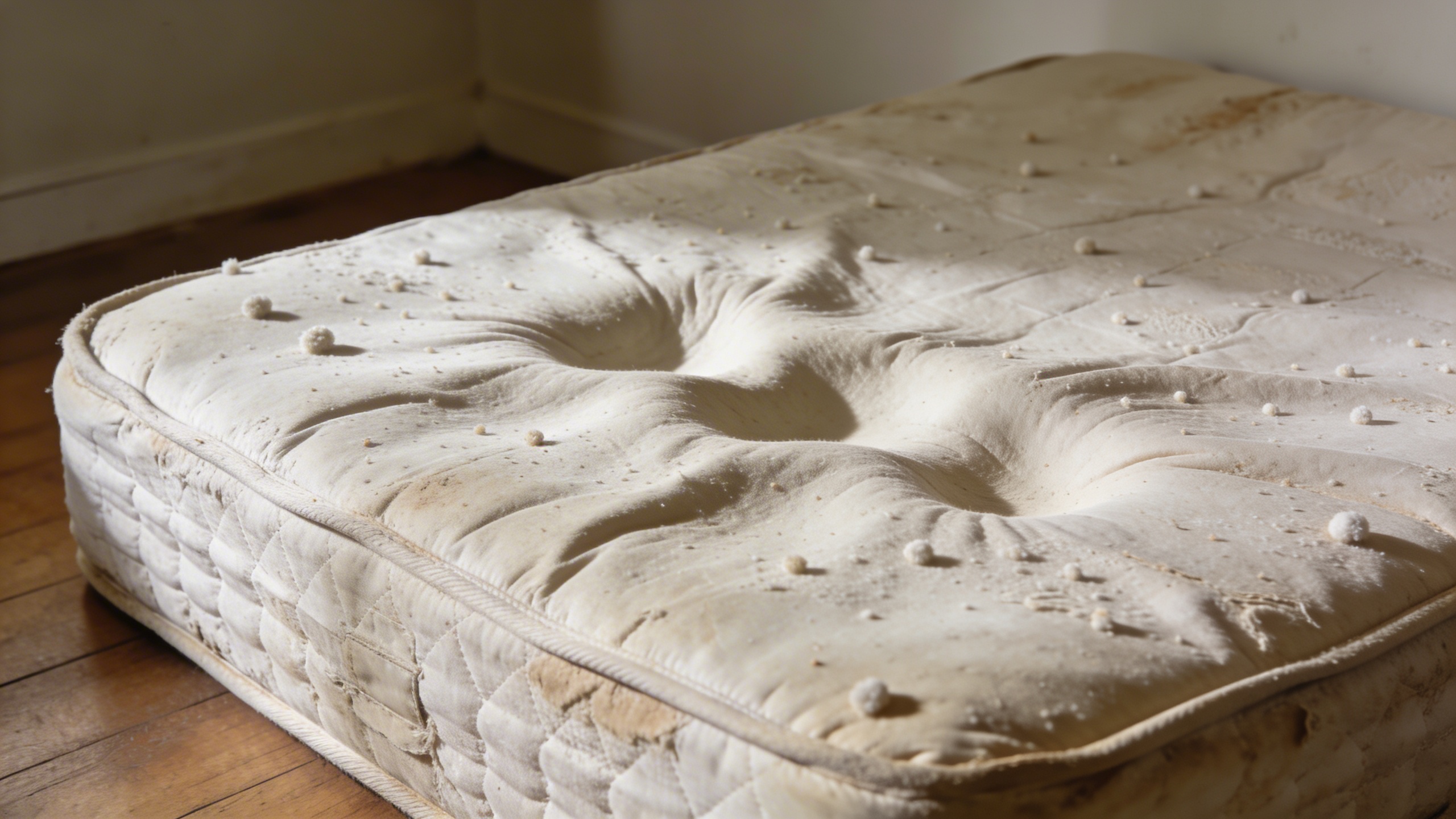
Mattress Sagging Signs
What I find most troubling about this sign is that many readers have normalized it. They tell me, "Oh, that is just where I sleep." That is exactly the problem. The area where you sleep should not be a valley. It should be a consistent, supportive surface that distributes your weight evenly.
Visible sagging typically happens fastest in the center third of the mattress, where hip and shoulder pressure concentrate night after night. If you share a bed, you might notice two distinct troughs with a relatively firm ridge in between. That ridge will not last. The surrounding foam is also breaking down, just more slowly.
When sagging exceeds two inches, you are no longer sleeping on a mattress. You are sleeping in a cradle that was never designed to cradle properly. Your body sinks into positions that strain muscles and joints. No amount of hope or mattress rotation will reverse this damage. The materials have been permanently compressed.
Sign 3: You Sleep Better at Hotels Than at Home
My readers sometimes describe this as a guilty pleasure. They travel for work or vacation and experience the best sleep of their lives on an unfamiliar bed. They return home, climb into their own mattress, and wonder what went wrong.
What is happening is this. Hotel mattresses, even budget ones, are designed with commercial durability in mind. They use higher-gauge coils, denser foam layers, and stronger support cores than most residential mattresses in the same price range. Hotels need their mattresses to perform consistently for hundreds of different bodies per year. That engineering shows.
When you sleep better in a hotel, your body is telling you something important. It is saying that you know the difference between adequate support and excellent support. You know what restorative sleep feels like. And you are not getting it at home.
Something to keep in mind is that this comparison only holds if you sleep well in multiple different hotels. If you sleep poorly everywhere except one particular hotel, there might be a noise or environmental factor at play. But when the pattern is consistent across different hotels, different cities, different mattress brands, you have a clear indication that your home mattress is substandard.
Hotel-quality sleep is absolutely achievable at home. The Saatva HD was specifically engineered for heavier individuals, featuring reinforced perimeter support that prevents edge sag and maintains consistent comfort across the entire sleep surface. If you have been yearning for that hotel mattress feel every single night, your current setup is simply not going to deliver it.
Sign 4: You Toss and Turn More Than You Used To
Sleep studies show that healthy adults shift position an average of forty times per night. That is normal. What is not normal is when you suddenly find yourself shifting constantly, unable to find a comfortable position, waking yourself up with the effort of staying still.
Increased restlessness during sleep often signals that your pressure points are not being properly cushioned. When a particular area of your body bears too much weight against a firm surface, nerve endings send discomfort signals to your brain. Your brain responds by prompting you to move. The cycle repeats all night long.
I have tested this theory with readers by having them switch to a properly zoned mattress for just two weeks. The difference in nighttime movement is often dramatic. They report falling asleep faster, staying still longer, and waking fewer times in the night.
Modern mattress technology offers zoned support systems that place softer material under shoulders and hips while maintaining firmer support beneath the waist and legs. This zoning reduces the need for positional adjustments by addressing pressure before it becomes discomfort.
Sign 5: Your Mattress Is Over 7 Years Old
Age matters more than most people realize. I have had readers tell me they have had the same mattress for fifteen years and that it still feels fine. When I ask follow-up questions, they describe back pain, poor sleep quality, and allergy symptoms that they have simply accepted as normal aging.
Most mattress materials begin meaningful degradation between seven and ten years. Innerspring coils can rust and lose tension. Foam loses resilience and begins to pack down. The quilted top layer breaks down, losing its original loft and comfort. Even natural materials like latex, which are more durable than foam, eventually oxidize and firm up beyond their optimal range.
After a decade, even the best mattresses lose approximately thirty percent of their original support and comfort characteristics. You might not notice the gradual decline because you adapt to it day by day. But when you compare your current mattress to how it felt when new, the difference is usually substantial.
The seven-year mark is a general guideline. If your mattress showed any of the other signs on this list before that age, treat the earlier sign as the relevant threshold. And if you are approaching ten years, the decision to replace should be straightforward regardless of apparent condition.
For a detailed breakdown of mattress lifespan by type, check out the Saatva Classic specifications and warranty information to understand what proper construction durability looks like.
Sign 6: You Wake Up with Allergies or Stuffy Nose
You blow your nose every morning. Your eyes are puffy. Your sinuses feel congested even though you are not sick. If this pattern repeats daily and disappears on weekends when you sleep elsewhere, your mattress deserves serious suspicion.
Dust mites are the primary culprit. These microscopic creatures thrive in warm, humid environments with plenty of dead skin cells to feed on. Your mattress is essentially a luxury resort for dust mites. They live in the top layers, breed rapidly, and their fecal matter and body fragments become airborne with normal movement, triggering allergic reactions.
Even if you wash your bedding weekly, the mites inside the mattress continue multiplying. Standard vacuuming does not reach deep enough. Encasements can help but only if used from the beginning of the mattress life. Once an infestation becomes established, the only real solution is replacement.
The time course matters here. If you developed these morning allergy symptoms after keeping the same mattress for several years, the correlation is strong. I have had many readers who spent hundreds on allergy medications and air purifiers, only to solve the problem completely by replacing their mattress.
For allergy sufferers specifically, the Saatva Loom and Leaf uses CertiPUR-US certified foam with naturally antimicrobial properties that resist dust mite colonization better than conventional mattress materials.
Sign 7: Your Mattress Creaks or Makes Noise
Your mattress should be nearly silent. Any creaking, squeaking, or groaning indicates structural problems that affect more than just the sound.
In innerspring mattresses, noise typically comes from coils that have lost their temper, developed rust, or shifted out of position. The individually pocketed coils in quality mattresses should not make noise even after years of use. When they do, the coil structure has been compromised.
Noise complaints are also common with mattresses that use lower-grade foam over coil systems. As the foam breaks down, it provides less cushioning between the coils and the sleep surface. The coils themselves become more exposed to direct pressure, which creates the movement that produces sound.
Something to keep in mind is that some noise is acceptable in brand-new mattresses during the break-in period. But persistent squeaking after three months indicates a manufacturing defect or design flaw that will only worsen. Do not let anyone tell you this is normal.
Hybrid mattresses, which combine foam layers with coil systems, tend to be quieter than traditional innersprings because the foam provides better isolation. The Saatva HD uses high-tensile steel coils that maintain their structure and silence far longer than standard innerspring alternatives.
Sign 8: You Feel Your Partner Moving All Night
Motion transfer is one of the most underrated mattress characteristics until you share a bed with someone who moves frequently. You feel every turn, every adjustment, every trip to the bathroom. Even small movements can jolt you awake if your mattress transmits motion poorly.
Poor motion isolation comes from two sources. The first is an inadequate comfort layer that does not absorb movement. The second is a coil system that transmits vibrations across the entire surface rather than containing them locally.
Readers in this situation often describe feeling like they are sleeping with someone who has restless legs syndrome, even when their partner sleeps perfectly still. The mattress is creating a problem that does not exist. Your partner is not disturbing you as much as your mattress is broadcasting every movement directly to your side of the bed.
Memory foam and latex excel at motion isolation because they absorb energy rather than transmitting it. Pocketed coils also help by allowing individual springs to respond independently rather than as a connected unit.
Sleep Number beds are often recommended for motion transfer problems, but I have found that the Saatva Loom and Leaf with its five-layer memory foam construction isolates motion more effectively than most airbed systems, without the mechanical complexity and potential failure points.
Sign 9: You Sleep Hot Even Though You Never Used To
Temperature regulation during sleep is a physiological process. Your body needs to shed heat to initiate and maintain deep sleep cycles. When your mattress traps heat instead of allowing it to dissipate, you fight against your own biology every single night.
The most common cause of increased heat retention is foam degradation. Traditional memory foam uses heat to soften and conform to your body. As it ages, this thermal-reactive property becomes exaggerated. The foam gets trap-happy with your body heat, creating a microclimate that prevents proper thermoregulation.
I have also seen this problem develop in mattresses that were fine initially but were placed on solid foundations instead of slatted bases. Without airflow beneath the mattress, heat builds up from below as well as above. Your body becomes sandwiched between two heat sources.
Newer mattress technologies address this directly. Gel-infused foams, phase-change materials, and open-cell structures all work to move heat away from your body. If you slept cool on your current mattress for years and now wake up drenched, the material breakdown is almost certainly the cause.
For readers specifically struggling with heat, the Saatva Loom and Leaf includes cooling gel memory foam with an breathable cotton cover that actively promotes airflow and heat dissipation. You can read more about cooling mattress technology in my complete guide to cooling mattresses.
Sign 10: You Wake Up Tired Despite 7-8 Hours
This is the most insidious sign because it is invisible. You did everything right. You slept the recommended duration. You did not look at screens before bed. You even avoided coffee after 2 PM. And yet, you wake up feeling like you ran a marathon instead of resting for eight hours.
Sleep quality matters as much as sleep quantity, and mattress degradation directly affects both. When your mattress fails to support proper sleep stages, you spend more time in light sleep and less time in the restorative deep sleep and REM phases that leave you feeling genuinely refreshed.
Pressure point discomfort, temperature fluctuations, and partner disturbances all fragment sleep architecture. You might technically sleep for eight hours while spending only three hours in genuinely restorative sleep stages. The result is a sleep debt that compounds day after day.
Many readers describe this as "sleep inertia," that heavy, foggy feeling that lingers for an hour or more after waking. They rely on caffeine to function until their brain finally kicks into gear. This is not a personality problem. It is a symptom of insufficient deep sleep.
The good news is that upgrading to a properly supportive mattress often produces dramatic improvements within the first week. Readers who felt chronically exhausted frequently report that their energy returns to levels they had forgotten were possible. Your mattress is not just about comfort. It is about whether your sleep actually works.
Sign 11: Lumps or Uneven Surfaces
Run your hand across your mattress surface right now. Do you feel raised areas, lumpy sections, or general unevenness? If the answer is yes, your mattress has structural problems that no amount of flipping or rotating will fix.
Lumps develop when padding layers shift, bunch up, or break apart. This typically happens first in the comfort layer, where the softest materials are most vulnerable to compression and movement. Once the padding becomes displaced, the surface feels bumpy and inconsistent.
What makes lumpiness particularly frustrating is that it affects different sleeping positions differently. Side sleepers feel lumps as sudden pressure points under their hips and shoulders. Back sleepers experience them as uncomfortable protrusions against their lumbar region. Stomach sleepers find that lumps push their spine into unnatural curves.
You might also notice that your fitted sheets no longer fit properly. If you find yourself wrestling with sheets that will not stretch smoothly across the surface, the mattress itself has changed shape. Sheets conform to what is underneath. If the surface is uneven, your sheets will never look or feel right.
When your mattress surface has lumps and uneven areas, the Saatva Classic features hand-tufted construction that prevents internal shifting and maintains consistent loft throughout the entire sleep surface, year after year.
Quick Fixes vs When to Replace
Before you head straight to the showroom or start browsing online, you should understand your options. Not every mattress problem requires full replacement. And not every temporary solution will serve you well for very long.
When a Mattress Topper Can Help
If your mattress has good underlying support but the comfort layer has worn out, a quality topper can extend its life by one to three years. I recommend this approach only if your mattress passes the following tests. The sagging is minimal, less than one inch. The coils or support core still feel solid when you press on them directly. Your body impressions are shallow. And the mattress itself is younger than seven years.
For back pain specifically, I have compiled a detailed list of the best mattress toppers for back pain relief that includes thickness recommendations by sleep position and body type.
A good latex or high-density memory foam topper costs between one hundred and three hundred dollars. That is a reasonable investment if it genuinely extends your mattress life. But I have seen readers spend money on toppers for mattresses that were already too far gone, ending up with an expensive band-aid that never really solved their problems.
When Replacement Is the Only Real Answer
Deep sagging, visible lumps, persistent noise, and allergy symptoms all point toward replacement. If you have owned your mattress for more than ten years, no topper in the world will restore what time has taken. If you wake up in pain every morning, the problem is structural and cannot be cushioned away.
I know that buying a new mattress is not a small decision. It is an investment in your health, your energy levels, and your long-term wellbeing. But consider the math. A two-thousand-dollar mattress that lasts twelve years costs less than seventeen dollars per month. If your current mattress is giving you daily back pain, poor sleep, and allergy symptoms, the cost of suffering is far higher than the cost of replacement.
For specific guidance on whether your mattress has reached the end of its useful life, see my complete guide to when you should replace your mattress in 2026, which includes decision trees for different mattress types and age ranges.
If It Is Time to Replace: Our Top 3 Picks
After testing hundreds of mattresses over the years, I have narrowed my recommendations down to three Saatva models that cover most sleep needs. These are the mattresses I recommend to friends and family, and the ones I would buy for my own home without hesitation.
Saatva Classic
The Saatva Classic is the flagship model and it has earned that status. It uses a dual coil system with a thirteen-gauge support layer and individually wrapped upper coils that respond to your body contours independently. The euro pillow top provides immediate pressure relief while the lumbar zone engineering maintains proper spinal alignment throughout the night.
What I appreciate most about this mattress is its durability. The coil construction resists sagging better than all-foam alternatives, and the Saatva quality control means you are getting materials that meet specifications consistently. Many readers who upgrade from older innerspring mattresses report that the Saatva Classic feels like a vastly superior version of what they remember good mattresses being.
The Saatva Classic comes in three firmness levels. Plush Soft suits side sleepers under one hundred thirty pounds. Luxury Firm is the most popular option and works well for most sleepers in most positions. Firm provides the solid surface that back and stomach sleepers over one hundred thirty pounds typically prefer.
Starting price is one thousand four hundred twenty-five dollars for the Queen size. The warranty covers fifteen years, and the return policy allows a full refund within one year. Visit Saatva to explore Saatva Classic pricing and customization options.
Saatva HD
The Saatva HD was designed specifically for heavier individuals and those who prefer a firmer sleeping surface. Where the Classic uses standard-gauge coils throughout, the HD incorporates heavier-gauge steel in the support core to prevent the premature sagging that heavier bodies often experience on standard mattresses.
The comfort layer combines supportive memory foam with a breathable Talalay latex layer that provides pressure relief without the heat retention common in traditional memory foam. The euro pillow top adds a luxury feel without compromising the firm support that larger body types typically need for proper spinal alignment.
Edge support is exceptional. Unlike many mattresses that compress noticeably when you sit or sleep near the edge, the Saatva HD maintains a consistent surface all the way to the perimeter. This matters for couples who share a smaller bed or individuals who spread out during sleep and need the full surface to feel usable.
Starting price is one thousand five hundred ninety-five dollars for the Queen. The warranty extends to twenty-five years, reflecting Saatva confidence in the heavy-duty construction. If you have struggled to find a mattress that supports your frame adequately without feeling like a board, the Saatva HD was designed with your body in mind.
Saatva Loom and Leaf
The Loom and Leaf is Saatva's all-foam luxury mattress, and it represents the premium end of memory foam technology. Unlike the dense, heat-trapping foams of a decade ago, the Loom and Leaf uses open-cell structure and gel-infused layers to promote airflow and temperature neutrality.
The mattress features five distinct foam layers. The base layer provides stability and support. The transition layer offers pressure relief and prevents the stuck-in-the-mud feeling that cheaper memory foams produce. The main comfort layer uses high-density memory foam with cooling gel infusion. The lumbar pad provides additional support where your lower back needs it most. And the organic cotton cover adds breathability and luxury feel.
Motion isolation on this mattress is outstanding. The memory foam absorbs energy completely, preventing partner movement from disturbing your side of the bed. For couples where one partner is a light sleeper, this characteristic alone justifies the investment.
Starting price is one thousand two hundred ninety-five dollars for the Queen. The twelve-year warranty is slightly shorter than the innerspring models, which is typical for all-foam mattresses, but the construction quality suggests this mattress will far exceed the warranty period in useful life. Explore Saatva Loom and Leaf options and current pricing.
| Feature | Saatva Classic | Saatva HD | Loom and Leaf |
|---|---|---|---|
| Type | Innerspring Hybrid | Heavy-Duty Hybrid | Memory Foam |
| Firmness Options | Plush Soft, Luxury Firm, Firm | Firm, Luxury Firm | Relaxed Firm, Firm |
| Queen Starting Price | $1,425 | $1,595 | $1,295 |
| Warranty | 15 years | 25 years | 12 years |
| Trial Period | 365 nights | 365 nights | 365 nights |
| Best For | Most sleepers, most positions | Heavier bodies, firm preference | Hot sleepers, motion isolation |
Our Verdict
After twelve years of mattress testing and countless conversations with frustrated sleepers, I have come to appreciate that the signs I have described in this article rarely appear in isolation. Most readers who recognize one sign will find they relate to several others. The mattress has been failing them for longer than they realized, and the cumulative effect on their health has been substantial.
The eleven signs covered here give you a good checklist for evaluating your current mattress. Work through them honestly. Measure your sagging. Count your age. Note your morning symptoms. The evidence will tell you whether you need a simple fix or a complete replacement.
If your mattress is under seven years old, shows minimal sagging, and only presents one or two of these signs, a quality topper might buy you additional time. But if you see deep impressions, persistent pain, allergy symptoms, or any combination of multiple signs, the math favors replacement. Your mattress is not going to recover. No product or technique will restore what years of use have permanently damaged.
The three Saatva mattresses I have recommended cover the vast majority of sleep needs. The Classic offers the balanced feel of premium innerspring construction. The HD provides the reinforced support that larger body types need. The Loom and Leaf delivers memory foam luxury without the heat retention that makes cheaper foams unbearable. All three come with a full year trial period, which gives you twelve months to determine whether the mattress genuinely solves your problems.
Sleep is not a luxury. It is a biological requirement that directly affects your physical health, mental clarity, and emotional resilience. A mattress that actively undermines your sleep is not just an inconvenience. It is a daily obstacle between you and your best life. If you have recognized yourself in several of the signs I have described, the most important thing you can do for yourself this year is replace that mattress.
Your body has been asking for better support. It has been sending you signals every single morning. The time to listen is now. Start exploring your Saatva mattress options today, and give yourself the sleep you deserve.
Complete Your Sleep Setup
- Saatva Graphite Topper - cooling memory foam, from $275
- Saatva Organic Sheets - 300TC sateen, from $145
- Saatva Latex Pillow - responsive support, $165
- Saatva Adjustable Base Plus - zero-gravity position, from $1,295
Frequently Asked Questions
How do I know if my back pain is from my mattress or something else?
Back pain from a mattress typically follows a specific pattern. It is worst in the morning, improves throughout the day, and intensifies again after sleeping on the same mattress another night. Pain from other sources, such as injury or medical conditions, tends to remain constant or worsen with activity rather than improving as the day progresses. If your pain has the morning-pattern quality and coincides with mattress age over seven years or visible sagging, your mattress is the most likely culprit.
Can I really extend my mattress life with a topper?
You can extend the effective comfort life of a supportive mattress by adding a quality topper, but only if the underlying support structure remains intact. A topper cannot compensate for a failed support core. If your mattress has deep sagging, broken coils, or structural noise, a topper will merely provide a thin layer of cushioning over a fundamentally broken foundation. In that scenario, you are paying for a topper that will compress and fail within months, on top of a mattress that needed replacement anyway.
What is the average lifespan of different mattress types?
Innerspring mattresses typically last seven to ten years before support degradation becomes noticeable. Memory foam mattresses generally last eight to twelve years, with higher-density foams lasting longer than lower-density alternatives. Latex mattresses are the most durable, often lasting twelve to fifteen years or more, but they represent a higher initial investment. Hybrid mattresses, which combine foam comfort layers with coil support systems, fall in the middle range at eight to twelve years, depending on the quality of both components.
Is the Saatva trial period really risk-free?
Yes. Saatva offers a full year trial period with no questions asked return policy. If you decide within 365 nights that the mattress is not right for you, they will arrange free pickup and full refund. This is one of the most generous trial periods in the industry, and it reflects Saatva confidence in their construction quality. I appreciate this approach because it removes the pressure of making a perfect decision upfront. You can live with the mattress for several seasons, experience it with different bedding, and still have time to change your mind if something does not feel right.
How do I dispose of my old mattress?
Saatva offers free old mattress removal when they deliver your new mattress, in most zip codes. They partner with charitable organizations and recycling facilities to keep mattresses out of landfills. If this service is not available in your area, local waste management services often have specific guidelines for large item disposal. Some cities offer mattress recycling programs. I have found that calling ahead to your local disposal service saves time and prevents frustration on delivery day.
What firmness level should I choose?
Your ideal firmness depends on your body weight, sleep position, and personal preference. As a general starting point, side sleepers usually prefer softer surfaces that cushion shoulder and hip pressure. Back sleepers typically do best with medium firmness that supports the lumbar curve without being too hard. Stomach sleepers generally need firmer support to prevent their midsection from sinking too deep. Body weight affects this significantly. Heavier individuals sink deeper into any mattress, so they often need firmer options to achieve the same feel that lighter sleepers get from softer models. Saatva offers multiple firmness levels specifically so you can tailor the feel to your specific situation rather than settling for a one-size-fits-all compromise.
Our Top Pick
Saatva Classic Mattress
From $1,095 | 365-night trial | Free white-glove delivery