
 by
by Hair growth is controlled by follicle cycling—the alternating phases of growth (anagen), transition (catagen), and rest (telogen). The hormonal environment during sleep directly governs follicle cycle duration and proliferation rate. This makes sleep quality a meaningful variable in long-term hair health, though one that's rarely discussed in the context of hair care.
Ready to upgrade your sleep foundation?
View Saatva Mattresses →Growth Hormone and the Anagen Phase
The hair follicle's dermal papilla cells—which drive the growth phase—are responsive to growth hormone (GH) and its downstream mediator IGF-1. GH is secreted primarily during slow-wave sleep, with the first major pulse occurring in the first 90-minute sleep cycle.
The mechanism:
- GH → stimulates IGF-1 production in the liver and locally in the scalp
- IGF-1 → promotes dermal papilla cell proliferation and prolongs anagen phase duration
- Longer anagen = longer hair growth period per follicle cycle = greater potential hair length and density
Chronic sleep deprivation reduces GH pulse amplitude. Studies in individuals with sleep disorders (OSA, insomnia) show significantly lower 24-hour GH profiles compared to healthy sleepers—a reduction that correlates with documented changes in body composition and, more relevantly for hair, reduced anagen phase activity. The same GH-dependent mechanism drives nighttime skin cell repair.
Cortisol and Telogen Effluvium
Cortisol—elevated by sleep deprivation—is an established inhibitor of hair follicle cycling. Specifically:
- Cortisol shortens anagen phase duration
- Promotes premature shift to telogen (resting) phase
- Inhibits proliferation of hair matrix cells
The clinical presentation of this process—telogen effluvium—involves diffuse shedding that begins 2–3 months after the stressor (in this case, a period of poor sleep). Because of this lag, people rarely connect the hair loss to the earlier sleep disruption.
The cortisol-hair connection also explains why the same life events that disrupt sleep (job loss, divorce, illness) are associated with hair shedding—sleep disruption may be the mediating mechanism rather than the stress itself.
Melatonin and Hair Follicles
Melatonin receptors are expressed in hair follicles, and melatonin has a direct effect on follicle cycling independent of its sleep-onset signaling role. Research by Fischer et al. (2004) found that melatonin promotes the anagen phase in women with early female pattern hair loss. This is consistent with the observation that topical melatonin formulas show promise in clinical trials for hair density improvement.
The implication: light-polluted sleep environments that suppress melatonin production may have a downstream effect on hair follicle cycling beyond their impact on sleep quality itself. Blackout curtains address both issues simultaneously.
Pillow Material and Hair Mechanics
Hair mechanical integrity—the strength and smoothness of the cuticle—is affected by friction during sleep. Cotton pillowcases create significant friction against the hair shaft, particularly during movement, leading to:
- Cuticle scale lifting and breakage (increases porosity, reduces shine)
- Mechanical shaft breakage in fragile or chemically treated hair
- Tangling, which creates additional mechanical stress during morning detangling
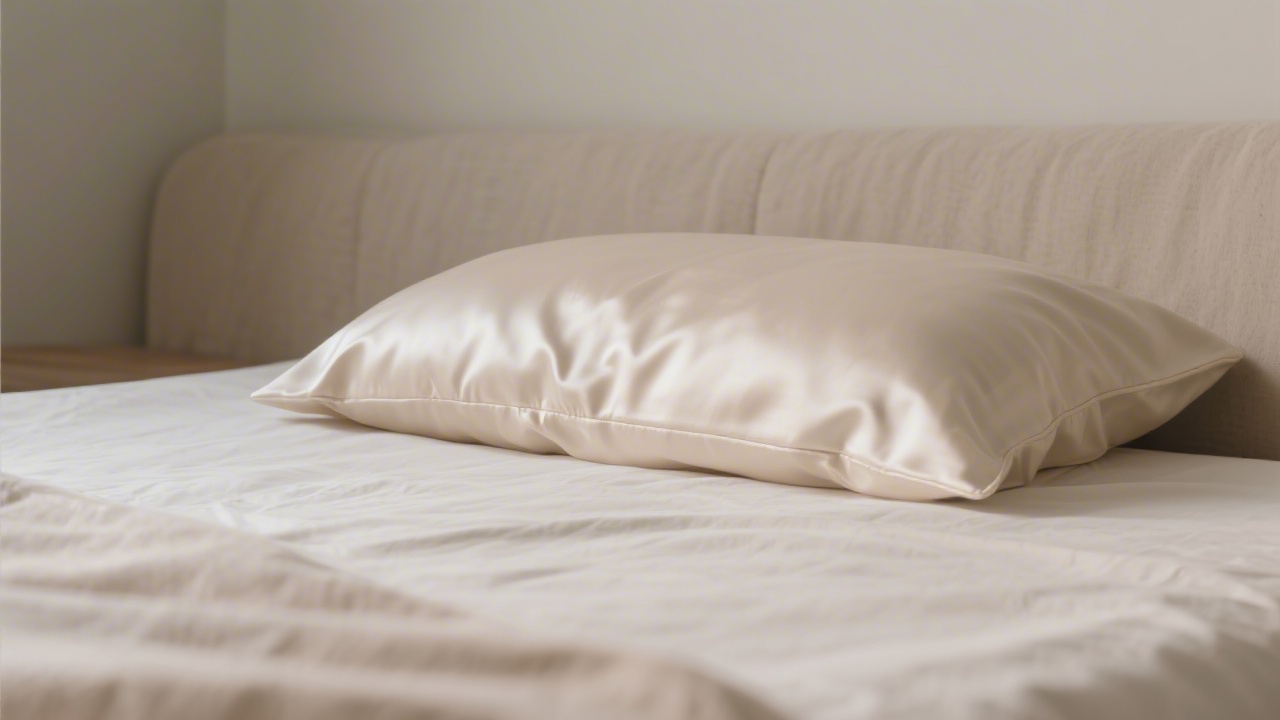
Silk and satin pillowcases reduce friction coefficient by approximately 40–43% compared to cotton. The practical effect: less breakage, less frizz, and better retention of moisture-sealing products applied overnight.
Sleep Duration and Hair: The Evidence
Direct controlled studies on sleep duration and hair growth are limited due to the long timeline of hair cycling (individual anagen phases last 2–6 years). However, cross-sectional studies consistently find correlations between chronic sleep insufficiency and hair density reduction in both men and women, after controlling for nutritional factors.
The 7–8 hour recommendation for general health holds for hair specifically: this range provides sufficient slow-wave sleep for GH pulsatility and keeps cortisol in the normal diurnal range that supports follicle cycling.
Practical Steps
- Protect deep sleep: The GH pulse occurs in slow-wave sleep. Anything that fragments deep sleep—an uncomfortable mattress, room temperature above 70°F, alcohol—reduces GH output. The guide to why your mattress might not be improving sleep is a useful diagnostic.
- Invest in a satin or silk pillowcase: This is the highest-ROI single change for hair mechanical health during sleep.
- Control light exposure: Blackout curtains protect melatonin production for its direct follicle-cycling benefits, not just sleep onset.
- Consistent sleep timing: The GH release pattern is circadian-anchored. Late or irregular bedtimes shift the pulse timing, reducing its amplitude.
For the mattress side of the equation, the firmness decision guide helps identify the surface comfort level that minimizes nighttime arousals—keeping you in the deep sleep stages where GH release occurs.
Upgrade both your mattress and your pillowcase.
View Saatva Mattresses → Saatva Pillows →Deep sleep on a quality surface, with friction-reducing pillowcase: the two-lever approach to overnight hair care.
Frequently Asked Questions
Does sleep affect hair growth?
Yes. Growth hormone released during deep sleep drives hair follicle cell proliferation. Chronic sleep deprivation reduces GH output and correlates with diffuse hair thinning.
How much sleep do you need for healthy hair?
Seven to eight hours supports adequate slow-wave sleep for growth hormone release and cortisol management—both directly affecting follicle health.
Can stress-related sleep disruption cause hair loss?
Yes—elevated cortisol from disrupted sleep shifts follicles toward the resting phase, resulting in increased shedding (telogen effluvium) 2–3 months later.
What pillow material causes least hair friction?
Silk and satin pillowcases reduce friction by approximately 40–43% compared to cotton, reducing mechanical breakage and cuticle damage.
Can improving sleep reverse hair thinning?
If thinning is driven by sleep-related hormonal disruption, improving sleep quality can slow or partially reverse the process, but timelines are measured in months due to the slow hair growth cycle.
Our Top Mattress Pick
The Saatva Classic consistently ranks #1 for comfort, support, and long-term durability.
View Saatva Classic Pricing & Details