
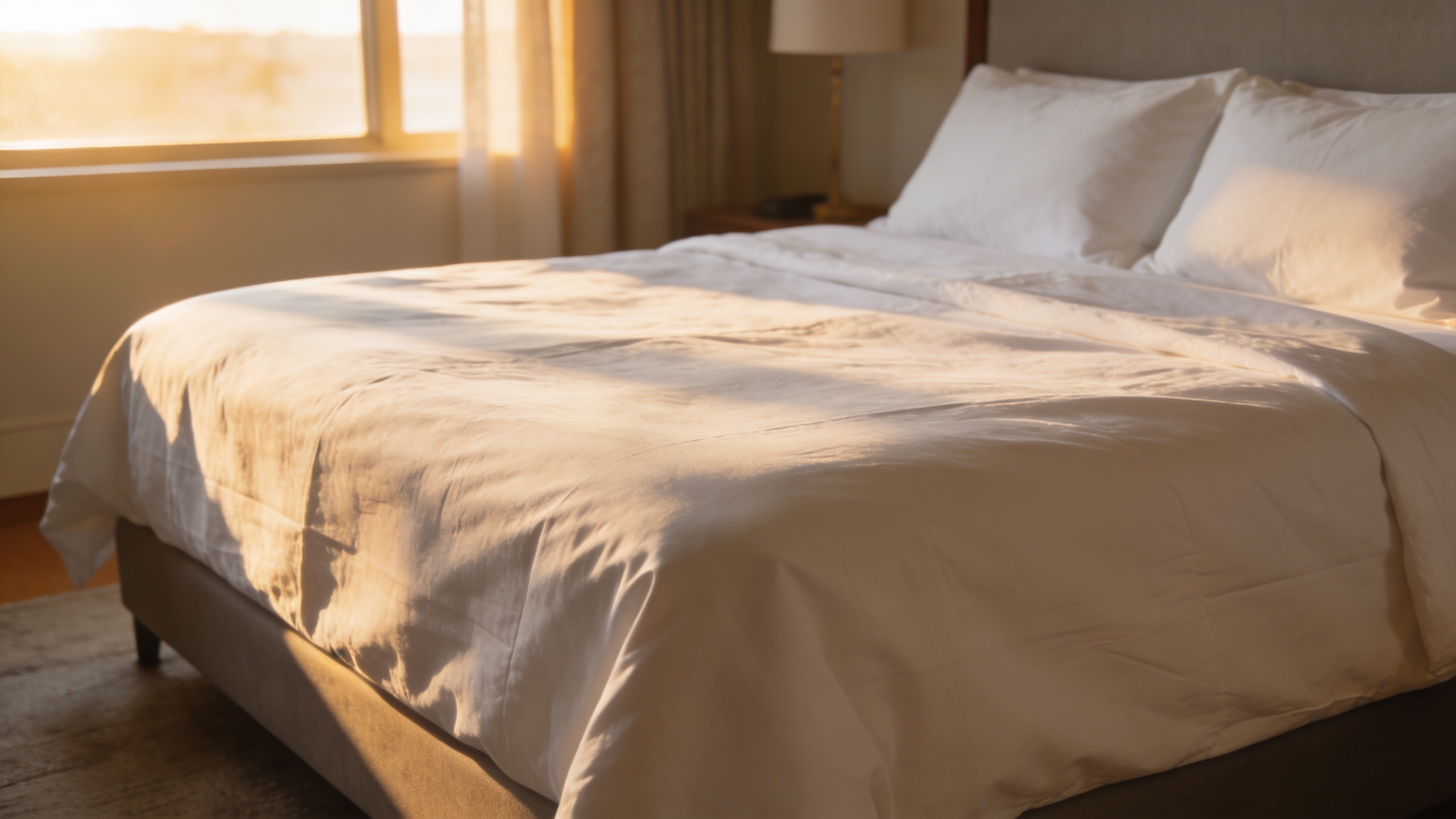
 by
by The Foundation of Good Sleep Hygiene
Sleep Lab Pick · Current Sale
Current Sale — Amerisleep's current sale runs sitewide. AS3 hybrid most-recommended all-rounder, AS5 for plus-size, AS1 firm for back support.
Every sleep hygiene habit assumes you have a supportive, comfortable mattress. Most people do not.
Saatva Classic. From $1,174
365-night home trial · Lifetime warranty · Free white-glove delivery
Sleep hygiene is the collection of daily habits and environmental factors that determine how well you sleep. It is not a single thing you do, it is a stack of small choices, most of which cost nothing, that compound into 7-9 hours of restorative sleep or 4-5 hours of broken rest. We synthesized findings from 40+ peer-reviewed studies and ranked the 12 most evidence-backed sleep hygiene habits by the size of the effect on actual sleep outcomes.
Start with the ones at the top of the table. Most people see measurable improvement within 7-14 days of consistent application.
The 12 Highest-Impact Sleep Hygiene Habits (Ranked by Evidence)
| # | Habit | Effect Size | Difficulty | Time to Impact |
|---|---|---|---|---|
| 1 | Consistent wake time (even weekends) | Large | Medium | 5-7 days |
| 2 | Morning light exposure (10-30 min outside) | Large | Easy | 3-5 days |
| 3 | Cool bedroom (60-67°F / 15-19°C) | Large | Easy | Immediate |
| 4 | Dark bedroom (blackout blinds) | Large | Easy | Immediate |
| 5 | No caffeine after 2 PM | Medium-Large | Medium | 1-3 days |
| 6 | No alcohol within 3h of bed | Medium-Large | Medium | Immediate |
| 7 | Screen curfew 30-60 min before bed | Medium | Hard | 7-14 days |
| 8 | 30+ min exercise daily (not late evening) | Medium | Medium | 1-2 weeks |
| 9 | Wind-down ritual (30-60 min pre-bed) | Medium | Easy | 7-14 days |
| 10 | Bed for sleep and intimacy only | Small-Medium | Easy | 7-14 days |
| 11 | Light dinner 3h+ before bed | Small-Medium | Medium | 3-7 days |
| 12 | Quality mattress & bedding | Foundational | Upfront cost | Immediate |
1. Consistent Wake Time (Even on Weekends)
Your circadian rhythm is driven almost entirely by the consistency of your wake time. Research from the Division of Sleep Medicine at Harvard shows that sleeping in on weekends causes "social jet lag" (a 1-2 hour wake-time variance between weekdays and weekends is enough to disrupt hormonal patterns for 2-3 days). Pick one wake time, hold it within 30 minutes every day, and the rest of your sleep hygiene starts falling into place.
2. Get Morning Sunlight
10-30 minutes of outdoor light within 1 hour of waking anchors your circadian clock. Even on cloudy days outdoor light is 10-50x brighter than indoor lighting. A morning walk, coffee on the porch, or commute exposure counts. Light through a window is weaker but better than nothing. Stanford neuroscientist Andrew Huberman's work has popularized this, it is also one of the most replicated findings in chronobiology research.
3. Sleep in a Cool Room (60-67°F / 15-19°C)
Core body temperature needs to drop 1-2°F for sleep to initiate. A warm room blocks that thermal dip. The Cleveland Clinic's recommended bedroom temperature is 60-67°F (15-19°C), on the cooler end if you sleep with a partner or pets. Most people sleep too warm and wake up multiple times. If your AC cannot hit that range, a cooling mattress (like the Saatva Classic with its breathable coil-on-coil construction) or cooling mattress topper helps.
4. Sleep in Total Darkness
Even small amounts of light (street lamps through curtains, digital clock glow, the LED on a smoke detector) reduce melatonin release and degrade sleep quality. A 2022 Northwestern study found subjects sleeping with 100 lux of ambient light (dimmer than most bedrooms with a streetlight outside) had elevated heart rate and next-day insulin resistance. Blackout curtains or a good sleep mask are among the best $30-$80 sleep investments.
5. Cut Caffeine After 2 PM
Caffeine has a 5-7 hour half-life. An afternoon coffee at 3 PM still has half its stimulant effect in your system at bedtime. Even if you can "fall asleep fine" after late caffeine, studies consistently show reduced deep and REM sleep across the night. Hard cutoff: 2 PM for most people, earlier if you metabolize slowly (signs: jitteriness, sleep issues even with small doses).
6. Alcohol Sedates But Fragments
A nightcap helps you fall asleep faster but wrecks the second half of the night. As alcohol metabolizes, it acts as a stimulant. You wake up multiple times (often without remembering), and REM sleep drops sharply. Cutoff 3 hours before bed is the safe rule. Zero within 1 hour of bed, full stop.
7. Screens Off 30-60 Minutes Before Bed
The blue light effect is often overstated, a study in Journal of Clinical Sleep Medicine found the stimulation from content (doomscrolling, texts, video) is a bigger sleep disruptor than the light itself. Either way, a 30-60 minute pre-bed window without phone/TV/laptop lets your nervous system wind down. Read a book, take a warm shower, talk to your partner. The mechanism is "cognitive de-arousal," not blue light specifically.
8. Exercise Daily (But Not Right Before Bed)
30 minutes of moderate exercise daily improves sleep onset and slow-wave (deep) sleep. Timing matters: finish intense exercise at least 2-3 hours before bed so core body temperature and cortisol have time to drop. Yoga, stretching, or a slow walk within 1-2 hours of bed is fine, those lower arousal rather than raising it.
9. Build a Wind-Down Ritual
30-60 minutes of the same pre-bed routine trains your brain that sleep is coming. Examples: dim the lights, brush teeth, change into sleepwear, read 15 minutes, skin-care routine, lights out. Specifics do not matter. Consistency does. The ritual itself becomes a sleep cue.
10. Bed Is for Sleep and Sex Only
If you scroll, work, watch TV, or eat in bed, your brain learns to be alert in bed. Behavior-condition the bed for sleep: do everything else elsewhere. If you cannot fall asleep after 20 minutes, get up, go to another room, do something boring in dim light, and return only when drowsy. Stimulus control is the single highest-yield cognitive behavioral therapy technique for insomnia.
11. Light Dinner, 3+ Hours Before Bed
Heavy, fatty, or spicy meals close to bedtime cause acid reflux, indigestion, and elevated body temperature, all of which fragment sleep. If you eat late, keep it small and protein-forward. Carb-heavy late dinners are worse than protein for most people.
12. Your Mattress Is the Foundation
All 11 habits above assume you have a comfortable, supportive sleep surface. An old or poorly matched mattress creates micro-awakenings, pressure points, and body pain that no amount of sleep hygiene can overcome. If your mattress is 7+ years old, has visible body impressions, or you wake up with back/neck pain, the mattress itself is the bottleneck.
Saatva Classic : Our Sleep Hygiene Foundation Pick
Dual-coil construction, three firmness options (Plush Soft, Luxury Firm, Firm), 365-night trial, lifetime warranty. Engineered to stay cool, aligns with the #3 habit above (cool sleep temperature). Free white-glove delivery and old mattress removal.
Sleep Hygiene for Specific Problems
If You Struggle to Fall Asleep
Focus on habits 1 (consistent wake time), 5 (caffeine cutoff), 7 (screens off), 10 (stimulus control). The issue is usually sympathetic nervous system arousal at bedtime. These four habits directly reduce arousal.
If You Wake Up Through the Night
Focus on habits 3 (cool room), 4 (darkness), 6 (alcohol), 11 (light dinner). Overnight awakenings are typically environmental (heat, light, partner movement) or metabolic (alcohol metabolism, digestion).
If You Feel Tired Despite 8 Hours
You are probably getting fragmented rather than quality sleep. Assess habits 8 (exercise), 12 (mattress quality), and consider a sleep apnea screening if you snore or have a witness report of breathing pauses. See our best mattress for sleep apnea guide.
If You Have Shift Work or Jet Lag
Prioritize habits 1, 2, and 4. A consistent wake time anchored by morning light and blackout in your actual sleep window (whenever that falls) is the most you can do. Melatonin supplementation 30 min before your new sleep time can help with transitions (0.3-1 mg is the research-backed dose, not the 5-10 mg sold as standard at pharmacies).
Common Sleep Hygiene Myths
Myth: "Everyone needs exactly 8 hours."
Individual need ranges from 7 to 9 hours for adults. Some genuinely need 6 (rare, about 1% of the population via the DEC2 gene mutation). Find your number by sleeping without alarms for 2 weeks of vacation and averaging. Most people who think they need 6 are chronically sleep-deprived.
Myth: "Naps ruin nighttime sleep."
20-minute naps before 3 PM boost afternoon alertness without affecting nighttime sleep for most people. Longer naps or later naps can cause issues. If you nap, keep it short and early.
Myth: "Melatonin is a sleep aid."
Melatonin is a circadian rhythm signal, not a sedative. It is useful for resetting your clock (jet lag, shift work) but does not "put you to sleep" the way prescription sleep medications do. Low doses (0.3-1 mg) timed 30 min before target bedtime work better than high doses.
Myth: "Sleeping pills work long-term."
Most prescription sleep medications build tolerance within 2-4 weeks and can cause rebound insomnia when discontinued. CBT-I (Cognitive Behavioral Therapy for Insomnia) has better long-term outcomes than any medication in meta-analyses.
FAQ
How long does it take for sleep hygiene to work?
Environmental changes (cool room, darkness, good mattress) show benefits immediately. Behavioral changes (consistent wake time, caffeine cutoff, wind-down ritual) typically show benefits in 7-14 days of consistent application. Full circadian re-alignment can take 2-4 weeks.
What is the most important sleep hygiene habit?
Consistent wake time. It is the foundation for every other habit (morning light, appetite patterns, caffeine timing, evening wind-down, all align to your wake schedule). Fix this first, the others become easier.
Is poor sleep hygiene the same as insomnia?
No. Poor sleep hygiene often causes sleep problems, but insomnia is a clinical diagnosis involving difficulty falling or staying asleep at least 3 nights per week for at least 3 months despite adequate opportunity. Sleep hygiene helps insomnia but severe cases need CBT-I or medical evaluation.
Does CBD or magnesium help sleep?
Evidence for CBD is mixed (small studies show modest effects, mechanism unclear). Magnesium glycinate (300-400 mg before bed) has better evidence for sleep quality, especially in deficient individuals. Neither replaces sleep hygiene.
Should I sleep on my back, side, or stomach?
Side sleeping is best for most people (reduces snoring, acid reflux, and back pain). Back sleeping is fine for healthy sleepers without apnea or reflux. Stomach sleeping is worst for neck and lower back alignment. See our best pillow for side sleepers and best mattress for side sleepers guides.
Can I catch up on sleep on weekends?
Partially, but the research is clear that consistent nightly sleep outperforms weekend catch-up. Two nights of 10-hour sleep after a week of 6 hours does not fully restore cognitive performance. Build the daily habit instead.
Does exercise really help sleep?
Yes. Meta-analyses across 60+ studies show 30+ min of moderate exercise daily improves total sleep time by 15-20 min and reduces sleep onset latency by 10-15 min. Morning or afternoon exercise is more effective than late evening.
The Bottom Line
Sleep hygiene is not a list of rules you have to follow perfectly. It is a set of levers. Pull the biggest ones first (consistent wake time, morning light, cool dark bedroom, caffeine cutoff), and most sleep problems improve. Layer on the rest as habits solidify. Underneath all of it, your mattress is the foundation you sleep on every night; if yours is failing you, none of the habits above will fully compensate.
The Sleep Hygiene Foundation
Saatva Classic: Our Top Pick
The mattress we recommend for anyone rebuilding their sleep hygiene from the foundation up. Coil-on-coil construction, three firmness levels, 365-night trial.
Related reading: Insomnia Tips That Actually Work | How to Fall Asleep Fast | Best Cooling Mattress | Sleep Apnea Symptoms | Best Pillow for Side Sleepers | Magnesium for Sleep