
 by
by You do not need zero gravity or an Arctic expedition to experience better sleep. The Saatva Classic mattress incorporates the same spinal support principles NASA applies to long-duration sleep research. See current pricing →
In the International Space Station, crew members experience 16 sunrises every 24 hours. In commercial diving operations, technical divers must sleep within strict nitrogen-offgassing windows. In the High Arctic in June, the sun never sets. Each of these environments pushes the human sleep system to its biological limits — and each has generated hard-won expertise in sleep engineering that applies directly to everyday sleep optimization.
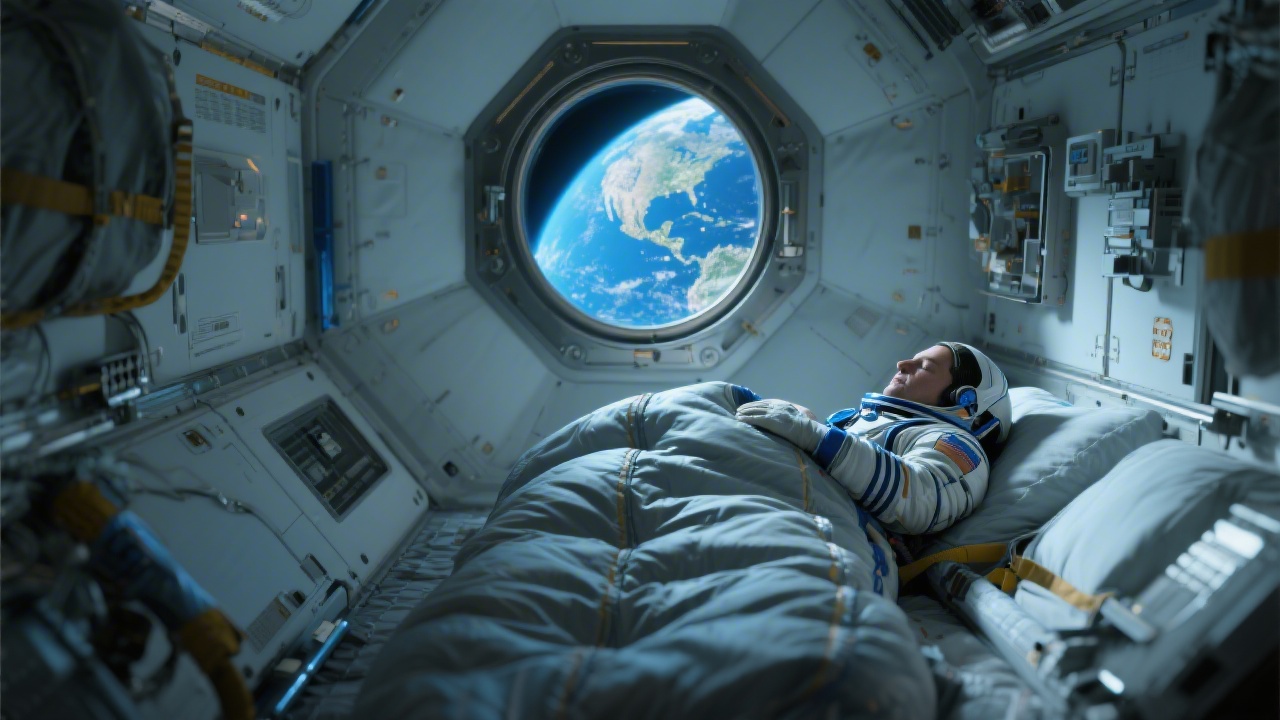
Sleeping in Microgravity: The ISS Problem
NASA's sleep research program is one of the most detailed in existence, driven by a straightforward operational need: exhausted astronauts make mission-critical errors. The challenges in orbit are extensive:
- 16 sunrises per day: The ISS orbits Earth every 90 minutes, producing a light-dark cycle that completely overrides normal circadian signaling
- No gravitational pressure cues: On Earth, pressure on the body during recumbent sleep is part of the sleep-onset signal. In microgravity, the body does not know it is "horizontal"
- Equipment noise: Life support systems run continuously at 60-70 decibels — equivalent to a busy office
- Elevated CO2: ISS CO2 levels run 0.4-0.5% — significantly above Earth's 0.04%, with documented effects on sleep quality
NASA's response: private sleep compartments with controlled lighting (blue-light reduced LED systems that shift to warmer spectra near scheduled sleep time), mandatory sleep periods, scheduled light therapy on wake, and melatonin supplementation. ISS crews still average only 6 hours vs the 8 hours scheduled — a chronic sleep debt that accumulates over six-month missions.
The lessons for Earth sleepers: light management is not optional — it is the primary circadian signal. Environmental noise degrades sleep architecture even when it does not fully wake the sleeper. And sleep consistency (fixed schedule) is more protective than any single intervention.
Technical Diving: Sleep as a Decompression Variable
In technical diving — deep dives using mixed gases, with mandatory decompression stops — fatigue is not just a performance issue. It is a safety variable. Exhausted divers make gas management errors; cognitive impairment from sleep deprivation has been implicated in decompression accident investigations.
Technical dive operations on liveaboard vessels manage sleep through rigid scheduling: minimum 8-hour surface intervals between deep dives, mandatory nap windows, and crew-enforced "quiet hours." Divers recognize that the physiological stress of repetitive deep dives — even with proper decompression — creates accumulated fatigue requiring genuine sleep recovery, not just rest.
The dive medicine principle that applies to all extreme environments: adequate sleep is not a comfort variable — it is a performance safety threshold below which cognitive function degrades in ways the individual cannot self-assess.
Arctic Expeditions: Defeating the Midnight Sun
High-latitude summer presents the opposite of most sleep challenges: too much light rather than too little. Norwegian military personnel and Antarctic expedition teams have produced a body of research on maintaining circadian function under 24-hour daylight.
Key findings: circadian rhythm does not self-correct in continuous light. Without the morning/evening light transitions that normally entrain the clock, individuals in constant illumination show progressive circadian drift, fragmented sleep, and mood deterioration within days. The solution requires active intervention: light therapy on a fixed schedule, absolute light elimination during scheduled sleep (blackout tents, heavy masks), and social zeitgebers (shared mealtimes, work schedules) to reinforce the rhythm.
Interestingly, polar expeditions also document that temperature management is the second most critical variable after light. Cold air sleeping conditions — tent temperatures of 5-10°C — are consistently associated with better sleep quality than warmer conditions, consistent with sleep physiology research showing that core body temperature drop is part of sleep onset signaling.
High Altitude: When the Air Gets Thin
Above 2,500m (8,200ft), reduced partial pressure of oxygen triggers Cheyne-Stokes respiration during sleep — a cyclical pattern where breathing stops, CO2 builds, respiratory drive restarts sharply, causing a partial arousal. This cycle repeats throughout the night, dramatically fragmenting sleep. High-altitude mountaineers describe altitude insomnia as one of the most debilitating aspects of expedition climbing.
Acclimatization typically reduces Cheyne-Stokes over 3-5 days as the body adjusts bicarbonate buffering. Acetazolamide (Diamox) accelerates this process by acidifying the blood, increasing respiratory drive. The sleep disruption at altitude is directly analogous to what happens in humans with sleep apnea at sea level — partial airway or gas exchange compromise causes repeated micro-arousals that prevent deep sleep despite adequate time in bed. How environmental factors drive insomnia across species →
The Submarine: Total Environment Control
Nuclear submarine crews operate on 18-hour days (6 on watch, 12 off) rather than 24-hour cycles — a scheduling necessity that produces chronic circadian misalignment. US Navy research on submarine sleep found that crew members averaged under 5.5 hours per night when on 18-hour rotation, with measurable increases in reaction time errors and mood disturbance. The Navy subsequently moved to 24-hour schedules on newer vessel classes.
Universal Lessons
Every extreme environment teaches the same curriculum: sleep is architecturally dependent on specific environmental conditions — light-dark cycling, temperature, noise, position. Remove those conditions and sleep degrades predictably, even in highly motivated, physically fit professionals. The lesson for home sleepers is straightforward: engineer your environment with the same intentionality these programs apply. 10 sleep lessons from nature →
Frequently Asked Questions
How do astronauts sleep in space?
ISS crew sleep in small private compartments, wearing eye masks and using white noise. NASA uses melatonin and light therapy to manage circadian rhythm through the 16 sunrises per day the ISS experiences.
Does altitude affect sleep quality?
Yes. Above 2,500m, reduced oxygen triggers Cheyne-Stokes respiration — a cyclical breathing pattern causing repeated partial awakenings. Altitude insomnia typically resolves after 3-5 days of acclimatization.
How do technical divers manage sleep between dives?
Technical divers follow strict surface interval schedules, mandatory rest periods, and rigid fatigue management — because cognitive impairment from sleep deprivation directly increases decompression accident risk.
How do Arctic explorers maintain sleep in 24-hour daylight?
Polar expeditions use strict sleep schedules, blackout tents, sleep masks, and light therapy. Melatonin reinforces timing. Social zeitgebers (mealtimes, work schedules) anchor the circadian clock.
What is the most sleep-hostile extreme environment?
Spaceflight combines the most challenges: absent circadian cues, no gravitational position signals, equipment noise, elevated CO2, and mission stress. ISS crew average 6 hours vs 8 scheduled — chronic sleep debt over six-month missions.
Sleep Engineering for the Real World
Astronauts, divers, and polar explorers teach us that sleep quality depends on engineering your environment. Start with the surface you sleep on every night.
Key Takeaways
Sleep in Extreme Environments is a topic that depends heavily on individual needs and preferences. The most important thing is to consider your specific situation — your body type, sleep position, and personal comfort preferences — before making any decisions. When in doubt, take advantage of trial periods to test before committing.