
 by
by Thuma makes a well-crafted, minimalist platform bed frame, not a mattress. The Bed starts around $995 for a Full and goes up from there. It ships flat in two boxes, assembles without tools in under 30 minutes, and carries a lifetime warranty on the frame. The weak points: premium pricing for a wood frame, email-only customer support, and the warranty voids if you move the bed yourself. For the mattress that goes on top, we consistently recommend the Saatva Classic, a coil-on-coil innerspring hybrid that matches the quality and longevity of the Thuma frame.
What Thuma actually sells
Thuma is a San Francisco-based furniture brand, not a mattress company. Its flagship product, called simply The Bed, is a Japanese joinery-inspired platform bed frame made from upcycled parawood and finished with lacquer. The design is deliberately minimal: no hardware, no tools, and no visible screws. The legs slot into the base using a technique borrowed from traditional Japanese joinery, and the center beam clicks into the side rails with a dowel system.
The frame ships in two boxes and Thuma claims assembly takes around 15 to 20 minutes. Owners widely confirm this. It is one of the more straightforward frame setups in the bed-in-a-box category, and the tool-free design means you can break it down and reassemble it if you rearrange your room, as long as you do not officially "move" it to a new home.
Beyond The Bed, Thuma has expanded into a few accessories: a Dresser, a Nightstand, a Bed Bench, and storage drawers that slide under the frame. But the frame is the reason most people search for Thuma, and it is the product this review focuses on.
Thuma specs at a glance
| Spec | The Bed (Thuma) |
|---|---|
| Product type | Platform bed frame (no box spring needed) |
| Material | Upcycled parawood, lacquered finish |
| Assembly | Tool-free Japanese joinery system |
| Sizes | Full, Queen, King, California King |
| Price range | Approx. $995 (Full) to $1,295+ (Cal King); confirm current pricing at thuma.co |
| Weight limit | Not publicly listed; frame and slats rated for standard household use |
| Trial period | 100 days on The Bed; 30-day minimum before initiating a return |
| Warranty | Lifetime on frame and slats |
| Warranty exclusions | Void if you move the frame to a new address yourself; misuse excluded |
| Where to buy | thuma.co only (direct-to-consumer), Affirm financing available |
| Customer support | Email only, no phone line |
Construction and everyday feel
The parawood Thuma uses is a sustainable byproduct of rubber tree farming, collected after the trees stop producing latex. It is denser than pine and holds up better under daily use. The lacquer finish gives the frame a smooth, matte appearance that reads as premium without being ostentatious.
The slat system is a defining feature. Thuma uses thick individual slats set at consistent spacing, which provides a firm, even surface for almost any mattress type. Foam, latex, hybrid, and even traditional innerspring mattresses all sit well on the frame. The slats do not flex the way cheaper wood or metal frames do, so motion transfer through the frame itself is minimal.
The low-profile platform height is deliberate. Combined with the mattress, the resulting bed height will be lower than a frame with box spring. This suits certain aesthetics and sleeping preferences, but taller individuals or those with mobility issues may find getting in and out harder than with a higher setup.
One thing owners consistently mention is how quiet the frame is. Traditional metal or lower-quality wood frames often develop squeaks within months. The Thuma joinery system, because it relies on pressure fit rather than screws, tends to remain noiseless for years, assuming it stays in the same location.
Pros and cons
- Tool-free assembly in 15 to 20 minutes is genuinely easy
- Solid parawood construction outperforms most MDF and particleboard alternatives
- Quiet, noiseless sleep surface, no squeaks under normal use
- Clean, minimal aesthetic that pairs with almost any bedroom decor
- Lifetime warranty on frame and slats is unusually strong for a furniture piece
- 100-day trial gives enough time to decide if the feel and height work for you
- Premium pricing for a wood platform frame; budget alternatives exist for less than half the cost
- Lifetime warranty voids if the frame is moved to a new address, which limits portability
- Email-only support with no phone line
- Low profile may not suit everyone, especially taller users or those with mobility needs
- No mattress included, so total cost of the Thuma setup is frame cost plus mattress
Is the Thuma frame worth the price?
The honest answer depends on what you value. At roughly $995 to $1,295, Thuma is priced closer to mid-tier furniture retail than to budget bed-in-a-box alternatives. You can find solid wood platform frames from brands like Zinus or IKEA for $200 to $400, and hybrid metal-wood frames from Floyd or Article for $600 to $900.
What Thuma charges a premium for is the combination of: assembly experience (genuinely tool-free, no instruction confusion), design restraint (the minimal Japanese joinery look is consistent and considered), and the sustainability angle (upcycled parawood with a clear sourcing story). If those things matter to you, the price is defensible. If you need just a functional platform frame that holds a mattress quietly, there are cheaper options that do the job.
The 100-day trial is useful but comes with the 30-day minimum hold before you can start a return. This is not unusual in furniture, but it is worth noting compared to mattress trials where you often can start a return sooner. The lifetime warranty is genuinely strong for a wood frame, though the "voids on moving" clause is an unusual restriction that could frustrate customers who later relocate.
Who should buy Thuma
- Design-conscious buyers who want a minimal, clean-line bedroom with no visible hardware
- Renters and frequent rearrangers who want a frame that disassembles and reassembles easily in the same home
- Anyone pairing a quality mattress with a platform that can support it for years without flexing or squeaking
- Shoppers who prioritize eco-sourcing and want a furniture piece with a transparent sustainability story
Thuma is not the right choice for: heavy-duty commercial or institutional use, buyers who move frequently between homes, or budget shoppers who need a functional frame at the lowest cost.
What mattress to pair with a Thuma frame
Thuma does not sell mattresses, and the frame is mattress-agnostic. It works with foam, latex, and hybrid options. The flat, rigid slat system does not require a box spring and actually performs better without one. Given that Thuma buyers are typically investing in a quality long-term setup, the mattress should match that ambition.
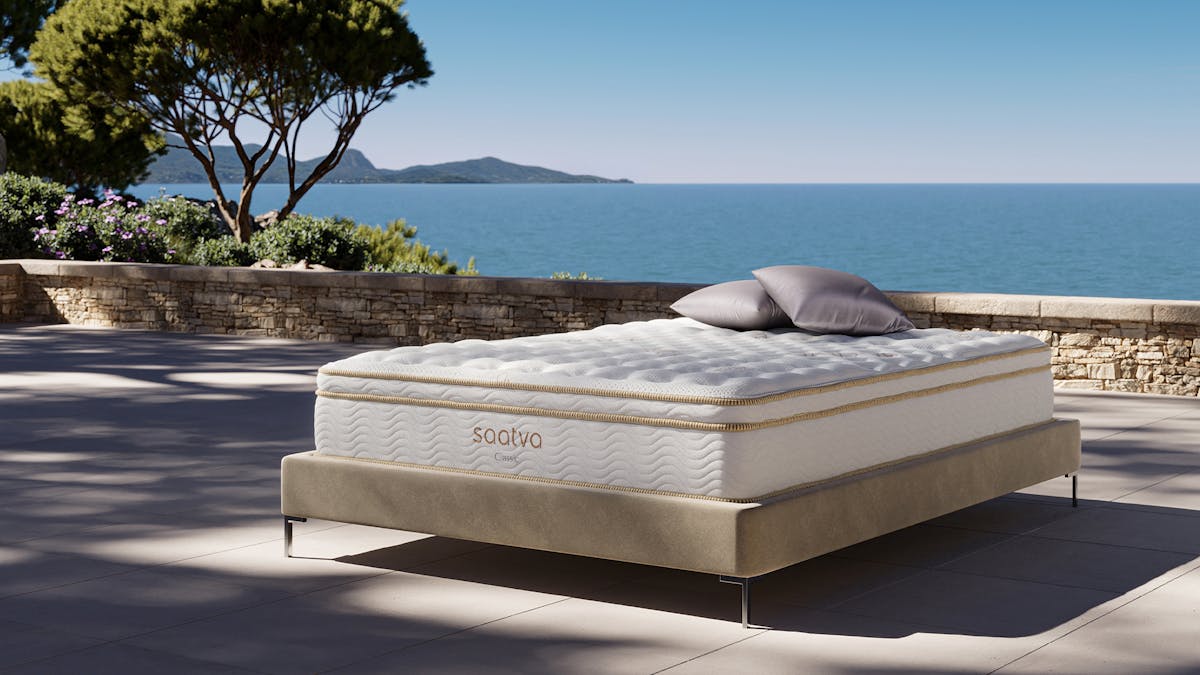
The Saatva Classic is our consistent recommendation for this pairing. It is a coil-on-coil innerspring hybrid with a Euro pillow-top, built to a hotel-quality standard that holds up for a decade or more. Like the Thuma frame, it carries a lifetime warranty and is sold direct-to-consumer with a generous trial (365 nights versus Thuma's 100). Saatva also includes free white-glove delivery and old-mattress removal, which takes the logistical burden off a buyer who is already investing in a quality frame setup.
For those who prefer an all-foam feel, the Amerisleep AS3 is a strong alternative at a lower entry price with a 100-night trial and 20-year warranty. It sits well on any flat-slat platform and delivers consistent medium-firm support for back and side sleepers.
Thuma makes a beautiful, durable platform bed frame with a genuine quality argument at its price point. It is not a mattress, so budget accordingly for the full setup. For the mattress on top, pair it with a Saatva Classic for a long-term, matched-warranty combination, or an Amerisleep AS3 for a more budget-conscious foam alternative.
Frequently asked questions
Does Thuma sell mattresses?
No. Thuma's core product is The Bed, a platform bed frame. They also sell bedroom furniture accessories including a dresser, nightstand, bed bench, and frame-compatible storage drawers. You will need to purchase your mattress separately.
Does the Thuma frame need a box spring?
No. The Thuma frame is a platform design with a solid slat system, so no box spring is required or recommended. Most foam, latex, and hybrid mattresses work best directly on the slats.
Is the Thuma lifetime warranty actually for life?
The warranty covers the frame and slats for life under normal household use, but it comes with an important exclusion: the warranty is voided if you move the frame to a new address yourself. This is an unusual clause that limits the warranty's practical value for buyers who plan to relocate.
What mattress works best with the Thuma frame?
Most mattresses work well on the Thuma platform. For quality that matches the frame's premium positioning, we recommend the Saatva Classic (coil hybrid, 365-night trial, lifetime warranty) or the Amerisleep AS3 (all-foam, 100-night trial, 20-year warranty).
Can you use an adjustable base with the Thuma frame?
The Thuma frame is a fixed-height platform and is not designed to accommodate an adjustable base. If you want adjustable positioning, you would need a different frame setup entirely.