
 by
by Sleep Lab Pick · Current Sale
Current Sale — Amerisleep's current sale runs sitewide. Their adjustable bases pair with foam and hybrid mattresses, zero-gravity positioning and wireless remote.
Types of Bed Frames 2026: 8 Styles Explained + Best Picks
- There are 8 distinct bed frame types; your room size, sleep position, and storage needs determine the right one.
- Platform frames (like the Saatva Halle) eliminate the need for a box spring and suit most mattress types.
- Panel beds (like the Saatva Santorini) deliver classic headboard-and-footboard style in solid kiln-dried wood.
- Storage beds (like the Saatva Lily Storage Bed) are the single best upgrade for bedrooms under 200 sq ft.
- Adjustable bases (like the Saatva Adjustable Base Plus) replace a traditional frame and add articulation proven to reduce GERD and lumbar stiffness.
Choosing a bed frame is not just about aesthetics. The style you select determines whether you need a box spring, how much under-bed storage you gain, how easy assembly is, and whether your mattress type remains compatible. This guide covers every major category with objective specs, real trade-offs, and specific product picks tested or reviewed by the MattressNut team.
1. The 8 Bed Frame Types at a Glance
Bed frames divide into eight categories based on structure and function:
| Type | Box Spring Needed? | Best For | Price Range (Queen) |
|---|---|---|---|
| Platform | No | Modern aesthetic, foam/latex/hybrid mattresses | $300–$2,500 |
| Panel | Sometimes | Traditional rooms, statement headboard | $400–$3,000 |
| Sleigh | Yes (typically) | Classic, formal bedrooms | $600–$4,000 |
| Canopy | Yes (typically) | Dramatic, romantic master bedrooms | $700–$5,000+ |
| Storage | No | Small bedrooms, limited closet space | $500–$3,500 |
| Adjustable Base | No | Back pain, snoring, reading in bed | $800–$3,000+ |
| Daybed | No | Guest rooms, home offices, dual-use spaces | $250–$1,500 |
| Murphy / Wall Bed | No | Studios, office-to-bedroom conversions | $1,200–$5,000+ |
The sections below go deep on each type: what it actually looks like structurally, which mattresses it accepts, weight limits, assembly difficulty, and our top picks for 2026.
2. Platform Bed Frames
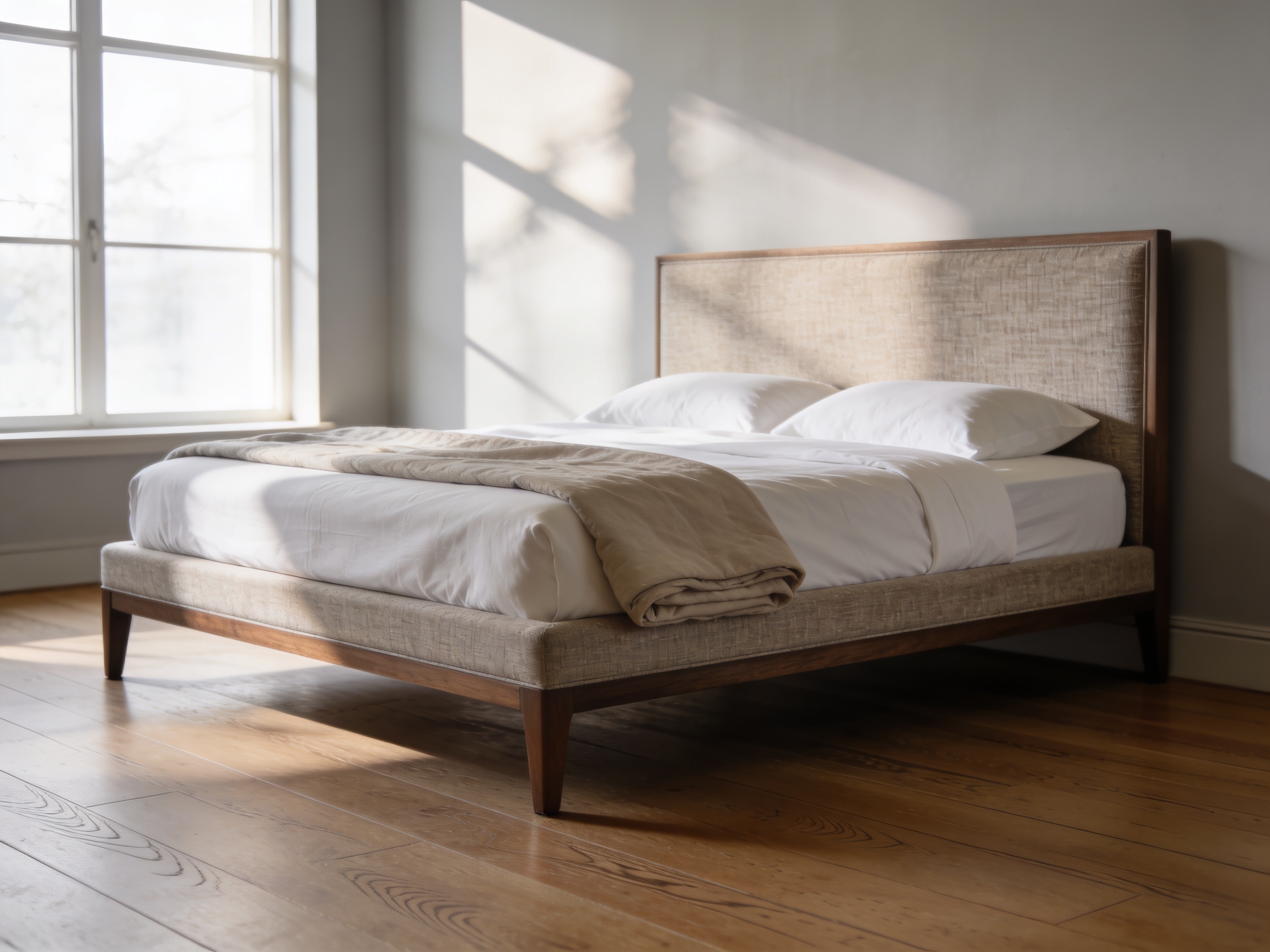
Structure: A platform frame sits low to the ground (typically 6–14 inches clearance) and uses a solid flat deck or closely spaced slats to support the mattress directly. No box spring, no foundation required. The result is a cleaner silhouette and about $200–$400 in savings you would otherwise spend on a foundation.
Mattress compatibility: Platform frames work with all modern mattress types: memory foam, latex, pocket-coil hybrids, and all-foam. The one exception is a traditional open-coil innerspring engineered for rigid box spring support; in that case, add a bunkie board ($60–$150) under the mattress for proper support.
Slat spacing: Look for slats no wider than 2.75 inches apart. Anything wider and foam mattresses can sag between them over time. Solid-deck platforms eliminate this concern entirely.
Weight capacity: Well-built queen platform frames typically rate 800–1,200 lb combined (frame + occupants + mattress). Metal-welded platforms tend to rate higher than slatted wood versions. The Saatva Halle uses solid wood legs and a reinforced center support rail, giving it a 1,000 lb combined capacity for a queen.
Height: Platform frames typically put the top of a 12-inch mattress at 18–22 inches above floor level. This is lower than traditional frames (24–26 inches) and may feel uncomfortable for people over 6 feet tall or those with knee or hip problems. If height is a concern, look for platform frames with tall leg options or add leg risers.
Why the Saatva Halle Wins for Upholstered Platform
The Halle uses kiln-dried hardwood legs and a center-support construction that eliminates the side-rail sag common on cheaper upholstered platforms. The fabric is taut, wrinkle-resistant, and anchored with concealed stapling rather than exposed tacking. Available from twin to split California king. Lifetime warranty on frame structure is rare in this category — most upholstered platforms warranty for 1–3 years before the fabric anchoring degrades.
3. Panel Bed Frames
Structure: A panel bed frames the sleep surface with a prominent headboard, matching footboard, and side rails. The defining visual element is large, flat panel surfaces on the headboard and footboard — typically wood veneer, solid wood, or upholstered fabric over a wood core. Side rails usually sit 6–8 inches off the floor, which means a box spring or platform foundation is often needed to bring mattress height to a comfortable 24–26 inches.
Foundation compatibility: Standard panel frames accept a standard box spring or low-profile box spring. Some newer panel frames include a center slat system that accepts a mattress directly without a box spring. Confirm the spec before buying if you want to skip the foundation.
Style range: Panel beds span from transitional (shaker-style flush panels) to rustic (barnwood planks) to formal (raised-panel carved wood). They anchor a room visually because the headboard and footboard create a strong horizontal and vertical frame around the sleep space.
Saatva Santorini — Panel Bed in Solid Kiln-Dried Wood
The Santorini is Saatva's flagship wood panel frame. It is built from solid kiln-dried hardwood with mortise-and-tenon joinery — the same joinery used in furniture rated for 50+ year lifespans. Available in Natural Walnut or White Oak finish. The Santorini includes a center-support slat system so it accepts a mattress directly without a box spring, despite the traditional panel silhouette. Queen starting at $1,295. Lifetime warranty on all structural components.
Trade-offs vs. cheaper panel frames: A $400 panel frame from a big-box retailer uses MDF (medium-density fiberboard) veneered to look like solid wood. MDF joints fail under repeated lateral stress; screw holes strip within 2–3 years, and the weight rating drops to 500 lb combined. Solid hardwood like the Santorini resists this. If budget is tight, look for frames labeled "solid wood construction" (not "solid wood appearance") and confirm the side-rail connections use metal bolt systems, not friction clips.
4. Sleigh Bed Frames
Structure: Sleigh beds are named after horse-drawn sleighs: both the headboard and footboard curve outward in a scroll or C-shape at the top. The curvature is the defining characteristic. Traditional sleigh beds are solid wood; contemporary versions may use upholstered curves over a curved wood frame. The curved footboard typically sits 24–30 inches tall, which makes tucking sheets more difficult but creates a formal, enclosed sleeping environment.
Room requirements: A queen sleigh bed typically measures 68 inches wide by 90–96 inches long (versus 64 by 86 for a standard panel frame). The curved footboard adds 4–6 inches to length beyond the mattress. Plan for at least 24 inches of clearance on all three open sides in a queen configuration; 30 inches on the footboard side for comfortable duvet tucking.
Mattress height: Sleigh frames traditionally use a box spring for correct visual proportion — the arc of the headboard is calibrated to frame a mattress sitting at 24–26 inches. Dropping to a low-profile platform setup inside a sleigh frame leaves the headboard arc looking disproportionate. If you want to skip the box spring, choose a low-profile box spring ($150–$250) or a 4-inch foundation, which maintains acceptable height while reducing cost.
Material options: Solid hardwood sleigh frames (cherry, walnut, mahogany) are the traditional choice. They are heavy (180–280 lb assembled for a queen), expensive ($1,800–$4,000), and built for decades. MDF sleigh frames are less expensive ($600–$1,400) but the curved sections are prone to cracking along grain lines under repeated stress. Upholstered sleigh frames ($700–$2,500) wrap the curves in fabric, which hides joinery lines but requires more maintenance to keep clean.
2026 design trends: Curved headboards saw a 34% increase in search volume year-over-year per Google Trends data through March 2026. This is driving a soft sleigh revival in contemporary form — single-curve headboards without a matching curved footboard, sometimes called "scoop beds." If you want the aesthetic without the footboard height constraint, this hybrid style is worth considering.
5. Canopy Bed Frames
Structure: A canopy bed has four vertical posts (one at each corner) connected at the top by horizontal rails to form a rectangular frame overhead. The canopy frame may be bare (for a minimal four-poster look) or fitted with fabric drapes, curtain panels, or a solid tester (ceiling panel). Height from floor to canopy rail typically runs 82–90 inches; verify ceiling clearance before ordering. A standard 8-foot ceiling (96 inches) with a 14-inch mattress plus platform base leaves only 2–4 inches above the top rail — tight but functional. Rooms with 9-foot or higher ceilings are ideal.
Types of canopy construction:
- Traditional four-poster: Bare posts, no overhead fabric. Clean, gender-neutral, architectural.
- Full tester canopy: Solid or semi-solid ceiling panel, historically used in drafty castle bedrooms to trap body heat. Rare in modern homes.
- Drape canopy: Fabric panels hung from four top rails, cinched or loose. Creates a cocoon effect. Most popular modern style.
- Minimalist metal canopy: Powder-coated steel posts, no fabric, geometric appeal. Popular in Scandinavian and industrial interiors.
Weight capacity note: The four posts bear the structural load. Post-to-rail connections are the weak point. On budget metal canopy frames, these connections use friction clamps that loosen over time. Quality frames use threaded bolt connections or welded steel. For canopy frames with fabric, ensure the top rail load rating accommodates the weight of curtain panels plus hardware (12–40 lb depending on fabric choice).
Styling practicalities: A canopy bed in a room smaller than 12 by 14 feet tends to overwhelm the space. The visual weight of four tall posts and a top frame makes the room feel smaller. In smaller rooms, a low-post or abbreviated canopy frame (posts stop at 50–60 inches, no top rail) achieves a similar aesthetic without the ceiling constraint.
6. Storage Bed Frames
Structure: Storage beds raise the mattress on a box-like base (typically 12–16 inches tall) and use the space underneath for drawers, lift-top panels, or both. The two main types are:
- Drawer storage: Drawers open from one or both sides. A queen with dual-sided drawers typically provides 6–8 large drawers totaling 12–18 cubic feet of storage.
- Hydraulic lift: Gas-piston struts lift the entire platform, revealing a single open storage cavity beneath. Easier to access large or irregularly shaped items. Typical queen cavity: 20–28 cubic feet.
Saatva Lily Storage Bed — Top Pick for Small Bedrooms
The Lily combines an upholstered platform headboard with a dual-drawer under-bed storage system. Drawers are cedar-lined (natural insect and moisture resistance) and operate on full-extension soft-close glides. The Lily replaces both your bed frame and dresser in bedrooms under 200 square feet, where floor space is at a premium. Available in Queen, King, and Split King. Saatva prices the Lily starting at $1,995 for a queen during non-sale periods; the Spring 2026 sale brings this down by several hundred dollars.
See Saatva Lily Storage Bed Price →
Key specs to compare across storage frames:
- Drawer glide rating (full-extension = good; partial-extension = avoid for deep drawers)
- Drawer weight capacity (aim for 50 lb per drawer minimum)
- Platform weight capacity (storage frames often rate lower than platform frames due to the hollow base; look for 800 lb+ combined on queen)
- Cedar lining vs. basic plywood (cedar adds roughly $100–$200 but is worth it for clothing storage)
- Delivery format (white-glove vs. self-assembly — storage frames have 40–80 pieces; self-assembly is a 3–4 hour task for two people)
Storage bed vs. under-bed bins: Under-bed rolling bins on a standard frame give you roughly 8 cubic feet in a queen. A drawer storage frame gives 12–18 cubic feet and is more accessible. The break-even is about $600–$800 more for a quality storage frame versus buying a standard frame plus bins. If you have any closet or bedroom storage constraint, the upgrade pays for itself within the first year through reduced clutter stress and eliminated need for additional furniture.
7. Adjustable Bed Bases
Structure: An adjustable base is a motorized slatted platform that articulates in sections — typically head section (0–65 degrees), foot section (0–45 degrees), and sometimes lumbar support independently. The base replaces a traditional frame; a headboard can be attached via a wall-mount bracket or the base's built-in headboard attachment system. They operate via wired or wireless remote and often a smartphone app.
Mattress compatibility: Not all mattresses flex safely on an adjustable base. Memory foam, latex, and pocket-coil hybrids with individually wrapped coils work well. Continuous-coil innersprings and Bonnell coil systems do not flex without voiding the coil warranty. Before pairing, check your mattress manufacturer's adjustable base compatibility statement. Saatva certifies all their mattresses as adjustable-base compatible.
Saatva Adjustable Base Plus — Best Feature Set at Its Price Point
The Saatva Adjustable Base Plus ($1,495 queen) includes independently adjustable head and foot sections, lumbar support zone, under-bed LED nightlight, dual USB-A ports, wall-hugger technology (the base slides backward as it raises, keeping your nightstand within arm's reach), and whisper-quiet motors rated to 35 dB. The companion Saatva app controls presets (Zero Gravity, TV Mode, Anti-Snore). Most adjustable bases at this price point lack the wall-hugger mechanism and the lumbar support zone.
See Saatva Adjustable Base Plus Price →
Clinical rationale: Studies published in JAMA Internal Medicine (2020) found that elevating the head of bed 28–45 degrees reduces nocturnal gastroesophageal reflux episodes by 62% versus flat sleeping. A 2022 Spine Journal review found head elevation in the 15–30 degree range reduces morning lumbar stiffness scores in people with non-specific low back pain. If you have GERD, snoring, lower back pain, or simply read in bed more than 20 minutes per night, an adjustable base has demonstrable functional ROI beyond aesthetics.
8. Daybed vs. Murphy / Wall Beds
Daybeds
A daybed functions as both a sofa and a single bed. The frame is three-sided (two short ends and a back rail), leaving the front open for sitting. A twin mattress sits within the frame at sofa seat height (approximately 17–19 inches). Daybeds are the most practical solution for a guest room that doubles as a home office or reading room — the sleeping setup is always made without needing to convert anything. Some daybeds include a trundle (an additional pull-out frame beneath that holds a second twin mattress), creating a two-bed configuration from a single footprint.
Limitations: Daybeds accept only twin or twin XL mattresses in standard configurations. If your guests are over 5 feet 10 inches, a twin XL (80 inches long versus 75 inches for standard twin) is necessary. Daybeds are guest-room solutions, not primary sleep solutions for adults who prefer a full or queen surface.
Murphy / Wall Beds
A Murphy bed folds vertically into a cabinet when not in use, freeing the room's floor plan during waking hours. The mechanism uses either a spring-counterbalance system or a piston system; piston systems are generally smoother to operate and hold their calibration longer. Modern Murphy beds integrate with shelving, sofas, and desk systems so the wall unit serves multiple purposes when the bed is folded up.
Key considerations:
- Installation requires anchoring into wall studs; not appropriate for renters without landlord approval.
- Standard Murphy beds accept mattresses 8–12 inches thick. Mattresses thicker than 12 inches often prevent the cabinet door from closing cleanly.
- Price range: $1,200–$2,500 for a freestanding queen unit; $3,000–$5,000+ for a custom built-in.
- Mattress life: Because the mattress is folded vertically daily, look for foam or latex mattresses with high-density cores (4 lb/cu ft minimum for foam); lower-density foams develop a permanent fold crease within 12–18 months of vertical storage.
Murphy vs. Daybed rule of thumb: If the room needs to function as a full office or living room during the day, Murphy bed. If it just needs sofa-plus-sleeping-space and you always have 100+ square feet dedicated to the sleeping area, a daybed with trundle is cheaper and simpler.
Saatva Bed Frame Comparison: 2026 Pricing and Specs
| Frame | Type | Material | Queen Price* | Box Spring? | Warranty |
|---|---|---|---|---|---|
| Saatva Halle | Platform (upholstered) | Hardwood legs + fabric | $1,095 | No | Lifetime |
| Saatva Santorini | Panel (wood) | Solid kiln-dried hardwood | $1,295 | No (slats included) | Lifetime |
| Saatva Lily Storage | Storage (upholstered) | Hardwood + cedar-lined drawers | $1,995 | No | Lifetime |
| Saatva Adjustable Base Plus | Adjustable base | Steel frame + motors | $1,495 | No | Lifetime (frame) |
| Saatva Classic Bed Frame | Metal platform | Steel | $225 | Optional | 1-year |
*Prices shown reflect standard non-sale queen pricing. Spring 2026 sale pricing is lower. Click through to see current live pricing.
View all Saatva current sale sale prices →
Frequently Asked Questions
Do all bed frame types require professional assembly?
No. Platform frames with slats typically assemble in 45–90 minutes with basic hand tools. Storage frames and canopy frames are more complex (40–80 pieces; 2–4 hours for two people). Adjustable bases ship pre-assembled and connect as a single unit. If white-glove delivery is available (Saatva offers this free), it eliminates assembly entirely and typically includes removal of your old frame.
How do weight ratings differ between frame types?
Platform frames on solid decks typically rate the highest: 1,000–1,500 lb combined on metal-welded units. Storage frames rate lower (700–900 lb combined) because the hollow base reduces structural cross-section. Canopy frames vary widely: cheap metal canopy frames may rate as low as 500 lb; solid wood canopy frames rate 800–1,000 lb. Always check the manufacturer's specified combined weight capacity (frame + occupants + mattress) and apply a 20% safety margin.
Which bed frame types do not require a box spring or foundation?
Platform, storage, and adjustable bases are all designed to support a mattress directly without a box spring. Panel and sleigh frames often require a box spring or low-profile foundation for correct mattress height and visual proportion. Canopy frames vary by model — check the spec sheet. Daybeds and Murphy beds always include integral support and do not use box springs.
Which frame types are safest for children?
Low-profile platform frames (under 12 inches clearance) are the safest for young children because fall height is minimized. Storage frames are also safe due to their solid base with no gap a child can get a limb trapped in. Avoid canopy frames for children under 6 due to climbing risk on the posts. Daybed frames with full three-sided rails are purpose-built for children who are active sleepers. For all frame types, ensure no sharp corner hardware is exposed and check screw caps are secure.
Are warranty terms different between frame types?
Significantly. Budget metal platform frames: 1-year limited. Mid-range wood frames: 5–10 years. Saatva frames (Halle, Santorini, Lily): lifetime warranty on structure. Adjustable base motors and electronics carry shorter warranties even on premium bases. The Saatva Adjustable Base Plus carries a lifetime warranty on the frame and a 3-year warranty on motors and electronics — better than the industry standard of 1–2 years for electronics.
What is Saatva's return policy on bed frames?
Most Saatva frames including the Halle, Santorini, and Lily are covered by a 30-day return window for unused, unassembled items. The Adjustable Base Plus has a 180-day adjustment period. White-glove delivery and setup is included free, and Saatva will remove your old mattress. For full current return terms, verify directly on the Saatva product page before purchase, as policies update periodically.
Verdict: Which Bed Frame Type Is Right for You?
Choose a platform frame if you want a low-profile modern look, you already own a foam or hybrid mattress, and you want to skip the box spring cost. The Saatva Halle is the strongest upholstered platform at its price point with a lifetime warranty and white-glove delivery.
Choose a panel frame if you want a traditional aesthetic with a statement headboard and footboard and you prefer solid wood over upholstery. The Saatva Santorini is built for decades with mortise-and-tenon joinery and does not require a box spring despite its traditional silhouette.
Choose a storage frame if your bedroom is under 200 square feet or you are eliminating a dresser. The Saatva Lily Storage Bed with cedar-lined, soft-close drawers is the cleanest execution of the storage bed concept at a luxury price point.
Choose an adjustable base if you have GERD, snoring, or lower back pain, or if reading in bed is a nightly ritual. The Saatva Adjustable Base Plus beats most competitors at this price band on feature count, motor noise, and warranty terms.
Choose a sleigh or canopy frame if you are furnishing a large master bedroom (12 by 16 feet minimum) and want a dramatic centerpiece. Budget 20% more for a solid wood version to avoid the joinery failures common in MDF alternatives.
Choose a daybed or Murphy bed for secondary rooms that need to multitask. Murphy beds require stud-anchored installation; daybeds are the simpler, rental-friendly option.
Up to $625 off Saatva bed frames and mattresses. Free white-glove delivery + old mattress removal. 365-night trial. Lifetime warranty on all furniture frames.
Related Sleep Lab Guides