
 by
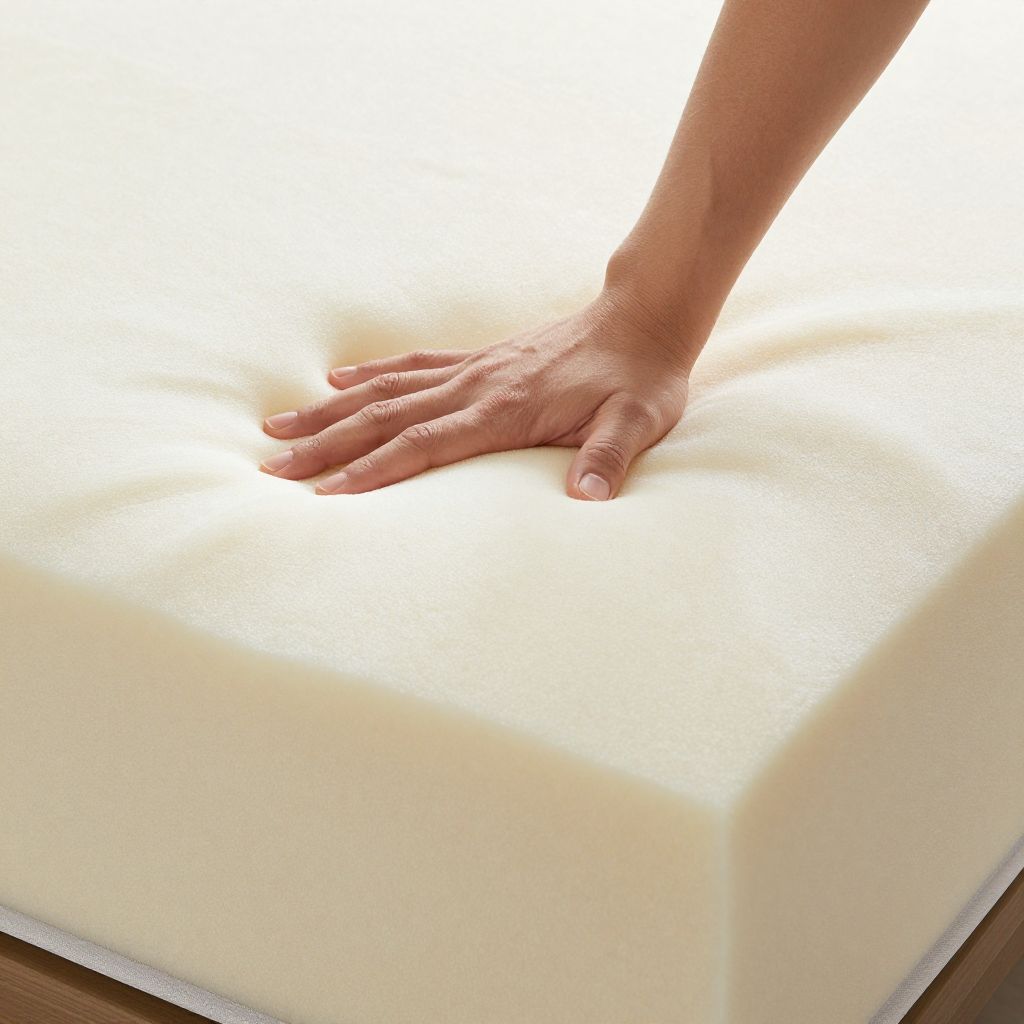
by Tempur material is Tempur-Pedic's proprietary high-density viscoelastic polyurethane foam, derived from research originally funded by NASA's Ames Research Center in the 1960s and 1970s. Tempur-Pedic licensed and commercialized the technology starting in 1992, and the company has held a patent moat around its specific formulation ever since. When most people say "memory foam," they're picturing Tempur material; when they say "Tempur-Pedic feel," they're describing the slow-rebound, body-cradling sensation that this specific foam delivers.
The actual chemistry of Tempur material is polyurethane viscoelastic foam, the same broad category as every other memory foam on the market. What makes it proprietary is the density (5-7 lb/ft3 in the comfort layer of most Tempur-Pedic models, compared to 3-4 lb/ft3 for typical bed-in-a-box brands), the cell structure (predominantly closed-cell in the original formulation, with hybrid open/closed cells in newer Tempur-APR and Tempur-ES variants), and the specific viscoelastic properties that make the foam soften noticeably as it warms up to body temperature.
The NASA Origin Story: Truth and Marketing
Tempur-Pedic's marketing has historically leaned heavily on the NASA connection. The story typically goes: NASA developed memory foam for astronaut crash cushions, and Tempur-Pedic adapted it for mattresses. The truth is more nuanced and worth getting right.
In the late 1960s, NASA contracted with Stencel Aero Engineering to develop seat cushioning that could reduce G-force injuries to pilots during ejection. The resulting material, called "slow spring back foam," was a temperature-sensitive viscoelastic polyurethane developed primarily by NASA contractor Charles Yost. The foam was never actually used in space missions. It was developed under NASA funding but designed for ejection-seat applications, which is closer to military aviation than to space flight.
NASA released the technology into the public domain in the early 1980s after determining it wasn't strategically critical. A Swedish company, Fagerdala World Foams, licensed and refined the formulation through the 1980s, and the Tempur-Pedic brand was founded in 1992 to commercialize the resulting material as a mattress and pillow product.
So: Tempur material has a real connection to NASA-funded research, but the foam was never used in space, and the modern Tempur formulation has been refined far beyond Yost's 1970s prototype. The current Tempur material is the result of three decades of Tempur-Pedic's own R&D, not a direct transplant from a NASA lab.
Current Tempur Material Specifications
Tempur-Pedic uses several variants of the core Tempur material across its 2026 mattress lineup. The variants differ in density, cell structure, and infused additives:
| Variant | Used in | Density | Key property |
|---|---|---|---|
| Tempur-ES | Tempur-Cloud, entry-level lines | ~4.5 lb/ft3 | Softer feel, faster rebound than original |
| Tempur-APR | Tempur-Adapt, Tempur-ProAdapt | ~5 lb/ft3 | Advanced Pressure Relief; balanced contouring |
| Tempur-APR+ | Tempur-ProAdapt, LuxeAdapt | ~6 lb/ft3 | Deeper contouring for side and pressure sleepers |
| Tempur-HD | Tempur-Breeze flagship | ~7 lb/ft3 | High-density base; durability and edge support |
| Tempur-CM+ | Tempur-Breeze (cooling layer) | Phase-change infused | Surface cooling beyond standard Tempur |
The headline density figures matter because polyurethane foam density is the single best predictor of long-term durability. At 5-7 lb/ft3, Tempur material is among the densest memory foams on the consumer mattress market. For comparison, a typical Casper or Nectar comfort layer is 3-4 lb/ft3; Amerisleep Bio-Pur is 4 lb/ft3; budget Amazon-direct memory foam is often 2-3 lb/ft3.
This is part of why Tempur-Pedic mattresses are priced two to three times higher than equivalent-thickness bed-in-a-box competitors. The raw foam input cost is substantially higher, and the manufacturing process for high-density viscoelastic foam is slower and more expensive than commodity foam production.
What Tempur Material Actually Feels Like
The signature Tempur feel comes from three properties working together:
- Temperature-responsive softening. Tempur material is engineered to be relatively firm at room temperature and soften noticeably as it warms toward body temperature (around 98 degrees Fahrenheit). When you lie down, the foam under your body warms up over 5-10 minutes and progressively molds to your contours.
- Slow rebound. When you change position or get up, Tempur material takes 5-10 seconds to return to its original shape, leaving a temporary impression. This is the "memory" in memory foam.
- Deep contouring. The high density combined with slow rebound creates the sensation of being cradled by the mattress rather than resting on top of it. Sleepers either love this or hate it; there's not much middle ground.
The contouring depth is what makes Tempur material polarizing. For back sleepers and side sleepers with pressure points (hips, shoulders), the deep cradle reduces pressure on bony prominences. For stomach sleepers and combination sleepers who move frequently, the slow rebound feels like sleeping in quicksand and makes position changes feel sluggish.
Tempur Material vs Amerisleep Bio-Pur (Direct Comparison)
Bio-Pur and Tempur material are both proprietary memory foams in the premium tier. They make different engineering trade-offs:
| Property | Tempur (Tempur-Pedic) | Bio-Pur (Amerisleep) |
|---|---|---|
| Density | 5-7 lb/ft3 | 4 lb/ft3 |
| Cell structure | Predominantly closed-cell (original), hybrid in APR/ES | Open-cell |
| Rebound time | 5-10 seconds | 2-3 seconds |
| Temperature sensitivity | High (softens with body heat) | Lower (more temperature-neutral) |
| Plant-based content | None (100% petroleum polyol) | Partial castor-oil polyol substitution |
| Sleep temperature | Warm to hot | Neutral to slightly warm |
| Off-gassing duration | 3-7 days | 24-72 hours |
| Queen price range (2026) | $1,999-$5,499 | $1,099-$1,799 |
| Warranty | 10 years (most lines), 25 years (LuxeAdapt) | 20 years |
| Best for | Sleepers who want deep cradle and slow-response memory foam | Sleepers who want memory foam contour without sinking |
For a sleeper who has slept on a Tempur-Pedic at a hotel and loved the deep-cradle feeling, the AS3 with Bio-Pur will feel responsive and significantly less sinking. For a sleeper who tried memory foam and hated feeling stuck, the AS3 is the safer pick. For a sleeper who specifically wants the slow-rebound classic Tempur feel and is willing to pay $2,000-$5,500 for it, Tempur-Pedic remains the category benchmark.
Try Amerisleep AS3 with Bio-Pur (Faster Rebound, Cooler Sleep) →
Why Tempur-Pedic Sleeps Hot (And What's Changed)
The heat-retention complaint about Tempur material is real and well-documented. The cause is twofold: high foam density and closed-cell structure. Dense closed-cell foam doesn't allow lateral air movement, so body heat warms the foam under the sleeper and stays trapped there throughout the night.
Tempur-Pedic has acknowledged this for years and engineered several heat-mitigation features into newer lines:
- Tempur-Breeze (introduced 2018, refreshed 2022): adds a phase-change material in the cover and a graphite-infused comfort layer. The Breeze degrees lineup (ProBreeze, LuxeBreeze) is engineered to sleep 4-10 degrees cooler at the surface than standard Tempur material.
- Tempur-CM+ cooling material: phase-change infusion that absorbs heat in the active sleep window (first 2-3 hours).
- SmartClimate covers: zip-off cover with cool-to-touch yarn on the sleep surface.
The flagship Tempur-LuxeBreeze sleeps notably cooler than the original Tempur material from the 1990s, but it still sleeps warmer than coil hybrids or pure latex mattresses. If hot sleep is the dominant complaint, the engineering reality is that high-density viscoelastic foam will always trap more heat than an open-cell or coil structure, regardless of cooling additives. For sleepers who run hot but want a foam mattress, Amerisleep Bio-Pur or Saatva Loom & Leaf (with its cooling cover) are alternatives worth considering before committing to a Tempur-Pedic at the $3,000-$5,500 price point.
Tempur Material vs Generic Memory Foam
Every memory foam mattress on the market is polyurethane viscoelastic foam. The category is huge and price varies tenfold. What distinguishes Tempur material from a $400 Amazon memory foam mattress isn't the chemistry; it's the manufacturing specs.
| Specification | Tempur | Mid-tier memory foam | Budget memory foam |
|---|---|---|---|
| Density (comfort layer) | 5-7 lb/ft3 | 3-4 lb/ft3 | 2-3 lb/ft3 |
| Indentation Load Deflection (ILD) | 10-14 (soft) to 18-22 (medium) | 10-20 range | Wider variance, often less consistent |
| Cell structure consistency | Engineered, batch-tested | Standardized commodity | Lower QC, batch variation |
| Expected body-impression onset | 10-15 years | 5-8 years | 2-3 years |
| CertiPUR-US certification | Yes | Usually yes | Inconsistent |
| Queen price (2026) | $1,999-$5,499 | $799-$1,499 | $199-$599 |
The density gap is the most important durability indicator. At 5-7 lb/ft3, Tempur material holds its rebound far longer than budget foams. A Tempur-Pedic mattress purchased in 2014 will typically still be in usable condition in 2026 with only minor body impressions, whereas a $400 budget memory foam from the same year is likely to have visible sagging and lost rebound.
For sleepers who want Tempur-like density without the Tempur price, Amerisleep Bio-Pur (4 lb/ft3) is the closest premium-density alternative. For sleepers willing to accept shorter mattress lifespan in exchange for lower price, mid-tier brands like Nectar or Casper offer 3-4 lb/ft3 foam at half the cost.
Tempur Material Alternatives by Sleeper Profile
- If you want the deep cradle: Tempur-ProAdapt remains the benchmark. Amerisleep AS5 (5-inch Bio-Pur layer) gets close at a third of the price.
- If you want memory foam without the heat: Amerisleep AS3 with Bio-Pur. The open-cell structure dissipates heat much faster than Tempur material.
- If you want memory-foam contour with bounce: Saatva Loom & Leaf, which uses high-density memory foam with a faster rebound profile than Tempur.
- If you want the Tempur feel for back pain specifically: Amerisleep AS2 with HIVE zoning targets lumbar support more precisely than uniform-density Tempur material does.
- If you want a Tempur alternative for couples: Saatva Classic Hybrid. The pocket coils give motion isolation comparable to Tempur material with significantly better edge support and cooling.
Tempur Material FAQs (2026)
Is Tempur material really from NASA?
The original viscoelastic foam formulation was developed under NASA contract for ejection-seat cushioning in the 1960s and 1970s. The foam was never used in space missions. NASA released the technology into the public domain in the early 1980s; Tempur-Pedic licensed and refined it starting in 1992. The current Tempur material is the result of 30+ years of Tempur-Pedic's own R&D.
Why does Tempur material sleep hot?
Tempur material is high-density (5-7 lb/ft3) and predominantly closed-cell, which traps body heat in the foam underneath the sleeper. Newer Tempur-Breeze lines mitigate this with phase-change cover material and graphite infusion, but the underlying foam still retains heat more than open-cell foams like Amerisleep Bio-Pur or coil hybrids.
Is Tempur material plant-based?
No. Tempur material is 100% petroleum-derived polyurethane foam. For plant-based memory foam alternatives, Amerisleep Bio-Pur uses partial castor-oil polyol substitution.
How long does a Tempur-Pedic mattress last?
At 5-7 lb/ft3 density, Tempur material is engineered for 10-15 years of usable life before significant body impressions develop. Tempur-Pedic warranties range from 10 years on entry lines to 25 years on the LuxeAdapt flagship.
Is Tempur material safe?
Tempur material is CertiPUR-US certified, which confirms low VOC emissions and the absence of PBDEs, formaldehyde, heavy metals, and ozone-depleting chemicals. Off-gassing typically resolves within 3-7 days, longer than open-cell foams because closed-cell structure releases residual chemicals more slowly.
What's the difference between Tempur-APR and Tempur-ES?
Tempur-APR (Advanced Pressure Relief) is the higher-density variant used in mid- and high-tier Tempur-Pedic models, with density around 5-6 lb/ft3. Tempur-ES is the softer, lower-density variant (around 4.5 lb/ft3) used in entry-level Tempur-Cloud lines. APR offers deeper contour; ES offers faster rebound and lower price.
Is Tempur material worth the price?
Tempur-Pedic mattresses run $2,000-$5,500 at queen size. For sleepers who specifically want the slow-rebound deep-cradle feel that Tempur material delivers, no competitor matches it. For sleepers who want premium memory foam contour without that specific feel, Amerisleep Bio-Pur or Saatva Loom & Leaf offer comparable durability at 30-50% lower price.
Compare with Amerisleep AS3 (Premium Memory Foam, Half the Price) →
Editorial note: MattressNut's analysis of Tempur material draws on Tempur-Pedic's published spec sheets, CertiPUR-US certification records, and NASA Spinoff archives documenting the original viscoelastic foam development. Tempur-Pedic is not currently a MattressNut affiliate partner; this analysis is independent of any commission arrangement. We compare Tempur material to materials available through partner brands (Amerisleep, Saatva) and disclose those relationships in CTAs.
2026 MattressNut Master Guides
- Live Mattress Sale Tracker — Memorial Day + Black Friday + brand discount calendar (updated weekly)
- Mattress Warranty Comparison 2026 — 20+ brands tiered by length, sagging threshold, prorated/non-prorated
- Foam Density Guide 2026 — the lb/ft³ number that predicts mattress lifespan
- Hotel Mattress Identifier — every chain + consumer equivalents (Saatva, Amerisleep alternatives)
- Live Mattress Price Tracker — 12 brands, all sizes, current Memorial Day 2026 pricing
- Our Medical Review Board — Dr. Burns + editorial standards