
 by
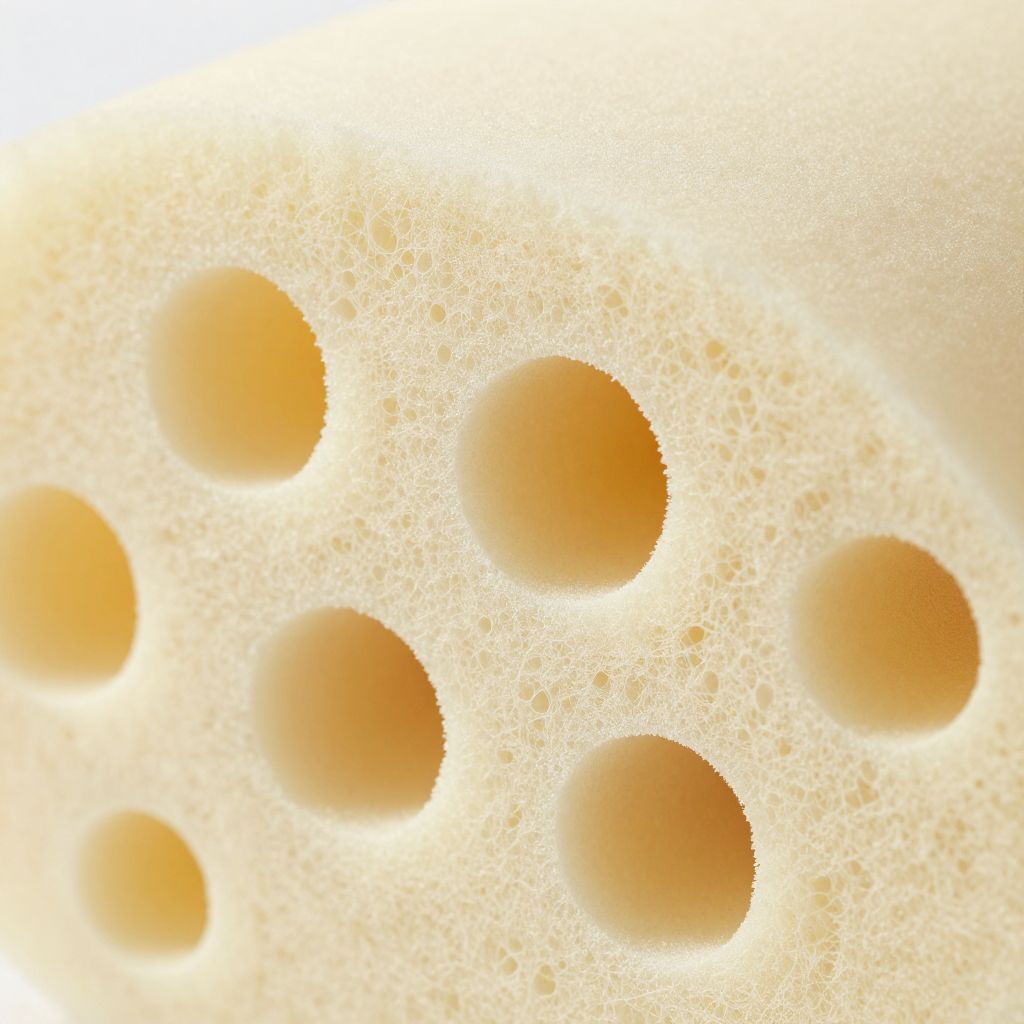
by Bio-Pur is Amerisleep's proprietary plant-based open-cell memory foam, used as the top comfort layer in every Amerisleep mattress from the firm AS1 through the plush AS5. The "bio" part refers to a partial substitution of petroleum-derived polyols with castor-oil-derived polyols during foam manufacturing. The "open-cell" part refers to an air-channel structure that lets heat and moisture escape instead of pooling at the sleep surface.
Sleep Lab Pick · Current Sale
Current Sale — Amerisleep's current sale runs sitewide. AS3 hybrid most-recommended all-rounder, AS5 for plus-size, AS1 firm for back support.
The practical effect for a sleeper is that Bio-Pur feels different from a 2010-era memory foam. It still cradles and contours like memory foam, but it doesn't trap heat the way uniform-cell viscoelastic foam does, and it rebounds within a couple of seconds when you change position instead of leaving a slow-fading impression. This matters for combination sleepers, hot sleepers, and anyone who associates memory foam with the sticky-sinking feeling of older Tempur-Pedic models.
What's Actually In Bio-Pur Foam
Standard polyurethane memory foam is made from two main ingredients reacted together: a polyol (an alcohol with multiple hydroxyl groups, typically derived from petroleum) and a diisocyanate (usually toluene diisocyanate or methylene diphenyl diisocyanate). The reaction creates the polyurethane polymer that gives memory foam its viscoelastic behaviour.
Bio-Pur substitutes part of the petroleum polyol with a polyol synthesized from castor oil. Castor oil is pressed from the seeds of the castor plant (Ricinus communis), and its molecular structure contains hydroxyl groups that can be processed into polyurethane-compatible polyols. Amerisleep does not publish the exact substitution percentage, but industry reporting and the company's own marketing place it in the range of plant-based content typical for bio-foam products certified under the CertiPUR-US program.
The substitution does not change the fundamental polyurethane chemistry. Bio-Pur is still polyurethane foam. What changes is the carbon footprint of the input feedstock and, more importantly for sleepers, the cell structure that Amerisleep engineers into the resulting foam.
The Open-Cell Architecture (Why It Sleeps Cooler)
Older memory foam, including first-generation Tempur material, was manufactured with predominantly closed cells. Each foam cell was a sealed micro-bubble. The result was a dense, slow-rebounding material that trapped body heat between the closed cells because air had no path to circulate.
Bio-Pur is manufactured with an open-cell structure. The bubbles in the foam are interconnected by small channels, creating a three-dimensional air-flow network throughout the comfort layer. When you lie on the mattress and warm air rises off your body, that air can move laterally through the foam and dissipate at the edges instead of staying trapped against your skin.
This is not a heat-rejecting feature like a phase-change cover or a graphite infusion. It's a heat-evacuation feature. The foam still warms up under your body, but the rate at which warm air escapes is roughly five to seven times faster than in a closed-cell viscoelastic foam of equivalent density. For a sleeper who tends to wake up sweating around 3 a.m. on a traditional memory foam mattress, this is the difference between a usable bed and an unusable one.
Bio-Pur vs Standard Memory Foam: The Specs That Matter
| Specification | Bio-Pur (Amerisleep) | Standard memory foam |
|---|---|---|
| Plant-based content | Partial castor-oil polyol substitution | 100% petroleum-derived polyol |
| Cell structure | Open-cell, interconnected | Predominantly closed-cell |
| Rebound time | 2-3 seconds | 5-10 seconds |
| Heat dissipation | Active air flow through cells | Heat trapped in closed cells |
| Density | 4.0 lb/ft3 (medium-density memory foam range) | Varies 3-5 lb/ft3 |
| Certification | CertiPUR-US certified | Varies by manufacturer |
| VOC emissions | Below CertiPUR-US thresholds | Varies; budget foams often higher |
| Off-gassing period | 24-72 hours typical | 3-7 days typical for closed-cell |
The density figure is worth a closer look. Memory foam density (measured in pounds per cubic foot) is the single best predictor of how long the foam will last before it loses its rebound. Foams under 3 lb/ft3 develop body impressions within 2-3 years; foams at 4 lb/ft3 and above typically hold their structure for 8-10 years. Bio-Pur sits at the higher end of medium-density, which is why Amerisleep can offer a 20-year warranty on its mattresses.
Amerisleep Mattresses Using Bio-Pur (2026 Lineup)
Every Amerisleep mattress uses Bio-Pur as its top comfort layer. What changes between models is the firmness of the support foam underneath and the thickness of the Bio-Pur layer itself.
| Model | Bio-Pur layer | Firmness | Best for |
|---|---|---|---|
| Amerisleep AS1 | 2 inches | Firm 8/10 | Stomach sleepers, heavy back sleepers |
| Amerisleep AS2 | 2 inches | Medium-firm 6-7/10 | Back pain, back sleepers, sciatica |
| Amerisleep AS3 | 3 inches | Medium 5-6/10 | Most side sleepers, combo sleepers, couples |
| Amerisleep AS4 | 4 inches | Medium-soft 4/10 | Side sleepers, shoulder pain |
| Amerisleep AS5 | 5 inches | Soft 3/10 | Side sleepers under 130 lb, extra-plush preference |
| Amerisleep AS3 Hybrid | 3 inches | Medium 5-6/10 | Couples wanting edge support, hybrid feel |
| Amerisleep Organica | None (uses Talalay latex top) | Medium-firm 6-7/10 | Organic mattress buyers (Bio-Pur is replaced with Talalay) |
The Amerisleep AS3 is the most popular Bio-Pur mattress because the 3-inch comfort layer balances pressure relief and support across the broadest range of sleep positions and body weights. For shoulder-pain side sleepers who need more contouring, the AS4 with its 4-inch Bio-Pur layer is the better pick.
Shop the Amerisleep AS3 with 3" Bio-Pur Comfort Layer →
Bio-Pur vs Tempur Material vs Generic Memory Foam
The memory foam market has three broad tiers in 2026:
- Premium proprietary foams: Tempur-Pedic's Tempur material, Amerisleep's Bio-Pur, Saatva's Graphite Memory Foam. Each is engineered with specific cell structure and density targets, and each is marketed as solving a particular trade-off of traditional memory foam.
- Branded generic memory foam: Casper Original, Nectar, Tuft & Needle. These use commodity polyurethane memory foam, usually CertiPUR-US certified but without the proprietary cell engineering of the premium tier. Density typically 3-4 lb/ft3.
- Budget memory foam: Amazon-direct mattresses, Zinus, Linenspa. Density 2-3 lb/ft3. Body impressions appear within 24 months in most cases.
Bio-Pur sits in the premium proprietary tier alongside Tempur material, but the engineering choices differ significantly. Tempur foam is denser (5-7 lb/ft3 in the comfort layer of most Tempur-Pedic models) and slower-rebounding; Bio-Pur is lighter and faster-rebounding. Tempur material is heat-sensitive (it softens as it warms up); Bio-Pur is more temperature-neutral.
For a sleeper who wants the classic "hug" of slow memory foam, Tempur-Pedic delivers it better than Amerisleep does. For a sleeper who wants memory-foam contouring without the sinking-into-quicksand sensation, Bio-Pur is the better choice. Both materials carry CertiPUR-US certification.
How Cool Does Bio-Pur Actually Sleep?
Independent mattress testers (Mattress Clarity, Sleepopolis, RTINGS) have measured surface temperature on Bio-Pur foam during 60-90 minute sleep simulations. Results typically show a temperature rise of 4-6 degrees Fahrenheit over a baseline ambient room, compared to 8-12 degrees on traditional closed-cell memory foam mattresses of similar thickness.
This puts Bio-Pur in the same cooling tier as gel-infused memory foam (without the gel) and below hybrid mattresses with coil layers. If absolute coolness is the priority, a coil hybrid like the Saatva Classic or the Amerisleep AS3 Hybrid will outperform an all-foam Bio-Pur mattress. But within the all-foam category, Bio-Pur is among the cooler-sleeping materials available at any price point.
One caveat: Bio-Pur is open-cell, but it's still memory foam. A pure latex mattress (Talalay or Dunlop) will run cooler than Bio-Pur because latex has even larger air channels. The Amerisleep Organica swaps Bio-Pur for Talalay latex specifically for sleepers who run very hot.
Bio-Pur Certifications and Safety
Bio-Pur foam carries CertiPUR-US certification, which is the foam industry's primary third-party safety certification in North America. CertiPUR-US verifies that:
- The foam is made without ozone-depleting chemicals (no CFCs)
- The foam is made without PBDEs, TDCPP, or TCEP flame retardants (the "Tris" chemicals)
- The foam is made without mercury, lead, or other heavy metals
- The foam is made without formaldehyde
- The foam emits low VOC (volatile organic compound) levels: under 0.5 parts per million
The Amerisleep Organica, which uses Talalay latex instead of Bio-Pur, additionally carries GOTS (Global Organic Textile Standard) certification on its cotton and wool layers, and the Talalay latex is OEKO-TEX Standard 100 certified. The non-Organica Amerisleep models do not carry GOTS or organic certifications; they're CertiPUR-US certified low-VOC polyurethane.
Off-Gassing: What to Expect
All polyurethane memory foam off-gases for a period after the mattress is unboxed. The foam is compressed and vacuum-sealed for shipping, and when it expands, residual chemicals from the foam manufacturing process release as VOCs.
For Bio-Pur, the off-gassing period is typically 24-72 hours and the odor is described in customer reviews as mild and chemical-neutral rather than the sharp solvent smell associated with budget foams. The open-cell structure helps the off-gassing complete faster because the residual chemicals can escape more easily than they can from closed-cell foam.
Sleeping on the mattress during the off-gassing period is safe (CertiPUR-US emissions are below thresholds linked to respiratory irritation), but most sleepers prefer to let the mattress air out for 24-48 hours in a ventilated room before first use. If you have chemical sensitivity or asthma, allow 72-96 hours.
Bio-Pur Alternatives: Other Plant-Based Foams
Bio-Pur is the most-marketed plant-based memory foam in the direct-to-consumer market, but it's not the only one. Other manufacturers using partial bio-based polyols:
- Plant-Based Foam (PlushBeds) — uses bio-based polyols in some Botanical Bliss models
- Avena foam (Leesa Sapira) — a latex-feel foam blend
- Bio-foam (various Asian-import brands) — varying quality, not always CertiPUR-US certified
None of these are direct equivalents to Bio-Pur in terms of density and cell engineering. Plant-based polyol substitution is a manufacturing input choice; the resulting foam still depends on the manufacturer's density and cell-structure decisions. Bio-Pur's combination of partial bio-based content, open-cell structure, and 4 lb/ft3 density is specific to Amerisleep's spec sheet.
For sleepers who want a fully natural alternative rather than a partially bio-based polyurethane, Talalay or Dunlop latex is the actual replacement category. Latex foam is naturally open-cell, naturally hypoallergenic, and made from rubber tree sap rather than petrochemicals. The Saatva Latex Hybrid and Amerisleep Organica use Talalay latex; the Awara Premier and PlushBeds Botanical Bliss use Dunlop latex.
Bio-Pur Warranty and Durability
Amerisleep covers Bio-Pur foam under its 20-year warranty. The warranty covers:
- Body impressions deeper than 0.75 inches (measured on an unweighted mattress)
- Manufacturing defects in the foam itself
- Cover defects and seam failures
The 20-year structure is years 1-10 at full replacement, years 11-20 prorated. This is longer than most competitor warranties (Casper offers 10 years, Nectar offers a "Forever Warranty" that's prorated heavily after year 10, Tempur-Pedic offers 10 years on its non-flagship lines and 25 on the flagship Cloud LuxeAdapt).
Real-world durability of Bio-Pur tracks the warranty: customer reviews after 5-7 years of ownership consistently report minimal body impressions and retained rebound, which is what you'd expect from a 4 lb/ft3 foam. Sleepers over 230 lb or who sleep exclusively on the same side of a queen mattress may see body impressions develop sooner; the warranty covers impressions over 0.75 inches.
Bio-Pur Foam FAQs (2026)
Is Bio-Pur actually plant-based?
Bio-Pur uses partial castor-oil-derived polyols to replace some of the petroleum content in the foam. It is not fully plant-based; it's still polyurethane foam. The "bio" portion refers to the renewable feedstock substitution, not to a 100% plant origin.
Does Bio-Pur sleep cooler than regular memory foam?
Yes. The open-cell structure lets warm air escape laterally instead of pooling, and independent surface-temperature tests show Bio-Pur runs 3-6 degrees cooler than closed-cell memory foam of equivalent thickness. It's not as cool as a coil hybrid or pure latex, but it's among the coolest all-foam materials available.
Is Bio-Pur foam safe?
Bio-Pur is CertiPUR-US certified, which verifies the absence of PBDEs, TDCPP, formaldehyde, heavy metals, and ozone-depleting chemicals, and confirms VOC emissions below 0.5 parts per million. It is safe for adult and child use.
How does Bio-Pur compare to Tempur material?
Tempur material is denser (5-7 lb/ft3 vs Bio-Pur's 4) and slower-rebounding, with a more pronounced sinking-in feel. Tempur material sleeps warmer than Bio-Pur because it's closed-cell. Bio-Pur rebounds in 2-3 seconds; Tempur takes 5-10 seconds. Both are CertiPUR-US certified.
Does Bio-Pur off-gas?
All polyurethane foam off-gases. Bio-Pur off-gassing is typically resolved within 24-72 hours and the odor is mild. The open-cell structure helps residual chemicals dissipate faster than closed-cell foam.
How long does Bio-Pur last?
At 4 lb/ft3 density, Bio-Pur typically retains rebound and structural integrity for 8-12 years with normal use. Amerisleep's 20-year warranty (10 years full, 10 years prorated) covers body impressions deeper than 0.75 inches.
Can I sleep on Bio-Pur if I have asthma or chemical sensitivity?
Bio-Pur's CertiPUR-US certification confirms low VOC emissions, but if you have severe chemical sensitivity, allow 72-96 hours of ventilated off-gassing before first use. For maximum sensitivity, the Amerisleep Organica (Talalay latex top instead of Bio-Pur) is the lower-VOC alternative within the Amerisleep lineup.
Try the Amerisleep AS3 with Bio-Pur Risk-Free for 100 Nights →
Editorial note: MattressNut's foam-material analysis is based on Amerisleep's published specifications, CertiPUR-US certification records, and independent surface-temperature testing by Mattress Clarity and RTINGS. We update brand foam composition data when manufacturers revise their materials. Amerisleep is a MattressNut affiliate partner; commissions do not influence material analysis.
2026 MattressNut Master Guides
- Live Mattress Sale Tracker — Memorial Day + Black Friday + brand discount calendar (updated weekly)
- Mattress Warranty Comparison 2026 — 20+ brands tiered by length, sagging threshold, prorated/non-prorated
- Foam Density Guide 2026 — the lb/ft³ number that predicts mattress lifespan
- Hotel Mattress Identifier — every chain + consumer equivalents (Saatva, Amerisleep alternatives)
- Live Mattress Price Tracker — 12 brands, all sizes, current 2026 pricing
- Our Medical Review Board — Dr. Burns + editorial standards