
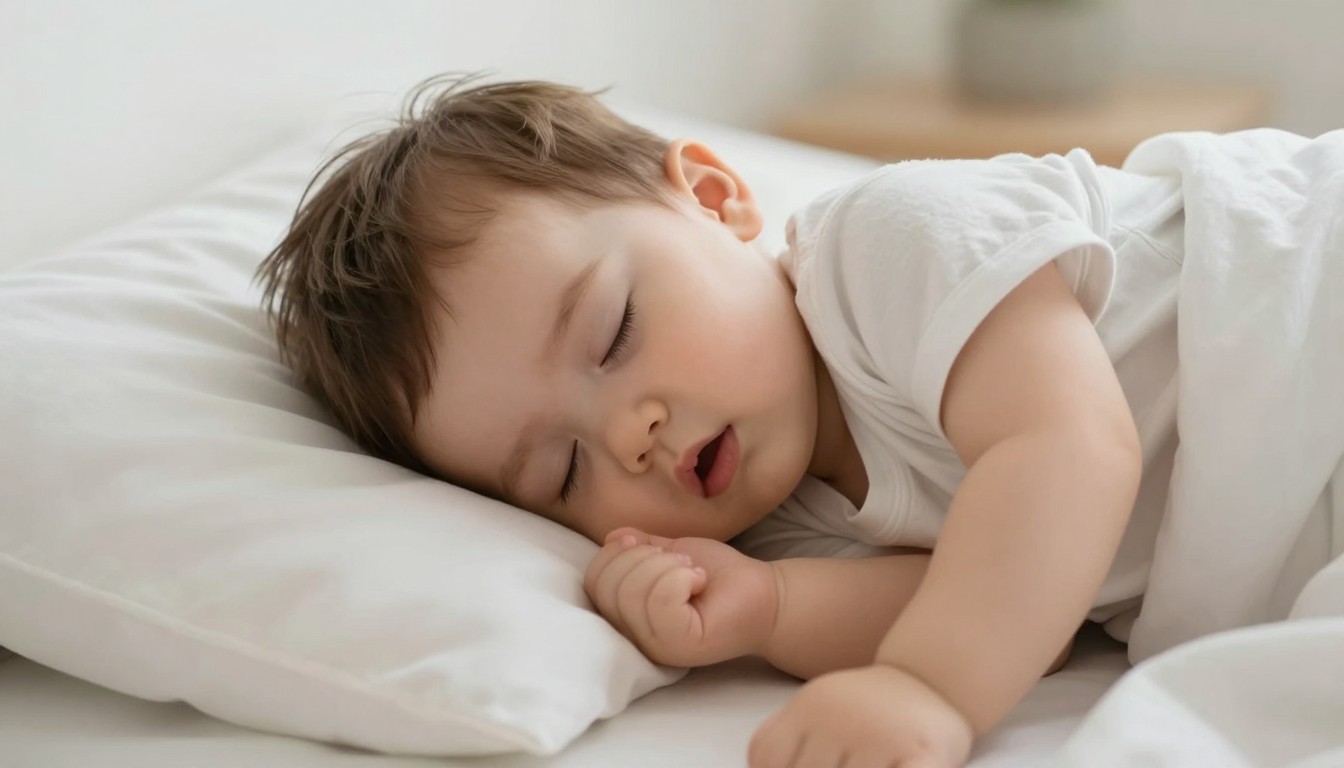
 by
by Quick answer: A sudden snore doesn’t reveal its cause. Track the sound and breathing pattern, note what changed, and contact your toddler’s pediatrician if it repeats or worries you.
- National Sleep Foundation figures cited in Is My Toddler’s Snoring Normal? estimate that about 27 percent of children snore occasionally.
- The same figures estimate that about 10 to 12 percent snore more regularly.
- The source distinguishes mild, temporary snoring from regular primary snoring, but neither label explains an individual child’s sudden change.
Updated July 2026 · Reviewed for accuracy
If the snoring is genuinely new, focus on what changed rather than how loud it sounds. The noise alone can’t identify a cause, and I wouldn’t buy a pillow, mattress, spray, or gadget as a first response.
Your best next step is to observe without trying to diagnose. A clear description of the timing, breathing pattern, sleep position, and recent changes gives your toddler’s pediatrician useful context.
What sudden toddler snoring tells you
About 27 percent of children snore occasionally, according to National Sleep Foundation figures cited in Is My Toddler’s Snoring Normal?. That statistic shows that an occasional snore isn’t rare, but it doesn’t tell you why your toddler started making the sound now.
The same source says about 10 to 12 percent of children snore more regularly, using the term primary snoring for that pattern. Those figures concern children generally, so they shouldn’t be treated as a toddler-specific diagnosis or as a reason to dismiss a new breathing noise.
“All of a sudden” is the most useful part of your question. It gives you a before-and-after point. Your toddler previously slept without the sound, as far as you noticed, and now the sound is present. That means the timeline deserves attention even though it doesn’t reveal the explanation.
My take: Loudness is less useful than pattern. Note whether the sound is isolated or recurring, whether breathing looks comfortable, and whether anything else changed at the same time.
A single noisy period and a recurring pattern aren’t interchangeable. Instead of deciding that the sound is “normal” or “abnormal” from one impression, write down exactly what happened. Plain observations are more reliable than labels.
Also separate snoring from the rest of sleep. Bedtime resistance, waking, naps, and a new breathing noise may appear during the same period without sharing the same explanation. Our guide to toddler sleep regression can help you organize broader sleep changes, but a regression label doesn’t explain sudden snoring.
What to check while your toddler is sleeping
The first useful detail is whether your toddler appears to be breathing comfortably. Watch from a safe position and describe what you can actually see or hear, without assigning a condition to it.
A practical observation checklist
- Did the sound begin as your toddler fell asleep, or did you notice it later?
- Does it continue steadily, or come and go?
- Is your toddler’s mouth open or closed?
- Does the nose sound clear or blocked?
- Does breathing look easy, or does it appear unusually effortful?
- Do you notice pauses, abrupt changes, gasping sounds, or repeated waking?
- Is your toddler sleeping on the back, side, or in another familiar position?
- Does the sound change after your toddler moves naturally?
You don’t need to wake or repeatedly move a comfortable child just to complete the list. The point is to capture what occurs naturally. If anything looks immediately dangerous or your child appears to be struggling to breathe, stop observing and seek urgent help.
A short audio or video clip can preserve details that are hard to describe from memory. Keep the recording private and use it only to explain the episode to an appropriate clinician. A clip can document the sound, but it can’t replace an examination or tell you the cause.
Look for a timeline change, not a culprit.
- A different pillow, sheet, sleep surface, or sleep position
- A change in the bedroom’s heating, cooling, airflow, or noise
- A recent change in bedtime, naps, or overnight waking
- A nose that sounds different from usual
- Other health or behavior changes you’ve already noticed
- Any medicine or care plan a clinician has recently discussed with you
These details are prompts for observation. Their presence doesn’t prove that any one of them caused the snoring.
Check how your toddler seems after waking as well. You can record whether mood, alertness, appetite, voice, or usual activity seems different, but avoid turning a normal variation into a diagnosis. The useful question is simply: “What is different from my child’s usual pattern?”
How to build a useful snoring record
A dated note is more useful than “this has been happening lately.” Record each episode in the same format so the pattern is easy to scan and you don’t have to reconstruct it later.
| What to record | Useful description | Avoid writing |
|---|---|---|
| Timing | “Started soon after falling asleep” | “It happens all the time” if you aren’t sure |
| Sound pattern | “Steady,” “intermittent,” or “changed after moving” | A guessed diagnosis |
| Visible breathing | Exactly what you saw, including any pauses or effort | “Breathing was fine” if you didn’t watch it |
| Sleep position | The position in which you noticed the sound | Assuming the position was the cause |
| Recent changes | New bedding, room conditions, routine, or health observations | Changing several things and guessing which mattered |
| After waking | How your toddler compared with their usual self | Conclusions based on one mood or behavior |
Use ordinary language. “Rough, low sound with the mouth open” is more informative than a medical term you aren’t confident about. If the pattern changes during the night, record the change instead of forcing the whole episode into one description.
Don’t delay seeking help merely to create a complete log. If you’re concerned, contact your toddler’s pediatrician with the information you already have. If the situation appears urgent, recording details comes second to getting immediate help.
It also helps to separate established facts from uncertainty. “I heard it on these nights” is an observation. “The new pillow caused it” is a conclusion the timeline alone can’t support.
Keep the record simple: what you heard, what you saw, when it happened, what recently changed, and how your toddler seemed afterward.
Could the pillow, mattress, or bedroom be involved?
A new pillow or bedroom change is a concrete timeline marker, but it isn’t proof of cause. I’d record that change and check the setup for ordinary comfort and safety rather than treating bedding as a cure.
Start with the pillow. Note whether one was recently introduced, removed, replaced, folded, or stacked. If you’re reviewing the basic fit and setup, our toddler pillow guide provides broader bedding context, but it shouldn’t be used to diagnose a new breathing sound.
Bedding audit, not treatment plan
- Check whether the sleep surface is flat, stable, and set up as intended.
- Look for bedding that has shifted from its usual position.
- Note any newly added pillow, protector, blanket, or soft item.
- Record changes in heating, cooling, or airflow.
- Avoid improvised wedges, stacked pillows, or adult snoring devices unless an appropriate clinician has directed their use.
The mattress itself can be inspected for obvious changes, such as a shifted setup or an unfamiliar sleeping area. That’s a basic environment check, not evidence that mattress construction explains snoring. Buying a different mattress in response to a sudden sound would be guesswork without clearer guidance.
The same restraint applies to room temperature, a fan, a heater, or a change in household noise. Write down what changed, but don’t assume a bedroom detail is responsible merely because the dates overlap. Our toddler bedroom setup guide can help you review the room as a whole without presenting it as a snoring treatment.
Naps belong in the record too. Sleep Foundation describes naptime as often important for keeping infants and toddlers rested, but its nap guidance doesn’t establish why a child snores. If naps recently shifted, note that as part of the wider sleep timeline rather than treating it as the answer.
When to contact a pediatrician
Breathing that looks difficult deserves more attention than sound volume alone. If you believe your toddler is struggling to breathe, is in immediate danger, or can’t be awakened normally, use local emergency services rather than waiting for an online explanation.
| Situation | Reasonable response |
|---|---|
| Your toddler appears to be in immediate danger or struggling to breathe | Seek urgent help through local emergency services. |
| You observe pauses, gasping sounds, unusual effort, or another worrying breathing change | Contact an appropriate clinician promptly and describe exactly what you observed. |
| The snoring repeats or becomes part of the regular sleep pattern | Discuss the pattern with your toddler’s pediatrician rather than diagnosing it from home. |
| The sound is new and you’re simply uneasy about it | Call the pediatrician. Parental concern is enough reason to ask for individual guidance. |
There isn’t a responsible universal waiting period I can give from the sound alone. Your toddler’s history, the breathing pattern, other changes, and the clinician’s judgment matter more than an arbitrary deadline.
Take your notes or recording to the conversation. Ask whether the clinician wants to know about sleep position, bedtime changes, naps, the way the nose sounds, waking, or daytime behavior. Let the clinician decide which details matter medically.
Don’t let prevalence statistics overrule what you see. Occasional snoring may be reported in many children, but a population estimate can’t assess the child in front of you.
My bottom line on sudden toddler snoring
One new sound gives you a reason to pay attention, not a diagnosis. I’d observe the breathing pattern, make a clean timeline, note recent changes, and contact the pediatrician if the snoring repeats, comes with other concerning observations, or simply doesn’t feel right.
I wouldn’t start with adult snoring sprays, mouthpieces, supplements, improvised pillow stacks, or a mattress purchase. None of those choices explains why the sound began, and changing several things at once can make the timeline harder to interpret.
Avoid these shortcuts
- Don’t diagnose a condition from loudness or an audio clip.
- Don’t assume that occasional means harmless in every individual case.
- Don’t assume a bedding or room change caused the snoring merely because it happened first.
- Don’t apply adult-oriented remedies to a toddler without appropriate professional guidance.
- Don’t wait to seek urgent help if breathing appears seriously difficult.
If you want background on the wider range of approaches people discuss, read our general guide to snoring remedies with one firm limitation in mind: general or adult advice isn’t automatically suitable for a toddler. For a young child with a sudden new symptom, individualized guidance belongs with a pediatric clinician.
FAQ
Is it normal for a toddler to suddenly start snoring?
National Sleep Foundation figures cited in Is My Toddler’s Snoring Normal? say occasional snoring occurs in about 27 percent of children, while about 10 to 12 percent snore more regularly. Those figures don’t determine whether your toddler’s sudden change is normal, so track it and ask the pediatrician if it repeats or concerns you.
Does a blocked-sounding nose explain the snoring?
A blocked-sounding nose is a useful observation, but the sound alone doesn’t prove what is happening or why. Record whether it is new, whether the mouth is open, and whether breathing looks comfortable, then give those details to your toddler’s pediatrician.
Should I change my toddler’s pillow?
Not as an attempt to diagnose or treat sudden snoring. If the pillow recently changed, record that fact and check that the sleep setup is being used as intended, but don’t assume the pillow is responsible.
Should I record my toddler snoring?
A short, private audio or video clip can help you describe what you heard and saw to a clinician. It can’t identify the cause, and recording should never delay urgent help if your toddler appears to be struggling to breathe.
When is toddler snoring an emergency?
If your toddler appears to be in immediate danger, is struggling to breathe, or can’t be awakened normally, contact local emergency services. For recurring snoring or other worrying changes that don’t appear immediately life-threatening, contact the child’s pediatrician for individual guidance.