
 by
by Wood slats are better for most mattresses. They distribute weight more evenly, run quieter long-term, and flex slightly to absorb motion. A quality metal platform frame (welded grid, gaps under 3 inches) is a close second and lasts longer. The main mistake is using a traditional metal rail frame with no platform surface, which will void mattress warranties and cause sagging within months.
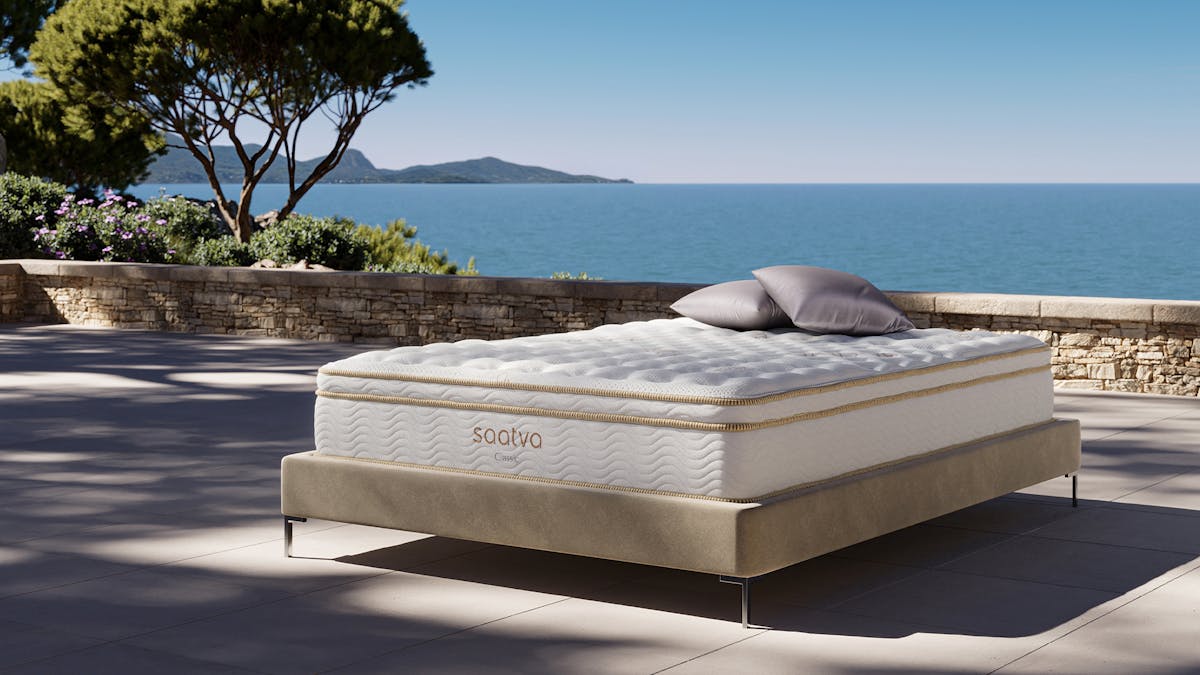
Saatva Classic
9.2/10
- Dual-coil construction eliminates the slat-dependency problem entirely
- Matched Saatva Foundation available — engineered wood frame, no gap concerns
- Free White Glove delivery with in-room setup and old mattress removal
- 365-night home trial, lifetime warranty
- Ships assembled, not in a box, so doorway clearance matters
- $99 return fee if returned during trial
If you are asking whether your current frame is good enough for a new mattress, the Saatva Classic with its matched foundation removes the question entirely. The foundation is an engineered wood frame built to Saatva's own load specs, so you get the support geometry the mattress was designed around.
Wood slat frames: what you need to know
Wood slat frames use individual boards, typically pine, spruce, or poplar, laid across a perimeter rail. The setup varies by manufacturer, but the meaningful specs are material, width, thickness, and spacing.
- Slat material: pine (most common), spruce, or poplar
- Typical dimensions: 2.75 to 3.5 inches wide, 0.75 to 1 inch thick
- Spacing: 2 to 4 inches, depending on the frame
- Slight natural flex in the slat absorbs micro-motion between partners
Advantages of wood slats
- Quieter: Wood-on-wood contact is softer than metal-on-metal joints, which tend to develop squeaks as bolts loosen over time.
- Better airflow: Natural material plus open gaps allow heat to move away from the mattress surface.
- Slight flex: Reduces motion transfer, useful for couples where one partner moves during the night.
- Replaceable: Individual slats cost $3 to $5 each and can be swapped without replacing the whole frame.
- Non-slip grip: Rough wood texture holds a mattress better than smooth steel, without a non-slip pad.
Disadvantages of wood slats
- Can crack: Thin slats under 3/4 inch are a problem under heavy loads. Budget frames often ship with undersized slat stock.
- Warping: High-humidity environments, basements especially, can cause slats to bow over months.
- Shifting: Slats that are not secured with a center strap or notch can slide out of position, creating an uneven support surface.
Metal bed frames: two very different products
Metal is not a single category here. There are two fundamentally different products that both get called "metal bed frames," and conflating them is the most common mistake shoppers make.
Type 1: traditional metal rail frame
Four metal side rails with a couple of cross-beam supports, but no platform surface at all. This type provides no support for a mattress placed directly on it. Using a foam or hybrid mattress directly on a traditional rail frame will cause sagging within weeks and will void most mattress warranties. Rail frames require a box spring or solid foundation placed on top before a mattress goes on.
Type 2: metal platform frame with grid
Metal frames with a welded steel grid or closely spaced metal slats, typically under 3 inches apart. These function as a complete foundation and can support a mattress directly. Zinus, Tuft and Needle, and similar brands produce metal platform frames in this category. Check the gap measurement on the specific model before buying, since not all frames from a given brand have the same spacing.
Advantages of metal platform frames
- Durability: A welded steel grid will outlast most wood slat setups by a decade or more. No warping, no cracking.
- Adjustable height: Many metal platforms offer multiple leg-height settings.
- Consistent support: Welded construction does not shift the way individual slats can.
- Lower entry cost: Decent metal platforms start around $60 to $80 versus $120 to $200 for a quality wood slat frame.
Disadvantages of metal platform frames
- Noise over time: Metal-on-metal joints develop squeaks as bolts work loose under load cycling. This is almost inevitable after two to three years on a low-to-mid-price metal frame.
- Mattress migration: Smooth steel gives a foam mattress almost nothing to grip, so a non-slip pad is usually necessary.
- Cold conduction: Not a meaningful thermal factor in most rooms, but steel conducts ambient cold slightly more than wood in unheated spaces.
Side-by-side comparison
| Factor | Wood slats | Metal platform (grid) |
|---|---|---|
| Noise level | Lower | Higher (long-term) |
| Durability | Good (10–15 yr) | Excellent (20+ yr) |
| Foam mattress compatibility | Excellent (3 in spacing or less) | Good (verify grid gap) |
| Repairability | Easy (swap individual slats) | Hard (weld or full replacement) |
| Airflow | Good | Good |
| Typical cost | $120–$300 | $60–$200 |
| Mattress grip | Good (rough texture) | Needs non-slip pad |
| Humidity sensitivity | Moderate (can warp) | None |
Which to choose by situation
Light sleepers bothered by noise: Wood slats. Metal platforms develop squeaks at bolted joints after two to three years of regular use. Wood-on-wood is quieter even when it ages.
Sleepers over 230 lb, or couples over 400 lb combined: Use 1-inch-thick wood slats or a welded metal platform. Thin wood slats (under 3/4 inch) can bow or crack under sustained heavy load.
Foam mattresses (memory foam, latex, or all-foam hybrids): Both work, but confirm gap spacing. Most foam mattress manufacturers require slat gaps of 3 inches or less. A grid metal platform with gaps under 2.5 inches is often the most reliable choice.
High-humidity spaces (basements, older homes): A metal platform is lower risk. Wood slats can warp in sustained humidity above 60%.
Budget-first: Entry-level metal platforms are $60 to $80 and outperform cheap thin-slat wood frames. If budget is tight, buy a verified grid metal platform rather than a bargain wood frame with undersized slats.
What mattresses actually require from a foundation
The spec that matters is maximum gap size, not the material. Most foam and hybrid mattress warranties state 3 inches as the maximum permissible gap between support slats or grid members. Going beyond that allows the foam core to deflect into the gap, which creates the contact points that degrade foam faster than normal compression does.
Innerspring mattresses with a low-profile foundation are less sensitive to gap size because the coil deck spans gaps internally. Foam-core mattresses, whether all-foam or hybrid, are the ones where slat spacing matters most.
A matched mattress-foundation pair from the same manufacturer eliminates this concern. The Saatva Classic paired with a Saatva Foundation, for example, is engineered as a system, so there is no guesswork about compatibility.
Frequently asked questions
Are wood slats or metal slats better for a mattress?
Wood slats are better for most situations. They generate less noise, provide a non-slip grip surface, and flex slightly to absorb motion. Metal grid platforms are more durable long-term but require a non-slip pad and tend to develop joint squeaks faster.
Can a metal bed frame damage a mattress?
A metal platform frame with a welded grid and gaps under 3 inches is fine for any mattress. The damaging type is the traditional metal rail frame with only four corner and side rails and no platform surface, which provides no middle support and will cause severe sagging within months on any foam or hybrid mattress.
Do wood slats squeak?
New wood slats rarely squeak. Squeaking develops when slats shift in their track or when adjacent slats touch each other during movement. Adding felt pads under each slat, using non-slip mat strips, or securing slats with a center strap fixes this in most cases.
What weight limit do wood slats have?
Standard 1x4 pine slats at 3/4 inch thick support 500 to 600 lbs combined sleeper weight when spaced 3 inches apart. For heavier couples or sleepers over 250 lbs, 1x6 boards at 1.5 inches thick or adding a center support rail is the right move.
Is a Zinus metal platform frame good for a Saatva mattress?
Several Zinus metal platform models have closely spaced grid supports at 2 to 3 inch gaps that meet Saatva's requirements. Confirm the gap measurement on the specific model before buying, since spacing varies across the Zinus product line.
How does slat spacing affect a foam mattress?
Foam deflects into any gap larger than 3 inches under sustained body weight. Over time this creates pressure lines in the foam core that compress unevenly and accelerate wear. Keeping gaps at 3 inches or less prevents this. Most foam mattress warranties are explicit on this point.
Wood slats win on noise and grip. Metal platform frames win on durability and cost. Both work well for foam and hybrid mattresses as long as slat or grid gaps stay at 3 inches or less. If you are buying a new mattress alongside a new base, a matched foundation-mattress pair from a single brand eliminates compatibility questions. The Saatva Classic with a Saatva Foundation is the version of that we recommend most.
Saatva Classic
9.2/10
Dual-coil innerspring hybrid with three firmness options, a reinforced lumbar zone, and free White Glove delivery. The matched Saatva Foundation removes any slat-spacing concern. 365-night trial, lifetime warranty.