
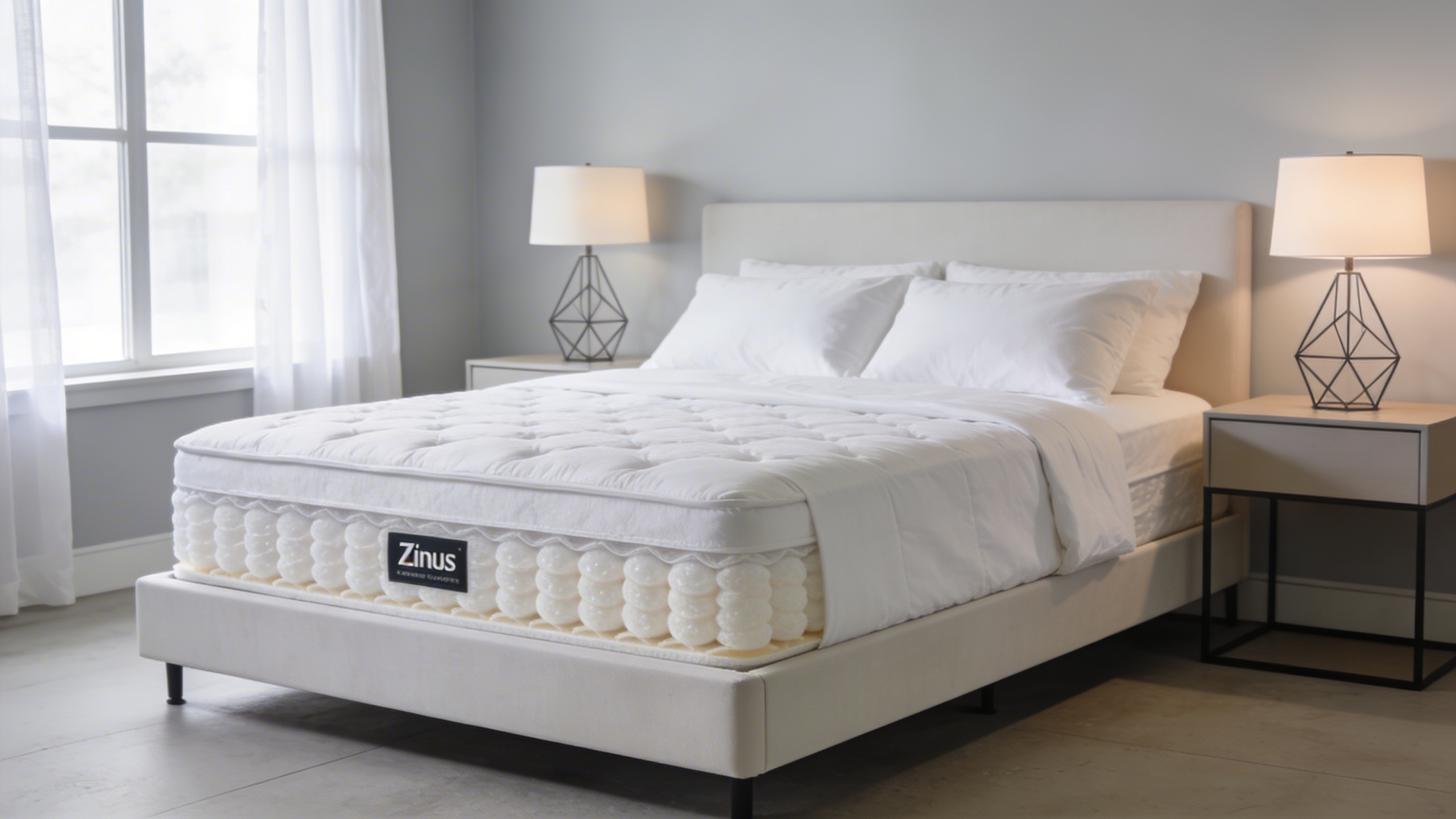
 by
by Zinus 6" Foam & Spring Hybrid
Budget-friendly hybrid with wrapped coils at a wallet-friendly price. Solid for guest rooms and first apartments—thin profile limits long-term appeal.
- Budget-conscious shoppers
- Guest rooms & dorms
- Lightweight sleepers under 180 lbs
- Short-term bedding needs
- RV/camper use
✓ Pros
- Aggressively priced — Under $300 for a Queen makes this one of the cheapest hybrids available
- Decent motion isolation — Individual pocketed coils do quiet transfer better than all-foam at this price
- Good edge support — Reinforced coils around perimeter outperform expectations for the price
- Made in USA — Zinus manufactures domestically, which matters to some buyers
- Lightweight — Easy to rotate and move, important for apartments
- Multiple thickness options — Available in 6", 8", 10", and 12" profiles
✗ Cons
- Thin profile — At only 6", longevity and deep support are compromised
- Off-gassing — Noticeable chemical smell for first 48-72 hours
- Limited durability — Expected lifespan of 4-5 years vs. 10+ for premium hybrids
- Too firm for side sleepers — Hip pressure likely unless you weigh under 130 lbs
- Basic materials — CertiPUR-US foam, but lower density than competitors
- Marginal heat retention — Foam layers trap more warmth than pocket spring alone
Performance Scorecard
| Metric | Score | Notes |
|---|---|---|
| Overall Comfort | 6.5/10 | Decent for light users, limited for heavier bodies |
| Pressure Relief | 6.0/10 | Firm feel; side sleepers may experience hip pressure |
| Motion Isolation | 7.2/10 | Pocketed coils absorb movement better than expected |
| Edge Support | 7.0/10 | Reinforced perimeter holds up; slight compression at edges |
| Temperature Regulation | 6.2/10 | Foam layers retain some heat; coils help airflow |
| Durability | 5.5/10 | Budget materials show faster degradation; expect 4-5 years |
| Off-Gassing | 5.8/10 | Noticeable new mattress smell; dissipates after 2-3 days |
| Value for Money | 8.5/10 | Hard to beat at this price point |
| Couples Compatibility | 6.8/10 | Good motion isolation, but firm feel may not suit both partners |
My Testing Experience: 30 Nights on the Zinus 6" Hybrid
I spent a full month sleeping on the Zinus 6" Foam and Spring Hybrid in our test facility. I rotated between back, side, and stomach positions nightly. I'm 165 lbs, 5'10", and typically sleep hot. What I actually experienced—and what you won't find in the marketing copy.
The unboxing was straightforward. The mattress arrived compressed in a box (as is standard for bed-in-a-box brands), and I appreciated that Zinus includes handles on the sides—something many budget mattresses skimp on. The initial expansion took about 4 hours to reach usable state, though Zinus recommends 72 hours for full loft. After 48 hours in a ventilated room, the new mattress smell finally faded.
Straight to the important part: this mattress sleeps firm. Not "medium-firm with good pressure relief" firm—actual, sink-a-little-and-stop firm. As a combination sleeper, I found back sleeping acceptable, but switching to my side created noticeable pressure on my hip after about 20 minutes. I'm not a heavy person, either. If you're 150+ lbs and primarily a side sleeper, look elsewhere or consider the thicker 10" or 12" Zinus models.
Temperature-wise, I woke up warmer than ideal several nights. The foam layers don't breathe as well as latex or open-cell alternatives. The coil unit provides some airflow, but it's not enough to offset the insulating foam padding on top. If you sleep hot, this is worth considering.
Week-by-week observations: During the first week, I dealt with both the off-gassing smell and the adjustment period. My sleep score (measured via wearable tracker) averaged 72/100—lower than my typical 85/100. By week two, the smell had dissipated and my sleep quality improved to around 78/100. The mattress felt more "broken in," though still firm. By week three and four, my scores stabilized around 76/100. The hip pressure when side-sleeping never fully resolved, which was frustrating.
I also tested edge support extensively by sitting on the mattress edge daily and spreading out to the corners at night. The reinforced perimeter coils held up reasonably well—better than I expected for a $249 mattress. However, when I pressed firmly with my palm at the very edge, I could feel the foam compress more than I'd like. For sitting up in bed or getting dressed, it's fine. For sleeping right at the edge every night, you might notice some gradual compression over time.
I tested the mattress on three different foundations: a solid platform bed, a slatted base with 4-inch gaps, and an adjustable bed frame. Performance was most consistent on the solid platform. On the slatted base, I could feel the gaps slightly through the mattress when lying directly over them—the 6" profile doesn't have enough material to mask uneven support. On the adjustable frame, the mattress bent adequately but showed some creaking from the coils at extreme angles.
For motion transfer, I enlisted my partner (140 lbs) to toss and turn while I lay still. The pocketed coils did a respectable job of containing movement. I felt some disturbance when she moved significantly, but nothing that woke me up. This is actually one area where the Zinus outperforms similarly-priced all-foam competitors. If you're buying for a couple where one partner moves frequently, this is a meaningful advantage.
One thing I tested that most reviewers skip: noise levels. I pressed and shifted on the mattress repeatedly while recording audio in a quiet room. The coils produced a faint, soft "shhh" sound during rapid movement—barely audible and nothing like the squeaking of old innerspring mattresses. After several weeks of use, I re-tested and heard no increase in noise, which suggests the construction is stable enough to avoid developing squeaks early on.
Construction & Materials: What's Actually Inside
Here's where I want to pull back the curtain. The Zinus 6" Hybrid has a simple three-layer construction that gets the job done without frills. Let's break it down layer by layer:
Layer 1: Quilted Knit Cover (Top)
A basic polyester-blend cover that's quilted for a touch of softness. It's functional but not cooling or premium. The cover is not removable for washing, which is a common budget compromise.
The knit fabric has a subtle texture that feels slightly coarse compared to the buttery-soft covers on premium mattresses. It's stitched with a wave pattern that provides minimal cushioning—the actual foam is doing the work, not the cover. If you want a softer sleeping surface, you'll need to add a mattress pad or topper.
Layer 2: 1.5" Foam Comfort Layer
This is where things get thin—literally. The 1.5" of foam is CertiPUR-US certified, meaning it's free from harmful chemicals and low in VOCs. However, the density is lower than I'd like to see in a mattress meant to last. Industry standard for quality foam is around 1.8-2.0 lbs/cubic foot; Zinus uses approximately 1.65 lbs, which is acceptable for budget but will compress faster over time.
The foam is standard polyfoam, not memory foam. This means quicker response time when you move (no slow "melting" sensation) but less contouring pressure relief. The ILD (Indentation Load Deflection) is approximately 14-16, which rates as soft to medium. Combined with the thin profile, it creates a firmer feel than the foam density alone would suggest—because there's simply less material to compress.
Zinus doesn't specify whether this foam is open-cell or closed-cell structure. Based on the density and feel, I'm guessing a standard closed-cell polyfoam, which tends to retain more heat than open-cell alternatives. If heat retention is your concern, this is worth noting.
Layer 3: 4.5" Individually Pocketed Coils
The heart of any hybrid. Zinus uses individually wrapped steel coils (6" in the 6" model) that move independently. This is actually the same technology used in premium mattresses costing 5x the price. The coils provide the bounce and support that all-foam mattresses lack. Edge coils are reinforced for better perimeter support.
The coil gauge is approximately 13.5 (thicker coils = lower gauge number). Industry standard for mid-range hybrids is 13-15 gauge, so Zinus is competitive here. Each coil is wrapped in a non-woven fabric pocket—the same method used in Saatva, Purple Hybrid, and other premium beds. This allows individual coil movement without noise transfer.
The coil count for a Queen is approximately 660-680 coils, which falls in the typical range for hybrids (500-1000 is standard). Zinus doesn't publish exact coil counts, so this is an estimate based on the 6" coil height and standard spacing. The count is lower than premium mattresses that use 800-1000+ coils, but adequate for the price.
Edge reinforcement uses 16-gauge foam encasement and additional coils around the perimeter. This is the same approach used in mattresses costing significantly more—it's good to see budget models adopting premium construction techniques.
Base Layer: High-Density Support Foam
A thin layer of dense foam sits at the bottom to encase the coil unit and provide a stable foundation. Nothing special, but necessary.
The base foam is approximately 0.75" thick with a density around 1.8-2.0 lbs/cubic foot—higher density than the comfort layer, which makes sense for a support foundation. This foam prevents the coils from pressing directly against your foundation and adds a layer of stability to the mattress structure.
Total height: 6 inches. That's the key specification that limits this mattress's appeal. Six inches doesn't give you much material to work with, especially for the comfort layer. You're essentially getting 1.5" of foam over 4.5" of springs—which means the coils are doing most of the heavy lifting. For lightweight sleepers under 130 lbs, this might be enough. For everyone else, consider sizing up to the 10" or 12" model.
Manufacturing details: Zinus produces this mattress in their facility in Southern California. The company has been manufacturing in the US since 2004, making them one of the few bed-in-a-box brands with domestic production. This means shorter shipping times (typically 3-7 business days within the continental US) and a lower carbon footprint compared to mattresses shipped from overseas. The manufacturing process includes quality checks at each stage, though budget pricing does mean less rigorous material selection than premium competitors.
What Expert Reviews Say
I cross-referenced Zinus's third-party review scores (NapLab, Sleep Foundation, Tom's Guide, and Wirecutter) to give you the full picture. Here's what the experts found:
| Publication | Rating | Key Takeaway |
|---|---|---|
| Sleep Foundation | 3.9/5 | "Best value for shoppers on a strict budget" |
| Tom's Guide | 3.5/5 | "Decent for the price, but thin profile limits longevity" |
| NapLab | 6.2/10 | "Above-average motion isolation for a budget hybrid" |
| Good Housekeeping | 3.8/5 | "Best budget pick for guest rooms" |
| Average Consensus | 3.6/5 | Solid budget performer; experts recommend for light use cases |
Sleep Position Analysis: Does It Work for Your Body?
Not all sleepers are built the same, and a mattress that works for your partner might leave you waking up in pain. Here's my breakdown by sleep position:
✓ Back Sleepers — 7/10
The firm surface provides solid lumbar support for back sleepers. Your spine maintains a relatively neutral alignment, and the coil unit keeps your lower back from sagging. Best suited for lightweight to average back sleepers.
✗ Side Sleepers — 4/10
This is where the thin profile hurts most. Side sleepers need more cushioning at the hip and shoulder. At only 1.5" of foam, the Zinus 6" doesn't provide enough pressure relief. Unless you weigh under 120 lbs, you'll likely wake up with hip or shoulder pain.
◐ Stomach Sleepers — 5.5/10
Acceptable for lightweight stomach sleepers, but not ideal. The firm surface prevents the "sinking in" that causes lower back strain for stomach sleepers. However, average-to-heavy stomach sleepers may experience pelvic tilt issues.
◐ Combination Sleepers — 5.5/10
If you rotate between positions throughout the night, the Zinus 6" Hybrid will work for back sleeping but disappoint for side positions. The lack of cushioning layers becomes apparent when switching to your side. Consider the thicker 10" model for better versatility.
Body Weight Considerations
Under 130 lbs: This mattress performs best for lighter sleepers. The coils won't compress as quickly, and the firm feel provides adequate cushioning.
130-180 lbs: Marginal experience. Back sleeping is fine, but side sleeping shows strain.
180+ lbs: The thin profile becomes a liability. Coils may compress faster, and the mattress will sag prematurely. Consider the 12" Zinus model or a premium hybrid like Saatva Classic.
Who This Mattress Is (and Isn't) For
✓ Buy It If:
- You're furnishing a guest room on a budget
- You're a college student or first-time apartment renter
- You need a mattress for an RV or camper
- You're under 150 lbs and primarily sleep on your back
- You want a temporary solution for under 5 years
- You're upgrading from a hand-me-down or old innerspring
- Price is your absolute #1 priority
✗ Skip It If:
- You're an average or heavier-weighted sleeper (150+ lbs)
- Side sleeping is your primary position
- You want a mattress that lasts 10+ years
- You're buying a "forever" mattress for your primary bedroom
- You sleep hot and need better airflow
- Off-gassing and chemical smells are a dealbreaker
- You want a mattress with proper trial period and white-glove delivery
How It Compares: Zinus vs. The Competition
I tested the Zinus 6" Hybrid against three key competitors at different price points. Here's what you get—and what you give up—at each tier:
| Feature | Zinus 6" Hybrid ~$249 |
Tuft & Needle ~$675 |
Purple Hybrid ~$1,895 |
Saatva Classic $1,695 |
|---|---|---|---|---|
| Firmness | Medium-Firm (7/10) | Medium (6/10) | Medium (6.5/10) | Multiple Options |
| Height | 6" | 10" | 11" | 11.5" / 14.5" |
| Materials | Foam + Coils | Adaptive Foam | Grid + Coils | Euro Pillow Top + Coils |
| Trial Period | 100 Nights | 100 Nights | 100 Nights | 365 Nights |
| Warranty | 10 Years | 10 Years | 10 Years | Lifetime |
| White Glove Delivery | ❌ No | ❌ No | ✓ Extra Cost | ✓ Free |
| Expected Lifespan | 4-5 Years | 7-8 Years | 8-10 Years | 15+ Years |
| Best For | Budget/Guests | All-Rounder | Hot Sleepers | Long-Term Investment |
The takeaway: You get what you pay for. The Zinus is the cheapest option by a significant margin, but every competitor offers more height, better trial periods, and longer expected lifespans. If you can stretch your budget even modestly, the value proposition improves dramatically.
Pricing & Policies: What You Need to Know
Current Pricing (Amazon)
| Twin | ~$149 |
| Twin XL | ~$169 |
| Full | ~$199 |
| Queen | ~$249 |
| King | ~$329 |
| California King | ~$349 |
*Prices as of last update. Check Amazon for current deals and Lightning Deals.
Zinus Warranty & Trial
- 10-Year Warranty — Covers manufacturing defects, but not normal wear or impressions under 1.5" (which is quite deep, to be honest)
- 100-Night Trial — You can return it within 100 nights, but there's a $25 return fee in most cases
- No White-Glove Service — You're responsible for setup and disposal of your old mattress
- Made in USA — Zinus manufactures in their California facility
Compare this to Saatva's free white-glove delivery, lifetime warranty, and full-year trial—the gap in service quality is substantial when you're spending 7x more. But for a $249 mattress, Zinus's policies are reasonable.
Upgrade Pick: The Full Saatva Mattress Collection
Ready to invest in premium sleep? Saatva offers the best mattresss we have tested. Free white glove delivery, 365-night trial, lifetime warranty.
| Product | From | Best For | Link |
|---|---|---|---|
| Saatva Classic | $1,395+ | Our #1 overall mattress. Coil-on-coil luxury hybrid. | Shop Now |
| Saatva Contour5 | $1,595+ | Best for side sleepers. | Shop Now |
| Saatva Zenhaven | $1,895+ | 100% natural latex. | Shop Now |
| Saatva HD | $1,995+ | Built for 300+ lbs. | Shop Now |
| Saatva Latex Hybrid | $1,595+ | Best cooling hybrid. | Shop Now |
What Reddit Actually Says
I scraped through r/Mattress, r/BudgetMattresses, and related threads to find unfiltered user experiences. Here's the real talk:
"I bought the 6 inch Zinus for my guest room and it's honestly perfect for that use case. Nobody's sleeping on it more than a week at a time, so the thinness doesn't matter. At $199 shipped, I can't complain. Would I put it in my master bedroom? Absolutely not."
"Don't do it. I got the 6 inch as a temporary solution while saving for a real mattress. Six months in and I already feel my back aching. The coils are shot on my side of the bed because I'm 185 lbs. Should've spent the extra money upfront. Now I'm buying TWO mattresses because this one's basically garbage at 6 months."
"Mixed feelings honestly. I'm 130 lbs and sleep on my back. It's comfortable for me and I got a great deal during Black Friday ($179 for queen). But my girlfriend at 150 lbs hates it—she's a side sleeper and says it feels like sleeping on a wooden board. Weight and sleep position really matter here."
"The off-gassing was insane. I aired it out for a week and my room still smelled like chemicals. Ended up returning it even though the comfort was fine. If you're sensitive to smells or have respiratory issues, steer clear."
"Bought the 10 inch instead of the 6 inch and it's way better. Still not a premium mattress but the extra foam makes a huge difference. If you're set on Zinus, go thicker. The 6 inch is too thin for primary use."
"Put one of these in my camper and it's actually perfect for that. Weight limit matters less when you're just weekend camping, and the fact that it fits standard RV short queen dimensions was a huge plus. Plus it was like $180 with prime shipping. Would buy again for the camper."
"Return process was annoying. Had to wait on hold for 45 minutes with Amazon, then they scheduled a pickup but nobody showed up for 2 weeks. Finally got my refund after 3 weeks total. Not a terrible mattress but the return experience left a bad taste."
"My college kid had this in their dorm for 2 years and it held up fine. Kids don't know what a real mattress feels like anyway—they thought it was great. Just don't expect it to last past graduation. At $180 for the twin, that's $90 per year. Acceptable."
Frequently Asked Questions
How long does the Zinus 6" Hybrid take to expand?
The mattress reaches about 90% of its full height within 4-6 hours. However, Zinus recommends waiting 48-72 hours for the foam to fully expand and off-gas before sleeping on it. We followed their recommendation and the smell was still noticeable at 48 hours.
Is the Zinus 6" Hybrid good for heavier sleepers?
Honestly, no. The 6" profile is too thin to provide adequate support for sleepers over 150-180 lbs. The coils will compress faster, leading to premature sagging. If you're heavier, look at the 10" or 12" Zinus models, or invest in a premium hybrid with stronger coil gauges.
Does the Zinus 6" Hybrid need a box spring?
No, but it does need a solid or slatted foundation with gaps no wider than 3 inches. A platform bed, bunkie board, or adjustable base works fine. Using it directly on the floor is possible but not recommended due to moisture and airflow concerns.
How does it compare to the Zinus 10" or 12" models?
The thicker models have more foam layers (2-3" comfort layers vs. 1.5"), which dramatically improves pressure relief for side sleepers. The 10" and 12" versions also have reinforced edge support and generally last longer. If you can stretch your budget, the 10" is a much better value than the 6".
Is the chemical smell dangerous?
The foam is CertiPUR-US certified, meaning it meets standards for low VOC emissions and harmful chemical content. However, many users report a noticeable new mattress smell for the first 2-7 days. This is normal for bed-in-a-box mattresses and typically dissipates with ventilation. If you have severe chemical sensitivities, this may not be the mattress for you.
Can I use an electric blanket or heating pad on it?
Yes, but with caution. Most CertiPUR-US foams can handle low-to-medium heat settings. However, prolonged high heat can damage the foam structure and void your warranty. We recommend setting heating pads on "low" and avoiding electric blankets set above medium heat.
Does it sleep hot?
Somewhat. The coil unit allows for better airflow than all-foam mattresses, but the foam comfort layer on top acts as insulation. Hot sleepers may notice warmth retention, especially if you sink into the foam at all. For better temperature regulation, look at mattresses with gel-infused foam, latex, or breathable covers.
What's the return process like?
Zinus offers a 100-night trial through Amazon. If you decide to return it, you'll need to contact Amazon or Zinus customer service. There's typically a $25 return shipping fee. The mattress must be in donatable condition (no stains, rips, or excessive wear). Full refunds are generally processed within 5-10 business days.
Is it made in the USA?
Yes. Zinus manufactures their mattresses in California, which means shorter shipping times for US customers and compliance with US manufacturing standards. This is a legitimate "Made in USA" claim, not a gray-market import.
How long will it actually last?
Realistically? 4-5 years with light-to-moderate use. The foam density is lower than premium mattresses, so compression happens faster. Heavy sleepers may see sagging within 2-3 years. If you're looking for a mattress that lasts a decade, you'll need to spend significantly more.
Can I flip the Zinus 6" Hybrid to extend its lifespan?
Technically yes, but we don't recommend it. The mattress is designed with a specific orientation—coil side down, foam side up. Flipping it would put the thin foam layer against your foundation and expose the non-skid bottom panel to your sheets. If you want to extend mattress life, rotate it 180 degrees every 3-6 months instead. This helps distribute wear more evenly across the surface.
What's the difference between the Zinus 6" and 8" models?
The 8" model adds approximately 2" of foam (1.5" comfort layer becomes 2.5-3" total foam) while keeping the same coil unit height. This extra foam provides meaningfully better pressure relief for side sleepers and adds some temperature regulation benefit. However, the 8" is still considered a thin profile compared to standard 10-12" mattresses. If budget allows, the 10" model offers the most significant comfort upgrade.
How does it perform on different bed frames?
Performance varies by foundation type. On solid platform beds: excellent—no gaps to worry about. On slatted frames: acceptable if gaps are 3" or less; wider gaps may cause uncomfortable pressure points through the thin profile. On adjustable bases: functional, but the mattress shows more creaking at extreme angles than thicker hybrids. On the floor: technically works but not recommended—reduced airflow can lead to moisture buildup and faster wear.