
 by
Amerisleep AS3 vs Casper The One (2026): Which Wins?
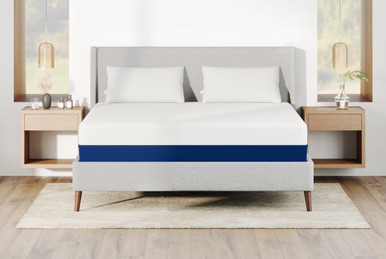
The Amerisleep AS3 is the stronger mattress for most buyers in this comparison. It delivers better motion isolation, a thicker 12-inch profile, a plant-based Bio-Pur build, and a 20-year warranty that is twice as long as Casper's 10-year coverage. The Casper The One has a legitimate case for back and stomach sleepers who prefer a firmer surface: it sits at medium-firm rather than medium, and its $799 to $999 queen price makes it $250 to $450 less expensive than the AS3. If you share a bed, sleep on your side, or want the lowest-tox foam build on this list, the AS3 is the clear choice. If you sleep on your back, sleep alone, and want to spend less, the Casper The One is a respectable alternative.
| Spec | Amerisleep AS3 | Casper The One |
|---|---|---|
| Price (queen) | From $1,149 | $799-$999 |
| Construction | All-foam (plant-based Bio-Pur) | All-foam (Breathe Flex + Align memory foam) |
| Firmness | Medium (5/10) | Medium-Firm (6-6.5/10) |
| Height | 12" | 11" |
| Cooling | 9/10 NapLab (open-cell Bio-Pur foam) | Open-cell Breathe Flex top layer |
| Motion isolation | 10/10 (NapLab) | Good (all-foam) |
| Edge support | 8.0/10 (NapLab) | Modest (all-foam) |
| Trial period | 365 nights | 100 nights |
| Warranty | 20 years | 10 years |
| Fire barrier | Fiberglass-free (per Amerisleep), CertiPUR-US | Fiberglass-free (confirmed by Casper) |
| Made in USA | Yes | Yes (designed and assembled) |
How we rate
These are MattressNut's editorial ratings, based on construction, brand specifications and independent lab data where available (NapLab, for the AS3). They are not results from our own lab tests. Last updated June 2026.
Amerisleep AS3
8.9/10
- Motion isolation 10/10 (NapLab)
- Plant-based Bio-Pur foam, CertiPUR-US certified
- HIVE 5-zone layer cushions shoulders and hips, supports the lower back
- 20-year warranty, double the Casper coverage
- Softer perimeter edges than a hybrid (NapLab 8.0/10)
- Medium firmness is not the right fit for strict stomach sleepers
- $250 to $450 more than Casper The One at comparable sale pricing
The AS3 takes the top spot here with better motion isolation (NapLab 10/10), a 12-inch plant-based build, and a 20-year warranty at a price $250 to $450 higher than the Casper The One prices listed here.
Casper The One
7.9/10
- Lowest price queen in this comparison at $799-$999 before promos
- Medium-firm feel matches back and stomach sleepers well
- Recognizable brand with a simple three-layer build
- Fiberglass-free, designed and assembled in the USA
- Open-cell Breathe Flex top layer reduces heat retention
- 10-year warranty, half the coverage of the AS3 20-year policy
- Firmer feel gives less pressure relief than the AS3 for side sleepers
- Only 11 inches thick, one inch less profile than the AS3
- No zoned support layer, single-density feel throughout
The Casper The One is Casper's stripped-back all-foam mattress: three foam layers, a medium-firm feel that suits back and stomach sleepers, and a queen price $250-$450 below the AS3.
Amerisleep AS3 vs Casper The One: Full Comparison
Construction and Materials
The AS3 is a 12-inch mattress built around Amerisleep's Bio-Pur foam, a plant-based polyurethane that replaces a portion of petroleum feedstock with plant-based oils. The substitution produces a more open cell structure than conventional memory foam, which means air moves through the material more freely. Below the Bio-Pur comfort layer sits the HIVE transition layer, a 2-inch piece of foam with thousands of hexagonal cutouts engineered to vary in firmness by body zone. The cutouts are wider under the shoulders to allow compression, narrower under the hips and lumbar to resist sinking. A high-density polyurethane base provides the structural foundation.
The Casper The One uses three foam layers in an 11-inch profile. The top layer is Casper's Breathe Flex polyurethane foam, an open-cell material designed for airflow and surface responsiveness. Below it sits Align memory foam, a traditional slow-rebound foam that adds contouring and smooths the feel between the top layer and the denser base. The bottom is Casper's Core Continuous Support high-density polyurethane base foam. Casper has confirmed that The One uses no fiberglass as a fire barrier, and it is designed and assembled in the United States within the Carpenter Co manufacturing family. Amerisleep lists the AS3 as fiberglass-free, and it is CertiPUR-US certified for content and emissions.
The AS3's build is more sophisticated in terms of zoned support and plant-based composition. The Casper The One is a straightforward three-layer foam stack aimed at broad compatibility at a lower price point. Both are CertiPUR-US certified, and neither uses loose detachable fiberglass in its fire barrier.
Firmness and Feel
The AS3 sits at medium 5 out of 10 on our firmness scale. The Bio-Pur surface is designed to cradle the body and respond more quickly than traditional memory foam. Side sleepers may benefit from this: the shoulder can sink into the Bio-Pur while the HIVE layer provides zoned cushioning and support. Back sleepers under about 230 lbs find the medium firmness delivers enough lumbar support without pushing back uncomfortably. It is a contouring bed, not a bouncy one.
The Casper The One feels firmer than its "medium" marketing label suggests. Reviewers generally describe it as sitting closer to medium-firm in real use, roughly 6 to 6.5 out of 10. The Breathe Flex top layer is more responsive than memory foam alone, so you get less of the classic sink-in feeling. Back sleepers appreciate that the firmer baseline keeps the lumbar from dropping too far. Stomach sleepers, who typically struggle on softer foam beds because of hip sinkage, often find the Casper's firmer profile more comfortable. For side sleepers, especially those over 150 lbs who need genuine shoulder cradling, the Casper The One can feel too firm at the pressure points.
The firmness difference between these two mattresses is one of the clearest factors in choosing between them. If you sleep on your side, the AS3's medium 5/10 is the correct choice. If you sleep on your back or stomach, the Casper's medium-firm 6/10 has a genuine argument.
Motion Isolation
NapLab scores the AS3 10/10 for motion isolation, with motion transfer 76% below its average. Both are all-foam mattresses and both absorb movement more effectively than any hybrid or innerspring at this price. The difference with the Casper is real but not dramatic. Where it shows up practically is when a partner shifts position at night: the AS3's Bio-Pur layer absorbs the movement almost entirely, while the Casper's more responsive Breathe Flex top layer transmits a small fraction of that motion across the surface.
For most couples, both scores represent excellent isolation. If one partner is a significantly restless sleeper or if one of you is a very light sleeper, the AS3 is the safer choice. For solo sleepers or couples who both sleep soundly, the Casper will feel fine.
Cooling Performance
NapLab scores the AS3 9/10 for cooling, with an 85.4°F peak surface temperature. The AS3's plant-based Bio-Pur foam has a more open cell structure than conventional memory foam, which helps move air through the mattress. The Casper's Breathe Flex top layer is also designed for airflow, and its three-layer build has fewer dense layers to trap heat than older memory foam designs. Neither mattress will leave most sleepers sweating the way traditional viscoelastic foam beds did a decade ago. The cooling gap between these two is narrow. Very hot sleepers may notice the AS3's open-cell edge. For average sleepers, both beds are adequate.
Edge Support
Edge support on both mattresses is modest, as is typical for all-foam beds without reinforced perimeters. NapLab scores the AS3 8.0/10, with 5.5 inches of sitting compression. Sit on the side of either bed to put your shoes on and the foam compresses under you, reducing the effective sleep surface at the very perimeter. Neither mattress is recommended for sleepers who regularly sleep right at the edge or who have mobility concerns that require a stable, firm perimeter for getting in and out of bed. A hybrid with a reinforced coil perimeter would serve that use case better.
Trial Period and Warranty
Both mattresses offer a 365-night sleep trial, so you have the same window to evaluate your purchase with either. Returns are free and handled directly by each brand. Neither requires a reason for the return, only that you have slept on the mattress for a minimum number of nights before initiating a claim.
The warranty gap is where these two diverge clearly. Amerisleep backs the AS3 with a 20-year warranty, covering sagging greater than 1.5 inches and defects in materials or workmanship. Casper backs The One with a 10-year warranty under a similar sagging threshold. If you buy a mattress and sleep on it until it genuinely needs replacing, the AS3's 20-year coverage gives you a longer window of manufacturer protection. The Casper's 10-year warranty is the market standard, not substandard, but the comparison goes to Amerisleep on this dimension.
Price and Value
The Casper The One is the more affordable mattress by a clear margin. Its queen sits between $799 and $999 depending on the active promotion, with MSRP around $999 and 20 percent off sales bringing it to $799. The Amerisleep AS3 queen is $1,149 on sale ($1,749 regular), a $250 to $450 premium over those Casper prices.
What you get for that premium: better motion isolation (NapLab 10/10), a thicker 12-inch profile versus 11 inches, a plant-based foam build, a zoned support layer the Casper does not have, and double the warranty coverage. For couples and side sleepers, the AS3's advantages justify the price difference. For a solo back sleeper on a budget who finds medium-firm foam comfortable, the Casper The One at $799 sale delivers solid value.
Who Should Buy the Amerisleep AS3
The AS3 is the right choice if you share a bed, sleep on your side, care about foam construction and certifications, or want the longest warranty in this comparison. The HIVE zoned support makes it the more accurate fit for side sleepers over roughly 130 lbs, where shoulder pressure relief and hip support need to work independently. Couples with different sleep styles will find the motion isolation gap between these two mattresses meaningful at 3 AM. The plant-based Bio-Pur foam is also a selling point for anyone who has had off-gassing concerns with conventional polyurethane beds.
Who Should Buy the Casper The One
The Casper The One is the better fit for back sleepers, lighter stomach sleepers, and solo buyers who want a well-regarded all-foam bed from a recognizable brand without paying $1,000 or more. Reviewers generally find it delivers what Casper promises at the price. If you have slept on medium-firm foam before and liked it, the Casper The One's three-layer build will feel familiar and comfortable. For anyone who finds medium-firmness foam beds too soft under the lower back, the Casper's firmer baseline solves that problem at a lower price than most alternatives in this range.
Our Verdict
The Amerisleep AS3 is the better mattress for most people comparing these two. Its motion isolation scores 10/10 at NapLab, its plant-based Bio-Pur build is cleaner than the Casper's standard polyurethane stack, and the 20-year warranty doubles Casper's coverage. The Casper The One is a reasonable choice at $799 to $999 for back and stomach sleepers who want a firm all-foam bed without a premium price tag. For couples, side sleepers, and anyone prioritizing low-tox construction, the AS3 is the pick.