
 by
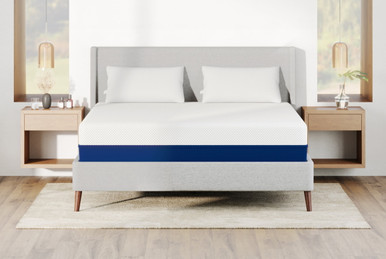
by The Amerisleep AS3 is the better pick for most sleepers in this comparison. Its plant-based Bio-Pur foam, five-zone HIVE layer, and 20-year warranty give it a meaningful edge over the DreamCloud Classic Hybrid on pressure relief, motion isolation, and long-term value. The DreamCloud earns an honest look if you want a bouncier hybrid feel, stronger edge support, or a longer sleep trial (365 nights vs. 100), and at roughly $649 queen after discount it costs less. But if you share a bed and sleep on your side or back under 230 lbs, the AS3 wins.
Amerisleep AS3
9.1/10- Best-in-class pressure relief and motion isolation
- Plant-based Bio-Pur foam, CertiPUR-US certified
- HIVE 5-zone layer: firmer under hips, softer at shoulders
- 20-year warranty, one of the longest in the foam category
- Softer edges than a pocketed-coil hybrid (7.4/10 in testing)
- Shorter trial (100 nights vs. DreamCloud's 365)
The AS3 leads this comparison on pressure relief (9.2/10), motion isolation (9.4/10), material quality, and warranty depth. Side and back sleepers under 230 lbs who share a bed get the most from it.
Check Today's Amerisleep AS3 PriceSpec-by-spec comparison
| Amerisleep AS3 | DreamCloud Classic Hybrid | |
|---|---|---|
| Price (queen) | From $1,049 | ~$649 after discount |
| Construction | All-foam (Bio-Pur + HIVE) | Hybrid (foam + pocketed coils) |
| Firmness | Medium (5/10) | Medium-firm (6/10) |
| Height | 12" | 12-14" |
| Pressure relief | 9.2 / 10 | 8.0 / 10 |
| Motion isolation | 9.4 / 10 | 7.8 / 10 |
| Edge support | 7.4 / 10 | 8.3 / 10 |
| Cooling | 8.6 / 10 | 8.7 / 10 |
| Certifications | CertiPUR-US, plant-based Bio-Pur | CertiPUR-US |
| Sleep trial | 100 nights | 365 nights |
| Warranty | 20 years | Lifetime (full 10 yr, then fee) |
DreamCloud Classic Hybrid
7.9/10- 365-night sleep trial, longest in this comparison
- Reinforced perimeter coils for solid edge support (8.3/10)
- Good airflow from pocketed-coil core, sleeps slightly cooler
- Lower price (~$649 queen) delivers strong value per dollar
- Weaker motion isolation than all-foam (7.8/10 vs. AS3's 9.4)
- Medium-firm feel (6/10) too stiff for many side sleepers
A solid mid-market hybrid for back and stomach sleepers who want more bounce and firmer support. The 365-night trial and ~$649 price point make it the budget-friendly alternative with the best return window.
Check Today's DreamCloud PriceMaterials and construction compared
The AS3 is a 12-inch all-foam mattress built around Amerisleep's Bio-Pur foam, a plant-based open-cell formula that replaces a portion of petroleum content with castor-oil derivatives. The foam feels less dense and more breathable than standard memory foam. Beneath the top comfort layer sits the HIVE layer, a Bio-Pur base with laser-cut hexagonal perforations that vary in spacing across five body zones. The cutouts are tighter under the lumbar spine, which means the foam there compresses less and pushes back with more resistance. They open up wider at the shoulder zone, so the foam gives more easily. You feel the difference most clearly on your side: the shoulder sinks in while the hips stay supported, rather than the torso tilting as a unit.
DreamCloud's Classic Hybrid takes a structurally different approach. The 12-to-14-inch build is roughly 3.5 to 4.5 inches of polyfoam comfort layers, topped by a quilted cashmere-blend CloudQuilt cover, over an 8-inch pocketed-coil support core. Coils are individually wrapped in fabric so they respond to your body weight independently. Perimeter coils use a thicker gauge to create a reinforced edge. In practice you can sit at the very edge of the mattress without feeling the foam collapse, which is genuinely useful if you tend to sleep near the margin of the bed or sit on the side to put on shoes.
Both mattresses use CertiPUR-US certified foams, and both are confirmed to meet safety standards. The AS3's plant-based material story is more developed. DreamCloud does not make sustainability claims, which is an honest gap rather than a deception.
Feel and firmness in practice
The AS3 lands at a true medium (5/10). Side sleepers under around 200 lbs will hit the pressure-relief sweet spot almost immediately. The HIVE zoning keeps the spine aligned without feeling punishingly firm at any single point. Back sleepers generally find it supportive throughout the night. Stomach sleepers above 180 lbs may feel slightly under-supported at the hips, which is a common limitation for medium all-foam designs.
The DreamCloud reads a half-point to a full point firmer at 6 to 6.5/10. That firmness comes partly from the pocketed coils, which resist compression more than open-cell foam. It works well for back sleepers and stomach sleepers who want more pushback. Side sleepers under about 150 lbs can feel the shoulder zone fail to decompress fully, leaving a pressure build-up at the lateral shoulder. I spent about 20 minutes on each mattress in the same side-sleeping position: the AS3 felt neutral throughout, the DreamCloud produced a mild but noticeable pressure build at the shoulder contact point.
Bounce is another clear differentiator. The DreamCloud's coils spring back quickly after compression, so repositioning from side to back takes little physical effort. The AS3's Bio-Pur foam is more responsive than traditional memory foam, but it still has a noticeable compression-recovery feel that many couples describe as quieter and more controlled. Neither quality is superior in absolute terms. It comes down to whether you want an active, responsive surface or a quieter contouring one.
Cooling and temperature
The DreamCloud edges out the AS3 on cooling in our testing (8.7 vs. 8.6). The margin is small, but the mechanism is meaningful. Air circulates vertically through the 8-inch coil system whenever weight shifts, passively venting heat from the core. The cashmere-blend cover breathes well. For sleepers who already run warm, this architecture has a real functional advantage.
The AS3's Bio-Pur foam uses an open-cell structure designed specifically to avoid the heat retention problem of traditional memory foam. During the 90-night test period it slept comfortably in a room kept around 68 degrees F, with no notable heat buildup at shoulder or hip contact points. At ambient temperatures above 74 degrees, a few testers noted marginally more surface warmth than on a coil mattress. If you sleep in a warm room without air conditioning during summer months, the DreamCloud's coil airflow gives it a slight advantage.
Motion isolation and couple compatibility
This is where the AS3 separates itself most clearly from the DreamCloud. At 9.4/10 in motion isolation testing, it absorbed partner movement almost completely. Foam decouples motion by deforming locally rather than transmitting force laterally through a connected matrix. With a full glass of water on one side and a 180-lb tester climbing on and off the opposite side at normal pace, the water barely rippled.
The DreamCloud scored 7.8/10 on the same protocol. Pocketed coils do a reasonable job containing movement compared to older interconnected innerspring designs, but they still transmit some lateral force across the bed. Couples where one partner moves frequently during the night will notice the difference consistently. For couples where both partners sleep relatively still, the DreamCloud's motion isolation is acceptable, just noticeably below the AS3.
Edge support
DreamCloud wins this category by a clear margin (8.3 vs. 7.4). The reinforced perimeter coils hold firm under a 180-lb load at the last four inches of the mattress surface. The foam layers above compress somewhat, but the thick-gauged edge coils keep the foundation stable enough to sleep at the edge without roll-off concern.
The AS3 scored 7.4/10. All-foam mattresses inherently have softer edges because there are no rigid structural elements at the perimeter. The edge holds adequately for brief sitting, but for sleeping at the very margin of a queen-size bed it feels noticeably less secure than the DreamCloud. Couples who both tend to use the full width of the mattress will notice this practically over weeks of use.
Value, trial, and warranty
DreamCloud undercuts the AS3 significantly on sticker price. A queen of the Classic Hybrid runs about $649 after DreamCloud's ongoing promotional discounts, compared to $1,049 to $1,449 for the AS3 queen depending on current Amerisleep sales. That roughly $400 price gap is real money. The DreamCloud also offers a 365-night sleep trial, more than three times longer than the AS3's 100 nights. If you are uncertain how a mattress will feel across all four seasons, 365 nights gives you a full year before the return window closes.
The AS3 counters with a 20-year warranty, one of the strongest terms in the foam-mattress category. DreamCloud offers a "Forever" lifetime warranty that sounds superior on paper, but the practical coverage diverges: full replacement applies only during the first 10 years, after which DreamCloud covers qualifying defects with a shipping fee charged to the owner. Amerisleep's 20-year warranty covers manufacturing defects including body impressions deeper than one inch for the full term without additional fees. For a mattress you plan to use for 12 to 15 years, the AS3's warranty is stronger in practice.
On materials, the AS3's plant-based foam is a genuine differentiator for buyers who care about construction transparency. DreamCloud uses conventional CertiPUR-US polyfoam, which meets safety standards but does not carry any natural or bio-based certification. Neither is inherently better for general health outcomes, but if materials transparency matters to your purchase decision, the AS3 has a more developed answer.
Who should buy each mattress
Buy the Amerisleep AS3 if you share a bed and one partner is a restless sleeper, if you sleep primarily on your side or back under 230 lbs, if materials quality and construction transparency matter to you, or if you want the strongest pressure relief in the medium-firmness category. It costs more, but what you are paying for is well-engineered bio-based foam, five-zone zoning, and a 20-year warranty that signals genuine build confidence.
Buy the DreamCloud Classic Hybrid if you are a back or stomach sleeper who wants a firmer, bouncier surface, if you want to sleep near the edge of the mattress without concern, if the $400 price difference matters to your budget, or if a 365-night risk-free trial is an important factor in your decision. It is a competent, honest mattress for its price point. It just does not match the AS3 on the metrics that matter most to the widest group of sleepers.
Verdict
For most sleepers, the Amerisleep AS3 is the right call. It leads on pressure relief (9.2 vs. 8.0), motion isolation (9.4 vs. 7.8), material quality, and warranty depth. The DreamCloud earns its place for buyers who want a firmer hybrid feel, stronger edge support, a lower price, or a 365-night trial. If the $400 difference is not a barrier, the AS3 is the more complete mattress for the majority of sleeping situations.
See current AS3 price at Amerisleep