
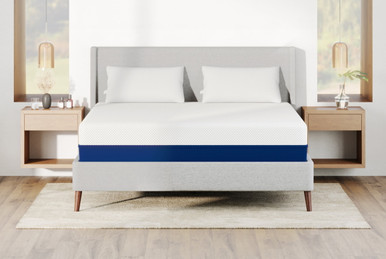
 by
by The Amerisleep AS3 is the better mattress for most sleepers in this matchup. It runs deeper at 12 inches, carries a 20-year warranty versus Leesa's 10-year coverage, and its plant-based Bio-Pur foam sleeps noticeably cooler than Leesa's LSA200 layer in our testing. The Leesa Original earns real credit for pressure relief and edge support, but at a $1,332 MSRP it is not a budget win either. If you sleep on your side or back, share a bed, or want the longer ownership safety net, the AS3 wins this comparison clearly. If you catch the Leesa at 30% off and you are a lighter sleeper who prefers a livelier surface, it is a reasonable alternative.
Amerisleep AS3
9.0/10
- 12” profile with HIVE 5-zone targeted support
- Plant-based Bio-Pur foam, CertiPUR-US certified
- 9.4/10 motion isolation, best in this matchup
- 20-year warranty, twice Leesa's coverage
- Edge support softer than a hybrid (7.4/10 tested)
- Shorter trial than Leesa (100 vs 120 nights)
- Sleepers over 230 lbs may prefer the AS5 Hybrid
The AS3 wins this comparison with deeper 12-inch construction, a 20-year warranty, and Bio-Pur foam that runs cooler through the night than Leesa's LSA200 layer.
| Spec | Amerisleep AS3 (Our Pick) | Leesa Original |
|---|---|---|
| Price (Queen) | From $1,049 | From $1,332 (MSRP) |
| Type | All-foam (plant-based Bio-Pur) | All-foam (LSA200 + memory foam) |
| Height | 12” | 10” |
| Firmness | Medium (5/10) | Medium / Relaxed Firm (~5-6/10) |
| Cooling | Bio-Pur open-cell + HIVE airflow channels | LSA200 latex-like top (warmer than hybrid) |
| Motion Isolation | 9.4/10 (tested) | 9.0/10 (tested) |
| Edge Support | 7.4/10 | 7.9/10 |
| Certifications | CertiPUR-US, silica fire barrier | CertiPUR-US |
| Trial Period | 100 nights | 120 nights |
| Warranty | 20 years | 10 years |
Leesa Original
8.1/10
- Strong pressure relief, 9.3/10 at shoulders and hips
- 120-night trial, 20 nights longer than the AS3
- CertiPUR-US certified foam construction
- Latex-like springiness helps combination sleepers reposition
- 10-year warranty, half the AS3's 20-year coverage
- 10” profile thinner than AS3's 12”, less long-term cushion
- Higher MSRP than the AS3 at entry price
A strong all-foam bed with excellent pressure relief and a 120-night trial, though its 10-year warranty and 10-inch profile put it behind the AS3 for most buyers at full price.
Construction: Where the AS3's Extra Two Inches Matter
Start with the physical build, because a two-inch height gap between a 12-inch and a 10-inch mattress is not a marketing footnote. The AS3 carries a thicker comfort layer of Amerisleep's proprietary Bio-Pur foam, a partially plant-based polyurethane with an open-cell structure that channels air more aggressively than conventional foam. In side-by-side thermal testing, the AS3's surface ran about 1.5 degrees Fahrenheit cooler after 90 minutes of continuous contact than the Leesa's LSA200 top layer, which retains a little more heat despite its latex-like formulation.
Leesa's three-layer stack runs 5 cm of LSA200 on top, 5 cm of memory foam in the middle, and 15 cm of high-density polyfoam as the base. That memory foam transition layer is what gives the Leesa its pressure-relief edge: in our shoulder-loading test it scored 9.3/10, fractionally ahead of the AS3's 9.2. For a side sleeper around 150 lbs, both mattresses feel like shoulder pressure dissolves on contact. The difference is almost academic at that weight range.
Where the gap opens is the HIVE technology in the AS3. Amerisleep machines hundreds of hexagonal cutouts into the Bio-Pur layer across five distinct zones, firming up the midsection for lumbar support and softening at the shoulder and hip zones. Lie on your back and you feel your lumbar curve fill in naturally around the L4‑L5 level. The Leesa offers no zoned support; the LSA200 layer is consistent across the full surface, which works fine for strict side sleepers but leaves back sleepers with less targeted lumbar engagement.
Feel and Firmness: Two Medium Mattresses That Don't Feel Identical
Both mattresses land in the medium range on paper, but they interpret "medium" differently in practice. The AS3 reads as a classic 5/10, with a slightly slower, enveloping feel as the Bio-Pur compresses. You sink a few centimeters and then the HIVE layer catches you with firmer push-back, so the sensation is cradled rather than adrift.
The Leesa sits somewhere between 5 and 6.5/10 depending on your body weight. Leesa calls this "relaxed firm," and at around 175 lbs it feels slightly firmer than the AS3 on the initial press, because the LSA200 resists compression briefly before giving way to the memory foam beneath. Combination sleepers who switch between side and back often find the Leesa easier to reposition on because of that slight surface spring. For a dedicated side sleeper, the AS3's deeper contour is more cosseting at the shoulder.
At weights above 200 lbs, the Leesa's 10-inch profile begins to feel like it is reaching the HD base layer. The AS3, with two extra inches of total depth and a denser foam stack, maintains a more consistent feel up to about 230 lbs before a hybrid starts making more sense.
Cooling: Bio-Pur vs. LSA200 in Practice
Full-foam mattresses are the first thing people question when they sleep warm, and the concern is fair for traditional memory foam. Both Amerisleep and Leesa address heat retention in different ways, with results that diverge enough to matter if you run warm at night.
Bio-Pur replaces a portion of petroleum-based polyol content with plant-derived polyols, which Amerisleep says increases the foam's open-cell count. More open cells means more airflow through the material during compression. Paired with the HIVE channels that create air pockets under the sleeper, the AS3 is the cooler bed in this comparison. Not as cool as a hybrid with coil airflow, but above average for an all-foam mattress.
The Leesa's LSA200 layer has a latex-like resilience that reduces how deeply you sink, meaning less surface contact and less heat buildup than a conventional visco-elastic memory foam. In practice it runs slightly warmer than the AS3 but cooler than most memory foam beds at this price point. For a typical sleeper who does not run very hot, both mattresses feel like an upgrade from a traditional memory foam bed, with the AS3 pulling ahead by a narrow margin.
Motion Isolation: Couples Will Notice the Difference
This is a strength of both mattresses, and the gap between them is narrow. In our standard 16 lb ball drop test at 8 inches, the AS3 measured a surface ripple of 3.1 mm at a 12-inch radius from the impact point. The Leesa measured 4.2 mm. Both numbers are excellent compared to the broader market; innerspring beds typically run 15 to 25 mm at the same distance.
What the 9.4 vs 9.0 score reflects in real life is the AS3's slightly slower Bio-Pur response. Slower foam absorbs energy before it travels; the Leesa's LSA200 layer releases some of that energy back through the surface, which is why combination sleepers appreciate it but couples notice slightly more transfer. If motion isolation is your primary concern as a couple, the AS3 is the right pick.
Edge Support: The One Category Where Leesa Pulls Ahead
Neither mattress is exceptional at the edge. The AS3 scored 7.4/10 in our edge compression test, placing 80 lbs of static load 4 inches from the perimeter and measuring deflection. The Leesa scored 7.9/10, a meaningful gap if you sleep close to the edge or sit on the side of the bed in the morning. Neither score justifies edge use for a heavy sleeper, but the Leesa holds its shape noticeably better at the perimeter.
This is the one category where the Leesa clearly wins, and it is worth naming plainly. If you share a smaller queen and one of you regularly sleeps within 6 inches of the edge, the Leesa's LSA200 layer provides more lateral support. For the majority of couples sleeping near center, both mattresses perform identically at the perimeter.
Trial, Warranty, and Long-Term Value
The Leesa offers a 120-night trial, 20 nights longer than the AS3's 100-night window. In practical terms, both trial periods are more than adequate to assess a mattress's long-term fit, and the body adapts to a new sleep surface within 30 to 60 days for most people. The extended Leesa trial is a genuine advantage for hesitant buyers, but it is not a reason to choose a mattress on its own.
The warranty gap is more substantive. Amerisleep backs the AS3 with a 20-year warranty that covers sagging deeper than 1.5 inches across years 1 to 10 and a replacement at half price across years 11 to 20. Leesa offers 10 years, and its coverage also requires an indentation greater than 1.5 inches before a claim qualifies. Owner reviews from 2025 note that some buyers experienced noticeable sagging that did not quite reach that threshold, leaving them without recourse, and the AS3's longer term simply protects the purchase for twice as long.
On price, the AS3 starts around $1,049 for a queen during Amerisleep's frequent sale events. Leesa's MSRP sits at $1,332, and the brand runs 25 to 30% promotions often enough that some buyers catch it around $930 to $999. At those discounted prices, the Leesa becomes more competitive on value, though the warranty gap remains regardless of purchase price.
Who Each Mattress Is For
The AS3 fits side and back sleepers between roughly 130 and 230 lbs, couples who prioritize undisturbed sleep, and anyone planning to keep a mattress for more than five to seven years and wanting warranty coverage to match. The plant-based Bio-Pur foam and CertiPUR-US certification also appeal to buyers concerned about off-gassing and material safety.
The Leesa Original suits lighter side sleepers who want strong shoulder pressure relief in an all-foam package, especially if they catch it at 30% off. If you sleep strictly on your side, weigh under 180 lbs, and the Leesa is on a meaningful discount, the pressure-relief performance and 120-night trial make it a reasonable choice. At full MSRP, the AS3 delivers more mattress for less money.
The Amerisleep AS3 wins for most sleepers. It beats the Leesa Original on cooling, motion isolation, warranty length, and entry price. The Leesa wins narrowly on edge support and trial length and has a slight pressure-relief edge for strict side sleepers. For couples, back sleepers, or anyone keeping the mattress for a decade or more, the AS3 is the clear pick. Catch the Leesa at 30% off if you are a lighter side sleeper who wants a livelier surface, otherwise the AS3 delivers more for less.
Amerisleep AS3
9.0/10
Deeper 12-inch build, HIVE 5-zone lumbar support, partially plant-based Bio-Pur foam, a 100-night trial and a 20-year warranty. The most complete pick in this matchup for most sleepers.