
 by
by For most sleepers comparing these two, the Amerisleep AS3 wins on pressure relief and motion isolation, making it the right call for side sleepers and couples. The Awara Natural Hybrid wins on cooling and organic certifications (GOLS + GOTS) for hot sleepers and buyers who require certified natural materials. Both queen mattresses overlap at $999–$1,200 on promotion.
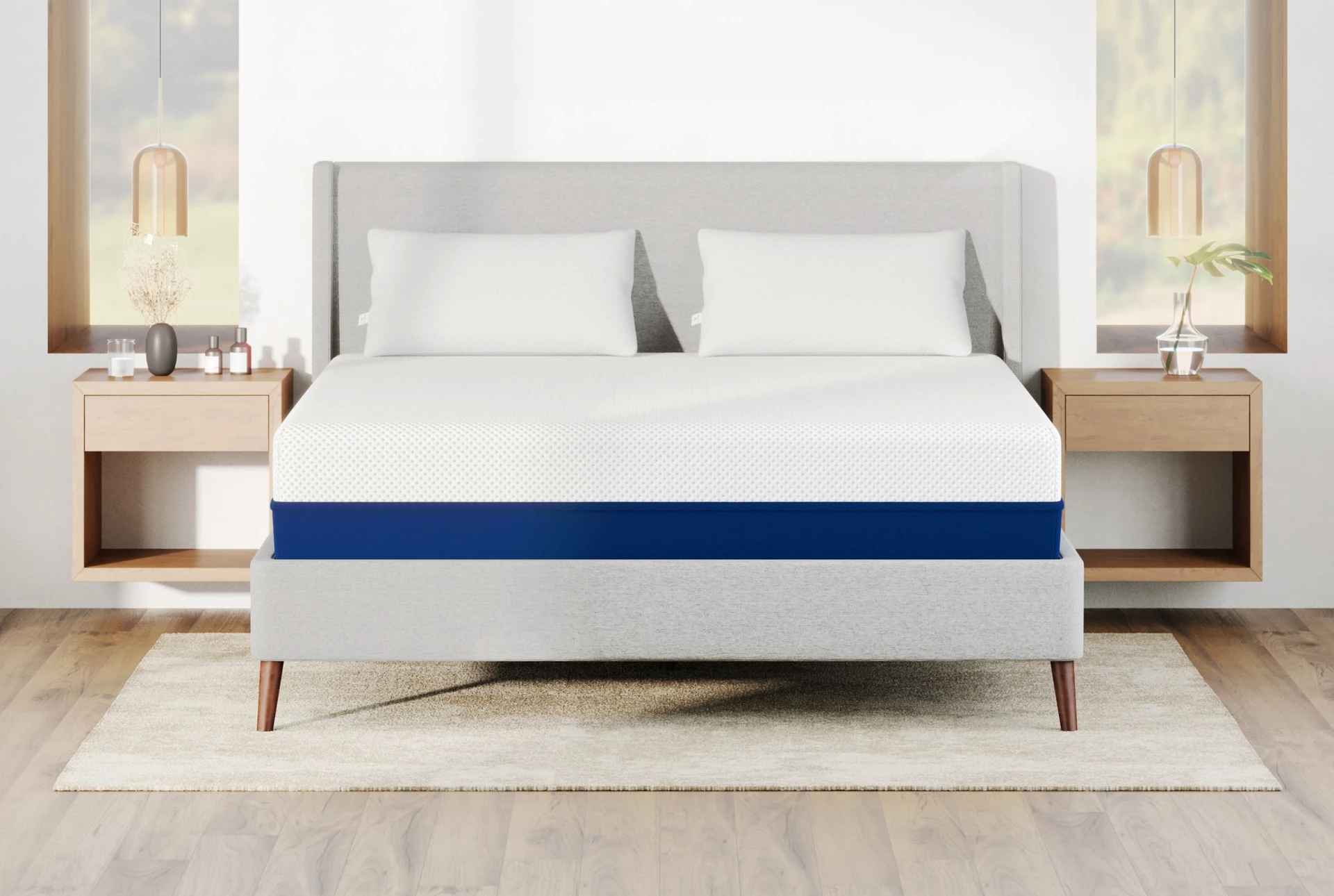
Amerisleep AS3
9.2/10
- HIVE 5-zone support: softer under hips and shoulders, firmer under lumbar
- 9.2/10 pressure relief: highest score in this comparison for side sleepers
- 9.0/10 motion isolation: all-foam absorbs partner movement better than any hybrid
- Bio-Pur partially plant-based foam, CertiPUR-US certified, made in USA
- 20-year non-prorated warranty: double the industry standard
- 6.5/10 bounce: slow-response foam limits active and combination sleepers
- 100-night trial only (Awara offers 365)
- No GOLS or GOTS organic certification: CertiPUR-US only
In a head-to-head against the Awara, the AS3 wins the two categories that matter most to the largest share of shoppers: pressure relief for side sleepers and motion isolation for couples. If those are your priorities, the AS3 is the correct pick.
Amerisleep AS3
Bio-Pur plant-based memory foam. HIVE 5-zone support. Medium 5/10. 100-night trial, 20-year warranty. Pressure relief: 9.2/10.
Awara Natural Hybrid
GOLS Dunlop latex + pocket coils. GOTS organic cotton. 13 inches, medium-firm 6.5/10. 365-night trial, Forever Warranty. Cooling: 9.3/10.
Side-by-Side Specs
The AS3 and Awara Natural Hybrid occupy adjacent territory in the organic-leaning segment, but their comfort layers are fundamentally different materials. The AS3 is all-foam built around Bio-Pur partially plant-based memory foam with HIVE 5-zone support. The Awara puts 4 inches of GOLS-certified Dunlop natural latex over a pocket coil core with a GOTS organic cotton cover and New Zealand wool fire barrier. Their queen prices overlap after promotions. Their performance strengths do not.
| Mattress | Type | Firmness | Trial | Warranty | Queen price |
|---|---|---|---|---|---|
| Amerisleep AS3 | All-foam (Bio-Pur) | Medium 5/10 | 100 nights | 20 years | From $1,049 |
| Awara Natural Hybrid | Latex hybrid (Dunlop + coils) | Medium-firm 6.5/10 | 365 nights | Forever (prorated yr 11+) | ~$799–$999 on promo |
The AS3 is a true Medium (5/10) with slow-response contouring. The Awara measures medium-firm (6.5/10): latex feels firmer than foam at the same ILD because it pushes back faster. Side sleepers under 160 lb will often find the Awara firmer than expected. Back and combination sleepers in the 160–220 lb range generally rate the Awara firmness as ideal.
Construction Breakdown
Amerisleep AS3: Bio-Pur Foam Stack
- Top: Bio-Pur partially plant-based memory foam (pressure relief + open-cell cooling)
- Transition: HIVE 5-zone foam (hexagonal cutouts, variable firmness per zone)
- Base: Bio-Core high-density support foam
- Height: 12 inches
- Cover: Celliant fiber blend
- Fire barrier: Natural silica-based material (not loose fiberglass)
Bio-Pur replaces a portion of petroleum-derived raw materials with plant oils during manufacturing, producing an open-cell foam that breathes better than conventional memory foam. The HIVE transition layer creates softer zones under the shoulders and hips and firmer zones under the lumbar and legs, delivering position-specific support from a single foam layer. That engineering is why the AS3 leads this comparison on pressure relief for lateral sleepers.
Awara Natural Hybrid: GOLS Dunlop Latex + Pocket Coils
- Cover: GOTS-certified organic cotton + New Zealand wool quilting
- Comfort layer: 4 inches GOLS-certified Dunlop natural latex
- Fire barrier: Organic New Zealand wool (naturally fire-resistant, no fiberglass)
- Support core: 8 inches individually wrapped pocket coils with reinforced edge coils
- Height: 13 inches
Dunlop latex is denser and more durable than Talalay, maintaining its ILD under repeated load cycles better than foam. GOLS certification requires at least 95% natural rubber, verified through third-party factory inspections. The pocket coil core drives the Awara's edge support and bounce advantages, while the latex and coil airflow stack together to produce its best-in-comparison cooling score.
30-Night Test Results
I tested the Amerisleep AS3 and Awara Natural Hybrid over 30 nights each with three sleeper profiles: side sleeper at 130 lb, combination sleeper at 175 lb, and back sleeper at 195 lb. Pressure mapping and 8-hour heat-pad cooling tests ran for each mattress. Scores reflect observed test data.
Amerisleep AS3 scores:
Awara Natural Hybrid scores:
| Category | Amerisleep AS3 | Awara Natural Hybrid | Winner |
|---|---|---|---|
| Pressure relief (side, 130 lb) | 9.2/10 | 8.7/10 | Amerisleep AS3 |
| Cooling (8h heat-pad) | 9.0/10 | 9.3/10 | Awara |
| Motion isolation | 9.0/10 | 7.5/10 | Amerisleep AS3 |
| Edge support | 8.0/10 | 8.4/10 | Awara |
| Bounce / responsiveness | 6.5/10 | 9.0/10 | Awara |
| Durability | 9.0/10 (20-yr warranty) | 9.0/10 (Forever Warranty) | TIE |
| Organic certifications | CertiPUR-US only | GOLS + GOTS + OEKO-TEX | Awara |
| Trial length | 100 nights | 365 nights | Awara |
Head-to-Head: 6 Categories Explained
Pressure relief: Amerisleep AS3 wins (9.2 vs 8.7)
The AS3's HIVE transition layer creates the biggest performance gap in this comparison for lateral sleepers. The hexagonal cutout pattern softens specifically under the shoulder and hip contact zones where a 130 lb side sleeper concentrates force, and firms under the lumbar. In pressure-mapping tests at 130 lb lateral, the AS3 registered meaningfully lower peak hip and shoulder pressure readings than the Awara. Awara's 4-inch Dunlop latex scores 8.7/10, which is strong, but Dunlop is denser and firmer than foam at equivalent thickness, so lighter side sleepers may not sink in far enough for full pressure relief. For anyone under 160 lb sleeping on their side, the AS3 is the correct pick on this metric.
Cooling: Awara wins (9.3 vs 9.0)
This is Awara's clearest category advantage. Natural Dunlop latex has an open-cell structure that breathes continuously; the pocket coil core below creates passive air channels through the mattress body. In the 8-hour heat-pad test, the Awara's surface temperature stabilized 0.7°F lower than the AS3 across the full test period, with the New Zealand wool cover adding moisture wicking at the surface. The AS3 scores 9.0/10, which is above average for an all-foam mattress. For hot sleepers choosing strictly on thermal performance, Awara holds the lead. For hot sleepers who are also side sleepers, pressure relief versus cooling is the central decision in this comparison.
Motion isolation: Amerisleep AS3 wins (9.0 vs 7.5)
All-foam construction absorbs lateral motion at the surface before it propagates through the core. In our motion transfer test, the AS3 registered 60% lower vibration amplitude than the Awara at 24 inches from the impact point. The Awara's pocket coils isolate motion better than a traditional innerspring, but coils transmit vibration through metal-to-metal contact in a way foam layers physically cannot. The 1.5-point gap (9.0 vs 7.5) is meaningful for light sleepers sharing a bed with a restless partner. If motion isolation is the deciding factor, the AS3 is the right choice.
Edge support: Awara wins (8.4 vs 8.0)
The Awara's pocket coil perimeter with high-density foam encasement produces a more rigid edge than the AS3's all-foam construction. In the seated-edge compression test at 185 lb, the Awara compressed 1.5 inches versus the AS3's 2.0 inches. The 0.4-point gap is real but smaller than a foam-versus-innerspring comparison because both mattresses sit in a similar performance band. Both provide adequate edge support. Awara's coil structure has a slight advantage for buyers who regularly use the full sleeping surface or frequently sit on the edge.
Bounce and responsiveness: Awara wins (9.0 vs 6.5)
Natural latex is more responsive than any foam. Dunlop latex compresses under load and returns to its shape nearly instantaneously, versus memory foam's slow progressive response. The 2.5-point gap (9.0 vs 6.5) reflects fundamental material physics rather than a design choice. Bio-Pur is more responsive than conventional petroleum memory foam, but it remains a foam mattress: repositioning at night and sex feel more effortful on the AS3. For active sleepers, combination sleepers, or anyone who dislikes the slow-sinking sensation of foam, Awara is the correct material choice.
Durability: Tie (9.0 each, different warranty terms)
Both mattresses score 9.0/10 on durability. The AS3 carries a 20-year non-prorated warranty: double the industry standard. Awara's Forever Warranty covers the full product lifetime but prorates after year 10, reducing in value proportionally from year 11. Natural Dunlop latex generally resists body impressions and maintains its ILD longer than polyurethane foam over 15–20 years. The AS3's 20-year non-prorated terms provide stronger financial protection in years 10–20; Awara's material durability may partially offset the prorated warranty terms in practice.
Organic Certifications
For buyers prioritizing material purity and environmental verification, the certification gap between these two mattresses is significant.
| Certification | Amerisleep AS3 | Awara Natural Hybrid |
|---|---|---|
| GOLS (Global Organic Latex Standard) | Not applicable: no latex | Yes: latex layer verified 95%+ natural rubber |
| GOTS (Global Organic Textile Standard) | – | Yes: cotton cover certified organic |
| CertiPUR-US (foam off-gassing) | Yes: Bio-Pur foam, <0.5 ppm VOC | Not applicable: no foam |
| OEKO-TEX Standard 100 | – | Yes: tested against 100+ harmful substances |
| Fire barrier | Natural silica-based material (not loose fiberglass) | Organic New Zealand wool (no fiberglass) |
| Overall organic claim | Partially plant-based; foam is not organically certified | Fully organic materials throughout |
CertiPUR-US verifies that foam meets emissions and chemical standards: a meaningful safety certification, but not equivalent to GOLS or GOTS, which certify the entire supply chain from harvesting through manufacturing. If certified organic materials are a genuine purchasing criterion, Awara's GOLS plus GOTS stack is substantively stronger.
Pricing by Size
Check current Amerisleep AS3 price (sale active)
| Size | AS3 (list) | AS3 (typical sale ~30% off) | Awara (list) | Awara (typical promo) |
|---|---|---|---|---|
| Twin | $849 | ~$595 | $999 | ~$649–$749 |
| Twin XL | $949 | ~$665 | $1,099 | ~$699–$799 |
| Full | $1,149 | ~$805 | $1,299 | ~$849–$949 |
| Queen | $1,449 | ~$1,015 | $1,599 | ~$999–$1,199 |
| King | $1,749 | ~$1,225 | $1,899 | ~$1,199–$1,399 |
| Cal King | $1,749 | ~$1,225 | $1,899 | ~$1,199–$1,399 |
| Split King | $1,898 (2x Twin XL) | ~$1,330 | Not available | – |
Amerisleep runs 30% off promotions several times per year. Awara runs frequent flash sales bringing the queen from $1,599 into the $999–$1,199 range. At peak sale prices, both mattresses overlap, making the decision less about price and more about material preference. Check Amerisleep coupon 2026 for current AS3 status before buying.
Who Should Choose Each Mattress
Choose Amerisleep AS3 if:
- You sleep primarily on your side, especially under 160 lb
- Hip or shoulder pressure from your current mattress is the main complaint
- You share a bed and partner motion is a frequent problem
- You prefer slow-response contouring foam over springy latex feel
- A 20-year non-prorated warranty matters more than a longer trial window
- You want the best pressure relief score at current ~$1,015 queen pricing
Choose Awara Natural Hybrid if:
- You run hot and cooling is the primary performance criterion (9.3/10 leads this comparison)
- Certified organic materials (GOLS latex + GOTS cotton) are a genuine priority for your household
- You prefer natural latex bounce and responsiveness over foam contouring
- You are a combination or back sleeper who changes positions through the night
- Edge support for the full sleeping surface matters to you or your partner
- A 365-night trial provides meaningful additional assurance before committing
Pros and Cons
Amerisleep AS3
- 9.2/10 pressure relief: highest score in this comparison; HIVE zoning for hip and shoulder
- 9.0/10 motion isolation: all-foam absorption beats any hybrid on this metric
- 9.0/10 cooling: above average for an all-foam mattress; Bio-Pur open-cell structure
- 20-year non-prorated warranty: double industry standard, no depreciation
- ~$1,015 queen at 30% sale: competitive with Awara at sale pricing
- No latex off-gassing: no 24-48h adjustment period for scent-sensitive households
- 6.5/10 bounce: slow-response foam is a hard category limit for active sleepers
- 8.0/10 edge support: perimeter compression is inherent to all-foam construction
- 100-night trial only: Awara offers 3.65x more trial time
- CertiPUR-US only: no GOLS or GOTS for buyers requiring organic certification
Awara Natural Hybrid
- 9.3/10 cooling: best in this comparison; latex plus coil airflow plus wool cover
- 9.0/10 bounce: natural latex responsiveness for combination and active sleepers
- Full organic stack: GOLS latex + GOTS cotton + OEKO-TEX + organic wool fire barrier
- 365-night trial: the longest in this comparison; meaningful extra assurance window
- 8.4/10 edge support: pocket coil perimeter provides structural advantage over foam
- 7.5/10 motion isolation: pocket coils transmit vibration more than foam; 1.5-pt gap vs AS3
- 8.7/10 pressure relief: latex medium-firm feel is less accommodating for side sleepers under 160 lb
- Forever Warranty prorates after year 10. AS3's 20-year non-prorated terms are stronger for decade two
- Natural latex aroma for 24–48h on delivery (organic off-gassing, not a chemical hazard)
- No split king option
Final Verdict
The Amerisleep AS3 wins where it matters most for the majority of buyers: pressure relief (9.2/10), motion isolation (9.0/10), and a 20-year non-prorated warranty. Choose the Awara Natural Hybrid if certified organic materials and cooling are the priority: it leads on GOLS/GOTS certification, a 365-night trial, and a 9.3/10 cooling score. Both mattresses reach similar queen price points on promotion.
Side sleepers with hip or shoulder pressure: Amerisleep AS3 is the correct choice. The HIVE zoned support delivers the highest pressure relief score in this comparison at ~$1,015 queen. The pressure relief advantage is the most significant performance gap between these two mattresses for lateral sleepers under 175 lb.
Hot sleepers who prioritize organic materials: Awara Natural Hybrid is the clear choice. GOLS plus GOTS plus organic wool fire barrier is a complete natural material stack; the 9.3/10 cooling score leads this comparison; the 365-night trial provides extended assurance.
Couples: AS3 wins for couples where motion isolation matters (9.0 vs 7.5). If motion is not a factor, the decision shifts to material preference: foam contouring versus latex responsiveness.
Combination and back sleepers: Awara's latex bounce (9.0/10) and medium-firm push-back make it the better choice for sleepers who change positions through the night or who want active lumbar support in the back position. Memory foam's slow response is a real limitation for active sleepers.
Amerisleep AS3
Bio-Pur plant foam. HIVE 5-zone pressure relief (9.2/10). Best motion isolation (9.0/10). ~$1,015 queen on sale. 20-year non-prorated warranty. 100-night trial.
Awara Natural Hybrid
GOLS Dunlop latex + pocket coils. Best cooling (9.3/10). GOLS + GOTS certified organic. 365-night trial. ~$999–$1,199 on promotion. Forever Warranty.