
 by
by Amish mattresses are handcrafted in small workshops across Pennsylvania, Ohio, and Indiana using traditional offset or pocketed coil units, cotton batting, and wool. Build quality and lifespan are genuine strengths. The real limitation is consumer risk: most Amish workshops offer no home trial, no white-glove delivery, and no old-mattress removal. For buyers who want that traditional, firm innerspring feel with real consumer protection, the Saatva Classic is the closest national equivalent and the one we recommend.
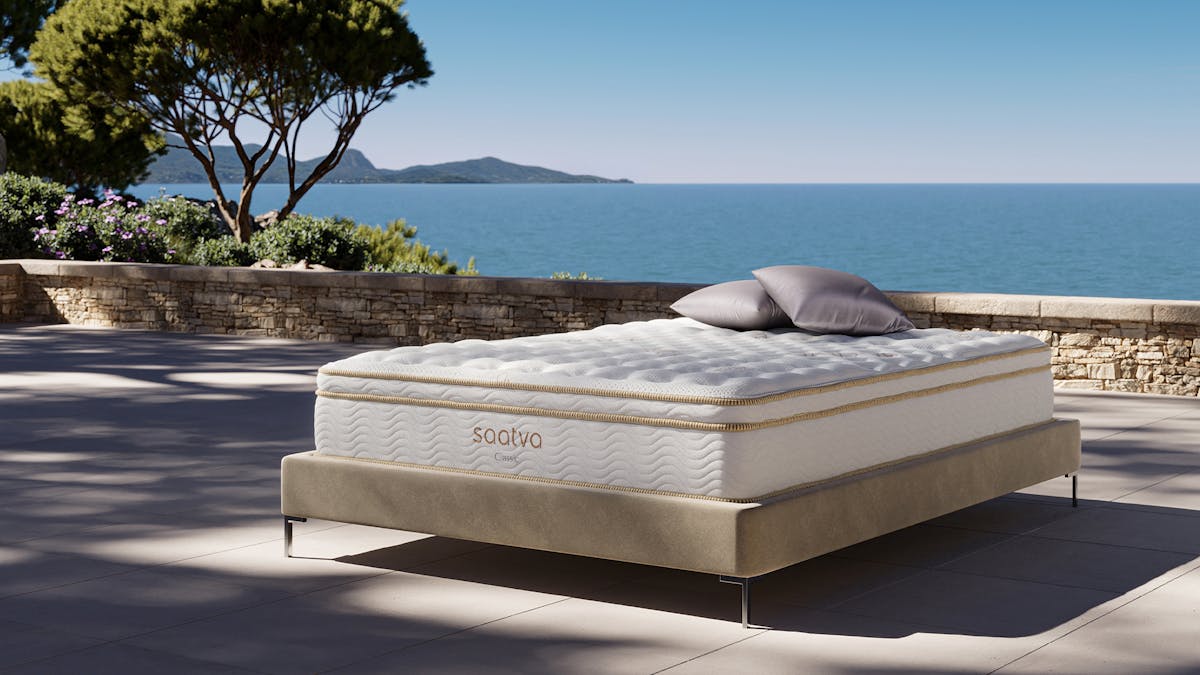
Saatva Classic
9.2/10
- Dual coil-on-coil construction with hand-tufted Euro pillow top and organic cotton cover
- Lumbar Zone reinforcement pads firm support under the lower back
- Free white-glove delivery, room-of-choice setup, and free old-mattress removal
- 365-night home trial, Lifetime warranty, and consistent quality across US factories
- Higher price than entry Amish workshop builds
- $99 return fee during the trial period
If what appeals to you about Amish mattresses is traditional innerspring craftsmanship and durability, the Saatva Classic delivers all of that at the national scale, with the consumer protections (365-night trial, Lifetime warranty, white-glove delivery) that Amish workshops typically cannot match.
Shop Saatva Classic
What is an Amish mattress?
There is no single Amish mattress company. The term covers dozens of independent workshops, primarily in Holmes County (Ohio), Lancaster County (Pennsylvania), and Indiana, that build mattresses by hand using traditional methods and sell through local furniture stores or by phone order. Common names include Holmes County Mattress, Lancaster Pillow Top lines, and house brands like Quiet Night, Elite Luxe, and Wonder Rest, but the underlying factory and specs matter more than the label.
Amish workshops typically build with offset or Bonnell coil spring units, dense cotton batting, wool comfort layers, and side-stitched borders for edge support. Many models are two-sided and designed to be flipped monthly, which is rare in mainstream mattress retail today. Construction standards are generally high within each workshop, though consistency varies between shops since there is no central quality control body.
Common Amish mattress types and pricing
Because Amish mattress lines are sold under regional house names rather than national model numbers, the table below describes construction types and approximate 2025 queen pricing based on typical Amish workshop ranges. In-store pricing in Holmes County or Lancaster can run slightly lower than what online Amish retailers post.
| Construction type | Core | Feel | Queen price range | Trial |
|---|---|---|---|---|
| Basic two-sided innerspring (Deluxe/Quiet Night type) | 12.5-gauge offset coil | Firm to medium-firm | $500 to $900 | None typical |
| Upgraded flippable (Elite/Comfort Core type) | Pocketed or offset coil + denser foam | Medium-firm | $900 to $1,600 | None typical |
| Pillow top (Elite Luxe/Ultra Pillowtop type) | Offset coil + multilayer foam + pillowtop | Plush medium | $900 to $1,600+ | None typical |
| Latex hybrid | Pocket coil + natural Talalay latex layer | Medium to medium-firm | $1,500 to $2,000 | None typical |
| Memory foam / gel foam | Foam or pocket coil core + gel-infused comfort | Medium soft | $1,300 to $3,000 | None typical |
Performance: what Amish mattresses actually do well
Amish mattresses earn their reputation in a few specific areas:
- Durability: heavy-gauge coil systems and dense foam layers hold up longer than many big-box competitors at the same price. Two-sided builds that get regular rotation can last 15 to 25 years.
- Edge support: side-stitched borders are a direct result of hand construction and are a genuine structural advantage. Edges stay firm, which matters for sitting on the edge and for couples who sleep toward the perimeter.
- Cooling: cotton and wool breathe naturally. There is no foam-trapping heat here; coil-heavy construction allows good airflow through the mattress core.
- No off-gassing: natural materials mean no chemical smell at unboxing. This is a real practical advantage, particularly for chemically sensitive buyers.
Where Amish builds are weaker: motion isolation (poor to moderate on Bonnell coil models, better on pocket coil), pressure relief for side sleepers (cotton batting conforms less than memory foam), and foam zoning for lumbar support (generally absent). For back-pain-specific support, a zoned innerspring hybrid like the Saatva Classic does more targeted structural work.
The consumer protection gap
Handcraft and durability are real advantages. The drawback is the risk profile. Amish mattresses are typically final sale or have tight regional exchange windows. If you order by phone and the mattress does not suit you, returning it means arranging transport back to the workshop, sometimes at your own cost. There is no standard home trial. White-glove delivery (carrying the mattress to your room, setting it up, removing the old one) is not part of the Amish workshop model.
This is not a criticism of build quality; it reflects the operational reality of small-batch regional craftsmanship. But it matters practically: buying a mattress without sleeping on it for 30 or more nights is a real risk, and a 10 to 15-year workshop warranty with no national service infrastructure is harder to act on than a lifetime warranty from a brand with a dedicated claims team.
Saatva Classic vs Amish mattresses: direct comparison
The Saatva Classic is a coil-on-coil innerspring hybrid that targets the same traditional-construction buyer that Amish mattresses appeal to. The engineering choices are comparable: dual coil layers (a base tempered coil and a top layer of individually wrapped pocket coils), a hand-tufted Euro pillow top with organic cotton, and a reinforced Lumbar Zone support pad. The practical differences are in service and consumer protection.
| Feature | Amish mattresses | Saatva Classic |
|---|---|---|
| Construction | Offset or pocket coil, cotton, wool, hand-built | Dual coil-on-coil, organic cotton, Euro pillowtop |
| Two-sided option | Yes, many models | No (one-sided) |
| Lumbar zoning | Absent or minimal | Yes, reinforced Lumbar Zone pad |
| Home trial | None typical | 365 nights |
| Warranty | 10 to 15 years (varies by workshop) | Lifetime |
| White-glove delivery | No | Free |
| Old mattress removal | No | Free |
| Queen price (mid-tier) | $900 to $1,600 | $1,995 |
| Nationwide availability | Regional (PA, OH, IN primarily) | All 50 states |
The Saatva costs more at the midrange. What you get for that premium: a 365-night trial that removes all the purchase risk, a Lifetime warranty backed by a national service team, and the Lumbar Zone reinforcement that Amish innerspring builds do not replicate. For buyers who are not physically near an Amish workshop and cannot test in person, Saatva is clearly the safer path.
Who should buy an Amish mattress
Amish mattresses make sense for a specific buyer. If you live within driving distance of a reputable Amish furniture store in Holmes County, Lancaster County, or Indiana, you can test the mattress on-site, develop a relationship with the shop, and pick up locally, which removes most of the logistical risk. If you specifically want a two-sided flippable build (rare in mainstream retail) or natural materials with zero foam-related chemistry, an Amish workshop can deliver at a price point that national DTC brands cannot easily match.
For buyers who cannot visit in person, who are not comfortable with a final-sale purchase, or who want a home trial before committing, an Amish mattress is a difficult recommendation. The craftsmanship is genuine, but the consumer infrastructure is not built for remote buyers.
Who should pick Saatva instead
Most buyers shopping for an Amish-style innerspring will be better served by the Saatva Classic. The coil-on-coil construction delivers a traditional innerspring feel, the Euro pillowtop adds surface softness without deep sinkage, and the Lumbar Zone supports spinal alignment on both back and side positions. The 365-night trial means you sleep on it for a full year before fully committing. The Lifetime warranty is backed by a company with a full service infrastructure. And the white-glove delivery, room-of-choice setup, and free old-mattress removal mean no heavy lifting on your part.
At $1,995 for a queen in Luxury Firm, the Saatva is more expensive than entry Amish builds. It is comparable to the midrange Amish pillowtop and latex hybrid lines, and notably cheaper than top-tier Amish memory foam builds. For the price, you get a significantly better risk profile.
Amish mattresses offer genuine craft, natural materials, and two-sided durability for regional buyers who can purchase in person. For everyone else, the Saatva Classic delivers traditional innerspring construction with a 365-night trial, Lifetime warranty, and free white-glove delivery, which is the risk profile Amish workshops cannot match.
Frequently asked questions
Is there a single national Amish mattress brand?
No. Amish mattresses come from dozens of independent workshops in Pennsylvania, Ohio, and Indiana, each selling under house brand names like Quiet Night, Elite Luxe, and Wonder Rest. Quality and specs vary between shops; the underlying factory matters more than the label name.
Can I buy an Amish mattress online?
Some workshops accept phone or email orders with regional shipping, but most prefer in-person purchases or local delivery. Direct-to-consumer ecommerce is uncommon. The model is regional, not national. Saatva ships nationwide with free white-glove delivery and a 365-night trial.
How long do Amish mattresses last?
Two-sided Amish innerspring builds that are rotated and flipped monthly can genuinely last 15 to 25 years. That durability depends on consistent maintenance. The trade-off is no home trial before purchase, which is a real risk for a mattress you have not tested in person.
Do Amish mattresses off-gas?
No. Natural cotton, wool, and steel coil construction means no chemical smell at unboxing. This is a genuine advantage over foam-heavy mattresses, particularly for chemically sensitive buyers or households with young children.
Amish mattress vs Saatva Classic: which is better value?
For regional buyers who can visit a workshop and test in person, an Amish mattress at $900 to $1,600 can be excellent value for durability and natural materials. For everyone else, the Saatva Classic's 365-night trial, Lifetime warranty, free white-glove delivery, and consistent quality across all US deliveries make it the better practical choice, even at $1,995.