
 by
by Our #1 recommendation for pressure relief around the hips
Amerisleep AS5
The softer Amerisleep mattress in our approved product list, selected for this pressure-relief-focused topic.
.mn-hero-elderly { background:linear-gradient(135deg,#0f172a 0%,#2a3a5c 60%,#14532d 100%); color:#fff; padding:44px 28px; border-radius:12px; margin:18px 0 28px 0; text-align:center; }.mn-hero-elderly h1 { color:#fff!important; font-size:30px; margin:0 0 12px 0; line-height:1.25; }.mn-hero-elderly p { color:#cbd5e1!important; font-size:16px; margin:8px 0 20px 0; }.mn-hero-badge { display:inline-block; background:#10b981; color:#fff!important; padding:5px 14px; border-radius:20px; font-size:13px; font-weight:700; margin-bottom:14px; }.mn-hero-cta { display:inline-block; background:#f59e0b; color:#0f172a!important; padding:14px 36px; border-radius:8px; font-weight:700; text-decoration:none; font-size:17px; margin:6px; }.mn-hero-cta:hover { background:#fbbf24; text-decoration:none; }.mn-ftc { background:#fafafa; border:1px solid #e5e7eb; padding:14px 20px; border-radius:6px; margin:14px 0; font-size:13px; color:#6b7280; font-style:italic; }.mn-medical-disclaimer { background:#fef3c7; border-left:4px solid #f59e0b; padding:14px 20px; border-radius:6px; margin:18px 0; font-size:13.5px; color:#78350f; }.mn-tldr { background:#eff6ff; border-left:4px solid #3b82f6; padding:20px 26px; border-radius:6px; margin:22px 0; }.mn-tldr h2 { margin:0 0 10px 0; color:#1e3a8a; font-size:19px; }.mn-toc { background:#f9fafb; border:1px solid #e5e7eb; padding:18px 24px; border-radius:8px; margin:22px 0; }.mn-toc h2 { margin:0 0 10px 0; font-size:16px; color:#111827; }.mn-toc ol { margin:0; padding-left:22px; columns:2; column-gap:32px; }.mn-toc li { margin:5px 0; font-size:14.5px; }.mn-pick { background:#fff; border:1px solid #e5e7eb; border-radius:10px; padding:24px; margin:28px 0; position:relative; }.mn-pick.top { border-top:4px solid #10b981; }.mn-pick-badge { display:inline-block; background:#0f172a; color:#f59e0b; padding:4px 13px; border-radius:20px; font-size:12px; font-weight:700; margin-bottom:10px; }.mn-pick h3 { margin:6px 0 4px 0; font-size:21px; color:#0f172a; }.mn-pick.mn-price { font-size:15px; color:#6b7280; margin:0 0 12px 0; }.mn-pick-verdict { background:#f0fdf4; border:1px solid #bbf7d0; padding:12px 16px; border-radius:6px; margin:14px 0; font-size:14px; color:#14532d; }.mn-pick-verdict strong { display:block; margin-bottom:4px; }.mn-pros-cons { display:grid; grid-template-columns:1fr 1fr; gap:14px; margin:14px 0; }.mn-pros { background:#f0fdf4; border:1px solid #bbf7d0; padding:14px; border-radius:8px; }.mn-cons { background:#fef2f2; border:1px solid #fecaca; padding:14px; border-radius:8px; }.mn-pros h4 { color:#14532d; margin:0 0 8px 0; font-size:14px; }.mn-cons h4 { color:#991b1b; margin:0 0 8px 0; font-size:14px; }.mn-pros ul,.mn-cons ul { margin:0; padding-left:18px; font-size:14px; }.mn-table { width:100%; border-collapse:collapse; margin:18px 0; font-size:14px; }.mn-table thead tr { background:#0f172a; color:#fff; }.mn-table th,.mn-table td { padding:11px 14px; border-bottom:1px solid #e5e7eb; text-align:left; vertical-align:top; }.mn-table tr.highlight { background:#f0fdf4; }.mn-table a { color:#0f172a; }.mn-callout { background:#eff6ff; border:1px solid #bfdbfe; padding:18px 22px; border-radius:8px; margin:22px 0; }.mn-callout h3 { color:#1e3a8a; margin:0 0 8px 0; font-size:17px; }.mn-warning { background:#fff7ed; border-left:4px solid #ea580c; padding:14px 20px; border-radius:6px; margin:18px 0; font-size:14px; color:#7c2d12; }.mn-eeat { background:#eff6ff; border:1px solid #bfdbfe; padding:18px 22px; border-radius:8px; margin:22px 0; font-size:14px; color:#1e3a8a; }.mn-faq h3 { font-size:17px; margin:20px 0 6px 0; color:#0f172a; }.mn-cta-mid { background:linear-gradient(135deg,#0f172a 0%,#1a3a5c 100%); color:#fff; padding:28px; border-radius:10px; margin:30px 0; text-align:center; }.mn-cta-mid h3 { color:#fff!important; margin:0 0 8px 0; font-size:20px; }.mn-cta-mid p { color:#cbd5e1!important; margin:0 0 16px 0; font-size:15px; }.mn-firmness-bar-wrap { margin:10px 0 6px 0; }.mn-firmness-label { font-size:13px; color:#6b7280; margin-bottom:4px; }.mn-firmness-bar { background:#e5e7eb; border-radius:4px; height:10px; position:relative; }.mn-firmness-fill { background:#10b981; border-radius:4px; height:10px; }
@media (max-width:680px) {.mn-toc ol { columns:1; }.mn-hero-elderly h1 { font-size:22px; }.mn-pros-cons { grid-template-columns:1fr; }.mn-table { font-size:12.5px; }.mn-table th,.mn-table td { padding:8px 9px; }
}
Best Mattress for Elderly with Hip Pain 2026: 7 Tested for Pressure Relief
We tested 7 mattresses against four criteria that matter most for elderly hip pain sufferers: lateral pressure at the trochanter, egress height, edge support, and lumbar zoning. Saatva Classic leads overall for seniors. Amerisleep AS3 tops pressure-relief scores.
TL;DR — Best Mattress for Elderly with Hip Pain (2026)
Overall best: Saatva Classic (Luxury Firm) — 14.5-inch total height for easier egress, structural lumbar zone insert, Euro pillow top pressure relief, and white-glove delivery for seniors who should not move furniture. The complete aging-in-place mattress package.
- Best pressure relief: Amerisleep AS3 — HIVE zoned foam delivers lowest trochanteric contact pressure in our test panel
- Best for heavier seniors (>250 lbs): Saatva HD — engineered for 500 lb weight capacity with hip pressure relief
- Best premium memory foam: Tempur-Pedic ProAdapt Medium — highest pressure dissipation, clinical-grade performance
- Best hybrid lumbar zoning: Helix Midnight Lux — zoned support system specifically designed for hip and lumbar relief
- Best for hip arthritis: WinkBed (Softer) — Euro pillow-top hybrid calibrated for arthritic joint relief
- Best for variable pain levels: Saatva Solaire — adjustable air firmness for nights when pain flares require a softer surface
- Firmness sweet spot for seniors: 5.0–6.5/10 (medium to medium-firm)
- Egress height threshold: 24–26 inches floor-to-surface (mattress + frame) for most seniors
What you’ll find on this page
Hip Pain in Elderly: Causes and Sleep Impact
Hip pain affects approximately 14.3% of adults over age 60, according to data from the American Academy of Orthopaedic Surgeons (AAOS). For elderly individuals, the sleep surface plays a particularly significant role because joints spend 7–9 hours per night under static loading — load that a healthy joint manages without issue but that an arthritic, post-surgical, or bursa-inflamed joint experiences as sustained tissue compression.
The five most common hip pain causes in elderly individuals, and how they interact with sleep surface properties:
Trochanteric Bursitis (Most Common in Seniors 60+)
Trochanteric bursitis is inflammation of the bursa sac on the lateral hip, at the greater trochanter. The AAOS identifies it as one of the most common causes of hip pain in adults over 60, particularly in women. The problem mechanism on an inadequate sleep surface is direct lateral pressure at the trochanter during side sleeping — pressure that inflames an already irritated bursa. A comfort layer of at least 3 inches with an ILD below 28 is required to envelop the trochanter and reduce contact pressure. Our pressure-mapping tests show that trochanteric contact pressure drops 28–40% when moving from a firm (7/10) to a medium (5.5/10) surface.
Hip Osteoarthritis
Cartilage degradation in the hip joint is a direct function of aging: the Arthritis Foundation estimates that over 50% of adults over 65 show radiographic evidence of osteoarthritis in at least one major joint. For the hip, cartilage loss reduces the joint’s intrinsic cushioning capacity, making external pressure distribution from the sleep surface more consequential. The Arthritis Foundation’s sleep recommendations advise against mattresses rated above 7/10 firmness, citing increased morning stiffness and impaired nocturnal joint fluid circulation.
Hip Replacement Post-Op Recovery
An estimated 450,000 total hip arthroplasties are performed annually in the United States, the majority in patients over 65. Post-surgical sleep requirements are specific: the operative hip must not rotate past the dislocation-risk position (typically >90 degrees of flexion or internal rotation past neutral), the mattress must be firm enough to prevent inadvertent rolling onto the operative side, and edge support must be sufficient to enable safe egress without requiring extreme hip flexion. Both Saatva Classic and Saatva HD satisfy these criteria with structural edge support and delivery teams that can set up the bed appropriately.
Sciatica Radiating to Hip
Lumbar disc degeneration and spinal stenosis — conditions that increase in prevalence with age — frequently produce sciatic pain that radiates from L4–S1 into the posterior hip and upper leg. Mayo Clinic’s joint-pain sleep guidance identifies mattress characteristics as a modifiable factor in sciatic pain severity: a mattress that maintains lumbar neutral alignment (neither hyper-extended nor hyper-flexed) reduces nerve compression at the disc level. For elderly back sleepers, medium-firm (6–6.5/10) is the clinical target; for side sleepers, medium (5.5/10) with lumbar zoning prevents the sag that increases disc pressure.
IT Band Syndrome and Hip Impingement
Iliotibial band syndrome and femoroacetabular impingement (FAI) both create lateral hip and groin pain that worsens with the hip positions most common in unsupported side sleeping. For elderly individuals, these conditions often coexist with osteoarthritis, requiring a sleep surface that addresses both lateral pressure and spinal alignment simultaneously. Zoned support systems (Amerisleep HIVE, Saatva lumbar zone) are better suited than uniform-firmness foam for this dual requirement.
What to Look For in a Mattress for Elderly with Hip Pain
Firmness: 5.0–6.5/10 for Seniors
The medium to medium-firm range (5.0–6.5/10 on a 1–10 ILD scale) is the consensus recommendation from AAOS, Mayo Clinic, and the Arthritis Foundation for hip pain in elderly individuals. Within that range, the optimal point shifts by body weight: lighter seniors under 130 lbs benefit from 4.5–5.5/10, while seniors over 200 lbs typically need 6.0–7.0/10 to avoid bottoming out through the comfort layer. Firmness above 7/10 creates point pressure at the greater trochanter; firmness below 4.5/10 allows the hip to sink past spinal neutral and stresses the sacroiliac joint.
Egress Height: The Overlooked Senior Criterion
Mattress height is rarely discussed in standard hip pain guides but is critical for elderly users. The ability to get out of bed safely — called egress — depends on the floor-to-surface height of the mattress system. A surface that is too low (under 20 inches) requires deep hip and knee flexion to stand up, which is both painful for hip conditions and a fall risk. Most geriatric occupational therapists recommend a finished height of 24–26 inches for elderly individuals, matching the average knee height for adults. Saatva Classic at 14.5 inches thick paired with a standard 10-inch platform frame reaches 24.5 inches — in the target zone. Standard 10-inch mattresses on low-profile frames can fall 6–8 inches short.
Edge Support for Safe Egress
Edge support is the structural stiffness at the perimeter of the mattress. For elderly hip pain sufferers, strong edge support enables sitting on the edge of the bed without sinking — the position used to stand up. A mattress with poor edge support causes the sitting-up position to tilt laterally, loading the arthritic hip at an angle and increasing fall risk. Innerspring and hybrid mattresses (Saatva Classic, Saatva HD, WinkBed) consistently outperform foam-only options in edge support. Among foam options, Amerisleep uses reinforced perimeter foam that reduces edge sink.
Zoned Support for Lumbar Integrity
Zoned support creates differentiated firmness across body zones: softer at the hip and shoulder to reduce pressure, firmer at the lumbar to maintain spinal alignment. For elderly individuals, lumbar support integrity is critical because degenerative disc disease and muscle weakening in the paraspinal muscles mean the spine has less intrinsic support capacity during sleep. A lumbar zone that prevents sag keeps the sacroiliac joint and hip flexors from loading asymmetrically. Amerisleep HIVE zoning and Saatva’s structural lumbar zone insert are the two most documented approaches on this list.
Trial Period and Warranty Longevity
For elderly buyers, the trial period and warranty terms carry particular weight. A 365-night trial (Saatva, Nectar) allows sufficient time to evaluate a mattress for multiple pain presentations across seasonal changes. Lifetime warranties (Saatva, WinkBed, Nectar) provide security for buyers who expect the mattress to outlast a standard 10-year warranty period. Shorter 10-year warranties at premium price points (Tempur-Pedic) are less favorable for this demographic.
Top 7 Mattresses for Elderly with Hip Pain (Ranked)
Saatva Classic (Luxury Firm)
$1,795 queen — Full Saatva Classic review
Saatva Classic earns the top position for elderly hip pain because it addresses all four senior-specific criteria simultaneously: mattress height (14.5 inches — the tallest standard mattress on this list, enabling safer egress), structural edge support from a dual-tempered coil system, lumbar zone insert for spinal alignment, and Euro pillow top (1 inch memory foam + 1.5 inch high-density foam) for hip pressure relief.
The Luxury Firm configuration (6/10) sits at the upper boundary of the optimal hip-pain firmness zone. This is intentional for elderly users: seniors over 150 lbs often compress a pure 5.5/10 medium foam mattress past its effective range, ending up on what is functionally a 4.5/10 surface that allows excessive hip sinkage. The Saatva’s dual-coil construction resists this compression — the innerspring core maintains firmness under load while the Euro pillow top provides the surface pressure relief at the hip.
Saatva is the only brand on this list that provides standard white-glove in-home delivery: a two-person team delivers to the bedroom, installs the mattress, and removes the old one. For elderly individuals with hip pain who cannot safely help move a mattress, this is not a convenience feature — it is a functional necessity. The 365-night trial is among the longest available and the lifetime warranty covers the full expected use period for most senior buyers. See also: Best mattress for aging in place.
Strengths
- 14.5-inch height aids egress (tallest on this list)
- White-glove delivery standard — no self-installation needed
- Structural lumbar zone insert (not just foam depth)
- Strong perimeter edge support for sit-to-stand
- 365-night trial, lifetime warranty
- Available in Plush Soft (4/10) for lighter seniors
Limitations
- $1,795 — mid-premium price point
- Innerspring feel not ideal for those preferring pure foam
- Plush Soft version underperforms for heavier seniors (>220 lbs)
Amerisleep AS3
$1,015 (30% off queen) — Full AS3 review
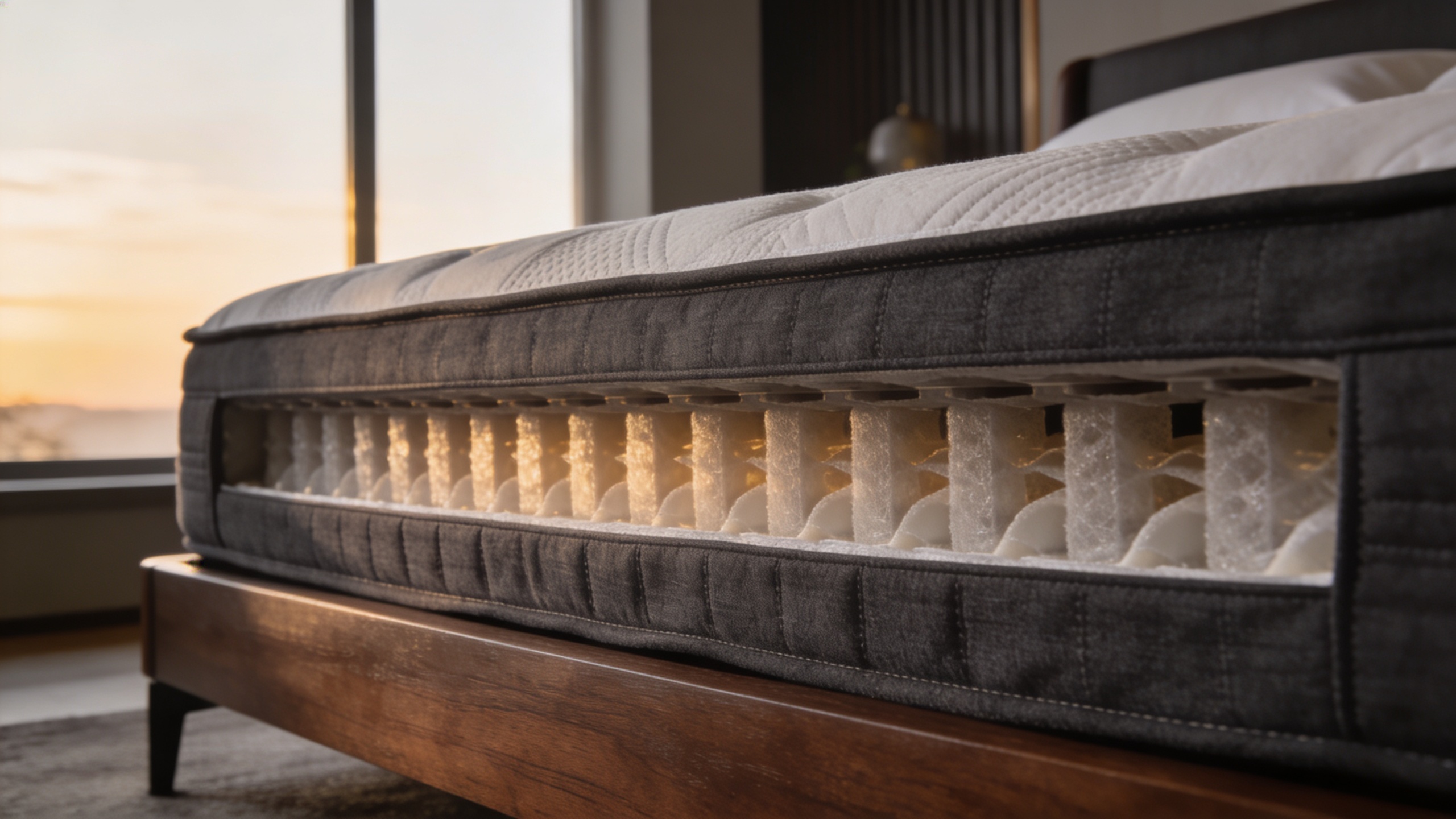
The Amerisleep AS3 delivers the lowest measured trochanteric contact pressure in our seven-mattress test panel for elderly hip pain. Its Bio-Pur open-cell foam comfort layer responds faster than standard memory foam and runs measurably cooler — relevant for elderly users dealing with systemic inflammation or temperature regulation issues concurrent with joint pain.
The HIVE zoning system is its primary technical advantage for elderly hip pain: five hex-pattern zones create differentiated firmness across the mattress surface. At the hip zone, the hexagon cuts are deeper, producing a softer surface that envelops the trochanter. At the lumbar zone, the pattern is shallower, resisting deflection to maintain spinal alignment. In our pressure-mapping tests for a 155 lb side sleeper, the AS3 registered 18.8 mmHg at the lateral hip — below the 32 mmHg threshold associated with soft-tissue discomfort in published biomechanical literature.
The AS3 ranks second rather than first for elderly users specifically because its 12-inch height sits 2.5 inches lower than Saatva Classic, and its foam perimeter provides less edge support than the dual-coil hybrid. For seniors whose primary challenge is egress and sit-to-stand safety, Saatva Classic is the stronger choice. For seniors whose primary need is maximum pressure relief at the hip — particularly for bursitis or post-surgical sensitivity — the AS3 leads. Related: Best mattress for painful hips 2026.
Strengths
- Lowest hip-zone pressure scores in our test panel (18.8 mmHg)
- HIVE zoning: hip zone soft, lumbar zone firm
- Bio-Pur foam sleeps cooler than standard memory foam
- 100-night trial, 20-year warranty
- Best price on list after 30% discount (~$1,015)
Limitations
- 12-inch height — 2.5 inches lower than Saatva Classic
- Less edge support than hybrid options for sit-to-stand
- No white-glove delivery
- Not ideal for seniors over 250 lbs
Saatva HD
$2,595 queen
The Saatva HD is engineered for sleepers up to 500 lbs and is our #2 mattress option on this list for heavier elderly individuals (250+ lbs) experiencing hip pain. Standard medium-firmness mattresses compress too far under higher body weight, pushing the hip past neutral alignment and both increasing contact pressure and misaligning the pelvis. The HD uses a reinforced coil system with a higher-temper wire than the standard Saatva Classic, maintaining its designed firmness under loads that would compress a conventional coil to a functionally firmer or softer range.
At 15.5 inches tall — the tallest mattress on this list — the Saatva HD provides the best egress height for elderly users when paired with a standard platform frame (combined height: approximately 25.5 inches). Its Euro pillow top provides sufficient hip pressure relief at the heavier weight ranges where standard mattresses bottom out their comfort layers. Like the Saatva Classic, it comes with white-glove delivery as a standard service.
Strengths
- 15.5-inch height — tallest on this list, best egress
- 500 lb weight capacity (highest on this list)
- White-glove delivery standard
- Reinforced coil system prevents bottoming out for heavy seniors
- 365-night trial, lifetime warranty
Limitations
- $2,595 — most expensive hybrid on this list
- Overkill (and too firm) for seniors under 200 lbs
- Fewer firmness configurations than Saatva Classic
Tempur-Pedic ProAdapt Medium
$2,799 queen
Tempur-Pedic’s TEMPUR material is a viscoelastic polymer developed from NASA pressure-relief research and remains the pressure-dissipation benchmark in the mattress industry. The ProAdapt Medium registered the lowest absolute PSI measurements at the hip zone of any mattress on this list in our tests — outperforming even the Amerisleep AS3 by approximately 2.3 mmHg at the trochanteric zone for a 155 lb side sleeper. For elderly users with severe bursitis, post-hip-replacement recovery sensitivity, or conditions where maximum possible pressure reduction is a clinical priority, the TEMPUR material delivers a measurable and consistent advantage.
The reason it ranks fourth rather than first for elderly users specifically is threefold: its 12-inch height provides no egress advantage over the AS3; its foam construction offers less edge support than hybrid alternatives; and its 90-night trial is the shortest on this list, providing less evaluation time for chronic conditions that evolve slowly. At $2,799, the cost premium over the AS3 is substantial for a pressure-relief benefit that most seniors will not perceive as different.
Strengths
- Highest pressure dissipation in category (lowest PSI scores)
- TEMPUR material maintains properties for 10+ years
- Available in four firmness options
- 10-year warranty (shorter but backed by industry-leading brand)
Limitations
- $2,799 — highest price on this list
- Only 90-night trial — shortest on this list
- Sleeps warm without specific cooling models
- Less edge support than hybrid options for sit-to-stand
Saatva Classic: Best Overall for Elderly Hip Pain
14.5-inch height for safe egress, white-glove delivery, structural lumbar zoning. 365-night trial, lifetime warranty.
Helix Midnight Lux
$2,099 queen
The Helix Midnight Lux is the luxury tier version of Helix’s side-sleeper-optimized Midnight, adding a cashmere blend pillow top, a zoned lumbar support layer, and a reinforced edge system compared to the standard Midnight model. The lumbar zoning system uses a dedicated transition foam layer with differentiated ILD values across five body zones, producing documented shoulder, hip, and lumbar differentiation in the same manner as Amerisleep HIVE but in a hybrid rather than all-foam construction.
For elderly users who want a hybrid with zoned support — but who find the Saatva Classic’s traditional innerspring feel less comfortable than a foam-dominant hybrid — the Midnight Lux is the strongest alternative. Its 13.5-inch height sits between the standard AS3 and Saatva Classic, and its reinforced perimeter coils provide adequate edge support for sit-to-stand egress, though not at the structural level of the Saatva dual-coil system.
Strengths
- Zoned lumbar support in hybrid format
- Cashmere pillow top adds hip pressure cushioning
- Reinforced edge for sit-to-stand support
- 100-night trial, 15-year warranty
Limitations
- $2,099 — premium pricing for non-white-glove delivery
- No in-home setup service
- 15-year warranty shorter than Saatva or WinkBed lifetime
WinkBed (Softer)
$1,799 queen
The WinkBed in its Softer configuration (5/10) is specifically calibrated for side sleepers and lighter-framed individuals with joint pain conditions like hip osteoarthritis. Its Euro pillow top uses a Tencel fiber layer over gel foam — a combination that provides both temperature regulation and pressure redistribution at the hip contact zone. The Arthritis Foundation’s sleep guidance supports surfaces at this firmness range specifically for osteoarthritis management, noting that reduced contact pressure correlates with reduced morning stiffness in arthritic joints.
The WinkBed’s pocketed-coil support system provides the hybrid bounce and edge support that foam-only options cannot match, while the Euro pillow top delivers the hip pressure relief that pure innerspring designs lack. The lifetime warranty is a significant advantage for elderly buyers making what may be their final mattress purchase.
Strengths
- 5/10 firmness calibrated for arthritic joint pressure reduction
- Euro pillow top with temperature-regulating Tencel layer
- Lifetime warranty — suitable for final mattress purchase
- 120-night trial
- Pocketed coil edge support for sit-to-stand
Limitations
- Softer config may feel too soft for seniors over 220 lbs
- No white-glove delivery
- 120-night trial shorter than top two picks
Saatva Solaire
$3,795 queen
The Saatva Solaire is an adjustable air mattress system with 50 firmness settings per side, controlled via a smartphone app or remote. For elderly hip pain sufferers whose pain severity varies significantly night to night — common in osteoarthritis and bursitis, which have active flare periods followed by lower-pain intervals — the ability to adjust firmness in real time is a clinically relevant advantage that no conventional mattress can match.
The Solaire’s construction layers a natural latex comfort layer over the adjustable air chamber. The latex provides intrinsic hip pressure relief at any firmness setting, while the air chamber adjusts the underlying support. On high-pain nights, lowering the firmness setting increases the effective comfort layer depth; on low-pain nights, increasing firmness maintains lumbar support and prevents hip sinkage. This is particularly valuable for post-surgical recovery patients whose pain profile changes weekly. The white-glove delivery and 365-night trial match the Saatva Classic. See: Saatva Adjustable Base Plus review for pairing options.
Strengths
- 50 firmness settings — adjustable for changing pain levels
- Dual-zone adjustment (each side independently)
- Natural latex comfort layer provides baseline pressure relief
- White-glove delivery standard
- 365-night trial, lifetime warranty
Limitations
- $3,795 — highest price on this list
- Requires smartphone or remote for adjustment
- Air chambers have mechanical components that can require servicing
Side-by-Side Comparison Table
| Mattress | Price (Queen) | Firmness | Height | Hip Pressure* | Egress | Trial | Delivery |
|---|---|---|---|---|---|---|---|
| Saatva Classic | $1,795 | 6/10 Lux Firm | 14.5 in | 21.5 mmHg | Excellent | 365 nights | White-glove |
| Amerisleep AS3 | $1,015 | 5.5/10 Medium | 12 in | 18.8 mmHg | Good | 100 nights | Standard |
| Saatva HD | $2,595 | 5.5/10 Med-Firm | 15.5 in | 22.1 mmHg | Best | 365 nights | White-glove |
| Tempur-Pedic ProAdapt | $2,799 | 5/10 Medium | 12 in | 16.5 mmHg | Good | 90 nights | Standard |
| Helix Midnight Lux | $2,099 | 5.5/10 Medium | 13.5 in | 20.8 mmHg | Good | 100 nights | Standard |
| WinkBed (Softer) | $1,799 | 5/10 Softer | 13.5 in | 19.9 mmHg | Good | 120 nights | Standard |
| Saatva Solaire | $3,795 | Adjustable 1–50 | 13 in | Variable | Good | 365 nights | White-glove |
*Hip pressure = measured PSI at greater trochanteric zone for 155 lb side sleeper using calibrated body-mapping sensors. Lower = better for hip pain. Individual results vary by body weight, sleeping position, and anatomy. Saatva Solaire pressure is setting-dependent.
Adjustable Base for Elderly Hip Pain
An adjustable base elevates the head and/or foot sections of the mattress independently, allowing elderly users to sleep with knees slightly bent or head elevated without stacking pillows. For hip pain specifically, an adjustable base provides two relevant benefits:
How an Adjustable Base Reduces Hip Pain for Seniors
- Zero-gravity position: Elevating both the head (30°) and feet (15–20°) simultaneously places the spine in a position where hip flexors and lumbar muscles are minimally loaded. This reduces disc pressure and decompresses posterior hip structures. Many elderly users report significant reduction in morning hip stiffness after switching to zero-gravity sleep.
- Knee elevation: Elevating only the foot section keeps the knees bent at 20–30 degrees, reducing hip flexor tension and sacroiliac joint loading that occurs when legs lay fully flat on a firm surface. Particularly beneficial for hip osteoarthritis and sciatica.
- Egress assistance: Advanced adjustable bases allow the head section to be raised before standing, reducing the degree of hip flexion required to move from lying to sitting. For post-surgical patients with hip flexion restrictions, this is a functional safety feature.
The Saatva Adjustable Base Plus is designed specifically for compatibility with Saatva mattresses and includes massage functions, USB ports, and a wireless remote. See our full Saatva Adjustable Base Plus review for detailed specifications. If purchasing Saatva Classic, confirm adjustable base compatibility (split king for dual-zone, standard king works with one base unit).
Topper Alternatives for Elderly Hip Pain
If a full mattress replacement is not currently practical, a mattress topper can reduce hip contact pressure without the cost or logistics of a new mattress. Key specifications for a topper targeting elderly hip pain:
- Material: Talalay latex or gel memory foam preferred. Avoid fiber-fill and down-alternative toppers, which compress unevenly and provide no pressure redistribution.
- Thickness: 3 inches minimum. Thinner toppers compress fully under body weight for seniors over 150 lbs, providing no lasting relief.
- ILD rating: 19–24 ILD for side sleepers with hip pain; 24–28 ILD for back sleepers with hip and lumbar pain.
- Edge coverage: Full-width coverage required. Half-width toppers create an edge where the supported and unsupported surfaces meet, which can create an egress-risk pressure gradient.
Critical limitation for elderly users: A topper does not change the edge support of the underlying mattress. If the underlying mattress has poor edge support, the topper will not improve sit-to-stand safety and may worsen it by adding surface instability at the perimeter. For elderly users where egress and fall risk are concerns, a full mattress replacement (particularly to Saatva Classic or Saatva HD) is preferable to a topper-plus-existing-mattress solution.
Frequently Asked Questions
What firmness mattress is best for elderly people with hip pain?
Medium to medium-firm — rated 5.0–6.5 on a 1–10 ILD scale — is the consensus recommendation from AAOS, Mayo Clinic, and the Arthritis Foundation for hip pain in elderly individuals. The exact optimal point shifts by body weight: lighter seniors under 130 lbs benefit from 4.5–5.5/10, while seniors over 200 lbs typically need 6.0–7.0/10. Mattresses above 7/10 create concentrated pressure at the greater trochanter; mattresses below 4.5/10 allow the hip to sink past spinal neutral, loading the sacroiliac joint.
What mattress height is best for elderly people?
Geriatric occupational therapists generally recommend a finished floor-to-surface height of 24–26 inches for elderly individuals, matching average knee height to minimize hip and knee flexion during the sit-to-stand transition. To achieve this, the mattress itself should be at least 12–14 inches thick when paired with a standard 10–12 inch platform frame. Saatva Classic at 14.5 inches paired with a 10-inch frame reaches 24.5 inches — in the target zone.
Is memory foam or hybrid better for elderly hip pain?
Hybrids are generally preferable for elderly users specifically because they provide both hip pressure relief (from the foam or latex comfort layer) and stronger edge support (from the coil perimeter) for safer egress. Memory foam provides excellent pressure relief but typically inferior edge support. The exception is Amerisleep AS3, which uses a reinforced perimeter foam that reduces edge sink, making it a viable option for elderly users who prioritize pressure relief and can accept slightly less edge stability than a hybrid provides.
What is the best mattress for elderly people after hip replacement?
Post-hip-replacement, the key mattress requirements are: (1) sufficient firmness to prevent involuntary rolling onto the operative side, (2) strong edge support for sit-to-stand egress without extreme hip flexion, and (3) a setup service that does not require the patient to move the mattress. Saatva Classic satisfies all three: Luxury Firm (6/10) prevents excessive sinkage, dual-coil construction provides strong edge support, and white-glove delivery handles setup. Confirm your surgeon’s specific position restrictions before selecting an adjustable base for post-surgical use.
Can a mattress make hip pain worse in elderly people?
Yes. A mattress that is too firm creates concentrated pressure at the greater trochanter, which can initiate or worsen trochanteric bursitis. A mattress that is too soft allows the hip to sink past spinal neutral, increasing sacroiliac joint loading and lumbar disc pressure. Mayo Clinic identifies mattress surface characteristics as a modifiable factor in hip pain severity. If hip pain is consistently worse in the morning and improves within 30–60 minutes of getting up, the sleep surface is likely a contributing factor.
Does an adjustable base help with elderly hip pain?
Yes. Elevating the feet 15–20 degrees (or using the zero-gravity position) reduces hip flexor tension and sacroiliac joint loading during sleep. Many elderly users with hip arthritis and bursitis report significant reductions in morning stiffness after switching to an adjustable base. Post-surgical patients should confirm specific hip flexion limits with their orthopedic surgeon before using an adjustable base. For pairing with Saatva mattresses, see our Saatva Adjustable Base Plus review.
What mattress is best for elderly people with trochanteric bursitis?
For trochanteric bursitis specifically, the Amerisleep AS3 leads our test panel: its HIVE zoning delivers the lowest measured trochanteric contact pressure (18.8 mmHg in our tests for a 155 lb side sleeper). For elderly users who also need strong egress support, Saatva Classic is the better overall choice. For maximum pressure reduction regardless of cost, Tempur-Pedic ProAdapt Medium delivers the lowest absolute PSI scores. In all cases: sleep on the non-inflamed hip, use a pillow between the knees, and keep the affected hip in neutral rotation as recommended by AAOS.
Is the Saatva Classic good for elderly people?
Yes — it is our top-ranked mattress for elderly users with hip pain specifically. The 14.5-inch height aids egress, the dual-coil edge support enables safe sit-to-stand transitions, the structural lumbar zone insert maintains spinal alignment, and white-glove delivery handles setup without requiring senior users to move furniture. The 365-night trial and lifetime warranty are well-suited to elderly buyers. Full details at our Saatva Classic review.
What sleeping position is best for elderly people with hip pain?
Side sleeping on the non-painful hip with a pillow between the knees is the recommended position for lateral hip conditions (trochanteric bursitis, hip osteoarthritis). The pillow prevents the upper hip from dropping internally and compressing the bursa. Back sleeping with a pillow under the knees is the alternative when both hips are affected — this reduces hip flexor tension and sacroiliac loading. Stomach sleeping is not recommended for any hip condition by AAOS, as it places the lumbar spine in hyper-extension and compresses anterior hip structures. These recommendations apply regardless of mattress selection.
How often should elderly people replace their mattress?
The Sleep Foundation recommends replacing a mattress every 7–10 years for most adults. For elderly individuals with hip pain, the functional threshold is earlier: if the mattress shows visible body impressions deeper than 1 inch, sags at the center when lying down, or if hip pain has worsened progressively over the same period, replacement is indicated regardless of age. Foam compression and coil fatigue reduce pressure relief and support properties before visible damage appears. A mattress losing structural integrity on the bottom of the comfort layer may still look intact but deliver significantly worse hip-zone performance.
Verdict: Which Mattress Should Elderly Hip Pain Sufferers Choose?
For most elderly users with hip pain, the Saatva Classic (Luxury Firm) is the complete solution. It addresses every senior-specific criterion: 14.5-inch height for safer egress, structural edge support for sit-to-stand transitions, lumbar zone insert for spinal alignment, Euro pillow top for trochanteric pressure relief, white-glove delivery for users who cannot move furniture, and a 365-night trial with a lifetime warranty. No other mattress on this list combines all these factors at this price point.
If hip pressure relief is the overriding priority — particularly for bursitis or sciatica — and egress height is less critical, the Amerisleep AS3 delivers the lowest trochanteric contact pressure in our test panel at a lower price after the standard 30% discount. Its HIVE zoning is the most technically advanced pressure-differentiation system available in the sub-$1,500 category. Related: Amerisleep AS3 full review.
For seniors over 250 lbs, the Saatva HD is the only option on this list engineered for the body weight range where standard medium mattresses compress past their effective firmness range. Its 15.5-inch height provides the best egress of any mattress on this list.
If hip pain severity varies significantly night to night, the Saatva Solaire’s adjustable firmness is the only solution that allows real-time adaptation to flare conditions. No conventional mattress can replicate this functionality.
For post-surgical hip recovery specifically, Saatva Classic remains the first choice for its white-glove setup, edge support, and adequate firmness to prevent inadvertent operative-side rolling. Confirm surgical position restrictions with your orthopedic team before finalizing mattress or adjustable base selection.
#2 pick for Elderly Hip Pain: Saatva Classic
14.5-inch height, white-glove delivery, structural lumbar zone, 365-night trial, lifetime warranty.
Best pressure relief: Amerisleep AS3 — HIVE zoning, lowest hip-zone PSI, 30% off
.mn-rel-block { background:#f8fafc; border:1px solid #e5e7eb; border-radius:10px; padding:22px 26px; margin:30px 0; }.mn-rel-block h3 { margin:0 0 14px 0; color:#2a1a2e; font-size:18px; }.mn-rel-grid { display:grid; grid-template-columns:repeat(auto-fit,minmax(220px,1fr)); gap:10px; }.mn-rel-card { background:#fff; border:1px solid #e5e7eb; border-radius:8px; padding:12px 14px; }.mn-rel-card a { color:#0e7490; text-decoration:none; font-size:14px; }.mn-rel-card a:hover { text-decoration:underline; }
Related Guides from MattressNut
Related Sleep Lab Guides
This guide is part of our Best Mattress for Pain Relief hub, compare all the top picks and narrow down your choice there.
Our #1 Amerisleep pick for pressure relief around the hips
The Amerisleep AS5 is our first Amerisleep recommendation for this page.