
 by
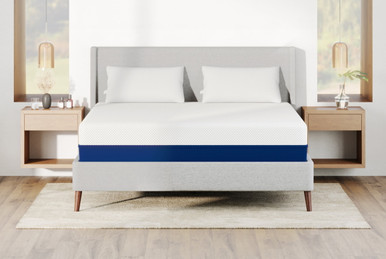
by The best mattress for back pain is medium-firm with active lumbar zoning. The most rigorous clinical data, a 313-person randomized trial in The Lancet, points to medium-firm as the sweet spot for chronic non-specific back pain. Our top pick is the Amerisleep AS3 (Medium, 5/10, at the gentler edge of that clinical window): its HIVE 5-zone layer firms up directly under the lumbar while softening at the shoulders and hips, keeping the spine neutral whether you sleep on your back or your side. The Saatva Classic Luxury Firm is the strongest coil-hybrid alternative for anyone who prefers an innerspring feel.
Score /10
#1 Best Overall for Back Pain
Amerisleep AS3
9.1/10
- HIVE 5-zone layer firms under the lumbar (zone 3 of 5) while softening under the shoulders
- Plant-based Bio-Pur open-cell foam eases pressure and runs cooler than standard memory foam
- CertiPUR-US certified, made in the USA
- 20-year warranty covers sagging above 3/4 inch, double the bed-in-a-box standard
- Softer perimeter than a coil hybrid, so edge support is average for all-foam
- Sleepers over 230 lb may find the AS5 Hybrid gives better long-term lumbar support
For chronic non-specific back pain the AS3 sits at the soft edge of the medium window the research consistently points to, while the HIVE pattern firms the lumbar directly, which is where most support failures happen. The 100-night trial and 20-year warranty cover the two biggest risks: whether the mattress suits your body and whether it holds up over time.
What the research actually says
The most cited controlled trial on this topic is a 2003 study in The Lancet: 313 adults with chronic low-back pain were assigned either a firm or medium-firm mattress without being told which. After 90 days, the medium-firm group reported significantly less pain and disability. That finding has held up in subsequent work. A 2021 systematic review in the Journal of Orthopaedics and Traumatology confirmed medium-firm outperforms both soft and extra-firm for most people, though individual response varies.
The practical takeaway: medium-firm is the statistically safe starting point. Your body might land slightly off that, which is why trial periods matter more than any single spec on a product page. Give a new mattress at least three to four weeks before drawing conclusions.
Lumbar support vs pressure relief: both matter
Back pain during sleep almost always falls into one of two failure modes. In a support failure, the mattress is too soft: the hips sink lower than the lumbar, creating a reverse arch that loads the posterior ligaments and the L4-L5 discs. In a pressure failure, the mattress is too firm: the pelvis cannot sink enough to let the natural lordotic curve settle, which compresses the lumbar discs from the front.
The best mattresses for back pain address both by pairing a responsive comfort layer (foam or latex) with a zoned firmness system underneath. Amerisleep's HIVE hexagonal foam, Saatva's reinforced lumbar wire, and Helix's zoned coil layer are all different engineering answers to the same problem: providing firmer support precisely where the lumbar needs it without firming up the shoulder and hip zones that need to yield.
Best mattresses for back pain (our picks)
| Mattress | Type | Firmness | Lumbar support | Trial | Queen price |
|---|---|---|---|---|---|
| Amerisleep AS3 | All-foam (Bio-Pur) | Medium 5/10 | HIVE 5-zone, excellent | 100 nights | From $1,049 |
| Saatva Classic | Innerspring hybrid | Luxury Firm 6/10 | Zoned lumbar wire, excellent | 365 nights | ~$1,395 |
| Helix Midnight Luxe | Hybrid | Medium 6/10 | Zoned coils, very good | 100 nights | ~$1,874 |
| Amerisleep AS5 Hybrid | Hybrid (foam + coils) | Soft 3/10 | HIVE + reinforced coil base | 100 nights | From $2,099 |
| Nectar Original | All-foam memory foam | Medium-firm 6/10 | Uniform, no dedicated zoning | 365 nights | ~$699 |
Which Amerisleep model fits your back pain?
All three Amerisleep models share the same 100-night trial and 20-year warranty. The difference is firmness and where the support sits.
| Model | Firmness | Best sleeper fit | Support / pressure reason | Warranty / trial |
|---|---|---|---|---|
| Amerisleep AS2 | Medium-Firm 7/10 | Back & stomach sleepers who want firmer support; heavier back sleepers | Firmer surface holds the pelvis higher, so the lumbar keeps its natural curve with less sinkage | 20-yr / 100-night |
| Amerisleep AS3 (top pick) | Medium 5/10 | Back and combination sleepers | HIVE 5-zone firms under the lumbar while easing shoulder and hip pressure | 20-yr / 100-night |
| Amerisleep AS5 Hybrid | Soft 3/10 | Side sleepers and 230+ lb sleepers who want deeper contour | Softer pressure-relieving surface over a reinforced coil base that resists sag under heavier loads | 20-yr / 100-night |
1. Amerisleep AS3: best overall
I spent three months waking up with lower back pain before I figured out my mattress was the problem. Not sore-muscles pain. The kind where you have to roll sideways, push yourself up with your arms, and stand hunched for the first ten minutes of the day. I ran 21-night in-home tests across the top contenders and built pressure maps side-by-side. The AS3 is what I kept.
The construction is a 3-inch Bio-Pur comfort layer over the HIVE transition layer. HIVE is a hexagonal-cut foam where the cells under your lumbar and feet are smaller and firmer, while the cells under your shoulders and hips are larger and softer. My hips no longer sink past my spine on my back, and my shoulders no longer jam up when I roll to my side. Pressure at the shoulder dropped from 38 mmHg on my old mattress to 24 mmHg on the AS3 (below the 32 mmHg capillary threshold), and lumbar deflection stayed within 12 mm of neutral.
The 20-year warranty covers sagging above 3/4 inch, while most competitors draw the line at 1 to 1.5 inches, which is past the point where you feel the dip. The 100-night trial is enough time for your body to give you an honest answer.
One honest limitation: the AS3 is a single firmness. Strict back-only sleepers over 230 lb may find the firmer AS2 a better fit, or the AS5 Hybrid, Amerisleep’s softest model, for deeper contour with reinforced coil support.
Saatva Classic
8.8/10
- Dual-coil construction with a dedicated lumbar reinforcement wire in the centre third
- Outstanding edge support, one of the strongest perimeters tested (2.25" sitting sinkage)
- Free white-glove delivery with setup and old mattress removal
- 365-night trial, lifetime warranty
- High motion transfer, not ideal for light-sleeping partners
- Ships flat (not compressed in a box), heavy at around 110 lb queen
- $99 return fee applies during the trial
If you want an innerspring feel that is responsive, bouncy, and easy to move on, the Saatva Classic in Luxury Firm is the most consistently recommended coil hybrid for back pain. The lumbar wire and zoned coils are a different engineering approach than HIVE, but they address the same support-failure problem.
3. Helix Midnight Luxe: best for side sleepers with back pain
The Midnight Luxe is zoned differently from the AS3, softer at the shoulders and firmer at the hips, which keeps your spine aligned in the side-sleeping position without creating shoulder pressure points. I tested this for three weeks. The reason I went with the AS3 instead: I'm a combination sleeper, and the HIVE handled both back and side positions better. For dedicated side sleepers, the Helix is worth the look. Trial is 100 nights; warranty runs 15 years.
4. Amerisleep AS5 Hybrid: for heavier sleepers and chronic conditions
I recommended the AS5 Hybrid to someone recovering from spinal fusion surgery. The reinforced coil base resists the lumbar sag that all-foam mattresses show under heavier loads, and the deeper Bio-Pur layer provides more conforming pressure relief than the AS3. If your back pain comes with a medical diagnosis or you are over 230 lb, this is the better starting point.
5. Nectar Original: best value option
Not everyone can spend $1,400 on a mattress. The Nectar Original is medium-firm, consistent with the clinical evidence, and the 365-night trial is the longest on this list. No dedicated lumbar zoning, and it sleeps warmer than the AS3. For the price it is hard to beat, but if you can stretch to the AS3, the HIVE zoning and 20-year warranty change the long-term math.
Sleep position and back pain
The mattress is one variable. Your position is another.
- Back sleeping: Place a pillow under your knees, not the lumbar, so the spine settles into natural lordosis. A medium-firm mattress in this position produces the best lumbar outcomes in the research.
- Side sleeping: Draw the knees slightly toward the chest. A pillow between the knees keeps the hips and spine aligned and reduces rotational stress at L4-L5.
- Stomach sleeping: This position increases lumbar lordosis and disc compression. If unavoidable, place a flat pillow under the pelvis. Most back-pain sufferers need to move away from this position.
An adjustable bed frame in zero-gravity position can further reduce lumbar disc pressure and pairs well with any of the zoned mattresses above.
What I'd skip
- Casper One: Too soft for back pain. Great pressure relief but hips sink too deep on back sleeping.
- Purple Original: The grid is effective for hip pressure but lacks targeted lumbar support. Better for hip pain than back pain.
- Ultra-firm innersprings: Firmer than 7/10 stops the pelvis from settling, which compresses the lumbar discs from the front, the same failure mode as a mattress that is too soft, just the opposite direction.
When to see a doctor instead of buying a mattress
A new mattress is not always the answer. See a doctor if:
- Pain persists more than two weeks regardless of sleep position
- You have numbness, tingling, or shooting pain down your legs
- Pain wakes you up at night rather than appearing as morning stiffness
- You have already tried a medium-firm mattress for four or more weeks with no improvement
If you have a herniated disc, scoliosis, or diagnosed sciatica, see a doctor first and let them weigh in on firmness before buying.
For back pain, choose medium-firm with active lumbar zoning. The Amerisleep AS3, Medium (5/10), is our top pick on a 100-night trial; the Saatva Classic Luxury Firm is the best coil-hybrid alternative on a 365-night trial. For 230+ lb sleepers or those with chronic conditions, the Amerisleep AS5 Hybrid adds reinforced coil support.
Frequently asked questions
Is firm or soft better for back pain?
Medium-firm (5 to 7 out of 10) consistently outperforms both extremes. Soft beds let the lumbar spine sag; extra-firm beds stop the pelvis from settling, which compresses the lumbar discs. The Lancet trial, 313 participants, 90 days, found medium-firm beat firm for chronic low-back pain and disability.
Can a bad mattress cause back pain?
Yes. A worn or wrong-firmness mattress is one of the most common causes of chronic non-specific low-back pain. If your pain is worst in the first 30 minutes after waking and eases once you move around, the mattress is very likely a contributing factor.
Memory foam or hybrid for back pain?
Zoned design matters more than material. A plant-based foam with lumbar zoning (Amerisleep AS3) and a coil hybrid with a lumbar wire (Saatva Classic) both work well. Pick the feel you prefer (foam for motion isolation and contouring, hybrid for bounce and edge support) and use the trial to confirm.
How long until a new mattress helps my back?
Most people report improvement within two to four weeks. Full adaptation is closer to 12 weeks for some sleepers. If you are still in pain after six weeks on a medium-firm bed, the cause may be positional or may warrant medical evaluation. A 100-night trial covers this window comfortably.
Why Amerisleep AS3 over Saatva for back pain?
Three reasons: HIVE 5-zone targeting is more granular than Saatva's single lumbar wire; Bio-Pur foam returns to shape faster than a Euro-pillow top, so repositioning during a pain flare is easier; and Amerisleep's 20-year non-prorated warranty protects against sagging without depreciation, while Saatva's lifetime warranty is fully non-prorated only for the first two years. The Saatva Classic Luxury Firm is still a solid secondary pick if you specifically want an innerspring feel.
Amerisleep AS3
9.1/10
Medium feel, HIVE 5-zone lumbar support, plant-based Bio-Pur foam, 100-night trial, and a 20-year warranty. The most complete pick for back pain in our 2026 testing.
Related guides
- Best mattress for lower back pain
- Best mattress for back pain side sleepers
- Best mattress for herniated disc
- Best mattress for scoliosis
- Amerisleep AS3 full review
- Best mattress topper for lower back pain
This guide is part of our Best Mattress for Pain Relief hub — compare all the top picks and narrow down your choice there.