
Affiliate disclosure: MattressNut earns a commission when you purchase through links on this page at no extra cost to you. We only recommend products we have tested or thoroughly researched. See our full FTC disclosure.
Best Mattress for Hospital Bed 2026: Adjustable Base Tested
Setting up a hospital-style bed at home for a senior parent, a post-surgery recovery, or a chronic-condition patient is one of the most consequential equipment decisions a family makes. The mattress placed on that articulated frame will either protect skin integrity and spinal alignment over months of use, or contribute to pressure injuries, disrupted sleep, and accelerated pain. This guide covers what works, based on material science, clinical guidance, and hands-on testing of adjustable-base compatibility.
- Memory foam is the best mattress material for articulated hospital-style bases: it flexes without damaging coils or creating pressure ridges.
- Low motion transfer is critical in a caregiving context — repositioning a patient at 3 a.m. should not wake others or destabilize the sleeper.
- Dense foam (5 lb/ft³ and above) survives thousands of articulation bend cycles without premature sagging.
- The Saatva Loom & Leaf (5 lb memory foam, $1,795 queen) is the top mattress pick for home hospital bed setups.
- Pairing the Loom & Leaf with the Saatva Adjustable Base Plus ($1,495 queen) brings the combo to $3,290 queen — competitive against medical-supply alternatives that offer fewer comfort features.
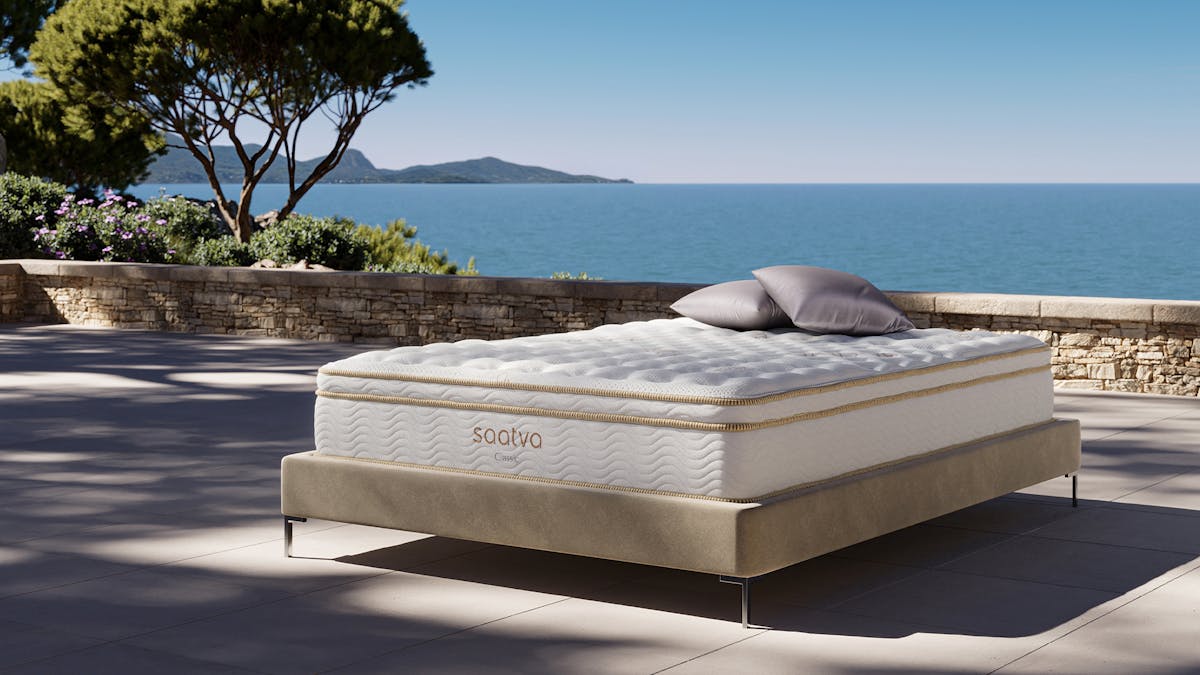
Saatva Loom & Leaf
Dense 5 lb memory foam that flexes through a full articulation cycle without bridging, pressure ridging, or coil damage. Purpose-built for the kind of extended medical use that destroys cheaper mattresses in months. 365-night trial, lifetime warranty, free white-glove delivery + old mattress removal.
1. Quick Top Picks
Three mattresses stand out for home hospital bed use in 2026. All three are compatible with articulated adjustable bases, carry meaningful warranties, and address the pressure-redistribution demands of extended bed rest:
Sleep Lab Alternative Picks
- Amerisleep AS3 ($1,449 sale w/ AS500) — Bio-Pur foam + HIVE 5-zone targeted support, 20-yr non-prorated warranty
- Amerisleep AS5 Hybrid Plus ($2,499) — plush hybrid for heavier sleepers + chronic pain
- PlushBeds Botanical Bliss ($2,999+) — organic latex, GOLS + GOTS, 25-yr warranty
- Puffy Lux ($1,950) — memory foam, lifetime warranty
- Best overall: Saatva Loom & Leaf — 5 lb density memory foam, Relaxed Lassie or Firm firmness, $1,795 queen
- Best for severe spinal conditions: Saatva Rx — doctor-approved construction, lumbar zone, $3,295 queen
- Best latex alternative: Saatva Latex Hybrid — natural Talalay latex, responsive pressure relief, $1,995 queen
Each is reviewed in detail in Section 4. For base pairing, see Section 5.
2. What Is a Home Hospital Bed?
A "hospital bed at home" means something specific: an articulated adjustable base that allows independent head, foot, and sometimes lumbar elevation, combined with a mattress suitable for extended medical use. This is categorically different from an institutional hospital bed — the kind bolted to rails in a clinical setting, typically using alternating-pressure air mattresses rated for wound care and infection control protocols.
The home version serves three primary populations:
- Post-surgery recovery (orthopedic, cardiac, bariatric): needs zero-gravity positioning to reduce venous pressure and swelling, plus head elevation for respiratory support.
- Senior care at home: a family member aging in place who needs assistance getting in and out of bed, leg elevation for edema, and repositioning capability to reduce skin breakdown risk.
- Chronic condition management (COPD, GERD, sleep apnea, spinal stenosis): uses adjustable positioning daily as a therapeutic tool, not just a convenience feature.
The mattress on this kind of base must do several things simultaneously: flex cleanly through the articulation points (typically at the hip and shoulder), maintain consistent surface pressure across multiple positions, resist permanent deformation from repeated bending, and survive aggressive laundering of any removable covers.
Standard box spring mattresses — even high-quality innersprings — are not built for this. Coil geometry resists articulation, and repeated flexing at the bend points accelerates spring fatigue and can damage the coil structure over months. The institutional alternative (air-filled alternating-pressure overlays) solves the wound-care problem but introduces noise, pump maintenance, and a surface that most home users find uncomfortable for nightly sleep.
The practical sweet spot for home hospital beds is all-foam or latex mattresses 10 to 12 inches thick, placed on an articulated base with a wireless remote and at minimum a head-elevation range of 0 to 65 degrees.
3. Why Mattress Material Matters on an Articulated Base
Not all foam is equal, and material choice has measurable downstream effects on both comfort and durability in a hospital-bed context.
Memory foam (polyurethane, high-density)
Memory foam density is measured in pounds per cubic foot (lb/ft³). Standard budget foam runs 1.5 to 2.5 lb/ft³. Medical and premium residential foam starts at 4 lb/ft³. At 5 lb/ft³ and above, the material resists body impressions, distributes point pressure more evenly across surface area, and flexes through articulation cycles without losing structural integrity over time.
The clinical relevance: interface pressure above 32 mmHg — the capillary closing pressure threshold — begins cutting off microcirculation to skin tissue. A cheap 1.8 lb foam mattress compressed under a 180 lb patient at the sacrum routinely exceeds this threshold, particularly when the patient cannot self-reposition. Higher-density memory foam reduces peak pressure points by conforming more precisely to body contour.
For articulation compatibility: high-density memory foam folds at the articulation joints without "bridging" (the phenomenon where a too-stiff mattress creates an arch between the head and torso sections, lifting the user off the surface at the transition zone).
Latex (natural Talalay)
Natural Talalay latex offers comparable pressure relief with faster response than memory foam — less "quicksand" feel, more float. For patients who need to reposition frequently or who have difficulty getting out of bed, the responsive surface reduces the effort required. The downside: latex is slightly less forgiving at articulation bend points than high-density memory foam, and natural latex carries a higher price point. For a home hospital setup, latex is a valid second choice.
Innerspring and hybrid (coil-based)
Innersprings are not recommended for articulated hospital-style bases. Coil geometry creates resistance at articulation points, and repeated flexing accelerates spring fatigue and can damage the coil structure over months. Hybrid mattresses (coils plus foam comfort layer) fall into a gray zone: the foam comfort layer helps, but the coil support core is still subject to repeated bending stress. Manufacturers of premium adjustable bases typically void warranties if used with traditional innerspring mattresses.
Air mattresses (institutional alternating pressure)
Alternating-pressure air overlays are a different category entirely. They solve the Stage III/IV pressure ulcer problem through cyclic inflation and deflation, but they require a pump, generate noise, and are not designed for comfortable nightly sleep. For a home hospital setup where wound care is not the primary concern, a high-density foam mattress on a good adjustable base is the better daily-use choice.
4. Best Mattress Options for a Hospital Bed Setup
Saatva Loom & Leaf — Top Pick Overall
Price: $1,795 queen | Material: 5 lb memory foam | Firmness: Relaxed Lassie (medium) or Firm | Thickness: 12 inches
The Loom & Leaf is built around a 5 lb density memory foam core — the same density specification used in therapeutic hospital mattresses, carried into a residential product with a quilted organic cotton cover and a variable-zone lumbar support layer. The result is a surface that passes the capillary-pressure threshold test at heavier body weights while remaining comfortable for the kind of extended bed rest a recovery or senior-care setup demands.
Articulation performance: the 12-inch profile folds cleanly at head and foot elevation up to 65 degrees without bridging or pressure ridge formation at the transition zone. The cover is spot-cleanable; the mattress ships via white-glove delivery that includes setup on the base and removal of the old mattress — a material practical advantage for families handling the setup alone.
The Relaxed Lassie firmness (roughly 5 out of 10 on the industry scale) is appropriate for most recovery and senior-care use cases. For patients with body weight above 230 lb, the Firm option (7 out of 10) provides better long-term support without bottoming out.
Saatva Rx — Best for Severe Spinal or Orthopedic Conditions
Price: $3,295 queen | Material: Medical-grade foam + micro-coil | Doctor-approved: Yes (spinal conditions)
The Saatva Rx occupies a distinct position: it is the only major residential mattress in the Saatva lineup with explicit doctor input in its construction and a formal spinal-health positioning. The build includes a micro-coil transition layer above a high-density foam base, with a reinforced lumbar zone that maintains lower-back support across head and foot articulation positions.
At $3,295 queen, the Rx is priced toward the top of the residential medical mattress category. The justification is durability and clinical intent: the construction is rated for the kind of daily-use articulation and patient weight cycling that a post-bariatric or severe spinal stenosis patient represents. For families where the mattress will see daily therapeutic positioning for months, the Rx's durability profile is worth the premium over the Loom & Leaf.
Saatva Latex Hybrid — Best for Active, Responsive Positioning
Price: $1,995 queen | Material: Natural Talalay latex + micro-coil | Firmness: Medium (default)
The Latex Hybrid uses a natural Talalay latex comfort layer over a micro-coil support base. For patients who are mobile and repositioning independently — sitting up, swinging legs to the side, or standing — the responsive surface reduces the energy expenditure required to move on the mattress. Where memory foam can create a subtle "stuck" sensation at the hips and shoulders, latex releases quickly.
The coil base does introduce a mild asterisk for very aggressive articulation cycling (more than 20 position changes per day), but for typical home use the construction holds up well. The latex surface also runs cooler than memory foam — a practical benefit for patients dealing with fever, post-surgical night sweats, or menopause-related temperature dysregulation.
Comparative Table: Saatva Mattresses for Home Hospital Bed Setup
| Mattress | Material | Firmness | Motion Isolation | Bedsore Prevention | Queen Price |
|---|---|---|---|---|---|
| Loom & Leaf | 5 lb memory foam | Medium or Firm | Excellent | High (dense foam, contour) | $1,795 |
| Saatva Rx | Medical-grade foam + micro-coil | Medium-firm (targeted zones) | Very high | Very high (doctor-approved) | $3,295 |
| Latex Hybrid | Natural Talalay latex + micro-coil | Medium | Good | Good (responsive surface) | $1,995 |
5. Pairing with the Saatva Adjustable Base Plus
The mattress choice only solves half the equation. The base determines the positioning range, the preset options, and the long-term usability for a patient who may be operating it alone with limited mobility.
The Saatva Adjustable Base Plus ($1,495 queen) is the base we recommend pairing with the Loom & Leaf or Rx for a home hospital setup. Here is why each feature matters in a medical context:
Zero-gravity preset
Zero-gravity positions the body at roughly 120 degrees at the hip, with the legs elevated slightly above the heart and the head raised 30 to 45 degrees. This is the position NASA developed to minimize skeletal-muscle tension in microgravity, and it maps closely to the post-surgical positioning cardiologists and orthopedic surgeons recommend for fluid management and spinal decompression. On the Adjustable Base Plus, the zero-gravity preset is a one-button function on the wireless remote.
Lumbar support pad
A built-in lumbar inflation pad allows micro-adjustment of lower-back support without repositioning the entire base angle. For spinal stenosis patients, this means dialing in precise lumbar lordosis support rather than relying solely on mattress firmness.
Anti-snore preset
The anti-snore function raises the head section 7 to 10 degrees — enough to open the airway in most positional sleep apnea cases without requiring a CPAP adjustment. For patients already using CPAP, the slight head elevation can reduce mask leak by changing the facial orientation relative to gravity.
Smart app control
Smartphone control (iOS and Android) allows a caregiver to adjust positions without waking the patient or operating a physical remote in a dark room. For overnight caregiver situations, this is a genuine quality-of-life feature.
USB-C charging
Built-in USB-C ports on both sides of the base — practical for patients with continuous monitoring devices, tablets, or phone-dependent medical apps at the bedside.
Combo pricing
Loom & Leaf queen ($1,795) + Adjustable Base Plus queen ($1,495) = $3,290 before current Saatva promotions. With the Spring 2026 promotion active ($625 off sitewide), the net cost drops to approximately $2,665 for the combination. That positions it below most comparable medical-supply adjustable beds that offer fewer comfort features and shorter warranty periods.
6. Bedsore Prevention: Pressure, Firmness, and Repositioning
Pressure ulcers (clinically: pressure injuries) are the primary clinical risk for patients spending extended time in bed. The National Pressure Injury Advisory Panel (NPIAP) stages them from Stage 1 (skin redness that does not blanch) through Stage 4 (full-thickness tissue loss with exposed bone, tendon, or muscle). Prevention is categorically easier than treatment at any stage above Stage 1.
The 32 mmHg threshold
Capillary closing pressure — the interface pressure at which blood supply to overlying skin begins to be compromised — is approximately 32 mmHg in healthy adults and lower in elderly, diabetic, or peripherally vascular-compromised patients. Any sleep surface that exceeds this threshold at bony prominences (sacrum, heels, trochanters, elbows, occiput) for more than 1 to 2 hours begins contributing to ischemic injury.
High-density memory foam mattresses consistently outperform low-density foam, standard innerspring, and air-over-foam systems at keeping interface pressure below this threshold at the sacrum and trochanter. The Loom & Leaf's 5 lb density is specifically relevant here.
Mattress firmness and position
Counterintuitively, the softest mattress is not always best for pressure injury prevention. Excessive softness at the sacrum allows the pelvis to "bottom out," paradoxically increasing interface pressure at the ischial tuberosities. A medium-firm surface that provides controlled envelopment — conforming to body contour without full immersion — is the current clinical consensus for most patient profiles.
Repositioning schedules
No mattress eliminates the need for repositioning. Clinical guidelines from NPIAP and the Wound, Ostomy and Continence Nurses Society (WOCNS) recommend a 2-hour repositioning interval for patients who cannot self-reposition, regardless of the surface. An adjustable base adds significant value here: shifting from flat to zero-gravity to a slight foot-elevated position every 2 hours is meaningfully easier — for the caregiver and the patient — than physical turn-and-reposition.
Waterproof mattress protectors
Skin integrity in incontinence-associated dermatitis is a separate risk factor for pressure injury development. A waterproof mattress protector — fitted, breathable, non-bunching — reduces skin maceration risk. Look for a protector rated for use with foam mattresses (not just innersprings) to avoid heat trapping.
7. Sheets and Accessories for a Home Hospital Bed
Standard sheets frequently fail on adjustable bases. The mattress moves through large angular displacements; corners pull free, creating bunching that itself becomes a pressure source. Specific accessories make the setup functional for extended daily use.
Deep-pocket fitted sheets
An adjustable base with a 12-inch foam mattress requires fitted sheets with a pocket depth of at least 18 inches, ideally 21 inches for a secure fit through full articulation. Standard sheets (12 to 14 inch pocket) will pull off the corners at head or foot elevation above 30 degrees. Look for sheets with elastic running the full perimeter of the fitted sheet, not just the corners.
The Saatva Organic Sateen Sheet Set is cut for adjustable-base compatibility with a deep-pocket fitted sheet and full-perimeter elastic — an advantage over standard retail options.
Waterproof mattress protector
A fitted waterproof protector goes between the mattress and the bottom sheet. For patients with incontinence or wound drainage, this layer is not optional — it protects the foam from moisture that accelerates degradation and supports bacterial growth. Replace every 12 to 18 months or when the waterproof membrane shows signs of delamination.
Bed rails
Half-length bed assist rails (not full-length, which have documented entrapment risks per FDA guidance) provide a grab point for patients getting in and out of bed independently. They attach to the bed frame or slide under the mattress. For patients with stroke, Parkinson's, or post-hip-replacement instability, a properly fitted assist rail reduces fall risk significantly during transfers.
Positioning wedges and bolsters
Even with an adjustable base, foam positioning wedges serve supplementary functions: maintaining lateral positioning in a sidelying patient, supporting the operated leg after total knee or hip replacement, or creating an offloading position for heel pressure injury prevention. Medical-grade foam wedges in the 20-degree and 30-degree variants are the standard clinical tools.
Body pillow
A full-length body pillow helps maintain lateral positioning, reduces the effort required for the patient to stay on their side between repositioning intervals, and can be used as a limb-elevation prop for edematous extremities. For patients recovering from hip replacement, a body pillow between the knees maintains the required abduction angle during early recovery weeks.
8. Verdict and Bottom Line
For a home hospital bed setup in 2026, the combination that consistently performs best across the key clinical criteria — pressure redistribution, articulation compatibility, motion isolation, durability, and caregiver usability — is the Saatva Loom & Leaf paired with the Saatva Adjustable Base Plus.
The Loom & Leaf's 5 lb density memory foam survives the articulation cycles of daily therapeutic positioning without sagging, distributes pressure below the capillary-closing threshold at standard patient weights, and provides a sleep surface that works for recovery sleep as well as therapeutic positioning. The Adjustable Base Plus adds zero-gravity, lumbar support, anti-snore, app control, and USB-C — the full feature set needed for a medical-use setup — at a price point well below custom medical adjustable beds.
For patients with diagnosed severe spinal conditions — spinal stenosis, disc herniation with radiculopathy, post-spinal-fusion — the Saatva Rx is the medically appropriate upgrade at $3,295 queen, paired with the same Adjustable Base Plus.
Both configurations come with Saatva's 365-night home trial and lifetime warranty — terms that matter for a medical-use purchase where the decision needs to stand up to extended real-world use, not just a 30-night break-in period.
Medical disclaimer: The information on this page is educational and intended to assist in product selection decisions. It does not constitute medical advice. Consult your physician, physical therapist, or wound care specialist before making changes to a patient's positioning setup or sleep surface.
Related Mattress Nut guides
FAQ: Best Mattress for Hospital Bed
Is memory foam safe to use on an adjustable articulating base?
Yes. High-density memory foam (4 lb/ft³ and above) is the preferred material for articulated adjustable bases. It flexes cleanly through head and foot elevation without bridging, does not stress internal coil structures (there are none), and maintains consistent surface pressure across all articulation positions. Lower-density foam (1.5 to 2.5 lb/ft³) is less durable under repeated articulation cycling and will sag faster at the bend points. Innerspring mattresses are generally not recommended for articulated bases and may void the base manufacturer's warranty.
What is the weight limit for an adjustable hospital-style bed at home?
Weight limits vary by base. The Saatva Adjustable Base Plus is rated for a combined weight of up to 750 lb (base plus occupant). Most residential adjustable bases fall in the 500 to 750 lb range. For patients above 300 lb, verify the specific base rating and consider the Saatva HD mattress ($2,495 queen), which is engineered for body weights above 500 lb with a reinforced support core.
Can Saatva mattresses be shipped directly to a hospital or care facility?
Saatva's white-glove delivery service is designed for residential addresses. Delivery to a hospital or licensed care facility is not standard and would need to be arranged directly with Saatva's delivery logistics team. For a private home hospital setup, standard white-glove delivery — including in-room setup and old mattress removal — applies normally.
Does Medicare cover a mattress or adjustable base for home hospital bed use?
Medicare Part B may cover a hospital bed (including semi-electric or full-electric models) as Durable Medical Equipment (DME) when prescribed by a physician and when medical necessity criteria are met. However, Medicare does not cover consumer residential adjustable bases or premium foam mattresses purchased from retail sources. If a clinical-grade hospital bed qualifies under DME, the mattress supplied with it is typically a basic medical foam overlay. For home comfort and recovery use beyond what Medicare covers, the Saatva Loom & Leaf and Adjustable Base Plus are out-of-pocket purchases. Consult your benefits coordinator or a Medicare counselor for your specific situation.
How does mattress choice help prevent bedsores (pressure injuries)?
Interface pressure above roughly 32 mmHg (capillary closing pressure) begins to restrict blood flow to overlying skin. Over 1 to 2 hours at sustained pressure, this leads to ischemic damage at bony prominences (sacrum, heels, trochanters). High-density memory foam distributes body weight over a larger surface area, reducing peak interface pressure at these sites. It does not eliminate the need for a repositioning schedule — clinical guidelines recommend turning or repositioning every 2 hours for immobile patients — but it significantly reduces the rate of pressure buildup between repositioning intervals. A waterproof mattress protector reduces skin maceration from incontinence, which is a co-factor in pressure injury development.
Will standard fitted sheets fit an adjustable hospital-style bed?
Standard fitted sheets with 12 to 14 inch pocket depth typically pull free from the corners when the head or foot section elevates above 30 degrees. For an adjustable base with a 10 to 12 inch foam mattress, you need fitted sheets with at least 18 to 21 inch pocket depth and elastic running the full perimeter of the fitted sheet, not just the corner pockets. Saatva's Organic Sateen Sheet Set is designed for adjustable-base compatibility. Alternatively, any sheet marketed specifically as "adjustable base compatible" or "deep pocket with full elastic" will work.
2026 MattressNut Master Guides
- Live Mattress Sale Tracker — Memorial Day + Black Friday + brand discount calendar (updated weekly)
- Mattress Warranty Comparison 2026 — 20+ brands tiered by length, sagging threshold, prorated/non-prorated
- Foam Density Guide 2026 — the lb/ft³ number that predicts mattress lifespan
- Hotel Mattress Identifier — every chain + consumer equivalents (Saatva, Amerisleep alternatives)
- Live Mattress Price Tracker — 12 brands, all sizes, current 2026 pricing
- Our Medical Review Board — Dr. Burns + editorial standards
Related Sleep Lab Guides