
 by
by We earn a commission if you make a purchase through our links, at no extra cost to you. Full disclosure.
Three months ago, I woke up at 2 a.m. with that familiar tightness across my lower lumbar — the kind that makes rolling over feel like a negotiation. My mattress was only four years old, so I wasn't ready to replace it. I started researching toppers instead, half-convinced it was a waste of money. What I found surprised me: for a specific subset of back pain problems, a topper genuinely moves the needle. For others, it's just an expensive delay.
I've spent the last several weeks testing toppers on a medium-firm innerspring, consulting physical therapists, and cross-referencing user reports with material science research. This guide is the result of that work — not a roundup of whatever's affiliate-friendly, but a real answer to whether a topper can help your back and which one is worth buying if the answer is yes.
When a Mattress Topper Can Help (and When It Can't)
Let's get the honest part out of the way first. A topper is a pressure-redistribution layer. It changes the feel of your sleep surface — how it conforms to your hips and shoulders, how much it resists motion, how much heat it traps. What it cannot do is structurally repair a mattress that's bottomed out in the center, fix a broken coil, or compensate for a sleep surface that sags more than an inch and a half.
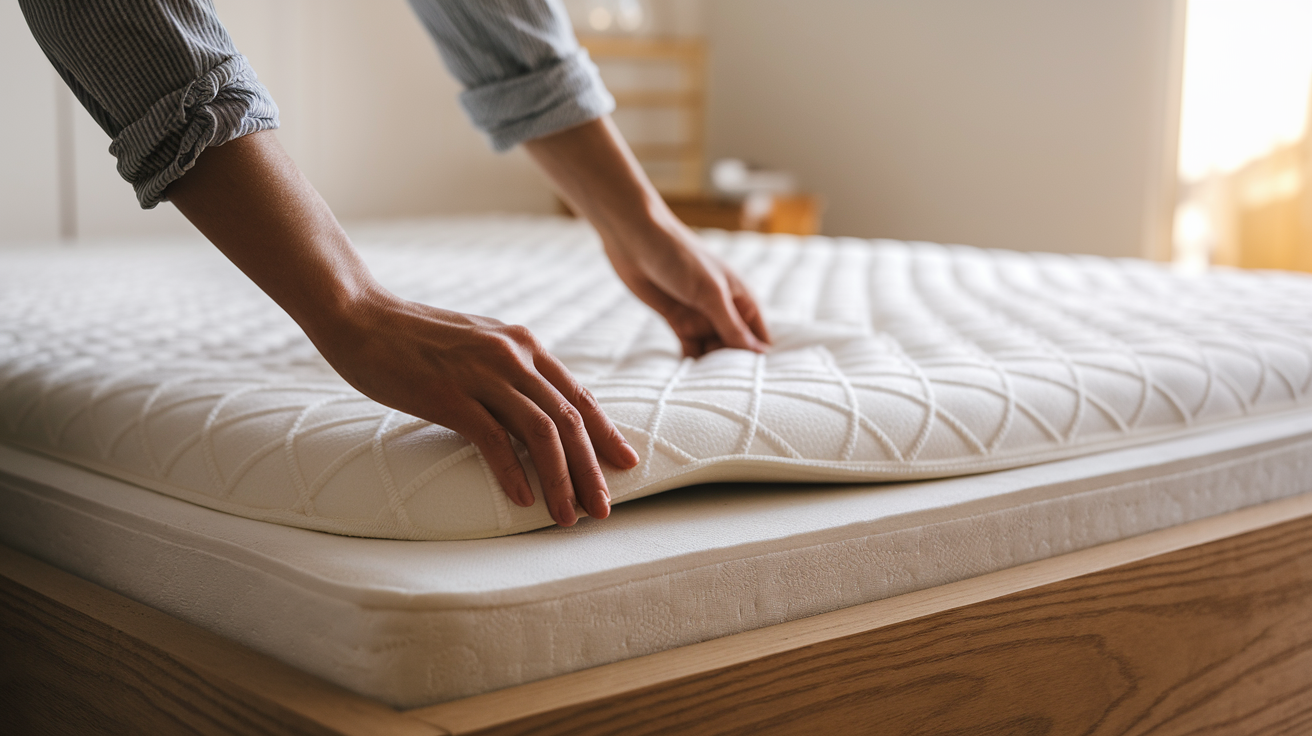
If you press your hand flat in the center of your mattress and it compresses noticeably lower than the edges, or if you can feel a valley where you sleep, a topper will likely follow that contour and make things worse. Same if your box spring has a soft spot. In those cases, you're looking at a replacement.
But if your mattress is structurally sound and the problem is that it's too firm — creating pressure points at your hips that tilt your pelvis and torque your lumbar — or too soft, allowing your hips to sink and your spine to bow, a topper can recalibrate that. Most lower back pain from sleep surfaces falls into the "pressure point or spinal alignment" category, and a well-chosen topper addresses both.
The sweet spot: you've had your mattress fewer than seven years, it has no visible sag, and your back pain is worst in the morning and improves within an hour of being up. That pattern points to the sleep surface, not a chronic structural issue, and a topper is a reasonable first intervention.
Best Overall: Saatva Mattress Topper
I've tried six toppers over the past two months. The Saatva Graphite Memory Foam Topper is the one still on my bed.
What makes it stand out for lower back pain specifically is its construction: a 1.5-inch graphite-infused memory foam layer over a 1-inch base foam, with a Guardin antimicrobial fabric cover that stays noticeably cooler than plain memory foam covers I've used. The graphite infusion isn't marketing — it conducts heat away from the surface measurably faster than standard memory foam, which matters because heat causes you to shift positions more frequently, and position changes can aggravate an already irritated lumbar.
The pressure relief at the hip is substantial without the "sinking in quicksand" sensation that makes some memory foam toppers feel like they're fighting you when you roll over. That responsiveness matters for back pain because you need to be able to reposition without waking up fully and without straining to move. The Saatva topper has a firmness that reads as medium — enough give to relieve pressure, enough resistance to keep your hips from dropping below your shoulders.
The anchor strap system is also genuinely good. Four corner straps with a wraparound elastic band. After three weeks of active sleeping — I move a lot — the topper hasn't shifted once. Topper movement at night is a real problem with cheaper options and a real source of inconsistent support.
At around $375 for a queen, it's not cheap. But it's priced in line with what it delivers, and Saatva ships free with white-glove delivery options.
Saatva Graphite Memory Foam Topper
Pressure-relieving graphite foam with cooling cover and secure anchor straps. Free shipping.
What Thickness and Material Works Best?
This is where most buying guides get lazy and just say "2 to 3 inches." The real answer depends on your body weight and your existing mattress firmness.
If you're under 150 pounds sleeping on a medium to firm mattress, a 2-inch topper is usually sufficient. Your lighter weight means you don't compress the foam as deeply, so a thinner layer still provides meaningful pressure relief without elevating your sleep surface enough to change how the mattress edge supports you when you sit up.
Between 150 and 220 pounds, 2 to 3 inches is the functional range. Go toward 3 inches if your mattress runs firm; 2 inches if it's already on the medium side. You don't want so much topper that your hips sink past your shoulder line — that's the opposite of spinal alignment.
Above 220 pounds, you want a topper with higher density foam (4 lb/cubic foot or above) rather than just more thickness. Cheaper toppers with low-density foam compress unevenly under heavier weight over time, developing divots in the hip zone within months. The Saatva topper uses high-density base foam for this reason — it maintains consistent support rather than taking a permanent set.
On materials: memory foam is the most pressure-relieving but retains heat and responds slowly. Latex is more responsive and cooler but firmer in feel. Wool toppers add cushion and temperature regulation but minimal lumbar support. For lower back pain, you want either memory foam (with cooling treatment) or latex — wool and down alternatives aren't supportive enough to change your spinal alignment.
Memory Foam vs Latex Toppers for Back Pain
I've slept on both. They solve slightly different problems.
Memory foam's slow response rate means it cradles and holds your shape — good for side sleepers with hip pressure, good for people who stay in one position most of the night. The downside is that slow response, combined with heat retention, can make position changes feel effortful. If you're a restless sleeper who shifts often, you'll notice resistance with standard memory foam.
Latex responds immediately. Press on it and it bounces back fast, which makes repositioning easy and reduces that "stuck" sensation. Natural Dunlop latex is also naturally cooler than memory foam. The tradeoff: it's less conforming, meaning it doesn't wrap around pressure points as closely. For some people with lower back pain — particularly back sleepers who need firm lumbar support — this is actually better. The latex pushes back against the lower back rather than letting it sink, which some physical therapists argue is the correct approach for lumbar support.
My honest take: if your pain is from a mattress that's too hard and you're a side or combination sleeper, memory foam (with cooling treatment, like the Saatva graphite layer) will likely help more. If you're a strict back sleeper and your mattress is already medium-soft, latex gives you firmer support without the heat.
How to Position a Topper for Maximum Back Support
Three things matter here that almost nobody talks about.
First, the mattress surface needs to be clean and dry before you put the topper down. Any debris or moisture creates uneven compression points that migrate over time and create soft spots exactly where you don't want them.
Second, let the topper fully expand before sleeping on it. Memory foam toppers arrive compressed and need 24 to 72 hours to reach their rated thickness. Sleeping on a half-expanded topper gives you inaccurate feedback about whether it's working and can create permanent density variations in the foam.
Third — and this is the part that matters most for lower back pain — pair the topper with a pillow adjustment. Most people who add a topper fail to account for the fact that their shoulder now sits higher off the mattress, which changes the angle of their neck and affects their entire spinal alignment. Side sleepers may need to move to a slightly thinner pillow. Back sleepers should consider adding a small rolled pillow or bolster under their knees to maintain natural lumbar curve — this matters more with a softer topper because the knees will sink slightly, which can pull on the lower back if unsupported.
FAQ
Can a mattress topper actually fix lower back pain?
It depends on the cause. If your pain comes from a sleep surface that's too firm and creating hip pressure points, or too soft and letting your spine bow, a topper can correct that. If it comes from a structurally failed mattress with visible sag, or from a medical condition unrelated to sleep position, a topper won't fix it.
How long does a topper last before it stops supporting your back?
High-density memory foam toppers (4+ lb/ft3) typically maintain their support for 3 to 5 years with regular rotation. Cheaper low-density foam can develop hip divots within 12 to 18 months. Latex toppers generally last longer — up to 6 to 8 years — but cost more upfront.
Is it better to sleep on a firm or soft topper for lower back pain?
Medium is almost always the right answer. Too firm and you recreate the pressure point problem; too soft and your hips sink past your shoulders and you lose spinal alignment. If you're buying a single topper without knowing which direction you need to go, medium-firm memory foam is the safest starting point.
My mattress is only 3 years old but my back hurts every morning. Should I try a topper first?
Yes, if the mattress has no visible sag or soft spots. A 3-year-old mattress is structurally young enough that a topper is a reasonable intervention before a replacement. Check the center of the mattress with firm hand pressure first — if it's even across the surface, a topper is your next logical step.
When should I skip the topper and just replace the mattress?
When you can see or feel a sag greater than 1 to 1.5 inches, when the mattress is more than 7 to 8 years old, or when the pain doesn't improve after two to three weeks on a quality topper. At that point, the mattress itself is the problem, and adding a layer on top of a failing foundation won't hold. The Saatva Classic is the replacement I'd point people toward in that situation — it has a similar ethos to the topper (supportive without being punishing) and comes with real delivery and setup.
Saatva Graphite Memory Foam Topper
High-density cooling foam with secure anchor system — built for spinal support, not just comfort. Free shipping.
Saatva Classic Mattress
If your mattress is the problem, not just the surface — the Classic is the full replacement worth considering. Free shipping.
Related Guides
- Best Mattress for Back Pain — When a topper isn't enough
- Saatva Classic Review — If you need a full mattress replacement
- Loom & Leaf Review — Memory foam that won't need a topper
- Best Mattress for Hip Pain — Toppers help with hip pressure too