
 by
by For most people, a mattress in a box is the better starting point: lower prices, long trial windows, and easy shipping, and our top pick in that format is the Amerisleep AS3, a Medium-feel all-foam bed with Bio-Pur foam, a 100-night trial, and a 20-year warranty. For a luxury innerspring alternative with professional white-glove delivery and a real coil-on-coil construction, the Saatva Classic is the strongest non-box DTC option. Both outperform anything from a traditional showroom at the same price point.
Mattress in a Box vs Regular Mattress: Which One Should You Buy?
If you are choosing between a mattress in a box and a regular mattress, the right pick is a medium-feel all-foam bed that balances support and softness and works for every sleep position, especially if you want easy shipping and a trial window at home. The Amerisleep AS3 fits that profile: it comes in a Medium feel, uses Bio-Pur foam, and is built to balance support and softness across sleep positions, backed by a 100-night trial, a 20-year warranty, and free shipping and returns. For shoppers who specifically want a luxury innerspring with white-glove delivery, the Saatva Classic remains the alternative on this page. A mattress does not treat any medical condition, and you should consult a doctor for persistent symptoms.
Amerisleep AS3
9.1/10
- HIVE 5-zone support layer adjusts firmness by body region
- Plant-based Bio-Pur foam runs cooler than standard memory foam
- CertiPUR-US certified, made in the USA
- 20-year warranty, one of the longest in the box-mattress segment
- Edges softer than a coil hybrid or Saatva
- Sleepers over 230 lb may prefer a hybrid option
The AS3 is the box mattress we would recommend to most sleepers. The HIVE zoning gives it support credibility that most roll-packed foams lack, and the 20-year warranty signals genuine durability confidence for the format.
Saatva Classic
9.2/10
- Dual coil-on-coil construction with a reinforced lumbar zone pad
- Free white-glove delivery: in-room setup and old-mattress removal included
- Outstanding edge support, rated 10/10 in independent lab testing
- 365-night trial and lifetime warranty, some of the best coverage in the industry
- Ships at full size, not compressed, so harder to maneuver in tight spaces
- $99 return fee during the trial period
- Motion isolation is moderate compared to all-foam options
The Saatva Classic is the benchmark for non-box DTC mattresses. You get a true innerspring construction with heavy-gauge coils, professional setup, and one of the longest trial windows available, all at a price that undercuts traditional showrooms significantly.
What is a mattress in a box?
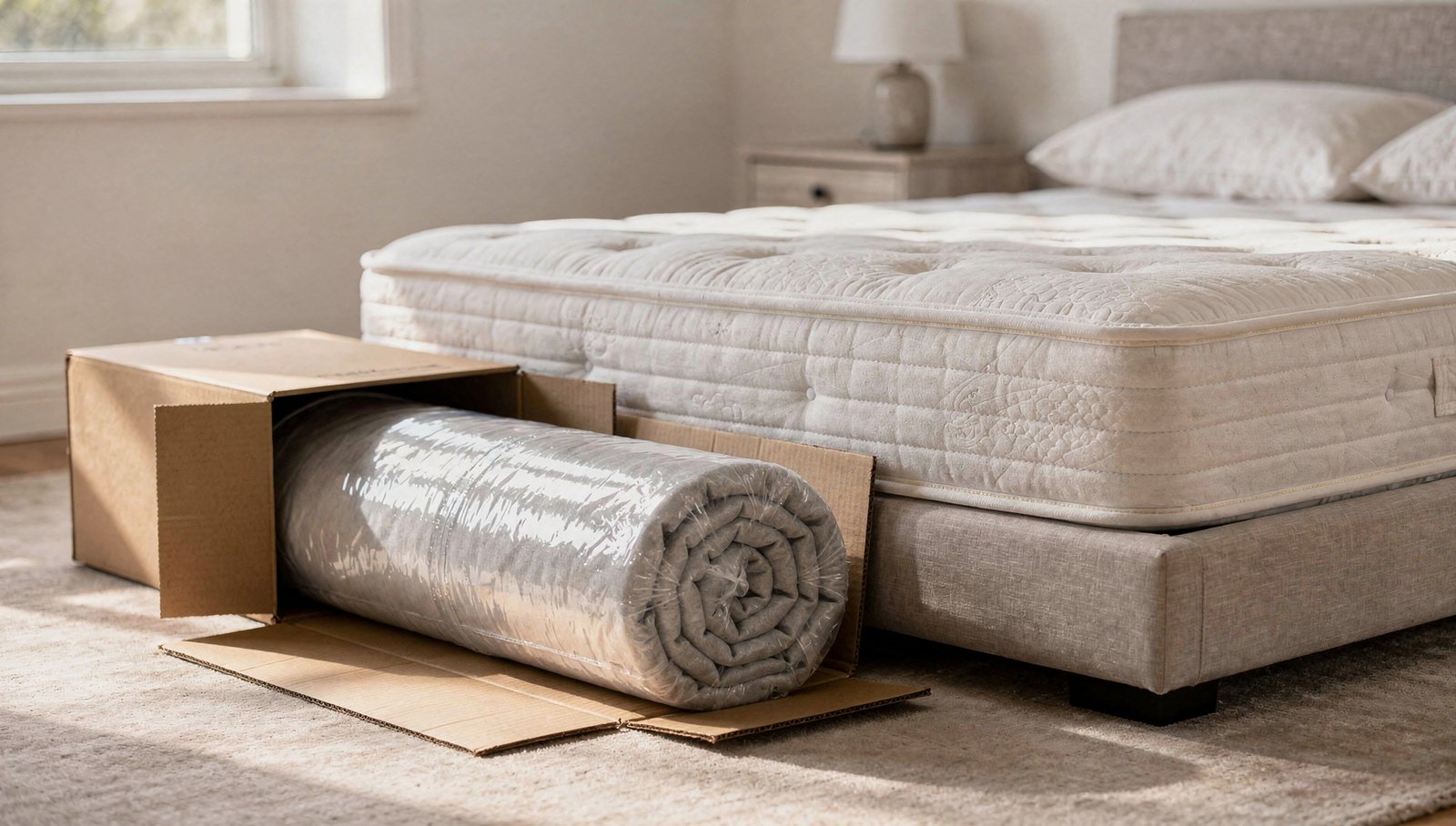
A mattress in a box is a foam or foam-hybrid mattress compressed, vacuum-sealed, and rolled into a cylinder small enough to ship via standard parcel carriers. You receive it at your door, carry it to the bedroom, cut the plastic wrapping, and it expands to full size over the next few hours. The technology is legitimate: compression does not permanently damage the materials when done correctly by reputable manufacturers.
The format took off because it eliminates two layers of cost: showroom overhead and a dedicated delivery crew. A queen that might cost $1,200 at a brick-and-mortar store can land at your door for $700 to $1,100 online with comparable construction. The trial period model also improved with the format. Most box brands offer 100-night trials, a far more useful evaluation window than lying on a mattress for four minutes in a fluorescent showroom.
What the format does not do well is coil thickness. Very thick, low-gauge coils are harder to compress safely, so many boxed hybrids use lighter-gauge coils than traditional innerspring mattresses. If you have always slept on a firm, bouncy innerspring and love it, most box mattresses will feel like a compromise.
Pros and cons of buying a mattress in a box
Price-to-performance at the entry level is hard to beat. Brands like Nectar, Amerisleep, and Casper cut showroom infrastructure and pass the savings through. For a first adult mattress, a guest-room upgrade, or anyone who has been sleeping on something 10-plus years old, the value is real.
The 100-night-or-more trial is genuinely better than a showroom test. You sleep on it in your actual environment, in your actual positions, before you are committed. That matters more than any in-store feel-test.
Logistics are easier for tight spaces. If you live in an apartment with a narrow staircase, a compressed mattress in a box gets through the door and up the stairs far more easily than a queen rolled in by a two-person crew.
The limitations: off-gassing is real on most foam mattresses. Plan to air the mattress for 24 to 48 hours before sleeping on it if you are VOC-sensitive. Returns, while free in most cases, require coordinating a pickup, not re-boxing the mattress yourself. And quality control at the budget tier is inconsistent: some cheaper brands use low-density foam that softens noticeably within two years, often after the trial window has closed.
When a traditional or white-glove mattress makes more sense
The traditional showroom model has real problems: inflated prices, naming conventions designed to prevent comparison shopping, high-pressure sales. But there are genuine situations where a non-box mattress is the better choice.
If you have a strong preference for thick innerspring coils, the kind that provide true edge support and long-term firmness, a coil-on-coil construction like the Saatva Classic cannot be replicated in a box. If you want professional delivery with in-room setup and old-mattress removal without paying extra, that is built into the Saatva price in a way box brands do not offer. And if you are a heavier sleeper over 250 lb, heavier-gauge coils in a full-size hybrid may hold up significantly better than the lighter coils available in the box format.
Box vs. traditional: key differences
| Factor | Mattress in a box | Traditional / white-glove |
|---|---|---|
| Delivery | Parcel carrier, self-setup | Two-person crew, in-room setup |
| Off-gassing | 24 to 72 hours typical | Minimal, ships at full size |
| Coil gauge | Lighter (16 to 18 gauge) | Heavier (13 to 15.5 gauge) |
| Old mattress removal | Not included | Usually included free |
| Trial window | 100 to 365 nights | 90 to 365 nights (DTC) or 30 nights (retail) |
| Typical lifespan | 5 to 8 years (quality brands) | 7 to 12 years |
Budget box option: what to look for under $800
For buyers keeping spend under $800, the Nectar Classic is the most consistently recommended entry-level foam mattress, with a 365-night trial and a lifetime warranty at roughly $699 to $749 for a queen in typical promo pricing. The medium-firm feel suits back and combination sleepers well. The main trade-offs: slow-response memory foam that can sleep warmer than open-cell designs, and no zoned support, which matters if you have specific lumbar or shoulder concerns.
For more picks, see our best mattress for back pain guide and the full best-mattress-in-a-box ranking.
Who should buy which
Buy a box mattress if: you are renting or expect to move in the next few years, you live in a building with a narrow staircase or elevator, or you specifically want an all-foam feel for pressure relief or motion isolation. The Amerisleep AS3 is the strongest single pick here.
Buy a white-glove DTC mattress if: you want a true innerspring feel, you are buying for a long-term home, you want old-mattress removal without arranging it separately, or you are heavier than 230 lb and want heavier-gauge coils. The Saatva Classic is the obvious choice.
Skip the traditional showroom entirely unless you have a very specific requirement, like testing in person before purchasing or a local retailer with a unique construction you cannot find online. The markup at retail is hard to justify when DTC options with equivalent or better trial windows exist at lower prices.
For box-format convenience and balanced comfort, the Amerisleep AS3 is our top pick with a Medium feel, Bio-Pur foam, a 100-night trial, and a 20-year warranty. For white-glove construction and a real innerspring feel, the Saatva Classic is the luxury alternative on a 365-night trial with a lifetime warranty. Budget shoppers will find the Nectar Classic a solid entry point under $750 with excellent trial coverage.
Frequently asked questions
Is a mattress in a box just as good as a regular mattress?
For most sleepers, yes. A well-made foam or foam-hybrid mattress in a box delivers comparable comfort and support to a traditionally sold foam mattress. The main gap is in coil engineering: a box mattress cannot fit the heavy-gauge coil-on-coil construction of something like the Saatva Classic. If you prefer a firm, bouncy innerspring feel, a box mattress may always feel like a compromise.
How long does a mattress in a box take to fully expand?
Most brands say 24 to 72 hours for full expansion. Many mattresses are sleepable within a few hours of unboxing. Latex expands faster than memory foam. It is normal for the mattress to look slightly compressed on the first night.
Does compression damage a mattress in a box?
Not when done correctly by reputable manufacturers. The materials are tested to return to full shape and performance after decompression. Low-quality foam at the budget tier recovers less completely and shows wear faster, which is why brand selection matters more with box mattresses than with traditional construction.
Is Saatva a mattress in a box?
No. Saatva ships at full size via a two-person white-glove delivery crew. It is a direct-to-consumer brand but not a box mattress. That distinction is meaningful: it means a heavier-gauge coil system, professional setup, and no off-gassing period.
What trial period should I expect for a box mattress?
Trial periods include 100 nights at Amerisleep and 365 nights at Puffy, Nectar, and DreamCloud; check each brand’s current terms. Always read the fine print: some brands require a minimum break-in period, usually 30 days, before allowing a return, and pickup logistics vary. The 365-night standard is more useful than 100 nights for catching gradual softening over time.
Amerisleep AS3
9.2/10
A Medium-feel all-foam bed with Bio-Pur foam and HIVE zoned support, shipped in a box with a 100-night trial and a 20-year warranty. Our top pick for most sleepers; choose the Saatva Classic if you want white-glove delivery and a true innerspring feel.