
 by
by Quick answer: Don’t take a splint off for sleep unless the clinician who fitted or prescribed it, or its written instructions, says nighttime removal is allowed. If you can’t confirm, keep it on and seek advice.
- The wear schedule must come from the instructions for your exact splint.
- A removable closure doesn’t automatically mean the splint is optional overnight.
- Wellavor Health treats nighttime removal, sleep position, and elevation as separate questions.
Updated July 2026 · Reviewed for accuracy
Your splint’s written wear schedule controls the answer. If it says to sleep in the splint, keep it on; if it specifically permits overnight removal, follow the conditions provided. This guide can help you find the right instruction, but it can’t give personal clearance to change a prescribed schedule.
“Removable” doesn’t mean optional overnight
If your splint has straps, buckles, or hook-and-loop closures, those features tell you how it opens. They don’t tell you when it should come off. A removable splint may still have instructions that include nighttime wear.
The question also leaves out several details that can change the answer: where the splint is worn, why it was supplied, who fitted it, and whether the wear schedule includes sleep. Without that context, a universal yes or no would be guesswork.
A Wellavor Health guide on sleeping with a splint discusses removal safety, sleep position, wrist elevation, pain, sleep quality, and healing speed. I’d still separate general reading from personal instructions. An online guide cannot know the purpose or fitting requirements of your particular splint.
My rule: Treat “removable” as a construction description, not permission. Nighttime removal should be stated in your care instructions or confirmed by the person responsible for your splint.
If a clinician fitted or prescribed the splint, use the paperwork or message they gave you. Look for wording about continuous wear, sleep, washing, exercises, or scheduled breaks. Follow the most specific instruction that applies to your situation.
If you chose a retail splint yourself, read its complete label rather than relying on the packaging headline. A product described for daytime support, occasional use, or nighttime use may have different directions. If neither the label nor a qualified professional answers your question, the construction alone isn’t enough to decide.
Use this bedtime decision check
Your discharge sheet, clinic message, fitting notes, or product directions are more useful than the fact that the splint feels easy to remove. Before bed, find the instruction that deals specifically with wear time.
| What you know | What it tells you | Bedtime response |
|---|---|---|
| The instructions explicitly say to wear it while sleeping | The nighttime schedule is clear | Leave it on and follow the fitting directions |
| The instructions explicitly allow removal for sleep | Removal is permitted under those instructions | Follow any conditions about storage, reapplication, or timing |
| The splint opens, but sleep isn’t mentioned | You know how it opens, not whether removal is allowed | Check with the fitter, prescriber, clinic, or supplier |
| Different instructions appear to conflict | The wear schedule needs clarification | Don’t choose the more convenient version without asking |
| The splint feels uncomfortable or keeps moving | There may be a fitting problem | Ask for fitting guidance instead of inventing a new schedule |
Read the full instruction rather than pulling out a convenient phrase. Permission to remove a splint for washing, for example, doesn’t necessarily say anything about sleeping. Likewise, directions to wear it “as instructed” send you back to the clinician’s specific plan.
If you need to ask for clarification, make the question precise. State what kind of splint you have, where it is worn, who supplied it, and exactly what your paperwork says about wear time. Mention whether your concern is permission, fit, comfort, or damage to the splint.
A useful question to ask: “My instructions say this about wear time, but they don’t mention sleep. Should I leave this exact splint on overnight, and are there any conditions for removing or adjusting it?”
That wording is far more useful than asking whether splints in general can come off. It keeps the answer tied to your device and instructions rather than someone else’s experience.
Make sleep easier without changing the wear plan
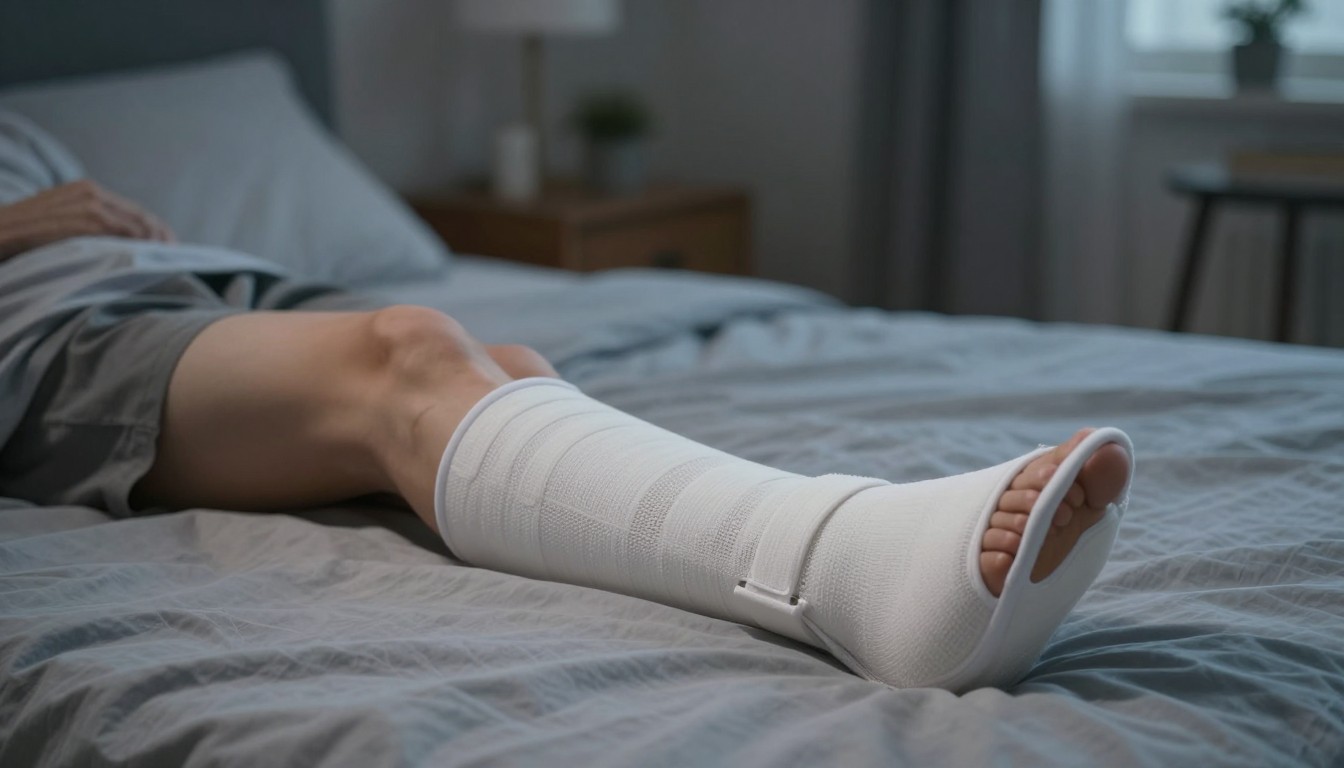
A pillow can support the area around a splinted arm or leg without changing the splint itself. The goal is to make the assigned position easier to maintain while leaving the prescribed fit and closures alone.
Set up the bed before settling down. Smooth loose bedding that could catch on an edge, place anything you may need within easy reach, and arrange pillows around the splinted area. Don’t push a pillow or folded fabric inside the splint unless your instructions specifically call for it.
- Use only a sleep position that doesn’t conflict with your personal instructions.
- Follow elevation guidance only if it was included in your care plan.
- Keep straps and closures in the position shown during fitting.
- Use any supplied cover exactly as directed.
- Keep the splint away from conditions its instructions tell you to avoid.
- Make changes to the bedding around the splint, not to the splint’s structure.
There isn’t one correct sleeping side for every splint. A position that works for a wrist support may be irrelevant to a leg, ankle, finger, or other device. I wouldn’t copy a photograph or another person’s setup unless it matches the instructions you received.
It also helps to distinguish support from elevation. A pillow may simply stop the splinted area from rolling or resting against a hard surface. Elevation is a separate instruction, so don’t invent an angle based on a generic illustration.
Keep the sleep setup practical: A pillow you already own may be enough for positioning. If you’re replacing pillows for unrelated reasons, our guide to buy-one-take-one pillow offers deals with the purchase terms, not splint care.
If you’re considering a sleep supplement because the splint is making bedtime difficult, treat that as a separate decision. Our guide to melatonin dose questions provides general context, but personal advice should come from a qualified professional who knows your circumstances.
A new pillow, mattress, or sleep aid cannot answer whether a splint may come off. That answer still belongs to the wear schedule. Comfort changes should work around it rather than quietly replacing it.
If the splint hurts, slips, or keeps waking you
A splint that slips in bed or feels different after you lie down presents a fitting question. It doesn’t automatically create permission to remove, loosen, tighten, bend, or pad the device.
I’d avoid unsupervised redesign. Don’t trim an edge, reshape a rigid section, place extra material inside, or change a closure beyond the directions you were given. Even a small adjustment can change how the splint sits, and this article has no way to judge whether that change fits its intended use.
Instead, describe the problem clearly to the clinic, fitter, prescriber, or supplier. Note where the issue occurs, whether it appears only in a particular position, whether the splint is moving, and whether anything about the device has become wet, loose, or damaged. Clear details make it easier for the responsible person to address fit separately from wear time.
Keep the decisions separate: Discomfort can be a valid reason to request help. It isn’t, by itself, evidence that taking the splint off overnight is appropriate.
If you believe the splint is creating an immediate threat to your health or safety, don’t wait for an article or a routine reply. Seek appropriate urgent or emergency care. The urgency of the concern and the normal wear schedule are separate questions.
A damaged splint also needs device-specific advice. Don’t assume the choice is limited to wearing it unchanged or leaving it off all night. The person or service responsible for the device may be able to explain the proper interim step or arrange an assessment.
How common splint situations change the answer
Splints can look similar while coming with very different instructions. The deciding information is the purpose and wear schedule attached to the specific device, not its general appearance.
| Situation | What matters before sleep |
|---|---|
| A clinician fitted the splint after an injury or procedure | Use the clinician’s wear schedule and fitting directions. Don’t substitute a generic online answer. |
| The splint was described specifically for nighttime use | Its stated use points toward wearing it at night, but the complete directions still govern fit and removal. |
| The splint was supplied for selected activities | Check whether sleep appears in the activity or wear instructions rather than extending the schedule yourself. |
| You bought a removable support without a personal fitting | Read the complete manufacturer directions. Ask a qualified professional if the directions don’t address your situation. |
| Removal is permitted for a specific task | Keep that permission within its stated purpose. It doesn’t necessarily extend to the whole night. |
A clinician-fitted splint deserves the narrowest reading of the instructions. If the paperwork says it may come off for a named task, follow that exception as written. Don’t broaden it because bedtime lasts longer or feels less convenient.
A store-bought support places more weight on the manufacturer’s directions, but it still doesn’t make internet consensus a personalized wear plan. If you’re using the support in response to an unresolved concern, asking a qualified professional is more reliable than experimenting with different nighttime schedules.
A splint intended only for sleep has the opposite issue: taking it off at bedtime would conflict with its stated use unless you were told otherwise. A device intended only for selected daytime activities may have a different schedule. The product category alone doesn’t settle which instruction applies to you.
The useful distinction: “Can this splint be opened?” is a construction question. “May I remove it while sleeping?” is an instruction question.
If no written direction covers your situation, don’t fill the gap with an assumption. Contact the person who fitted or prescribed the splint, the clinic named on your paperwork, or the supplier identified in the directions.
FAQ
The splint’s own wear schedule remains the deciding document in every answer below. These short answers explain what information to check, not whether your individual splint is medically safe to remove.
Can I take a removable splint off at night?
Not simply because it is removable. Take it off for sleep only if the instructions for that splint, or the clinician responsible for it, explicitly allow nighttime removal.
If sleep isn’t mentioned, check before changing the schedule. The closure tells you how the splint opens, not when opening it is appropriate.
What if my instructions say to wear the splint “as needed”?
That phrase may not explain whether sleep is included. Ask the prescriber, fitter, clinic, or supplier what “as needed” means for your particular use case.
Until it is clarified, don’t translate an ambiguous phrase into firm permission for overnight removal. Quote the exact wording when you ask.
Can I loosen the straps while I sleep?
Only follow adjustment instructions supplied with the splint or given during fitting. Don’t change the straps merely because they are accessible.
If the fit feels wrong, treat that as a reason to request fitting guidance. It is not something a general article can safely calibrate from a description.
What if I cannot sleep while wearing the splint?
Sleep difficulty doesn’t rewrite the wear schedule. Start with allowed changes around the splint, such as arranging the bedding and using a position that matches your instructions.
If those changes don’t help, contact the responsible clinician or supplier and explain that the device is interfering with sleep. Ask about both fit and permitted removal rather than assuming they have the same answer.
What should I do if I cannot reach anyone tonight?
Read the complete paperwork, fitting notes, and manufacturer directions, paying particular attention to sleep and wear time. If the answer remains unclear and there is no immediate safety concern, avoid making an unsupported change and seek clarification when the responsible service is available.
If you believe there is an immediate threat to your health or safety, use appropriate urgent or emergency care. An online guide cannot assess that situation.
Bottom line: Don’t remove a splint for sleep based only on comfort or the fact that it opens. Use the nighttime instructions for your exact splint, and ask the responsible professional whenever those instructions are missing or unclear.