
 by
by Quick answer: Usually, you should wait. Sleep on a newly unboxed mattress only if its own setup instructions explicitly permit immediate use and the surface has opened evenly enough to support you as intended.
- Tom’s Guide reports that most mattress brands it contacted advised against sleeping on a mattress while it expands.
- Bed Consultant says some manufacturers permit immediate use, but it generally recommends waiting for full expansion.
- Sleep Junkie takes a different view for memory foam, saying normal use may help the material expand sooner.
Updated July 2026 · Reviewed for accuracy
My answer is simple: don’t guess with a brand-new bed. If the care sheet tells you to wait, wait. If it expressly permits immediate sleep and the mattress looks evenly opened, you can follow that product-specific guidance.
The mixed answers online aren’t necessarily contradictions about the same mattress. They reflect different constructions, packaging methods and manufacturer instructions. Your mattress’s directions carry more weight than a universal rule from the internet.
Why the Advice About Sleeping on It Conflicts
Tom’s Guide says the majority of mattress brands it contacted gave a firm “no” to sleeping on a compressed mattress while it was still expanding. That supports the cautious answer: let the mattress complete the setup process before placing your weight on it for a full night.
Bed Consultant allows for more nuance. It says some manufacturers permit sleep straight away, while still recommending that buyers generally wait until the mattress has fully expanded and follow the maker’s care instructions.
Sleep Junkie presents the permissive side of the argument for memory foam. It says sleeping, rolling or stepping on the mattress won’t stop expansion and may reduce the time the material needs to open. I wouldn’t turn that into blanket permission for every mattress, because its advice addresses memory foam rather than every compressed construction.
My rule: Put the mattress instructions first, direct guidance from its manufacturer second and general online advice last. If your setup guide says not to sleep on it yet, that settles the question.
The well-known “wait 24 hours” idea isn’t a universal cutoff. Sleep Junkie specifically discusses sleeping on memory foam before 24 hours and says it can be acceptable, while the brand guidance reported by Tom’s Guide leans toward waiting. A fixed clock can’t resolve differences between individual mattresses.
There’s also a meaningful difference between brief handling and sleeping in one position for the night. A source that permits rolling or stepping on memory foam isn’t automatically saying that every unfinished mattress is ready to deliver its intended comfort and support.
What “Still Expanding” Actually Means
A compressed mattress isn’t yet in its intended final condition when the wrapping first comes off. During setup, you’re watching for the sleep surface, edges and corners to open into a consistent shape. The practical question isn’t whether the mattress has moved at all. It’s whether the surface appears ready for normal use under the maker’s directions.
I separate that check into shape and feel. Shape is visible: one area may still look folded, pinched, low or uneven. Feel is what you notice with light hand pressure: one section may seem less open or less consistent than the surrounding surface.
Neither check replaces the instructions. A mattress can look reasonably flat before the maker’s stated waiting period ends, and another model may be cleared for immediate sleep before it looks cosmetically perfect. That’s why appearance alone shouldn’t override a clear setup restriction.
Signs I’d keep waiting:
- The setup guide gives a waiting instruction that hasn’t been satisfied.
- A corner or broad section remains visibly folded, compressed or much lower than the rest.
- The cover is still pulled awkwardly around an area that hasn’t opened.
- The mattress isn’t yet placed on the support surface required by its manufacturer.
- You can’t find any product-specific directions confirming that immediate use is allowed.
Don’t use odor as your expansion gauge. A mattress may have a noticeable new-product smell without looking uneven, or it may look unfinished without smelling strongly. If an odor bothers you, ventilate the room and delay use until you’re comfortable, but judge expansion through the instructions and the mattress’s physical condition.
I’d also avoid evaluating comfort while the surface is visibly unfinished. A low corner, a compressed edge or a folded section can make the first impression misleading. You’re judging a mattress that hasn’t yet reached the condition in which it was designed to be used.
Use This Decision Table Before Going to Bed
One sentence in the setup guide outweighs any generic waiting rule. Find the instructions on the packaging, care card or manufacturer’s official support material, then match your situation below.
| What you find | What I’d do | Reason |
|---|---|---|
| The manufacturer explicitly permits immediate sleep | Inspect the whole surface, then use it if no area remains severely folded or trapped. | The permission applies to your mattress rather than mattresses in general. |
| The instructions say to wait | Honor the full setup direction before sleeping on it. | General advice can’t cancel a product-specific restriction. |
| The instructions are silent or missing | Wait for an even surface and ask the manufacturer for model-specific guidance. | Silence isn’t the same as permission. |
| A large area remains visibly compressed | Keep weight off that area and continue the approved setup process. | The mattress clearly hasn’t reached a consistent condition. |
| You already slept on it once | Inspect it, read the directions and contact support if the shape remains abnormal. | One early night doesn’t prove damage, but it also doesn’t replace proper setup. |
If the directions aren’t in the box, search using the exact mattress name rather than the brand alone. Different models from one company can have different materials and setup requirements. Keep the packaging label or order details nearby so customer support can identify the correct product.
For a closer look at the consequences and uncertainties, read what happens if you sleep on a mattress too soon. The central point remains the same: “too soon” is defined by the condition and instructions of the mattress you actually own.
Comparing options? The Saatva Classic is the pick we keep coming back to — see the final verdict ↓
How to Set Up an Expanding Mattress Properly
The first useful step happens before you throw anything away: locate the care and setup directions. Expansion advice printed on a model-specific insert is more useful than a general rule remembered from another mattress.
- Prepare the support surface. Confirm that the frame, base or foundation matches what the mattress manufacturer requires.
- Move the package into position. Opening it near the bed reduces unnecessary bending and dragging after the mattress begins to unfold.
- Remove the wrapping carefully. Keep cutting tools away from the fabric cover and internal materials.
- Let the mattress open naturally. Spread it into the intended orientation without forcing a stubborn section.
- Inspect the top, edges and corners. Look for areas that remain trapped, folded or markedly lower than the rest.
- Follow any stated waiting direction. Don’t replace it with a generic timetable from a different brand or model.
- Add bedding after the readiness check. A bare surface is easier to inspect than one hidden beneath sheets and a protector.
I wouldn’t jump on the mattress, apply artificial heat or repeatedly fold it in an attempt to hurry the process unless its maker expressly instructs you to do so. Sleep Junkie says ordinary use can help memory foam expand, but that isn’t evidence for improvised treatments across every construction.
Sheets aren’t a reliable indicator either. Putting them on doesn’t prove the bed is ready, and leaving them off doesn’t mean expansion is complete. I prefer to keep the mattress uncovered during the visual check because it makes low corners, folds and uneven sections easier to see.
Check the support underneath before blaming expansion for every odd sensation. A mattress may be open while the bed frame, base or foundation is creating a separate problem. For another setup consideration, see this under-mattress guide.
Don’t force the clock. If you need a bed immediately but your mattress says to wait, use another suitable sleep surface. A rushed first night isn’t worth ignoring a clear care instruction.
Does Mattress Type Change the Answer?
Memory foam is the only construction addressed specifically in the conflicting guidance here. Sleep Junkie says normal use won’t prevent a memory foam mattress from expanding and may help it open sooner. That makes an early night more defensible when the model’s own instructions also permit it.
Tom’s Guide reports broader caution from the mattress brands it contacted, while Bed Consultant says policies vary and directs owners back to the manufacturer. Taken together, those sources don’t support one waiting period for every mattress type.
I wouldn’t transfer instructions from one construction to another. A rule written for a compressed memory foam mattress may not apply to a mattress containing a different combination of materials. Even two mattresses that arrive in similar boxes can carry different care directions.
| Situation | Best source of the answer |
|---|---|
| Compressed memory foam with clear immediate-use permission | The model’s setup directions, supported by the permissive memory-foam guidance from Sleep Junkie |
| Any mattress with an explicit waiting instruction | The manufacturer’s stated process |
| A construction you can’t identify | The product label, order record or manufacturer support |
| A mattress that didn’t arrive compressed | Its delivery and setup directions, because the usual expansion question may not apply |
The safest editorial answer is therefore conditional, not evasive: wait unless your specific mattress is cleared for immediate use. That approach respects the disagreement among published sources without pretending every bed behaves identically.
What to Do If You Already Slept on It Too Soon
One early night doesn’t prove that you ruined the mattress. Sleep Junkie expressly says normal use during memory foam expansion is acceptable, so an automatic-damage claim would be too strong. The uncertainty is whether that advice fits your particular model.
Remove the bedding and inspect the mattress in good light. Look across the surface from more than one angle, paying particular attention to any corner, edge or broad section that remains lower or folded. Take clear photographs if the shape looks abnormal.
Next, compare what you see with the manufacturer’s setup directions. If those instructions say to continue waiting, leave the mattress undisturbed on its approved support surface. If they permit immediate sleep but the shape still concerns you, send the manufacturer the model details and photographs.
Contact the manufacturer if:
- The mattress remains visibly uneven after its stated setup process is complete.
- A folded or compressed area doesn’t show further improvement.
- The care directions are missing, contradictory or unclear.
- You’re unsure whether the mattress is on an approved base.
- You notice damage to the cover or packaging that may have affected setup.
Don’t diagnose a permanent defect from the first impression alone, but don’t keep sleeping on a markedly unfinished surface while hoping it resolves. Product support can tell you whether the appearance falls within that model’s expected setup process and what action its policy allows.
Keep your notes factual. Record when you opened the package, what the instructions said and which areas remained uneven. That gives the manufacturer something more useful than a general statement that the mattress “doesn’t feel right.”
ONE OPTION WORTH COMPARING
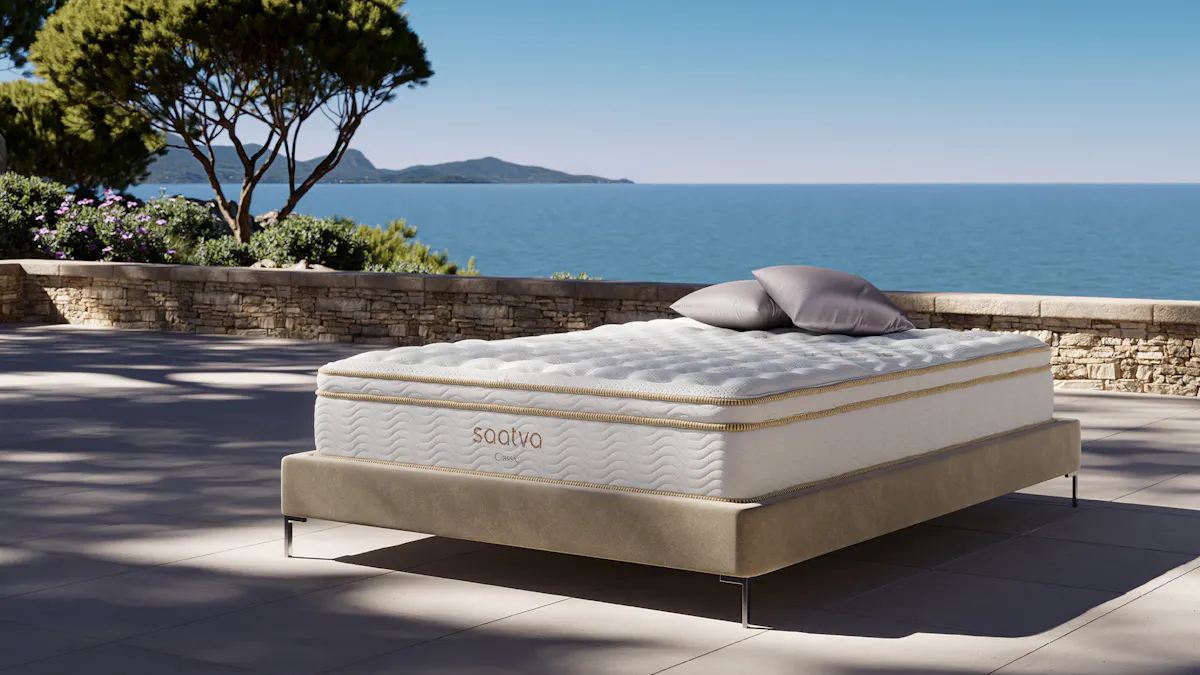
Shopping as well as reading? Here is one current option worth comparing: the Saatva Classic. Check today’s price, sizing and return terms on the official product page before you order.
Saatva Classic
- 365-night home trial and lifetime warranty, per saatva.com
- Handcrafted in the USA, free white-glove delivery
- Flexible financing available
FAQ
Will sleeping on an expanding mattress ruin it?
Not necessarily. Sleep Junkie says ordinary use won’t stop memory foam from expanding, but Tom’s Guide reports that most brands it contacted advised waiting. Follow your mattress’s own instructions rather than assuming one early-use rule covers every model.
How do I know when the mattress has fully expanded?
Check that the top, edges and corners have opened into a reasonably consistent shape, then compare that condition with the manufacturer’s setup directions. A mattress that still has a pronounced fold, trapped corner or broad low section doesn’t look ready to me, even if part of the surface appears flat.
Can I put sheets on the mattress while it expands?
You can follow the bedding instructions supplied for your model, but I prefer leaving the surface visible until the readiness check is complete. Sheets can hide uneven areas and make it harder to compare one corner or edge with another.
Does walking or rolling on memory foam help it expand?
Sleep Junkie says sleeping, rolling and stepping on memory foam may decrease its expansion time. I’d treat that as memory-foam-specific guidance, not permission to jump on or force every compressed mattress, and I’d still defer to the maker’s directions.
What should I do if one corner won’t expand?
Keep the mattress on its approved support surface, avoid forcing the corner and complete the manufacturer’s stated setup process. If the corner remains compressed afterward, photograph it and ask the manufacturer for model-specific instructions.