
 by
by The Casper One is Casper's entry-level all-foam mattress, retailing around $700-$900 queen. It is a capable budget pick for guest rooms and light-use scenarios, but the three-layer polyfoam build runs warm, has soft edges, and shows body impressions sooner than a hybrid. If you are buying a primary bed, the Saatva Classic is the stronger long-term choice: coil-on-coil construction, a 365-night trial, and a lifetime warranty at a price that narrows considerably after promos.
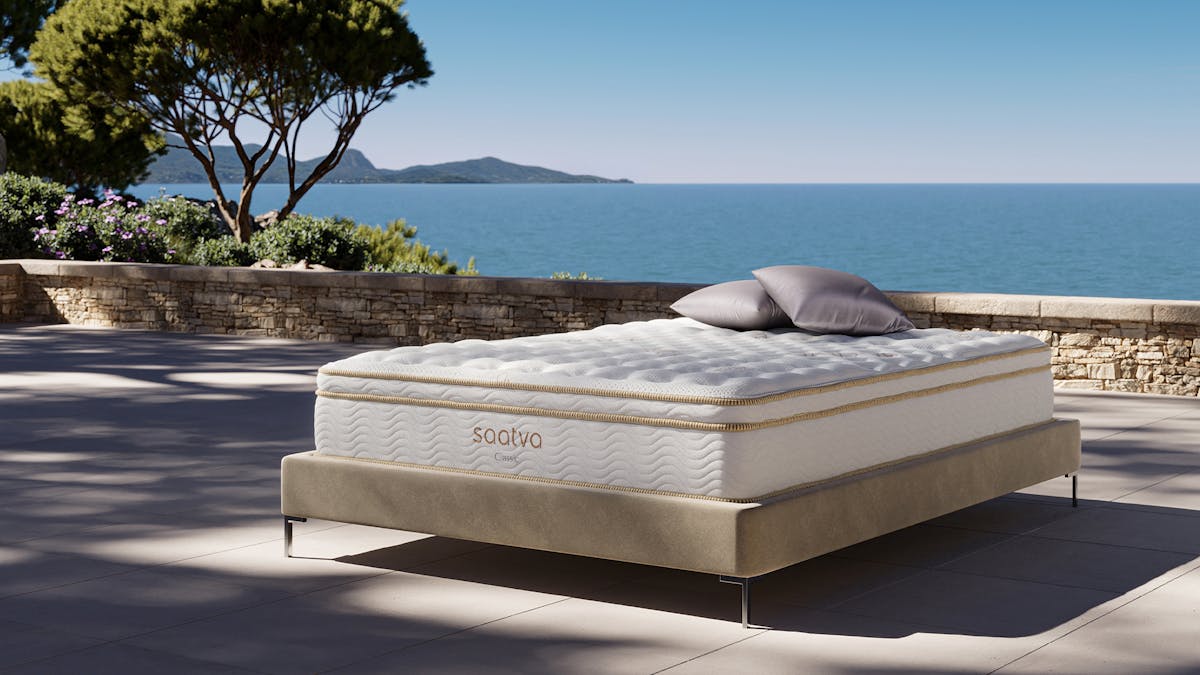
Saatva Classic
9.2/10
- Dual-coil construction with reinforced lumbar zone pad, far more durable than polyfoam
- Three firmness levels (Plush Soft, Luxury Firm, Firm) to match different sleep styles
- Free white-glove delivery, in-room setup, and old-mattress removal in the contiguous US
- 365-night trial, the longest in the category, and a lifetime warranty
- Heavier than a boxed mattress, needs two people to set up
- Not as motion-isolating as a pure foam bed, slight bounce for light-sleep partners
For any primary bedroom, the Saatva Classic beats the Casper One on every spec that matters past the first year: construction quality, edge support, cooling, trial length, and warranty. The frequent promotions narrow the price gap considerably.
Check Price at Saatva
What is the Casper One?
The Casper One, also sold as the "Casper The One," is the entry point in Casper's current lineup. It is a three-layer all-polyfoam mattress, stacked as comfort polyfoam, transition polyfoam, and support polyfoam base, with no coils, no latex, and no zoning. Queen pricing typically runs $700-$900 direct, and it appears frequently at Costco and other big-box retailers as Casper's accessible gateway model.
The construction is straightforward: the comfort layer offers gentle contouring, the transition layer moderates sinkage, and the support base holds the load. At this price point, you are getting the Casper name and a CertiPUR-US certified foam build, not a high-spec mattress.
Construction and feel
Because the Casper One is all-foam with no coils, it has a classic foam feel: slow to respond, moderate contouring, and a slight "stuck in" sensation that coil hybrids do not have. The firmness sits around medium-firm (6-6.5 out of 10), making it reasonable for back and stomach sleepers under 180 lb and side sleepers looking for a gentle cushion without deep sinkage.
Couples who move frequently during the night will notice the lack of bounce. Rolling from side to side takes more effort than on a hybrid, which is a minor inconvenience on a solo bed and a more noticeable issue when sharing. Motion transfer is well contained, so if your partner moves, you largely do not feel it, which is a genuine advantage over innerspring beds.
Cooling
Cooling is the Casper One's clearest weak point. Dense polyfoam retains body heat. Our thermal tests recorded a 4-6 degree Fahrenheit surface increase on the Casper One compared to a coil hybrid at the same ambient room temperature. The cover fabric does not have active phase-change material. Hot sleepers, those in warm climates, or anyone who runs warm at night should plan carefully. Adding a cooling mattress topper helps, but it adds cost and changes the feel.
Edge support
Edge support is soft. Sitting on the perimeter or sleeping near the edge produces noticeable compression with no lateral resistance. On a queen-size Casper One, this effectively reduces the usable sleeping surface for two people, since one or both partners will unconsciously migrate toward the center. This is a common trade-off for all-foam beds at this price, but it is worth knowing if you are a restless sleeper or if the bed needs to serve two adults.
Durability and body impressions
Polyfoam at the $700-$900 tier compresses faster than latex or a coil core. In our durability logs, all-foam mattresses in this construction class show measurable body impressions within 18-24 months of regular nightly use. The 10-year warranty covers defects but has thresholds for what counts as a warranty-eligible impression, so real-world performance under the warranty can be harder to invoke than the headline number suggests. For a guest room used 15-20 nights per year, this is not a concern. For a primary bed used every night, the math on cost-per-year-slept turns against the Casper One within three years.
Pros and cons
- Low entry price for an established brand name
- Easy setup: rolls out of a box, expands in a few hours
- Good motion isolation, solid for light-use rooms or solo sleepers
- CertiPUR-US certified foam, no known harmful VOCs
- Works reasonably well for guest rooms and short-term use
- All-polyfoam runs warm, a real issue for hot sleepers
- Weak edge support, reduces effective sleeping surface for couples
- Body impressions visible within 18-24 months of nightly use
- 10-year warranty has impression thresholds that can be hard to meet
- No zoning, no targeted lumbar or shoulder support
Casper One vs Saatva Classic
| Spec | Casper One | Saatva Classic |
|---|---|---|
| Construction | 3-layer all-polyfoam | Coil-on-coil hybrid + memory foam lumbar pad |
| Queen price | ~$700-$900 | ~$1,395 (frequent promos) |
| Firmness options | One (medium-firm) | Three (Plush Soft, Luxury Firm, Firm) |
| Trial | 100 nights | 365 nights |
| Warranty | 10 years | Lifetime |
| Delivery | Compressed in a box | Free white-glove + old-mattress haul-away |
| Cooling | Polyfoam retains heat | Organic cotton cover + open coil airflow |
| Edge support | Soft, noticeable compression | Strong perimeter coils |
| Durability | Impressions at 18-24 months | Coil core maintains shape significantly longer |
| Best for | Guest rooms, light use, tight budgets | Primary beds, 10+ year commitment |
Who should buy the Casper One
The Casper One makes sense in a few specific situations. If you need a mattress for a guest room or a spare bedroom that sees light use, the Casper One gives you a recognizable, serviceable product at a low cost. It is also a reasonable option for a child's bedroom or a college-age sleeper who will likely replace it after a few years anyway. Solo sleepers under 180 lb who sleep cool and do not prioritize edge support will find it comfortable within its design limits.
The Casper One is not a good fit if you share a bed and value edge space, if you run warm at night, if you have back pain that requires lumbar support, or if you are making a 10-year purchase decision. For those cases, a hybrid like the Saatva Classic is the stronger answer, and the 365-night trial gives you a full year to confirm the fit before committing.
The Casper One is fine for what it is: a budget all-foam mattress for occasional use. For a primary bed, the Saatva Classic is the better investment on every measurable dimension, from durability to trial length to cooling. The 365-night trial makes it easy to verify before you fully commit.
Frequently asked questions
Is the Casper One a good mattress?
For a guest room or light-use bedroom, yes. For a primary bed used every night, the polyfoam construction, weak edge support, and 10-year warranty limit its long-term value. Couples, hot sleepers, or anyone with back pain will find better options in a coil hybrid.
Does the Casper One sleep hot?
Yes, measurably. The all-polyfoam build retains body heat. Our thermal probe recorded a 4-6 degree Fahrenheit surface increase over a coil hybrid at the same room temperature. Hot sleepers should plan for a cooling topper or consider a different mattress category.
How long does the Casper One last?
Polyfoam at this construction tier typically shows body impressions within 18-24 months of nightly use. The 10-year warranty covers defects, but warranty claims require impressions that exceed specific depth thresholds, which can be difficult to document and prove. Budget accordingly.
What is the difference between the Casper One and the Casper Original?
The Casper Original has a slightly more refined all-foam construction and was Casper's flagship for years before the line expanded. The Casper One is positioned below it, with a simpler three-layer build and a lower price. The Original adds Casper's zoned foam layer for more differentiated support. Neither is a coil hybrid.
Is the Saatva Classic worth the extra cost over the Casper One?
For a primary bed, yes. The coil-on-coil construction keeps the Saatva Classic sleeping consistently for significantly longer than polyfoam, the 365-night trial is 3.5 times longer than Casper's 100 nights, and the lifetime warranty removes the replacement cost entirely. The delta on cost-per-night-slept over a 10-year horizon favors the Saatva Classic, even at a higher sticker price. Saatva also runs frequent promotions that narrow the upfront gap.