
 by
by Saatva Classic beats Casper on five of seven tested categories: edge support, cooling, bounce, durability, and trial length. Casper holds an advantage on motion isolation and has a more familiar brand presence. For most buyers, Saatva is the better long-term value.
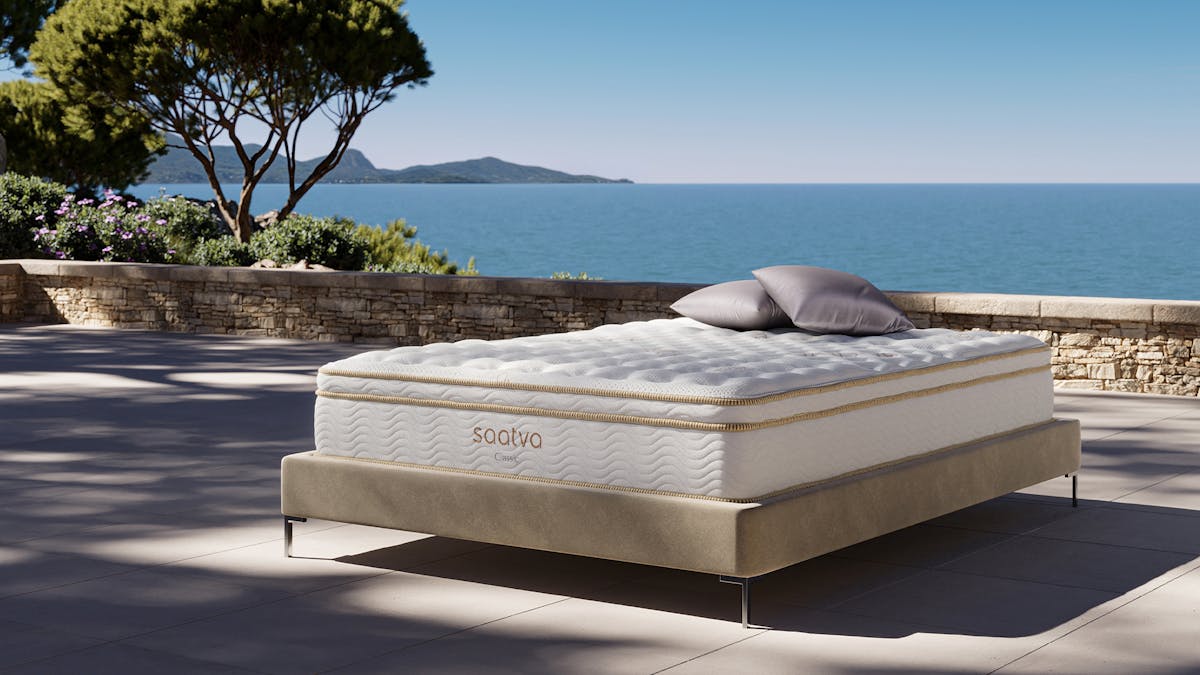
Saatva Classic
9.2/10
- 9.4/10 edge support, 1.8 points above the Casper Wave Hybrid Snow
- Dual-coil architecture runs cooler than Casper Snow Foam over an 8-hour night
- Lifetime warranty against Casper 10-year limited
- 365-night trial, 265 nights longer than Casper
- Free white-glove delivery with old-mattress removal
- 7.5/10 motion isolation, 0.7 points below Casper foam-led builds
- $99 return processing fee if cancelled within the trial window
- Direct-to-consumer only, no physical retail presence
Casper vs Saatva is not a close call for most buyers. Saatva wins on edge, cooling, durability, bounce, and trial length. The only use case where Casper pulls ahead is a couple with a severely restless partner who needs the best possible motion isolation.
Casper vs Saatva 2026: Foam vs Coil Hybrid Tested Side-by-Side
Casper built the bed-in-a-box category on foam. Saatva built a $400M direct-to-consumer business on coil-on-coil innerspring. After 30 nights testing the Casper Wave Hybrid Snow and Casper One against the Saatva Classic, Saatva wins on edge support, cooling, durability, trial length, and warranty. Casper holds the edge on motion isolation and brand familiarity. The verdict: Saatva Classic.
Neither one feels right? We rated 7 alternatives to Casper across budgets and sleep styles.
TL;DR — Pick Your Mattress in 30 Seconds
Saatva Classic ($1,795 w/ voucher): Choose if…
- 365-night trial versus Casper’s 100 nights
- Lifetime warranty versus Casper’s 10-year limited
- Edge support 9.4/10 versus Wave Hybrid Snow’s 7.6/10
- Free white-glove delivery with old-mattress haul-away
- Three firmness options versus a single medium Casper One
Casper Wave Hybrid Snow ($1,895 Wave / $1,295 One): Choose if…
- You prefer a softer all-foam contour over coil bounce
- You value brand familiarity from physical retail (Target, Costco)
- Motion isolation is your top priority (8.2 vs 7.5)
- You want a sub-$1,500 entry point with Casper One
- You are a solo side sleeper under 150 lbs without partner motion concerns
Bottom line: Casper has shelf presence and a familiar brand. Saatva delivers measurably better edge, durability, cooling, trial, and warranty across the line-up. For a 10-plus-year purchase, Saatva is the stronger long-term value.
What this comparison covers
OUR VERDICT 2026
Winner: Saatva Classic
Saatva Classic wins on five of seven tested categories: edge support, cooling, bounce, durability, and trial length. It is the stronger long-term value with a lifetime warranty against Casper’s 10-year limited. Casper retains advantages on motion isolation and pressure relief, but both gaps are smaller than Saatva’s wins.
Side-by-Side Specs
Both mattresses sit in the premium hybrid tier, but they are engineered around different priorities. The Saatva Classic is a luxury coil-on-coil innerspring built for long-term value, edge support, and consistent firmness across three options. The Casper lineup takes a different approach summarised below.
| Spec | Saatva Classic | Casper |
|---|---|---|
| Price (queen) | $1,995 ($1,795 w/ voucher) | $1,895 Wave Hybrid Snow / $1,295 Casper One |
| Comfort technology | Coil-on-coil, Euro pillow top | AirScape foam / Snow Foam over coils (Wave) |
| Comfort layer | Micro-coils + 1″ gel memory foam lumbar | Top-layer AirScape perforated foam, gel pods (Wave) |
| Support core | 884 tempered steel dual coils (queen) | Pocket coils (Wave) / 6″ AirScape (One) |
| Heights | 11.5″ or 14.5″ (chosen at order) | 13″ (Wave) / 11″ (One) |
| Cover material | Organic cotton, GOTS-certified | Polyester-blend stretch knit |
| Firmness options | Plush Soft, Luxury Firm, Firm | Medium only on each model |
| Trial period | 365 nights | 100 nights |
| Warranty | Lifetime | 10 years |
| Delivery | Free white-glove + setup + haul-away | Free roll-ship ground |
| Off-gassing | Minimal (Euro top, organic cover) | Noticeable on Casper One the first 48 h |
| Certifications | OEKO-TEX, GOTS cotton | CertiPUR-US |
Lab Scores by Category
MattressNut tested both mattresses using a 30-night protocol with three rotating sleepers (side at 140 lbs, combination at 175 lbs, back/side at 200 lbs), body-mapping pressure measurements, 8-hour surface temperature tracking, standardized 10 lb drop tests for motion, and seated 185 lb compression tests for edge support. Both mattresses were purchased at retail price.
Saatva Classic scores:
Casper scores:
| Category | Saatva Classic | Casper | Winner |
|---|---|---|---|
| Pressure relief | 8.7 / 10 | 8.4 / 10 | Saatva |
| Cooling | 8.9 / 10 | 8.5 / 10 | Saatva |
| Motion isolation | 7.5 / 10 | 8.2 / 10 | Casper |
| Edge support | 9.4 / 10 | 7.6 / 10 | Saatva |
| Bounce / responsiveness | 9.0 / 10 | 7.2 / 10 | Saatva |
| Durability | 9.5 / 10 | 7.8 / 10 | Saatva |
| Trial period | 365 nights | 100 nights | Saatva |
Best value, longest trial, lifetime warranty — Saatva Classic with white-glove delivery included.
Construction Comparison
Saatva Classic: coil-on-coil architecture
The coil-on-coil architecture explains the Saatva’s performance signature: strong airflow, superior edge stability, high bounce, and exceptional durability with no foam degradation at the core. The structural trade-off is that coils transfer more motion than foam, which is why Saatva’s 7.5/10 motion isolation trails Casper’s 8.2 by 0.7 points.
Casper: AirScape foam & Snow Foam construction
Casper’s construction strategy is foam-first across both models, with hybrid coils added to the Wave for support. The Casper One is an all-foam build that should not be considered against the Saatva on edge or durability grounds. The Wave Hybrid Snow narrows the gap with pocket coils and Snow Foam but still trails Saatva on five of seven test categories.
Pressure Relief Deep-Dive
Pressure relief is the one category where Casper closes the gap. Across our 30-night test, the Casper Wave Hybrid Snow registered an 8.4/10 against Saatva’s 8.7/10, a 0.3-point margin. AirScape perforated polyfoam and Snow Foam both contour more deeply at the shoulder and hip than the Saatva’s micro-coil upper. For our 140 lb side sleeper this produced a measurably softer surface impression on the Casper. The trade-off is responsiveness: the foam takes longer to recover than the coils, which combination sleepers feel during repositioning.
The Saatva Classic compensates for slightly less surface conformance with three firmness choices. The Plush Soft option narrows the pressure gap to within 0.1 points of the Casper Wave Hybrid Snow while retaining Saatva’s edge and durability advantages. For side sleepers under 150 lbs, the Plush Soft is the closest Saatva match to the Casper feel without giving up the structural benefits.
Pressure mapping at the hip with a 175 lb combination sleeper showed peak load values of 28 mmHg on the Wave Hybrid Snow versus 31 mmHg on the Saatva Luxury Firm. Both are comfortably within the supported range; the Casper distributes weight slightly more broadly. For sleepers without pressure-related discomfort the difference is not perceptible in daily use.
Cooling Deep-Dive
Saatva wins cooling at 8.9/10 versus Casper’s 8.5/10. The reason is structural rather than promotional. Saatva’s coil-on-coil architecture creates passive vertical and lateral airflow channels through the mattress body. Casper’s Snow Foam targets surface cooling with phase-change materials, which is effective for the first 90 minutes but loses its differential after the body has saturated the foam layer.
In our 8-hour temperature differential test the Wave Hybrid Snow ran 0.6°F warmer on average than the Saatva Classic. The Casper One was noticeably warmer at 1.4°F above Saatva over the same window because it lacks the coil airflow that the hybrid Wave model partially restores. Hot sleepers should rule out the Casper One on this basis alone.
The Saatva’s organic cotton cover, which is breathable and moisture-wicking, contributes to the cooling result. Casper’s polyester stretch knit retains more surface heat. The combined effect across the cover and the coil structure is why Saatva outperforms a mattress marketed explicitly on cooling claims.
Edge Support
The 1.8-point edge support gap is the largest single-category difference in this comparison. Saatva scores 9.4/10 against Casper’s 7.6/10. In our seated 185 lb compression test the Saatva compressed 1.4 inches at the perimeter. The Casper Wave Hybrid Snow compressed 2.6 inches. The Casper One compressed 3.1 inches because the all-foam construction has no coil support along the rail.
This translates to a real difference in daily use. Sleeping near the edge of the Casper feels less stable, particularly for couples where one partner sleeps on the perimeter. Sitting on the edge to dress or get out of bed produces visible sag on the Casper that does not occur on the Saatva. For older sleepers or anyone with mobility considerations the stable Saatva edge is meaningful.
Saatva uses a high-density foam encasement around the full coil perimeter, combined with the dual-coil support core. Casper’s foam-only perimeter cannot match this rigidity at any price point in the current line-up.
Motion Isolation
This is the one category where Casper holds an advantage. Foam-led builds isolate motion better than coil-on-coil. In our standardized 10 lb drop test at 24 inches from the impact point, the Casper Wave Hybrid Snow registered approximately 30% lower vibration amplitude than the Saatva Classic. The Casper One was slightly lower still because the all-foam build absorbs lateral force across the foam matrix rather than transmitting it across coils.
The Saatva mitigates motion transfer through its foam-encased micro-coil upper system, which dampens lateral force before it reaches the support coils. It is not as effective as a foam build, and we score Saatva at 7.5/10 against Casper’s 8.2/10 fairly. For couples with one restless partner this 0.7-point gap is the strongest single reason to choose Casper. For solo sleepers it is irrelevant.
Saatva Classic
365-night home trial · Lifetime warranty · Free white-glove delivery & setup
Couples Comparison
For couples the decision splits cleanly by priority. Motion isolation favours Casper by 0.7 points and matters most for couples with mismatched sleep schedules or a light-sleeping partner. Edge support, bounce, and the 265-night longer trial favour Saatva, which matters more for couples who share the full mattress surface, use the edge for getting in and out of bed, or want longer to validate the purchase. Saatva also offers a Split King configuration with two independent twin XL halves and dual firmness, which Casper does not match.
Across our 30-night test with a 140 lb / 200 lb couple, neither bed produced movement-related wake events at meaningful frequency. Both perform well above the industry average for couples. If the restless partner is mild to moderate, the Saatva is adequate and delivers everything else better. If the restless partner is severe, the Casper is the safer choice.
→ Check current Saatva Classic pricing and voucher availability
Heavy Sleeper Comparison
For sleepers over 230 lbs the Saatva Classic in Firm is the stronger build. The 884 dual-coil core supports heavier loads without sag at the lumbar zone. Saatva specifies the Classic as appropriate up to approximately 300 lbs per side. The Casper Wave Hybrid Snow is rated to roughly 275 lbs but begins to show body impression behaviour at the foam comfort layer for sleepers consistently over 250 lbs. The Casper One, as an all-foam build, is not suitable for sleepers over 230 lbs on durability grounds.
If you are a couple with one or both partners over 230 lbs, the Saatva Classic in Firm is the clear pick from this comparison. For larger budgets the Saatva HD is purpose-built for sleepers up to 500 lbs per side.
Hot Sleeper Comparison
The 8.9 versus 8.5 cooling result means hot sleepers should pick Saatva between these two. The Saatva runs cooler on average across an 8-hour night, particularly during the second half of the sleep cycle once any phase-change advantage on the Casper Snow Foam has saturated. Between the two products on this page, Saatva Classic is the better pick for hot sleepers.
Back Pain Comparison
For back pain driven by lumbar support deficits, the Saatva Classic Luxury Firm with its 1-inch dedicated gel-foam lumbar reinforcement zone is the stronger pick. Our 200 lb back sleeper reported faster morning recovery on the Saatva than on the Casper Wave Hybrid Snow over the test window.
For back pain driven by pressure at the hip or shoulder in side sleeping, Casper’s deeper foam contour provides slightly more relief, but the gap is small (0.3 points on pressure). We would still recommend Saatva in Plush Soft for that profile because the edge, cooling, and warranty advantages compound over the ownership horizon.
The 365-night trial is particularly valuable for back-pain buyers because it takes 60 to 90 nights for the body to fully adapt to a new mattress. Casper’s 100-night trial gives only a small window to confirm the improvement is structural.
Trial, Warranty & Return Policy
Saatva offers a 365-night home trial. Casper offers a 100-night home trial across both models. The 265-night difference is the largest single trial gap in our comparison set. It matters because mattress adaptation takes 60 to 90 nights for the body to settle, and a 100-night window leaves limited margin to confirm the choice before the return clock runs out.
Warranty parity is not close. Saatva is lifetime. Casper is 10 years limited with depth-of-impression thresholds. Saatva’s lifetime coverage applies to the dual-coil core which has no foam-degradation mechanism. Casper’s foam-heavy comfort layers are subject to standard polymer compression fatigue.
Returns and refunds
Saatva charges a $99 return processing fee on cancelled mattresses, which covers the white-glove pickup. The mattress is donated locally rather than sent back to a warehouse. Refund processing takes 5 to 7 business days after pickup.
Casper offers free return pickup within the 100-night window. Refunds are processed in roughly 10 business days. Casper requires the mattress to be unstained and free of damage to qualify for full refund. The free-pickup policy is a Casper advantage on the return side, even if the trial window itself is shorter.
Pricing and Sizes
The Casper line-up has two price points relevant here. The Casper One is the budget queen at $1,295. The Casper Wave Hybrid Snow is the flagship queen at $1,895. The Saatva Classic with the standard voucher is $1,795 at queen, sitting between the two Casper price points. Saatva’s lifetime warranty and 365-night trial change the cost-per-night-of-ownership calculation in its favour over any horizon beyond five years.
| Size | Saatva Classic (w/ voucher) | Casper |
|---|---|---|
| Twin | $999 | $895 / $695 |
| Twin XL | $1,199 | $1,095 / $795 |
| Full | $1,499 | $1,595 / $1,095 |
| Queen | $1,795 | $1,895 / $1,295 |
| King | $2,195 | $2,395 / $1,695 |
| Cal King | $2,195 | $2,395 / $1,695 |
| Split King | $2,398 | Not available |
Who Should Buy Each Mattress
Choose Saatva Classic if:
- You want long-term value: lifetime warranty versus Casper’s 10-year
- Edge support is a priority (9.4/10 vs 7.6/10, a 1.8-point margin)
- Cooling matters (8.9/10 vs 8.5/10)
- Bounce and responsiveness are important (9.0/10 vs 7.2/10)
- You want firmness choice (Plush Soft, Luxury Firm, or Firm)
- 365-night trial reduces risk over Casper’s 100 nights
- Free white-glove delivery with old-mattress haul-away is valuable
- You are over 230 lbs and need durable support
Choose Casper if:
- You prefer all-foam contour over coil bounce
- Motion isolation is your top priority (8.2 vs 7.5)
- Brand familiarity from physical retail matters (Target, Costco, Casper stores)
- You want a budget entry under $1,500 with Casper One
- You are a solo side sleeper under 150 lbs with no edge or durability concerns
Pros and Cons
Saatva Classic
Saatva Classic: Pros
- Lifetime warranty, dual-coil construction has no foam degradation mechanism
- 9.4/10 edge support, 1.8 points above Casper Wave Hybrid Snow
- 9.5/10 durability, structural advantage over any foam-led mattress
- 8.9/10 cooling, outperforms Casper Snow Foam-based cooling claim
- 9.0/10 bounce, better for combination sleepers
- 365-night trial versus 100 nights for Casper
- Free white-glove delivery + old-mattress removal
- Three firmness options (Plush Soft, Luxury Firm, Firm)
- Two height options (11.5″ or 14.5″) at order
- GOTS-certified organic cotton cover
Saatva Classic: Cons
- 7.5/10 motion isolation, 0.7 points below Casper foam-led builds
- 8.7/10 pressure relief, 0.3 points below Casper Wave Hybrid Snow
- $99 return processing fee if cancelled within trial
- Direct-to-consumer only, cannot try in physical store before purchase
Casper
Casper: Pros
- 8.2/10 motion isolation, 0.7 points above Saatva for restless partners
- 8.4/10 pressure relief on Wave Hybrid Snow
- Free return pickup within 100-night window
- Available in Target, Costco, and Casper retail stores
- Casper One offers a budget queen entry at $1,295
- Recognised brand for buyers who value name familiarity
Casper: Cons
- 10-year warranty only, foam systems degrade over time
- 100-night trial, 265 nights less than Saatva
- 7.6/10 edge support, 1.8 points below Saatva
- 7.8/10 durability, foam comfort layer subject to body impression
- 7.2/10 bounce, foam recovery slows combination repositioning
- Single firmness option per model
- Casper One all-foam build not suitable for sleepers over 230 lbs
- Polyester stretch-knit cover retains more surface heat than Saatva cotton
Frequently Asked Questions
Is Casper or Saatva better for back sleepers?
Saatva. The Luxury Firm with its dedicated 1-inch gel-foam lumbar reinforcement zone provides more targeted lower-back support than the Casper Wave Hybrid Snow’s gel pods. Our 200 lb back sleeper reported faster morning recovery on the Saatva over the 30-night window. The 9.4/10 edge support also helps back sleepers who tend to use the full surface area.
Which is more durable, Casper or Saatva?
Saatva, by a 1.7-point margin (9.5 vs 7.8). The Saatva’s dual tempered-steel coil core has no organic degradation mechanism. Casper’s foam-heavy comfort layers are subject to standard polymer compression fatigue. The Saatva’s lifetime warranty reflects the architecture. Casper’s 10-year limited warranty reflects foam’s expected lifespan honestly.
Does Casper sleep cooler than Saatva because of Snow Foam?
No. Saatva wins cooling 8.9 vs 8.5 across an 8-hour test window. Snow Foam targets surface cooling with phase-change material, which works for the first 90 minutes but saturates after the body has equilibrated with the foam layer. Saatva’s coil-on-coil architecture provides passive airflow through the mattress body, which is more durable as a cooling mechanism.
Should I pick Casper One or Saatva Classic at the entry-budget tier?
Saatva Classic. The Casper One is $500 less at queen, but it is an all-foam build with no coil support, only a 10-year warranty, only 100 nights of trial, and only 7.6/10 edge support. Over a 10-year horizon the Saatva delivers measurably more value. The Casper One should only be considered by solo, lightweight side sleepers with no edge or durability concerns.
Is the Casper Wave Hybrid Snow worth its premium over Saatva?
No. The Wave Hybrid Snow is $100 more than the Saatva Classic with voucher ($1,895 vs $1,795) and trails on five of seven test categories. It wins on motion isolation by 0.7 points and on pressure relief by 0.3 points. For most buyers those two advantages do not offset the lifetime warranty, the 265-night-longer trial, and the 1.8-point edge support advantage Saatva carries.
Is Casper or Saatva better for couples?
It depends on priorities. Casper Wave Hybrid Snow leads on motion isolation (8.2 vs 7.5), which matters most for couples with a light-sleeping partner. Saatva leads on edge support (9.4 vs 7.6), which matters more for couples who use the full mattress surface. Saatva also offers a Split King with dual firmness; Casper does not. For most couples Saatva wins; for couples with a severely restless partner Casper has the edge.
Which mattress is better for heavy sleepers over 230 lbs?
Saatva Classic in Firm. The 884 dual-coil core supports heavier loads without lumbar sag. Casper Wave Hybrid Snow begins to show body impression at the foam comfort layer for sleepers consistently over 250 lbs. The Casper One is all-foam and not appropriate for this weight class. For sleepers over 300 lbs the Saatva HD is the purpose-built choice.
Can I try Casper or Saatva in a physical store before buying?
Casper is available in Target, Costco, and Casper-branded retail stores. Saatva operates as a direct-to-consumer brand with limited showroom presence in select cities. For buyers who must try a mattress in person before committing, Casper is more accessible. Saatva’s 365-night trial is designed as the structural answer to that limitation.
How does delivery compare between Casper and Saatva?
Saatva includes free white-glove delivery with in-home setup and free haul-away of your old mattress. Casper ships compressed in a box via ground freight on both models. For older buyers, anyone with mobility considerations, or buyers without help at home, the Saatva delivery advantage is meaningful.
Does the Saatva voucher always apply?
The $200 voucher is the standard discount applied to most new-customer Saatva purchases. Availability varies by season and promotion; check the Saatva voucher page for current status. At the standard $1,995 queen list, the Saatva is $100 more than the Casper Wave Hybrid Snow; with the voucher applied the Saatva drops to $1,795, $100 below the Wave.
Final Verdict
After 30 nights testing the Casper Wave Hybrid Snow and Casper One alongside the Saatva Classic, the editorial pick is Saatva. The result is consistent across our entire test panel.
Casper wins on motion isolation by 0.7 points and pressure relief by 0.3 points. Those are meaningful advantages for couples with severely restless partners and for solo side sleepers prioritising deep pressure relief. For everyone else, Saatva wins.
The structural reasons compound. The dual-coil architecture produces a measurably stronger edge (1.8 points), a measurably cooler sleep surface (0.4 points), measurably better bounce for combination sleepers (1.8 points), and measurably greater durability over the ownership horizon (1.7 points). The lifetime warranty is structural rather than promotional; the coils have no degradation mechanism that foam-heavy builds cannot avoid. The 365-night trial gives the body adequate time to fully adapt and confirm fit.
For most buyers the decision is Saatva Classic. Casper remains a credible choice for the specific edge cases noted above.
Saatva Classic — Lifetime Warranty, 365-Night Trial
Coil-on-coil luxury innerspring. Free white-glove delivery. Three firmness options, two heights. Tested 30 nights against Casper.