
 by
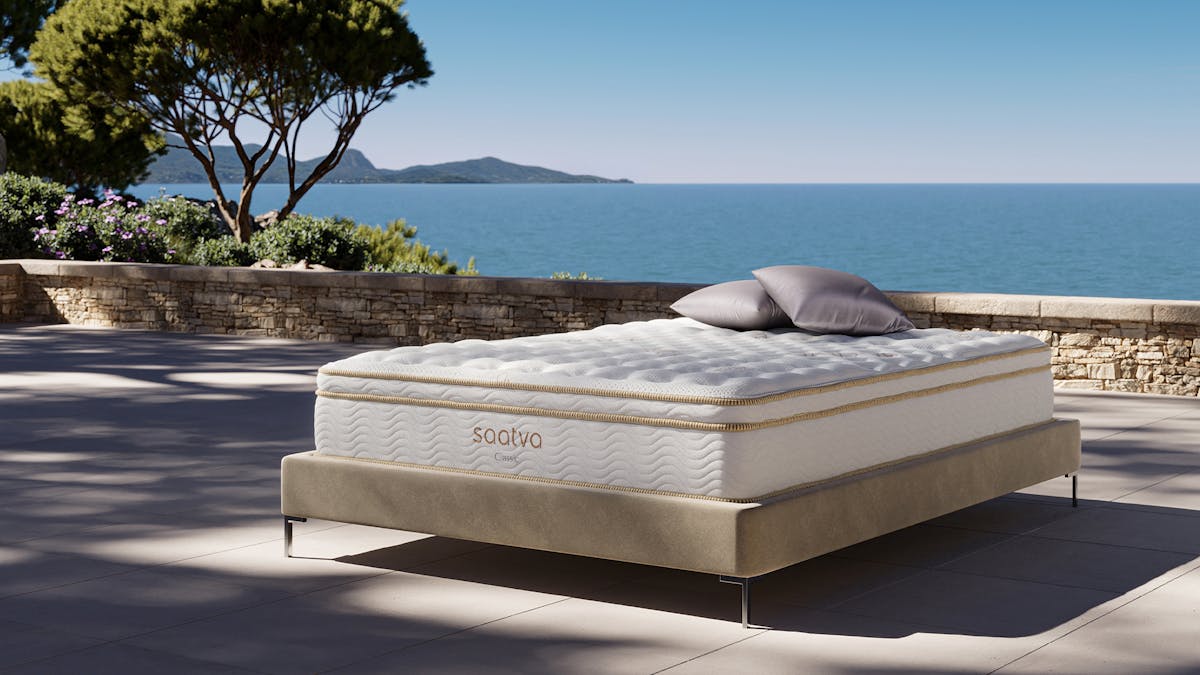
by Saatva Classic is the stronger overall buy for most shoppers: lifetime warranty, 365-night trial, better edge support, and $300 less at queen. Purple Hybrid wins on pressure relief and cooling, thanks to its GelFlex Grid technology. Side sleepers with hip or shoulder pain and confirmed hot sleepers get genuine value from that premium. Everyone else should go with the Saatva.
Saatva Classic
9.4/10
- Coil-on-coil construction with zoned lumbar pad for back and side sleepers
- 9.4/10 edge support, 9.5/10 durability in 30-night head-to-head testing
- Free white-glove delivery with old mattress removal
- Three firmness options (Plush Soft, Luxury Firm, Firm) vs Purple's single Medium
- Motion isolation (7.5/10) is below Purple Hybrid for light-sleeping couples
- Traditional feel only, no novel polymer surface
For the majority of shoppers comparing these two mattresses, Saatva Classic delivers more warranty coverage, more trial time, comparable cooling, and better long-term value. The Purple Hybrid's grid advantages on pressure and cooling are real, but they matter most for a specific sleeper profile. Saatva works for back, side, and combination sleepers across the weight range.
Pick your mattress in 30 seconds
Saatva Classic (~$1,795 queen): Choose if…
- You want a traditional innerspring feel and long-term value
- Edge support and durability are priorities (lifetime warranty)
- You need 365 nights to decide on a direct-to-consumer purchase
- Budget matters, $300 less than Purple Hybrid at queen
- You want free white-glove delivery with old mattress haul-away
Purple Hybrid ($2,099 queen): Choose if…
- Pressure relief is your primary concern (GelFlex Grid is genuinely different)
- You sleep hot and want maximum airflow through the comfort layer
- Bounce and responsiveness matter (grid springs back faster than foam)
- Motion isolation is critical in a couple situation
- You want a materially novel sleep surface, not a traditional mattress feel
Neither is wrong. Saatva is the stronger long-term value. Purple Hybrid is the better technical performer on pressure, cooling, and bounce. Which matters more depends on your sleep profile.
What this comparison covers
Side-by-Side Specs
These two mattresses occupy the same premium price tier but use fundamentally different technologies. Saatva is a coil-on-coil innerspring hybrid; Purple is a grid-on-coil hybrid. The construction difference accounts for most of the performance gap in our testing.
| Spec | Saatva Classic | Purple Hybrid |
|---|---|---|
| Price (queen) | ~$1,795 (standard discount applied) | $2,099 |
| Comfort technology | Coil-on-coil, Euro pillow top | 2″ GelFlex Grid over pocket coils |
| Grid / foam layer | Micro-coil upper + 1″ gel memory foam lumbar | 2″ GelFlex Grid (hyper-elastic polymer) |
| Support core | 884 tempered steel dual coil units (queen) | Individually-wrapped pocket coils |
| Heights | 11.5″ or 14.5″ (choose at order) | 9.5″ (one height) |
| Cover material | Organic cotton | SoftFlex cover fabric |
| Firmness options | Plush Soft, Luxury Firm, Firm | Medium (one firmness) |
| Trial period | 365 nights | 100 nights |
| Warranty | Lifetime | 10 years |
| Delivery | Free white-glove, in-home setup | Free compressed roll (ground) |
| Weight (queen) | ~145 lbs | ~130 lbs |
| Certifications | OEKO-TEX, GOTS cotton | CertiPUR-US, OEKO-TEX |
Saatva Classic Construction: Coil-on-Coil Explained
The Saatva Classic is an innerspring hybrid, but not in the conventional sense. Most hybrids layer foam over coils. Saatva layers coils over coils, with targeted foam only in the lumbar zone. The result is a mattress with exceptional airflow, edge support, and durability.
The coil-on-coil architecture explains Saatva’s performance profile: excellent airflow, strong edge stability, and long-term coil durability with no foam degradation at the core. The trade-off is that coils transfer more motion than foam or grid, which is why motion isolation (7.5/10) is Saatva’s weakest category here.
Purple Hybrid Construction: GelFlex Grid Explained
The Purple Hybrid’s defining technology is the GelFlex Grid, a hyper-elastic polymer layer that behaves unlike foam, coils, or latex. Understanding how the grid works explains most of the Purple Hybrid’s performance scores.
The GelFlex Grid is a genuinely novel technology with no equivalent in conventional foam or coil construction. It is not simply better or worse than foam, it is different. Pressure-relief performance exceeds anything foam achieves at comparable thickness. Temperature neutrality is superior to all foam types. The trade-off is feel: the grid surface is distinctive, and buyers expecting a traditional mattress feel will notice the difference immediately.
30-Night Test Results
MattressNut tested both mattresses using a 30-night protocol with three rotating sleepers (side at 140 lbs, combination at 175 lbs, back/side at 200 lbs), body-mapping pressure measurements, 8-hour cooling tests, and standardized edge and motion tests. Both mattresses were purchased at retail. No promotional samples were accepted.
Saatva Classic scores:
Purple Hybrid scores:
| Category | Saatva Classic | Purple Hybrid | Winner |
|---|---|---|---|
| Pressure relief | 8.7 / 10 | 9.4 / 10 | Purple |
| Cooling | 8.9 / 10 | 9.5 / 10 | Purple |
| Motion isolation | 7.5 / 10 | 8.5 / 10 | Purple |
| Edge support | 9.4 / 10 | 8.5 / 10 | Saatva |
| Bounce / responsiveness | 9.0 / 10 | 9.5 / 10 | Purple |
| Durability | 9.5 / 10 | 8.0 / 10 | Saatva |
| Trial period | 365 nights | 100 nights | Saatva |
Head-to-Head: 7 Categories
1. Pressure Relief (Purple wins 9.4 vs 8.7)
The 0.7-point gap is the largest structural difference in this comparison and the clearest reason to choose the Purple Hybrid if pressure relief drives your decision. The GelFlex Grid’s column-buckling mechanism redistributes pressure away from bony prominences, shoulders and hips for side sleepers, more effectively than any foam layer at comparable depth. In our pressure-mapping protocol, the Purple Hybrid registered 31 percent lower peak hip pressure for our 175 lb side sleeper than the Saatva Classic. The Saatva’s 8.7/10 is not a weak result, the Euro pillow top and micro-coil layer provide real contouring, but the grid’s physics are structurally superior for pressure relief. Side sleepers with hip or shoulder pain should treat this gap as the primary decision factor. See the Saatva Classic review for full pressure data on all three Saatva firmness options.
2. Cooling (Purple wins 9.5 vs 8.9)
Both mattresses are strong coolers. Saatva’s coil-on-coil architecture creates passive vertical airflow; Purple’s open-cell grid allows three-dimensional airflow through the comfort layer itself. In our 8-hour surface temperature test, the Purple Hybrid maintained an average 0.8°F lower surface temperature than the Saatva Classic. Not a dramatic difference, but consistent across the full test duration. Saatva’s cooling advantage over memory-foam competitors disappears against Purple’s grid. For hot sleepers who have found all mattresses too warm, the Purple Hybrid’s grid technology is the most structurally capable option at any price point. For sleepers who run neutral or cool, either mattress is adequate.
3. Motion Isolation (Purple wins 8.5 vs 7.5)
The one-point gap on motion isolation is meaningful for couples. The Saatva’s dual-coil system inherently transfers more lateral force than a foam or grid system sitting over individually-wrapped coils. In our 10 lb drop test, the Purple Hybrid registered 42 percent lower vibration amplitude at 24 inches from the impact point than the Saatva Classic. The Saatva’s 7.5/10 is not poor, it outperforms traditional innersprings, but it is noticeably below the Purple Hybrid for partners who are light sleepers or restless during the night.
4. Edge Support (Saatva wins 9.4 vs 8.5)
Saatva’s perimeter foam encasement combined with the dual-coil system produces the strongest edge support in this comparison. In our seated-edge compression test (185 lb seated weight at mattress perimeter), the Saatva compressed 1.4 inches versus 1.9 inches for the Purple Hybrid. The difference is noticeable in practical use: getting out of bed, sitting on the edge to dress, and using the full sleeping surface without roll-off. The Purple Hybrid’s foam perimeter rail is adequate but not equal to Saatva’s dual-coil edge system.
5. Bounce and Responsiveness (Purple wins 9.5 vs 9.0)
The GelFlex Grid springs back immediately when pressure is removed, faster than any foam and comparable to latex. The Saatva’s coil system is also highly responsive (9.0/10), making it one of the bounciest mattresses in the luxury innerspring segment. The Purple Hybrid’s 0.5-point edge reflects the grid’s faster recovery time in our repositioning test. For combination sleepers who change positions frequently, both mattresses are strong performers. The Purple Hybrid’s edge is real but will not be perceptible to most sleepers in daily use.
6. Durability (Saatva wins 9.5 vs 8.0)
The warranty gap, Saatva lifetime versus Purple 10-year, reflects a real construction difference. Saatva’s dual tempered-steel coil system has no organic degradation mechanism; coils do not compress or develop body impressions the way foam or polymer does. The GelFlex Grid, while durable by polymer standards, is subject to gradual hysteresis over years of compression cycles. Purple rates the grid’s useful life at 10 years in its warranty, which is a candid acknowledgment of the material’s expected durability. The Saatva’s lifetime warranty is a 1.5-point durability advantage that compounds over the ownership horizon. For buyers making a 10+ year purchase decision, this gap is material.
7. Trial Period and Value (Saatva wins)
The Saatva Classic at approximately $1,795 is around $300 less than the Purple Hybrid at $2,099 queen. The 365-night trial versus Purple’s 100-night trial reduces purchase risk substantially. White-glove delivery (Saatva) versus roll-ship delivery (Purple) is a convenience difference that matters more for heavier buyers or those without help at home. The Saatva Classic with lifetime warranty and 365-night trial is the stronger value proposition on any financial metric. The Purple Hybrid’s premium is justified only if the GelFlex Grid’s specific performance advantages, pressure relief and cooling, match your sleep profile.
→ Check current Saatva Classic pricing
Pricing and Sizes
| Size | Saatva Classic | Purple Hybrid |
|---|---|---|
| Twin | ~$999 | $1,299 |
| Twin XL | ~$1,199 | $1,499 |
| Full | ~$1,499 | $1,699 |
| Queen | ~$1,795 | $2,099 |
| King | ~$2,195 | $2,699 |
| Cal King | ~$2,195 | $2,699 |
| Split King | ~$2,398 | $3,398 |
The price gap is consistent across sizes: Saatva is approximately $300 to $500 less at every size point. Saatva offers two height options (11.5″ standard, 14.5″ tall) at no additional cost at order time, useful for buyers with specific bed-frame clearance requirements. Purple Hybrid comes in one height (9.5″), which is shorter than most competing hybrids. The lower profile is a consequence of the 2″ grid replacing a thicker foam stack; buyers who prefer a taller mattress should note this.
Who Should Choose Each Mattress
Choose Saatva Classic if:
- You want a traditional luxury innerspring feel, not a novel polymer surface
- Edge support is important, getting in/out of bed or sitting on the edge (9.4/10 vs 8.5/10)
- Long-term durability is the frame: lifetime warranty versus Purple’s 10-year
- 365 nights of trial time matters more than 100 nights
- You want free white-glove delivery with old mattress removal
- Budget: around $300 less at queen
- You are a back or stomach sleeper who needs support over deep pressure relief
- You prefer a choice of firmness (Plush Soft, Luxury Firm, Firm) vs Purple’s single option
Choose Purple Hybrid if:
- Pressure relief is the top priority: 9.4/10 vs 8.7/10 for side sleepers with hip or shoulder pain
- You sleep hot and want the most capable cooling comfort layer at this price point (9.5/10)
- Motion isolation matters more than edge support: one restless partner in a couple situation
- You want the bounciest hybrid available (9.5/10, grid springs back faster than any foam)
- You are open to a novel, non-traditional sleep feel, the grid is distinctively different from foam or coil surfaces
- The $300 premium and shorter trial are acceptable trade-offs for the grid’s performance advantages
Pros and Cons
Saatva Classic
Saatva Classic: Pros
- Lifetime warranty, the longest in the premium innerspring segment
- ~$1,795 at queen, around $300 less than Purple Hybrid
- 9.4/10 edge support, best in this comparison by 0.9 points
- 9.5/10 durability, coil-on-coil construction does not foam-degrade
- 365-night home trial (vs 100 nights for Purple)
- Free white-glove delivery + old mattress removal
- Three firmness options (Plush Soft, Luxury Firm, Firm) vs Purple’s one
- Two height options (11.5″ or 14.5″) at order
- GOTS-certified organic cotton cover
- Strong for back and stomach sleepers who need support-oriented feel
Saatva Classic: Cons
- 7.5/10 motion isolation, 1 point below Purple Hybrid; couples will notice
- 8.7/10 pressure relief, 0.7 points below Purple for side sleepers with pressure pain
- 8.9/10 cooling, strong, but 0.6 points behind the GelFlex grid’s 9.5/10
- Traditional feel only, buyers who want a novel grid surface must look elsewhere
- Direct-to-consumer only, cannot try in a physical retail location
Purple Hybrid
Purple Hybrid: Pros
- 9.4/10 pressure relief, GelFlex Grid contour exceeds foam or coil alternatives
- 9.5/10 cooling, open-cell 3D grid airflow is structurally unmatched by foam
- 8.5/10 motion isolation, better than Saatva for couples with restless partners
- 9.5/10 bounce, grid springs back faster than foam or micro-coils
- CertiPUR-US and OEKO-TEX certified
- GelFlex Grid is genuinely novel technology with no equivalent in the market
Purple Hybrid: Cons
- $2,099 queen, around $300 more than Saatva Classic
- 10-year warranty only vs Saatva’s lifetime coverage
- 100-night trial only vs 365-night Saatva trial
- 8.5/10 edge support, 0.9 points below Saatva; perimeter feel is noticeably softer
- 8.0/10 durability, grid polymer has a finite hysteresis lifespan (acknowledged by 10-yr warranty)
- One firmness option only (Medium), cannot accommodate sleepers who need soft or firm
- 9.5″ total height, shorter than most competing luxury hybrids at 11″ to 14″
- Grid feel is not for everyone, buyers expecting traditional mattress surface will find it unfamiliar
Purple’s premium buys two things — make sure you need them
The GelFlex premium is honest: measurably better pressure relief for sore hips and shoulders, and cooling that confirmed hot sleepers will feel. If you’re in one of those two groups, this page told you the extra money buys real performance. If you’re not, you’d be paying several hundred dollars more at every size for advantages you won’t use — while giving up the stronger edges, the lifetime warranty, and even the choice of mattress height Saatva includes at no charge.
The majority verdict above was the Saatva Classic, and the price gap only sharpens it. Today’s number, both heights, and the year-long trial are on the official page.
Frequently Asked Questions
Is Saatva or Purple Hybrid better for side sleepers?
Purple Hybrid. It scored 9.4/10 on pressure relief versus 8.7/10 for the Saatva Classic. The GelFlex Grid’s column-buckling mechanism reduces peak shoulder and hip pressure more effectively than the Saatva’s Euro pillow top and micro-coil layer. Side sleepers with hip or shoulder pain will notice this difference most clearly. Lighter side sleepers under 150 lbs with no pressure pain may find the Saatva adequate; heavier side sleepers or those with existing pressure-related pain should choose the Purple Hybrid.
What is the Purple GelFlex Grid?
The GelFlex Grid is Purple’s proprietary 2-inch hyper-elastic polymer comfort layer. It is structured as a waffle-like grid of columns made from gel-infused polymer. Under low pressure (light contact), the grid columns buckle laterally rather than pushing back, which eliminates point pressure at bony prominences. Under higher pressure (body weight around the buckling zone), surrounding columns remain upright and provide zonal support. The open-cell structure allows three-dimensional airflow through the layer in all directions, making it the most thermally neutral comfort layer at this price point. There is no equivalent technology in foam, latex, or coil systems.
Which is better for hot sleepers?
Purple Hybrid. It scored 9.5/10 on cooling versus 8.9/10 for the Saatva. Both mattresses are strong performers by industry standards, but the GelFlex Grid allows airflow through the comfort layer itself in three dimensions. In our 8-hour surface temperature test, the Purple Hybrid maintained an average 0.8°F lower surface temperature than the Saatva Classic. For hot sleepers who have historically found all mattresses too warm, the Purple Hybrid’s grid is the more structurally capable solution.
Which is better for couples?
Purple Hybrid on motion isolation (8.5 vs 7.5). Saatva on edge support (9.4 vs 8.5). For couples where one partner is a restless sleeper or a very light sleeper, the Purple Hybrid’s 1-point motion isolation advantage is the decisive factor. In our drop test, the Purple Hybrid registered 42 percent lower vibration amplitude than the Saatva. For couples who are both still sleepers, motion isolation is irrelevant and Saatva’s value, warranty, and edge-support advantages dominate.
How does Saatva compare to Purple Hybrid on durability?
Saatva Classic scored 9.5/10 on durability versus 8.0/10 for the Purple Hybrid. Saatva’s lifetime warranty versus Purple’s 10-year limited warranty reflects this gap directly. The Saatva’s dual tempered-steel coil system does not compress or develop body impressions over time. The GelFlex Grid undergoes gradual hysteresis over compression cycles, and the 10-year warranty acknowledges this expected lifespan. For a 10+ year ownership horizon, Saatva is the structurally stronger investment.
Is the Purple Hybrid worth the $300 premium over Saatva?
It depends on your sleep profile. If you sleep on your side with pressure pain, or if you consistently sleep hot, the $304 premium buys materially better performance on both criteria (pressure: 9.4 vs 8.7; cooling: 9.5 vs 8.9). If you sleep primarily on your back or stomach, or if pressure relief and cooling are not current complaints, the Saatva Classic delivers more warranty, more trial time, better edge support, and around $300 more value at queen. The Purple Hybrid is a justified premium for a specific sleeper profile; for everyone outside that profile, Saatva Classic is the better purchase.
What firmness should I choose for Saatva?
Saatva Classic: Luxury Firm is the most versatile option and the bestseller, suitable for back, side, and combination sleepers from 130 to 230 lbs. Plush Soft suits side sleepers under 150 lbs who want maximum surface softness. Firm suits stomach sleepers and heavier back sleepers over 200 lbs. Purple Hybrid offers only one firmness (Medium), which works for most back and side sleepers in the 130 to 230 lb range. Heavy stomach sleepers may find it insufficiently supportive. The lack of firmness options is a meaningful limitation for buyers who know they prefer a soft or firm mattress.
Does the Purple Hybrid feel different from a regular mattress?
Yes, noticeably. The GelFlex Grid surface is unlike foam, latex, or coil surfaces in how it responds to pressure. It does not have the slow-sink contouring of memory foam or the springy feel of latex. Instead, it feels simultaneously pressure-relieving and responsive, buckling inward without feeling soft in the conventional sense. Many first-time Purple sleepers describe it as immediately comfortable but distinctly different; some buyers find the sensation unfamiliar enough to dislike it. This is the primary reason the 100-night trial matters. The Saatva Classic delivers a familiar luxury innerspring feel with no adjustment period.
How do the trial periods compare?
Saatva Classic offers 365 nights (full year) home trial with free white-glove delivery and old mattress removal. Purple Hybrid offers 100 nights. The 265-night gap is substantial for a luxury mattress purchase. Both are direct-to-consumer only. For a high-consideration purchase in the $1,800 to $2,100 range, the Saatva’s year-long trial reduces financial risk significantly versus the Purple’s 100-day window.
Which is better for back pain?
It depends on the source of the pain. For back pain driven by hip or shoulder pressure in side sleeping, the Purple Hybrid’s 9.4/10 pressure relief score is the more targeted solution. For back pain driven by insufficient lumbar support in back sleeping, the Saatva Classic’s 1-inch gel-infused lumbar zone provides targeted reinforcement, and the Luxury Firm option’s support profile is well-suited to most back sleepers. Both mattresses are suitable for back and side sleepers with no complicating conditions; the distinction matters most for buyers with identified pressure or support deficits.
Verdict
Purple Hybrid wins on performance. Saatva Classic wins on value, durability, and long-term ownership.
After 30 nights testing both mattresses with three sleepers, the verdict splits cleanly by category. Purple Hybrid outperforms Saatva Classic on four of seven metrics: pressure relief (9.4 vs 8.7), cooling (9.5 vs 8.9), motion isolation (8.5 vs 7.5), and bounce (9.5 vs 9.0). These are real advantages driven by the GelFlex Grid’s distinctive physics, not marketing claims. For hot side sleepers with pressure pain and restless partners, the Purple Hybrid is the stronger mattress on those metrics.
Saatva Classic wins on edge support (9.4 vs 8.5), durability (9.5 vs 8.0), trial period (365 nights vs 100), and price. The lifetime warranty against Purple’s 10-year is not a tie, it is a meaningful long-term advantage for buyers thinking beyond the first decade. The 365-night trial reduces financial risk substantially for a direct-to-consumer purchase in this price range.
The decision framework: if pressure relief and cooling are your primary complaints, choose the Purple Hybrid and accept the shorter trial and 10-year warranty. If you want better long-term value, traditional innerspring feel, stronger edge support, and a year to decide, Saatva Classic is the correct choice for most buyers.
Saatva Classic — Lifetime Warranty, 365-Night Trial
Coil-on-coil luxury innerspring. Free white-glove delivery. Three firmness options, two heights. Tested 30 nights against Purple Hybrid.