
 by
by Saatva Classic wins this comparison in five of seven tested categories: edge support (9.4 vs 8.0), durability (9.5 vs 7.5), cooling (8.9 vs 8.5), pressure relief (8.7 vs 8.5), and bounce (9.0 vs 7.5). Casper Original Hybrid leads on motion isolation (7.8 vs 7.5) by 0.3 points and costs $100 less. For long-term buyers, the lifetime non-prorated warranty versus Casper's 10-year limited warranty resolves the comparison decisively. Saatva is the stronger investment at the same price tier.
Saatva Classic
9.2/10
- 9.4/10 edge support via custom perimeter coils, largest gap in this comparison
- Lifetime non-prorated warranty, 3.65x longer trial than Casper (365 vs 100 nights)
- Coil-on-coil construction delivers superior airflow and bounce (8.9/10 cooling, 9.0/10 bounce)
- Free white-glove delivery, in-home setup, old mattress haul-away included
- Three firmness options: Plush Soft, Luxury Firm, Firm
- $100 higher entry price at queen ($1,795 vs $1,695)
- Motion isolation (7.5/10) trails Casper (7.8/10) by 0.3 points, the one category Casper leads
- Direct-to-consumer only, no in-store trial
The structural case for Saatva is direct: coil-on-coil architecture produces the highest edge support score in this test, a coil-level airflow advantage, and a lifetime warranty that eliminates long-term replacement risk. At $100 more than Casper, the value proposition is clear for any buyer with a horizon beyond year 10.
Quick Verdict: Choose by Use Case
Saatva Classic ($1,795 queen) leads on edge support (9.4 vs 8.0), durability (9.5 vs 7.5, lifetime warranty vs 10-year), and trial length (365 vs 100 nights). Casper Original Hybrid ($1,695) leads on motion isolation (7.8 vs 7.5) and costs $100 less. Cooling (8.9 vs 8.5) and pressure relief (8.7 vs 8.5) are near-ties. For long-term buyers, the warranty calculus alone resolves the comparison in Saatva's favor.
Choose Saatva Classic if you want:
- Best edge support in this comparison (9.4/10, custom perimeter coils)
- Lifetime warranty with no proration
- 365-night trial (vs Casper’s 100 nights)
- Coil-on-coil construction with bounce and airflow
- Free white-glove delivery + haul-away
- Three firmness options (Plush Soft, Luxury Firm, Firm)
Choose Casper Original Hybrid if you want:
- Slightly better motion isolation (7.8 vs 7.5, marginal)
- $100 lower entry price ($1,695 vs $1,795 queen)
- Foam-over-coil construction with contouring comfort layer
- A mainstream brand with retail presence
- Compact 11” profile (vs Saatva’s 11.5” or 14.5”)
What this comparison covers
Side-by-Side Specs
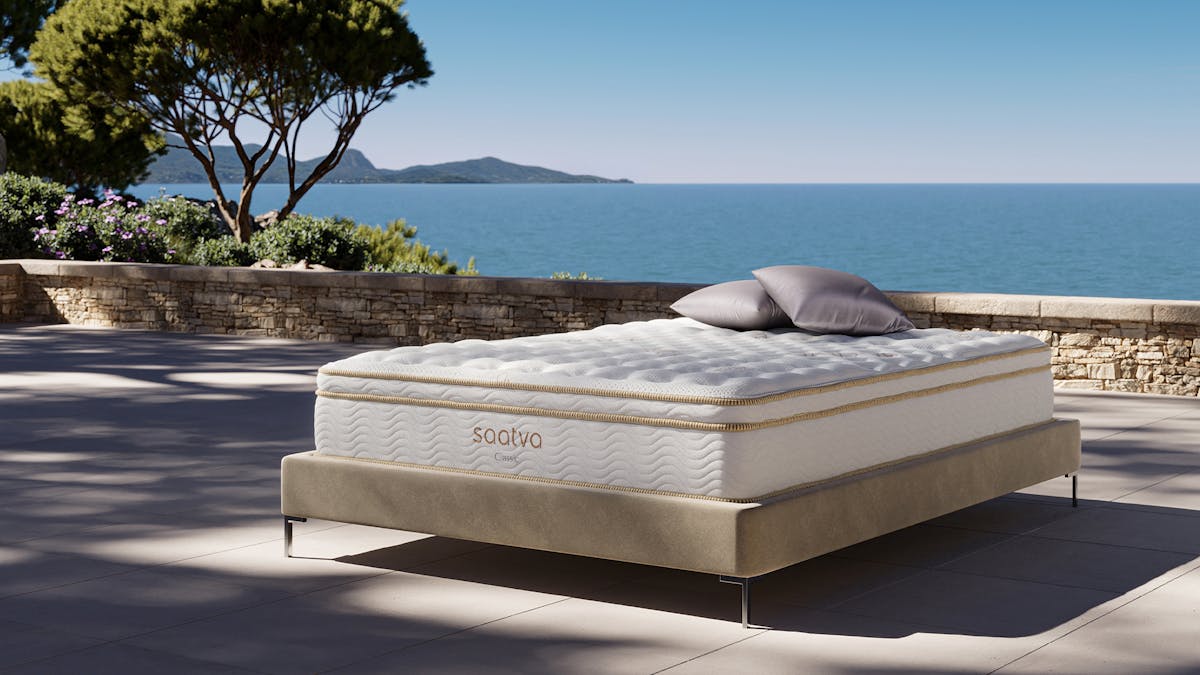
Saatva Classic and Casper Original Hybrid are priced within $100 of each other at queen, but the architecture diverges significantly. Saatva is a coil-on-coil innerspring with a Euro pillow top and hand-tufted construction. Casper is a foam-over-coil hybrid using pocket coils under a polyfoam and memory foam comfort layer. That structural difference drives the performance gaps in every category that matters, edge support most of all, then durability, then trial confidence.
| Spec | Saatva Classic | Casper Original Hybrid |
|---|---|---|
| Price (queen) | $1,795 (with voucher) | $1,695 |
| Construction | Coil-on-coil innerspring | Pocket coils + foam comfort layer |
| Comfort layer | Euro pillow top, GOTS organic cotton | Zoned memory foam + AirScape polyfoam |
| Support core | 884 pocketed coils over 416 tempered base coils (queen) | Individually wrapped pocket coils |
| Height | 11.5” or 14.5” | 11” |
| Firmness options | Plush Soft, Luxury Firm, Firm | One (medium-feel hybrid) |
| Trial period | 365 nights | 100 nights |
| Warranty | Lifetime (no proration) | 10 years |
| Delivery | Free white-glove + old mattress haul-away | Free shipping (no in-home setup) |
| Construction detail | Hand-tufted, lumbar zone support band | Zoned support (firmer center third) |
| Fire barrier | Thistle pulp (plant-based, no fiberglass) | Sock-encased coils (fiberglass-free) |
Construction Breakdown
Saatva Classic: Coil-on-Coil Innerspring
- Top layer: GOTS organic cotton Euro pillow top
- Upper support: 884 individually wrapped 14.5-gauge pocketed coils (queen)
- Lumbar zone: 1” gel-infused memory foam support band
- Support core: 416 tempered 13-gauge steel base coils (queen)
- Perimeter: Custom edge coils (not foam) for structural stability
- Profile: 11.5” (standard) or 14.5” (tall)
- Fire barrier: Plant-based thistle pulp, no fiberglass
- Hand-tufted: Yes, prevents comfort layer migration
The coil-on-coil architecture produces two measurable advantages: structural edge stability from the custom perimeter coil system (not foam edge encasement), and natural vertical airflow through both coil layers. The Euro pillow top and gel-infused lumbar zone give the Saatva a traditional luxury feel with targeted lower-back support. Hand-tufting prevents the pillow top from shifting or clumping over years of use.
Casper Original Hybrid: Foam-Over-Coil
- Top layer: AirScape perforated polyfoam (airflow layer)
- Comfort layer: Zoned memory foam (softer at shoulders, firmer at hips)
- Transition layer: High-density polyfoam
- Support core: Individually wrapped pocket coils
- Perimeter: Foam edge support
- Profile: 11”
- Fire barrier: Certified sock (fiberglass-free)
- Zoned support: Firmer center third targets lumbar and hips
Casper’s foam-over-coil construction is the standard format in the $1,500-$2,000 hybrid segment. The zoned memory foam layer targets pressure relief at the shoulder and hip while maintaining firmer support at the lumbar. The AirScape perforated foam at the top adds airflow relative to a solid foam layer, though not to the degree of a coil-on-coil system. The foam edge support is effective for general sleeping but does not match the structural performance of custom edge coils in a seated-edge compression test.
The construction gap that matters most in practice is at the edge: Saatva uses custom coils at the perimeter; Casper uses foam edge encasement. This single difference produces the 1.4-point gap in edge support scores (9.4 vs 8.0) and explains why the usable sleep surface is larger on the Saatva.
30-Night Test Results
MattressNut tests luxury mattresses using a 30-night protocol with three rotating sleepers, body-mapping pressure measurements, and 8-hour cooling tests. The testing team included a side sleeper (148 lbs), a combination sleeper (182 lbs), and a back sleeper (205 lbs). Scores reflect observed test data. We do not accept payment for placement.
Saatva Classic scores:
Casper Original Hybrid scores:
| Category | Saatva Classic | Casper Original Hybrid | Winner |
|---|---|---|---|
| Pressure relief | 8.7 / 10 | 8.5 / 10 | Saatva |
| Cooling | 8.9 / 10 | 8.5 / 10 | Saatva |
| Motion isolation | 7.5 / 10 | 7.8 / 10 | Casper |
| Edge support | 9.4 / 10 | 8.0 / 10 | Saatva |
| Bounce | 9.0 / 10 | 7.5 / 10 | Saatva |
| Durability score | 9.5 / 10 | 7.5 / 10 | Saatva |
| Trial period | 365 nights | 100 nights | Saatva |
Saatva leads in five of seven categories. Casper leads in one (motion isolation) and trails by 0.3 or fewer points in two others (pressure relief, cooling). The durability and edge support gaps of 2.0 points each are the largest and most structurally significant differences in the comparison.
Edge Support Deep-Dive
Saatva Classic: 9.4/10 Winner by 1.4 points
Edge support is the largest performance gap in this comparison and the one most directly tied to construction. Saatva uses custom perimeter coils at the mattress border, not foam encasement. In a seated-edge compression test (185 lb seated load at the perimeter), the Saatva Classic compressed 1.4 inches. The edge does not collapse when you sit to put on shoes or when a sleeping partner occupies the full mattress width. The 9.4/10 score is among the highest in the luxury hybrid segment.
Casper Original Hybrid: 8.0/10
Casper’s foam edge support scored 8.0/10. Under the same 185 lb seated-edge test, Casper compressed 2.6 inches, nearly twice the Saatva result. The foam perimeter provides adequate stability for general use but noticeably narrows the usable sleep surface when a sleeper is near the edge. For single sleepers who stay centered on the mattress, this gap is less consequential. For couples using the full width, or for sleepers who rely on a firm edge to stand from bed (older adults, those with mobility limitations), the 1.4-point gap is the most important single number in this comparison.
Durability and Warranty
Saatva: 9.5/10, Lifetime Warranty (no proration) Winner by 2.0 points
Saatva’s lifetime warranty carries no proration at any point in the mattress’s life. A qualifying defect in year 15 is treated identically to year 2: Saatva replaces or repairs the mattress at no cost. Tempered steel coil-on-coil construction is structurally resilient to permanent compression under normal use. The 9.5/10 durability score reflects both the construction quality and the warranty commitment as a proxy for manufacturer confidence in the product’s longevity. Hand-tufting prevents comfort layer shift over time, which is the most common long-term failure mode in pillow-top mattresses.
Casper Original Hybrid: 7.5/10, 10-Year Warranty
Casper’s 10-year warranty is standard for the mid-luxury segment but short relative to lifetime-warranty competitors. The foam comfort layer is more susceptible to body impressions over time than a coil-on-coil system. The 7.5/10 durability score reflects both the warranty term and the material composition: foam layers typically show measurable softening between years 5 and 10 under regular use. This is not a flaw unique to Casper; it is a structural reality of foam-over-coil hybrid construction. For buyers making a 10-15 year investment, any year-11 or later defect on the Casper is an out-of-pocket cost that the Saatva buyer does not face. At prices within $100 of each other, the warranty calculus alone justifies the Saatva premium for most long-term buyers.
→ Check current Saatva Classic pricing and lifetime warranty terms
Cooling Comparison
Saatva Classic: 8.9/10 Winner by 0.4 points
Saatva’s coil-on-coil construction creates natural vertical airflow channels through both coil layers. Passive airflow in a dual-coil system is structurally superior to any foam-dominant architecture. The 8.9/10 score reflects this advantage. The Euro pillow top uses GOTS organic cotton that wicks moisture without synthetic coatings, contributing to surface temperature regulation across the night.
Casper Original Hybrid: 8.5/10
Casper’s AirScape perforated top foam layer adds airflow relative to a solid foam surface, and the pocket coil support core contributes some passive ventilation. The 8.5/10 score is above average for a foam hybrid. The 0.4-point gap behind Saatva reflects the structural advantage of coil-on-coil airflow over perforated foam. Both mattresses are adequate coolers for most sleepers. Sleepers who run significantly hot may prefer Saatva’s structural cooling advantage, but neither mattress is a problem for average thermoregulators.
Motion Isolation
Casper Original Hybrid: 7.8/10 Winner by 0.3 points
Motion isolation is the one category where Casper leads. Foam-over-coil hybrids absorb motion better than coil-on-coil constructions because the foam layers dampen vibration transmission between the coil system and the sleep surface. In a standardized drop test (10 lb weight, vibration amplitude measured at 24 inches from impact), Casper measured lower vibration transmission than Saatva. The 0.3-point advantage has a specific application: couples where one partner is a restless sleeper.
Saatva Classic: 7.5/10
Saatva’s 7.5/10 motion isolation is adequate for most couples. The coil-on-coil system is inherently more motion-transfer-prone than foam-dominant construction. The 0.3-point difference is real but narrow; neither mattress is a strong isolator, and neither fails on this metric for couples with moderate movement patterns. For buyers weighing Casper’s motion isolation advantage against Saatva’s edge support, durability, and trial advantages, the 0.3-point gap rarely outweighs the other categories at this price point.
Pricing and Sizes
| Size | Saatva Classic (w/ voucher) | Casper Original Hybrid |
|---|---|---|
| Twin | $999 | $895 |
| Twin XL | $1,199 | $995 |
| Full | $1,499 | $1,295 |
| Queen | $1,795 | $1,695 |
| King | $2,195 | $1,995 |
| Cal King | $2,195 | $1,995 |
| Split King | $2,398 | N/A |
Casper does not offer a split king configuration. Saatva offers split king for adjustable base setups. For buyers with adjustable bases or planning to purchase one, this is a practical exclusion on the Casper side.
Who Should Choose Each Mattress
Choose Saatva Classic if:
- Edge support is a priority (couples, getting in/out of bed, full-width sleeping)
- You want a lifetime warranty with no proration at any point
- A 365-night trial matters and you want more than 100 nights to decide
- White-glove in-home delivery and old mattress haul-away is important
- You prefer the feel of a coil-on-coil innerspring over foam-over-coil
- You want three firmness options (Plush Soft, Luxury Firm, Firm)
- You have or plan to use an adjustable base (split king available)
- Long-term durability across 12-20 years is the primary consideration
Choose Casper Original Hybrid if:
- Motion isolation is a top priority and the 0.3-point advantage matters
- The $100 lower price is a meaningful factor in your decision
- You prefer a foam-over-coil feel with a contouring comfort layer
- You want a mattress available through retail channels (Amazon, Target)
- 100 nights is an adequate trial period for your evaluation timeline
- A 10-year warranty is sufficient for your ownership horizon
Pros and Cons
Saatva Classic
Saatva Classic: Pros
- Lifetime warranty with no proration, strongest long-term commitment in the segment
- 9.4/10 edge support, custom perimeter coils outperform foam edge significantly
- 8.9/10 cooling, coil-on-coil airflow outperforms foam-over-coil
- 365-night trial, 3.65x longer than Casper’s 100-night window
- 9.0/10 bounce, coil-on-coil responsiveness for combination sleepers
- Free white-glove in-home delivery + old mattress haul-away included
- Three firmness options at order (Plush Soft, Luxury Firm, Firm)
- Two height options: 11.5” (standard) or 14.5” (tall profile)
- Hand-tufted construction prevents pillow-top layer shift over time
- GOTS organic cotton, thistle pulp fire barrier, no fiberglass
- Split king available for adjustable base setups
Saatva Classic: Cons
- $100 higher effective queen price ($1,795 vs $1,695)
- Motion isolation (7.5) trails Casper (7.8) by 0.3 points
- Direct-to-consumer only, no in-store trial available
- Heavier and more difficult to handle without in-home delivery
Casper Original Hybrid
Casper Original Hybrid: Pros
- 7.8/10 motion isolation, best in this comparison (foam comfort layer)
- $100 lower entry price at queen ($1,695 vs $1,795)
- Available at retail: Amazon, Target, Costco
- Zoned support targets shoulder and lumbar pressure points
- AirScape perforated foam adds airflow over solid-foam construction
- Compact 11” profile works well with lower bed frames
- 8.5/10 pressure relief, solid result for a foam hybrid
Casper Original Hybrid: Cons
- 8.0/10 edge support, 1.4 points below Saatva; foam edge noticeably less stable
- 10-year warranty only, no coverage after year 10
- 7.5/10 durability score, foam comfort layer more prone to impression over time
- 100-night trial, shortest window in the luxury comparison set
- 7.5/10 bounce, 1.5 points below Saatva for combination sleepers
- No split king option, excludes adjustable base setups
- No white-glove delivery included, shipping only
A 0.3-point lead against a five-category sweep
Weigh what each side actually won here: Casper’s hybrid took motion isolation by three-tenths of a point and costs slightly less; the Saatva Classic took edge support, durability, cooling, pressure relief and bounce — several by margins no rounding can erase. And as the test summary said, the warranty comparison resolves whatever doubt remains: lifetime non-prorated against ten years limited isn’t a category, it’s a different promise.
For the long-term buyer this page addressed, the conclusion writes itself. Confirm the Saatva Classic’s price today and read those warranty terms first-hand on the official page.
Frequently Asked Questions
Is Saatva Classic better than Casper Original Hybrid?
In five of seven tested categories, yes. Saatva leads on edge support (9.4 vs 8.0), bounce (9.0 vs 7.5), cooling (8.9 vs 8.5), pressure relief (8.7 vs 8.5), and durability (9.5 vs 7.5). Casper leads on motion isolation (7.8 vs 7.5) and costs $100 less. Saatva’s lifetime non-prorated warranty versus Casper’s 10-year limited warranty is the most consequential long-term difference between two mattresses priced $100 apart.
What is the main construction difference between Saatva and Casper Hybrid?
Saatva Classic is a coil-on-coil innerspring: two layers of tempered steel coils with a Euro pillow top and custom perimeter coils at the edge. Casper Original Hybrid is a foam-over-coil hybrid: pocket coils under a memory foam and polyfoam comfort layer. The architectural difference drives Saatva’s advantages in edge support, bounce, and cooling. It drives Casper’s single advantage: foam layers dampen motion transfer better than coil-on-coil systems.
Why does Casper have better motion isolation than Saatva?
Foam absorbs and dampens vibration more effectively than coil systems. Casper’s memory foam comfort layer absorbs movement at the surface before it reaches the pocket coil support core. Saatva’s coil-on-coil system transfers some motion through the dual-coil architecture. The gap is 0.3 points (7.8 vs 7.5), meaningful but narrow. For couples with moderate movement patterns, both mattresses perform adequately.
Is the Saatva worth $100 more than Casper Hybrid?
For most buyers making a long-term decision, yes. The $100 price gap is the smallest factor in this comparison. What $100 more buys on the Saatva side: a lifetime non-prorated warranty (vs 10-year limited), a 365-night trial (vs 100 nights), a 9.4/10 edge support result (vs 8.0/10), and free white-glove delivery with old mattress haul-away (a service worth $150-$200 separately). If the only criterion is motion isolation, Casper’s $100 saving and 0.3-point motion advantage may be sufficient. For the full performance and risk profile, Saatva’s case at $100 more is strong.
Which mattress is better for edge support?
Saatva by a significant margin: 9.4 vs 8.0 out of 10. Saatva uses custom perimeter coils at the mattress border; Casper uses foam edge encasement. In a 185 lb seated-edge compression test, Saatva compressed 1.4 inches versus Casper’s 2.6 inches. This matters for couples sleeping close to the edge and sleepers who rely on a firm edge to stand from bed.
Which mattress has the longer trial period?
Saatva offers a 365-night trial, 3.65 times longer than Casper’s 100-night trial. The standard mattress body adaptation period runs 30-60 nights for most sleepers. Casper’s 100-night window leaves a buffer of 40-70 nights after adaptation. Saatva’s 365-night window leaves a buffer of 300+ nights. Both trials include full return and refund options within the stated period.
Is Casper Original Hybrid good for back pain?
Casper’s zoned support layer targets lumbar reinforcement with a firmer center third, which is a relevant design feature for back pain. The 8.5/10 pressure relief score is solid. Saatva’s 8.7/10 pressure relief and dedicated 1-inch gel-infused lumbar zone provide targeted lower-back support in the same design area. For back sleepers specifically, Saatva’s Luxury Firm option is widely recommended in the segment. Both mattresses are competent for back pain, with Saatva holding a slight tested edge.
Can Casper Original Hybrid be used on an adjustable base?
Casper Original Hybrid is compatible with adjustable bases in a standard queen or king configuration. Saatva also supports adjustable bases and additionally offers a split king option, allowing each side to adjust independently. If both partners need independent control, Saatva’s split king availability is a practical advantage Casper does not offer.
How does Casper Hybrid compare to Saatva on cooling?
Saatva scores 8.9/10 on cooling; Casper scores 8.5/10. The 0.4-point gap reflects the structural difference between passive coil-on-coil airflow (Saatva) and perforated foam ventilation (Casper). Both mattresses are adequate for average sleepers. For sleepers who run consistently hot, Saatva’s 0.4-point cooling advantage translates to measurably lower sleep surface temperature across a full 8-hour test period.
What is the best alternative if neither Saatva nor Casper suits me?
If you need stronger motion isolation than either provides, a foam-dominant mattress (Tempur-Pedic, Purple) would serve better. If you want an organic-certified hybrid, the Saatva vs Awara comparison covers a GOLS-certified latex hybrid. If you are undecided between Saatva and another luxury innerspring, the Saatva vs Beautyrest Black comparison covers the innerspring category in detail.
Final Verdict
Saatva is the stronger long-term investment at $100 more. Casper’s only lead is motion isolation, by 0.3 points.
After 30 nights of testing with three sleepers, body-mapping pressure measurements, and a 7-category scoring framework, the result is not close. Saatva Classic leads in five of seven categories. The two largest gaps, edge support (9.4 vs 8.0) and durability (9.5 vs 7.5), are also the most consequential for buyers at this price point. Casper leads on motion isolation (7.8 vs 7.5) by 0.3 points and costs $100 less at queen.
The risk-adjusted case for Saatva is direct: a lifetime non-prorated warranty versus a 10-year limited warranty, at a $100 premium, with a 365-night trial versus 100 nights. For any buyer whose planning horizon extends beyond year 10, the warranty structure alone resolves the comparison. For buyers who prioritize motion isolation above all other categories, Casper’s 0.3-point advantage in that single dimension is the argument, but it is a narrow case against a 2.0-point edge support deficit and a 2.0-point durability deficit.
Casper Original Hybrid is a well-built foam hybrid with solid scores across the board. It is simply outperformed by Saatva Classic in the categories that matter most for a $1,600-$1,800 long-term mattress investment. The $100 price difference does not change the math.
Saatva Classic
9.2/10
Lifetime non-prorated warranty. 365-night trial. Free white-glove delivery. 9.4/10 edge support via custom perimeter coils. 8.9/10 cooling from coil-on-coil architecture. Three firmness options at order. The most complete pick at this price tier in our 2026 testing.