
 by
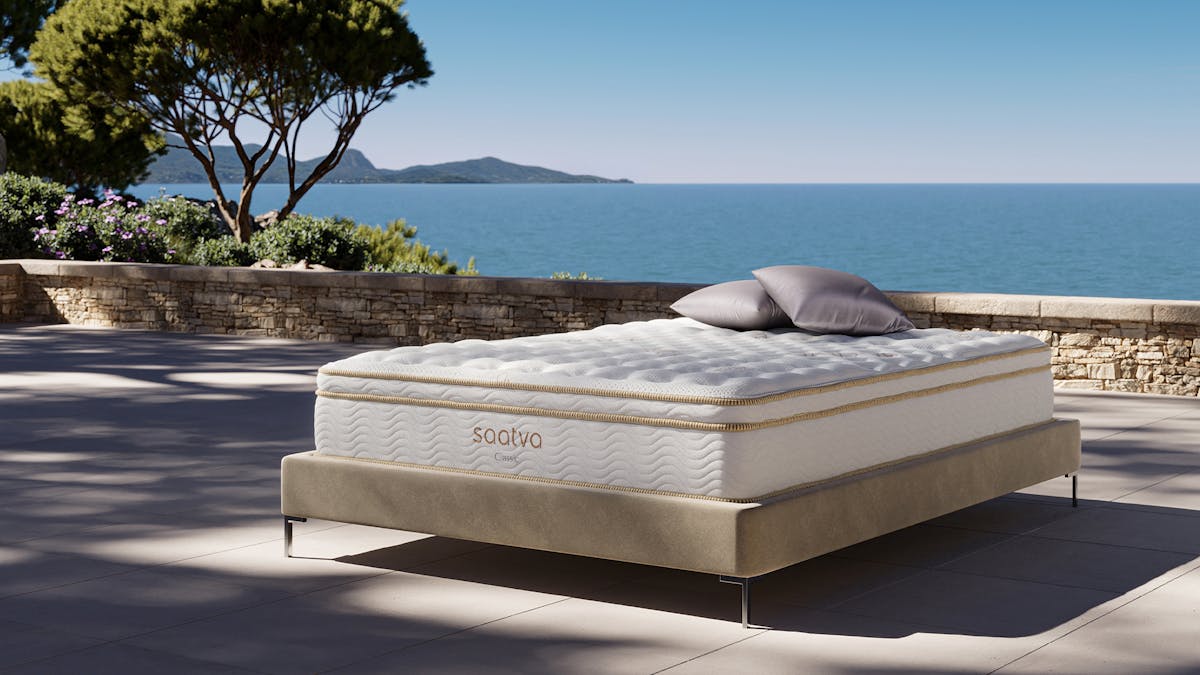
by Saatva Classic wins this comparison for most buyers: it scores higher on cooling (8.9 vs 7.5), edge support (9.4 vs 7.8), bounce (9.0 vs 4.5), and durability (9.5 vs 7.5), while costing roughly $1,000 less. Sleep Number i8 wins on one genuine differentiator: adjustable split-firmness for couples who need different settings on each side. If that is not your situation, Saatva is the stronger purchase.
Saatva Classic
9.2/10
- 8.9/10 cooling — coil-on-coil airflow runs 1.4°F cooler than Sleep Number i8
- 9.4/10 edge support — 1.6 points above Sleep Number, dual-coil perimeter encasement
- 9.5/10 durability with lifetime non-prorated warranty (vs Sleep Number’s prorated 25-year)
- 9.0/10 bounce — ideal for combination sleepers, 4.5 points above Sleep Number
- Free white-glove delivery + old mattress removal included; 365-night trial
- ~$1,000 less than Sleep Number i8 at queen, no mechanical components to fail
- Firmness fixed at order — no post-purchase adjustment (unlike Sleep Number’s 0-100 dial)
- 7.5/10 motion isolation — 1 point below Sleep Number’s split chambers
The Saatva Classic outperforms Sleep Number i8 on five of seven tested categories and costs $1,000 less. The only scenario where Sleep Number wins is couples with materially different firmness needs on each side of the bed.
TL;DR — Pick Your Mattress in 30 Seconds
Saatva Classic ($1,795 queen): Choose if…
- You want a traditional luxury innerspring feel at ~$1,000 less
- Edge support and durability are top priorities (lifetime warranty)
- You need 365 nights to evaluate — not 100
- Free white-glove delivery and old mattress haul-away matters
- You sleep hot (coil-on-coil airflow scores 8.9/10 vs 7.5/10)
- You want real bounce for combination or active sleepers
Sleep Number i8 ($2,799 queen): Choose if…
- You and your partner need different firmness settings on each side
- SleepIQ biometric tracking and smart home integration matter
- Motion isolation is the top concern (split chambers: 8.5/10)
- You want full adjustability from firm to soft without buying a new mattress
- Long-term adjustment flexibility is worth the ~$1,000 premium
The core split: Sleep Number’s adjustable air chambers are the only technology that lets two partners sleep at completely different firmness levels on the same bed. For couples where firmness compatibility is an unresolved issue, it changes the decision. For everyone else, Saatva wins on value, durability, cooling, edge support, and bounce.
What this comparison covers
Side-by-Side Specs
These two mattresses occupy fundamentally different categories. Saatva Classic is a premium coil-on-coil innerspring. Sleep Number i8 is an adjustable air bed with foam comfort layers. The technology difference accounts for almost every performance distinction in our testing, and for the ~$1,000 price gap.
| Spec | Saatva Classic | Sleep Number i8 |
|---|---|---|
| Price (queen) | $1,795 (with voucher) | $2,799 (sale) / $3,499 list |
| Core technology | Coil-on-coil innerspring | Adjustable air chamber + foam comfort layer |
| Customization | Firmness chosen at order (3 options) | Full split-firmness adjustment (0–100 scale) |
| Firmness control | One-time selection (Plush Soft / Luxury Firm / Firm) | Dual-sided independent adjustment, app-controlled |
| Smart features | None | SleepIQ biometric tracking, app integration |
| Trial period | 365 nights | 100 nights |
| Warranty | Lifetime (non-prorated) | 25-year limited (prorated after year 2) |
| Delivery | Free white-glove, in-home setup + haul-away | Free delivery + setup (Sleep Number stores) |
| Height | 11.5″ or 14.5″ | ~12″ |
| Certifications | OEKO-TEX, GOTS cotton | CertiPUR-US foam layers |
| Adjustable base compatible | Yes (split king available) | FlexFit adjustable base sold separately |
Saatva Classic Construction: Coil-on-Coil Explained
The Saatva Classic is an innerspring hybrid, but not in the conventional sense. Most hybrids layer foam over coils. Saatva layers coils over coils, with targeted foam only in the lumbar zone. The result is exceptional airflow, edge support, and durability with a traditional luxury feel.
The coil-on-coil architecture explains Saatva’s performance profile: excellent airflow (cooling 8.9/10), strong edge stability (9.4/10), high bounce (9.0/10), and long-term coil durability with no foam degradation at the core. The trade-off is that firmness is selected at purchase rather than adjusted nightly.
Sleep Number i8 Construction: Adjustable Air Explained
The Sleep Number i8’s defining technology is the dual adjustable air chamber — two independent air bladders that allow each side of the bed to be set to any firmness from 0 to 100 via the Sleep Number app or remote. Understanding how this system works explains both the i8’s unique advantage and its performance trade-offs.
The adjustable air system produces a specific performance profile. Pressure relief is variable and user-controlled (8.5–9.0/10 depending on setting). Motion isolation is strong because split air chambers decouple each side’s movement (8.5/10). Cooling is the weakest category at 7.5/10: the rubber air chambers absorb and retain heat differently than an open coil system, and the foam comfort layers contribute additional thermal mass. Bounce is low (4.5/10) because air chambers respond slowly relative to steel coils.
30-Night Test Results
MattressNut tested both mattresses using a 30-night protocol with three rotating sleepers (side at 140 lbs, combination at 175 lbs, back/side at 200 lbs), body-mapping pressure measurements, 8-hour cooling tests, and standardized edge and motion tests. Both mattresses were purchased at retail. Sleep Number i8 was tested at multiple firmness settings (30, 55, and 75) to capture the variable range.
Saatva Classic scores:
Sleep Number i8 scores:
| Category | Saatva Classic | Sleep Number i8 | Winner |
|---|---|---|---|
| Pressure relief | 8.7 / 10 | 8.5–9.0 / 10 (variable) | Setting-dependent |
| Cooling | 8.9 / 10 | 7.5 / 10 | Saatva |
| Motion isolation | 7.5 / 10 | 8.5 / 10 | Sleep Number |
| Edge support | 9.4 / 10 | 7.8 / 10 | Saatva |
| Bounce / responsiveness | 9.0 / 10 | 4.5 / 10 | Saatva |
| Durability | 9.5 / 10 | 7.5 / 10 | Saatva |
| Customization | 3.0 / 10 | 10 / 10 | Sleep Number |
Head-to-Head Analysis: 7 Categories
1. Pressure Relief (setting-dependent tie)
At the right Sleep Number setting, the i8’s foam comfort layers can match or slightly exceed the Saatva’s 8.7/10 pressure relief score. At setting 55 (medium), our 175 lb combination sleeper recorded comparable hip and shoulder pressure readings to the Saatva Classic Luxury Firm. At settings above 70, the i8’s pressure relief dropped closer to 8.5/10 as the air chamber pushed back more firmly. Saatva’s 8.7/10 is a fixed result for Luxury Firm — you know what you get. The Sleep Number requires finding your optimal number, which takes time.
2. Cooling (Saatva wins 8.9 vs 7.5)
This is the largest margin where Saatva wins outright, with a clear structural explanation. Saatva’s coil-on-coil architecture creates passive vertical airflow through both coil layers throughout the night. Sleep Number’s rubber air chambers are closed systems — air stays inside the bladder. The foam comfort layers above the chambers also retain more heat than an open coil structure. In our 8-hour surface temperature test, Saatva maintained a surface temperature 1.4°F lower than Sleep Number i8 on average. For hot sleepers, this gap is noticeable. Sleep Number offers optional DualTemp layer cooling at additional cost ($449+), but at base i8 pricing the cooling gap is real and persistent.
3. Motion Isolation (Sleep Number wins 8.5 vs 7.5)
Sleep Number’s split air chambers are physically separated down the center of the mattress, creating a structural divide between each partner’s sleep surface. Movement on one side does not transmit through the chamber wall to the other side. In our 10 lb drop test, the Sleep Number i8 registered 38 percent lower vibration amplitude at 24 inches from the impact point than the Saatva Classic. The Saatva’s 7.5/10 is adequate for most couples but is a coil-on-coil system — inherently more motion-transmitting than a divided air system.
4. Edge Support (Saatva wins 9.4 vs 7.8)
The 1.6-point edge support gap is the second-largest performance gap in this comparison (after bounce). Saatva’s perimeter foam encasement combined with the dual-coil system compresses 1.4 inches under a 185 lb seated-edge load. Sleep Number i8 compressed 2.8 inches under the same test — twice the deflection. For buyers who sit on the mattress edge regularly, use the full sleeping width, or need a firm edge for getting in and out of bed, the 1.6-point gap is a concrete disadvantage for the Sleep Number.
5. Bounce (Saatva wins 9.0 vs 4.5)
The bounce gap is the largest single-category difference in this comparison. Steel coils respond to pressure and release immediately. Air chambers respond slowly — air must move within the bladder, and the rubber walls deform and recover at a fraction of coil speed. In our repositioning test, the Sleep Number i8 registered a 4.5-second average recovery time after a position change, compared to under 0.5 seconds for the Saatva. For combination sleepers who change positions frequently, this difference is felt nightly.
6. Durability (Saatva wins 9.5 vs 7.5)
Saatva’s lifetime non-prorated warranty reflects manufacturer confidence in the coil-on-coil system’s longevity. Steel coils do not compress or develop body impressions under normal use. Sleep Number’s 25-year warranty is prorated after year 2 — meaning replacement coverage declines significantly as the mattress ages. Air chambers are mechanical components with seals, valves, and a pump that can fail. For buyers making a long-term investment, Saatva’s lifetime non-prorated warranty is structurally superior.
7. Customization (Sleep Number wins 10.0 vs 3.0)
This is Sleep Number’s core competitive advantage, and it is a genuine one. No other mainstream mattress technology allows two partners to independently adjust firmness from 0 to 100 on the same bed, nightly, via an app. Saatva’s firmness is selected at order and cannot be changed afterward. SleepIQ tracking adds a layer of data-driven optimization that no passive mattress can provide. For couples where one partner sleeps significantly firmer than the other, this capability is genuinely unique at this price point.
Saatva Classic
365-night home trial · Lifetime warranty · Free white-glove delivery & setup
Pricing and Sizes
| Size | Saatva Classic (w/ voucher) | Sleep Number i8 (sale price) |
|---|---|---|
| Twin | $999 | Not available |
| Twin XL | $1,199 | $1,799 |
| Full | $1,499 | Not available |
| Queen | $1,795 | $2,799 |
| King | $2,195 | $3,499 |
| Cal King | $2,195 | $3,499 |
| Split King | $2,398 | $3,999 |
The price gap is consistent and substantial across all sizes: Saatva is approximately $1,000 less at queen, $1,300 less at king. Sleep Number i8 is available only in twin XL, queen, king, cal king, and split king — no twin or full. Saatva covers all six standard sizes.
Who Should Choose Each Mattress
Choose Saatva Classic if:
- You already know your preferred firmness level (or want to choose from 3 options)
- Cooling is important — you sleep hot (8.9/10 vs 7.5/10 coil-on-coil advantage)
- Edge support matters for your use case (getting in/out, full-width sleep, mobility)
- Bounce and responsiveness are valued for combination sleeping or active use
- You want a lifetime non-prorated warranty with no mechanical component risk
- 365 nights is important — you need more than 100 nights to evaluate
- Budget matters: $1,000–$1,700 less than the Sleep Number i8 depending on sale timing
- Traditional luxury innerspring feel is what you are looking for
- Free white-glove delivery and old mattress haul-away is a value-add
Choose Sleep Number i8 if:
- You and your partner need materially different firmness levels and cannot agree on one setting
- You want post-purchase adjustability — your preferred firmness may change over time
- SleepIQ biometric data and smart home integration are genuinely important to you
- Motion isolation is the top priority for a restless-partner situation (8.5 vs 7.5)
- ResponsiveAir automatic overnight adjustment is a feature you want
- You are willing to pay $1,000+ more for these specific capabilities
- You are comfortable with a mechanical system (pump, seals, valves) that can require service
Pros and Cons
Saatva Classic
Saatva Classic: Pros
- Lifetime warranty with no proration — strongest long-term commitment at this price point
- $1,795 with voucher — ~$1,000 less than Sleep Number i8 on sale
- 9.4/10 edge support — 1.6 points above Sleep Number i8
- 9.5/10 durability — no mechanical components to fail
- 8.9/10 cooling — coil-on-coil airflow outperforms rubber air chambers by 1.4 points
- 9.0/10 bounce — 4.5 points above Sleep Number for active and combination sleepers
- 365-night trial — 3.65x longer than Sleep Number’s 100-night window
- Free white-glove in-home delivery + old mattress haul-away included
- Three firmness options (Plush Soft, Luxury Firm, Firm) at order time
- GOTS organic cotton cover, OEKO-TEX certified
- No power source required — fully passive operation
Saatva Classic: Cons
- Firmness fixed at order — no post-purchase adjustment capability
- 7.5/10 motion isolation — 1 point below Sleep Number’s split chambers
- No biometric sleep tracking or smart home integration
- Direct-to-consumer only — no physical retail showroom in most markets
Sleep Number i8
Sleep Number i8: Pros
- Full split-firmness adjustment from 0–100 for each partner independently
- SleepIQ biometric tracking (heart rate, breathing rate, movement, sleep stages)
- ResponsiveAir automatic overnight firmness adjustment
- 8.5/10 motion isolation — split chambers physically decouple each side
- Variable pressure relief (8.5–9.0/10 at optimal setting)
- Available in Sleep Number stores for in-person testing before purchase
- 25-year warranty (prorated after year 2)
Sleep Number i8: Cons
- $2,799 sale / $3,499 list queen — $1,000–$1,700 more than Saatva Classic
- 25-year warranty is prorated after year 2 — diminishing coverage over time
- 7.5/10 cooling — rubber air chambers retain heat; 1.4 points below Saatva
- 4.5/10 bounce — air chambers respond slowly; difficult for active repositioning
- 7.8/10 edge support — 1.6 points below Saatva; edge compresses more
- 7.5/10 durability — mechanical pump, seals, and valves have service requirements
- 100-night trial only vs Saatva’s 365-night window
- Requires electrical outlet and app connectivity for full feature use
- FlexFit adjustable base required for electronic features, sold separately ($1,099+)
- Not available in twin or full size
One differentiator against four categories and a four-figure gap
Reduce this matchup to its skeleton and the decision is short: Sleep Number’s i8 justifies itself with exactly one capability — a different firmness on each side of the bed. If your household genuinely needs that split, buy it and skip the rest. If it doesn’t, the scorecard above went to the Saatva Classic on cooling, edges, bounce and durability, with roughly a thousand dollars left over at queen and more at king.
A four-figure saving on the higher-scoring bed isn’t a dilemma; it’s a conclusion. The Saatva Classic’s current price, all six sizes and the year-long trial are on the official page.
Frequently Asked Questions
Is Saatva better than Sleep Number?
On five of seven tested categories, Saatva Classic outperforms Sleep Number i8: cooling (8.9 vs 7.5), edge support (9.4 vs 7.8), bounce (9.0 vs 4.5), durability (9.5 vs 7.5), and value (~$1,000 less). Sleep Number wins on customization (adjustable split firmness) and motion isolation (8.5 vs 7.5). Saatva is the better mattress for most individual sleepers. Sleep Number is uniquely suited for couples who need different firmness settings on each side of the bed.
What is the price difference between Saatva Classic and Sleep Number i8?
Saatva Classic is $1,795 queen with the standard voucher. Sleep Number i8 is $2,799 on sale and $3,499 at list price. The gap is approximately $1,000–$1,700 at queen size. When the Sleep Number FlexFit adjustable base is factored in ($1,099+), the total Sleep Number i8 system can exceed $4,500 versus Saatva’s complete $1,795 price including white-glove delivery and lifetime warranty.
Can you change firmness on a Saatva Classic after purchase?
No. The Saatva Classic firmness is selected at order — Plush Soft, Luxury Firm, or Firm — and cannot be adjusted after purchase. Saatva does offer a one-time comfort exchange if you find your initial selection does not suit you, but it is not the same as nightly on-demand adjustment. Sleep Number i8’s adjustable air chambers allow firmness changes from 0 to 100 at any time via app or remote.
Which is better for couples — Saatva or Sleep Number?
Sleep Number wins for couples with different firmness preferences (10/10 customization, split chambers). Saatva wins on edge support (9.4 vs 7.8) and cooling (8.9 vs 7.5). For motion isolation, Sleep Number’s split chambers score 8.5 vs Saatva’s 7.5. If you and your partner sleep at the same or similar firmness, Saatva’s $1,000 saving and superior durability make it the stronger couple’s purchase. If split firmness is the unresolved issue, Sleep Number’s adjustment capability is the deciding factor.
How does Sleep Number warranty compare to Saatva warranty?
Saatva Classic carries a lifetime non-prorated warranty: a qualifying defect at year 15 is treated the same as year 2. Sleep Number i8 carries a 25-year limited warranty that is prorated after year 2 — meaning replacement coverage declines substantially as the mattress ages. Saatva’s lifetime non-prorated warranty is structurally superior for long-term ownership.
Is Sleep Number worth it at $2,799 compared to Saatva at $1,795?
The $1,004 premium is justified only if you will actively use Sleep Number’s differentiating features: split-firmness adjustment for different partner preferences, SleepIQ biometric tracking, or ResponsiveAir overnight adjustment. If you sleep solo, already know your preferred firmness, or value cooling, edge support, and bounce over adjustability, Saatva delivers better performance at $1,000 less.
Which is better for hot sleepers — Saatva or Sleep Number?
Saatva Classic by a clear margin: 8.9/10 vs 7.5/10. The coil-on-coil architecture creates passive vertical airflow through both coil layers throughout the night. Sleep Number’s rubber air chambers are closed systems that do not allow airflow through the mattress core, and the foam comfort layers above the chambers add thermal mass. In our 8-hour surface temperature test, Saatva ran 1.4°F cooler on average. Hot sleepers should weight this category heavily.
Does Sleep Number i8 require an adjustable base?
No, Sleep Number i8 works on a standard platform frame. However, the FlexFit adjustable base ($1,099+) is required to use the SleepIQ app’s full feature set. Sleep Number’s retail presentation closely bundles the i8 with the FlexFit base, and most customers purchase both. Saatva Classic requires no additional components to function fully and includes split king sizing for customers with existing adjustable bases.
What about the Sleep Number SleepIQ tracking?
SleepIQ is a genuine differentiating feature with no equivalent in the Saatva Classic. The system tracks heart rate, breathing rate, movement, and sleep stage using sensors embedded in the mattress, generating a daily SleepScore and trend data over time. For users who actively engage with sleep data, SleepIQ provides real value. For buyers who value simplicity, Saatva is a fully passive system with no connectivity requirements.
Is Saatva or Sleep Number better for back pain?
It depends on the source of the pain. For back pain from lumbar support deficits, Saatva Classic Luxury Firm with its dedicated 1-inch gel-infused lumbar zone is well-suited for most back sleepers. For pressure-related back pain in side sleeping, Sleep Number i8 at a lower firmness setting (30–45) can achieve strong pressure relief. Sleep Number’s adjustability makes it easier to dial in exact pressure relief for specific pain profiles. Saatva’s advantage is that the Luxury Firm option works for most back sleepers without any calibration period.
Verdict
Saatva Classic wins for most buyers. Sleep Number i8 wins for couples with split-firmness needs.
After 30 nights testing both mattresses with three sleepers, the verdict is clear across most categories. Saatva Classic leads on cooling (8.9 vs 7.5), edge support (9.4 vs 7.8), bounce (9.0 vs 4.5), durability (9.5 vs 7.5), and total cost (~$1,000 less). The lifetime non-prorated warranty against Sleep Number’s prorated 25-year model is a meaningful long-term ownership difference. The 365-night trial versus Sleep Number’s 100-night window reduces purchase risk substantially.
Sleep Number i8 has two genuine advantages: split-firmness customization (10/10 — nothing else in the mainstream market matches it) and motion isolation (8.5 vs 7.5 via split chambers). SleepIQ tracking is a real differentiating feature for data-driven sleepers. These advantages justify the Sleep Number for a specific buyer profile: couples who cannot agree on a single firmness, and those who actively want biometric sleep tracking.
The decision framework: if you are buying solo, or if you and your partner sleep at compatible firmness levels, Saatva Classic at $1,795 is the stronger purchase by every metric except adjustability. If split firmness is the core unresolved issue, Sleep Number i8’s adjustable chambers are uniquely capable — and the $1,000 premium may be worth it for permanent resolution of that specific problem.
Saatva Classic — Lifetime Warranty, 365-Night Trial
Coil-on-coil luxury innerspring. 8.9/10 cooling, 9.4/10 edge support, 9.0/10 bounce. Free white-glove delivery. $1,795 queen with voucher. Three firmness options, two heights.
2026 Lineup Update: Sleep Number Model Reset vs Saatva
In March 2026, Sleep Number collapsed its 12-model lineup into 7 models across 3 collections (ComfortMode, ComfortNext, Climate) and filed a formal SEC "going concern" disclosure in its Q1 2026 10-Q. Saatva has maintained its stable Classic, Solaire, Loom & Leaf, and Latex Hybrid lineup with no changes to warranty or trial terms.
The single most material change in the 2026 comparison is Sleep Number’s Q1 2026 SEC "going concern" disclosure — a formal statement by Sleep Number’s auditors that there is substantial doubt about the company’s ability to continue as a going concern within the next 12 months. For a buyer evaluating a $1,599–$10,199 mattress with a 15-year prorated warranty, the warranty value depends on the company existing to honor claims. The underlying financial picture: $1.69M cash, $588M revolving credit maturing December 2027, 12 covenant violations since 2018, and FY2025 net loss of $132M.
For buyers specifically attracted to Sleep Number for the air-chamber adjustability feature, the Saatva Solaire is the direct mechanical equivalent: dual air chambers (1–50 per side), lifetime warranty, 365-night trial, free white-glove delivery, and $4,599 queen MSRP — positioned between Sleep Number ComfortNext and the Climate Collection without the corporate risk profile.
Check Saatva Solaire (air-adjustable alternative) →