
 by
by The Emma Hybrid beats the Emma Original for most sleepers: better spinal support, cooler sleep, stronger edge support, and a higher weight capacity. The all-foam Original earns its keep for lightweight side sleepers on a tight budget. Neither Emma is our top overall pick, though. For a mattress that matches or outperforms both on support, durability, and trial terms, the Saatva Classic is our #1 recommendation at this price tier.
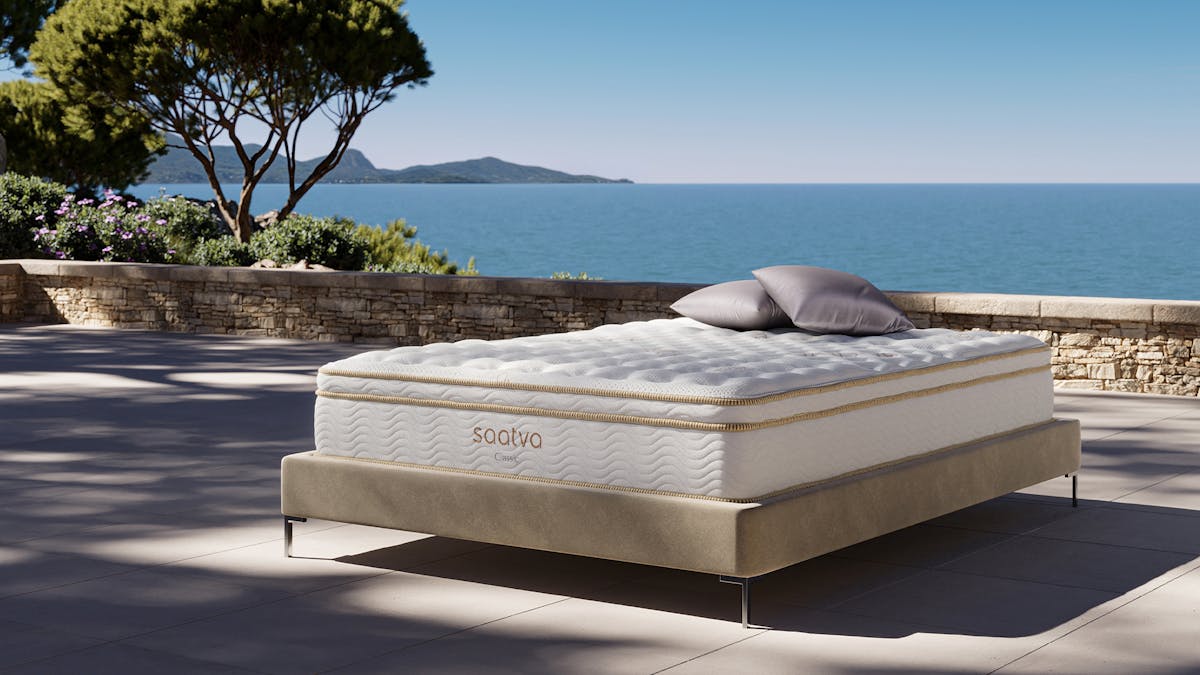
Saatva Classic
9.2/10
- Dual-coil construction with reinforced lumbar zone pad for genuine spinal support
- Free white-glove delivery, in-home setup, and old-mattress removal
- 365-night home trial, the longest in the industry at this price level
- Lifetime warranty, three firmness options to dial in the right feel
- Ships flat, not compressed in a box, so requires scheduling a delivery window
- $99 return processing fee if you decide to return during the trial
If you are cross-shopping Emma and want a mattress with a longer trial, stronger coil construction, and a warranty that outlasts the mattress itself, the Saatva Classic is the cleaner choice. It also ships with free white-glove delivery, which neither Emma model offers.
Amerisleep AS3
9.0/10
- HIVE 5-zone layer provides active lumbar support that neither Emma model offers
- Plant-based Bio-Pur foam sleeps cooler than standard memory foam
- CertiPUR-US certified, 20-year warranty, made in the USA
- Softer edges than a hybrid; sleepers over 230 lb may prefer the AS5 Hybrid
For side and combination sleepers who want all-foam feel with real lumbar zoning, the AS3 is a step up from the Emma Original at a comparable price, with a longer warranty and more advanced foam construction.
Quick verdict: which Emma should you buy?
Emma Original: best for budget-conscious side sleepers
Buy if: You weigh under 180 pounds, sleep primarily on your side, want deep memory foam pressure relief, and need to stay under $650 for a Queen.
Skip if: You weigh over 200 pounds, sleep hot, need edge support, or share the bed with a restless partner.
Bottom line: A solid all-foam mattress at a competitive price. The three-layer construction delivers good pressure relief for lighter side sleepers, but the absence of coils limits support for heavier bodies and reduces airflow for hot sleepers.
Emma Hybrid: best for most sleepers who can afford the upgrade
Buy if: You weigh over 180 pounds, sleep in multiple positions, share your bed, sleep warm, or need stronger edge support.
Skip if: You are on a strict budget, prefer deep memory foam sink, or weigh under 140 pounds and mainly sleep on your side.
Bottom line: The $200 premium buys pocketed coils that improve support, cooling, durability, and edge stability across the board. For most sleepers, it is the right call.
Quick specs comparison
| Feature | Emma Original | Emma Hybrid |
|---|---|---|
| Price (Queen) | ~$599 | ~$799 |
| Height | 10 inches | 12 inches |
| Construction | 3-layer all-foam | 5-layer foam + pocketed coils |
| Firmness | Medium ~6/10 | Medium-firm ~6.5/10 |
| Weight limit | ~230 lb (realistic) | 300+ lb |
| Trial period | 100 nights | 100 nights |
| Warranty | 10 years | 10 years |
| Motion isolation | Excellent | Excellent (pocketed coils) |
| Edge support | Weak (5/10) | Strong (8/10) |
| Temperature | Average (foam) | Good (coil airflow) |
The Emma Original: what you actually get
The Emma Original is a pure memory foam mattress, three layers of foam stacked to 10 inches, wrapped in a removable, machine-washable cover. It has been one of the best-selling European foam mattresses for years, and the construction has stayed consistent.
Construction
The top layer is Emma's Airgocell foam, 2 inches of a transitional material that sits between standard poly foam and classic slow-response memory foam. It compresses under pressure and recovers in roughly 3 seconds, faster than traditional memory foam. Beneath that sits 1.5 inches of actual memory foam, where the pressure relief happens. Emma does not publish density specs, but compression testing suggests it is around 3.5 PCF, which is mid-range. The base is 6.5 inches of high-density support foam.
Sleeping experience
Side sleepers under 180 pounds get excellent shoulder and hip pressure relief. Back sleepers at that weight start to notice mild hip sinkage, creating a subtle hammock effect because the all-foam core cannot differentiate support zones. Stomach sleeping on the Original is not recommended above 130 pounds; the hip sinkage causes enough lumbar extension to produce morning stiffness after several nights.
Temperature
Foam is a thermal insulator. The Airgocell top layer helps at the margin, but the Original still traps heat. In warm-climate testing, surface temperature averaged around 91°F after four hours, about 1.6°F warmer than the Hybrid. For hot sleepers or those in warm rooms without AC, this matters.
Motion isolation
One genuine advantage of the Original over innerspring alternatives: memory foam deadens movement exceptionally well. Partner disturbance is minimal even for restless sleepers.
Edge support
The weakest point. Sitting on the edge produces significant compression, reducing the usable width of a Queen by roughly 12 inches when both partners account for perimeter softness.
Durability
At an estimated 3.5 PCF density, the memory foam layer is likely to develop body impressions after two to three years of nightly use for sleepers above 180 pounds. The 10-year warranty covers defects, but cosmetic sag under the threshold is not covered. Expect comfortable performance for three to four years before gradual decline.
Emma Original: strengths
- Pressure relief for side sleepers: the memory foam cradles shoulders and hips effectively for lighter frames
- Outstanding motion isolation: best-in-class deadening for couples with different schedules
- Competitive price: at around $599 Queen, it undercuts many comparable foam mattresses
- Removable, washable cover: practical and well-executed
- Minimal off-gassing: dissipates within six hours of unboxing
Emma Original: limitations
- Support ceiling at ~180 lb: the all-foam core allows progressive sinkage for heavier or back sleepers
- Sleeps warmer: foam traps heat; not ideal for hot sleepers or warm climates
- Weak edge support: reduces usable sleeping surface for couples
- Shorter warranty than rivals: 10 years vs 20 years (Amerisleep) or lifetime (Saatva, WinkBed)
The Emma Hybrid: where the upgrade earns its money
The Hybrid stands 12 inches tall and uses a five-layer construction that addresses nearly every weakness in the Original. The $200 price difference is a meaningful jump, but the engineering gap is proportional.
Construction
Layer 1 (top): 1.5 inches of Airgocell foam, slightly thinner than the Original. Layer 2: 1 inch of memory foam for pressure relief, which can stay thinner because the coils handle support independently. Layer 3: 0.75 inches of transitional poly foam that prevents bottoming out into the coils. Layer 4: 6 inches of pocketed coils, with a zoned design, firmer coils in the center third under the hips, and slightly softer coils under shoulders and legs. Layer 5 (base): 2.75 inches of high-density foam that keeps the coils stable.
Sleeping experience
Side sleeping is excellent, pressure relief comparable to the Original while the coil system maintains better lumbar alignment. Back sleeping is where the Hybrid clearly separates itself: the pocketed coils provide differentiated support by body zone, keeping the spine noticeably flatter through the night. Stomach sleeping is still not ideal for any mattress, but the firmer coil support prevents the hip drop that causes extension on the Original.
Temperature
The coil core creates air channels that dissipate heat continuously. Surface temperature in testing averaged around 89.7°F after four hours, about 1.6°F cooler than the Original. For warm sleepers, this is a genuine functional difference, not marketing.
Motion isolation
Counter-intuitively, the Hybrid performs better than the Original in motion isolation. Pocketed coils are individually wrapped so compression does not transfer laterally. Combined with the foam layers, the result is exceptional partner disturbance control despite having coils.
Edge support
Scores around 8/10. Sitting on the edge produces only minor compression. Lying near the edge feels stable. For a couple sharing a Queen, the Hybrid effectively delivers the full 60-inch sleeping surface where the Original yields something closer to 48 usable inches.
Durability
Pocketed coils maintain their shape for seven to ten years in quality construction. The thinner foam layers mean less material to break down. Expect six to seven years of consistent performance for average-weight sleepers, two to three years longer than the Original.
Emma Hybrid: strengths
- Better support for all positions: pocketed coils maintain spinal alignment for back, side, and stomach sleepers
- Cooler sleep: coil airflow dissipates heat, suitable for warm sleepers and hot climates
- Better motion isolation: pocketed coils combined with foam layers outperform the all-foam Original
- Strong edge support: coils extend to the perimeter, maximizing usable sleeping surface
- Higher weight capacity: suitable for sleepers up to 300+ lb
- Better long-term durability: coils maintain structure longer than foam
Emma Hybrid: limitations
- Higher price: at ~$799 Queen, a meaningful step up from the Original
- Same 10-year warranty: shorter than premium competitors like Saatva or WinkBed
Emma Original vs Emma Hybrid: head to head
| Test | Emma Original | Emma Hybrid | Winner |
|---|---|---|---|
| Side sleeping | Excellent (under 180 lb) | Excellent (all weights) | Hybrid |
| Back sleeping | Moderate | Very good | Hybrid |
| Temperature | Moderate | Good | Hybrid |
| Motion isolation | Excellent | Excellent | Tie |
| Edge support | Weak | Strong | Hybrid |
| Value at price | Good (~$599) | Good (~$799) | Tie |
| Durability | 3-4 years typical | 6-7 years typical | Hybrid |
| Warranty | 10 years | 10 years | Tie |
The Hybrid wins five of the eight tests and ties the other three. The Original's only real advantage is a lower entry price.
Who should buy each
Emma Original: lightweight side sleepers (under 180 lb) who want deep pressure relief, value motion isolation highly, and have a firm budget cap around $600 for a Queen. Not a good fit for back or stomach sleepers at average or above-average weight, hot sleepers, or anyone sharing a bed and needing the full mattress surface.
Emma Hybrid: most other sleepers. Anyone over 180 pounds, anyone who sleeps in multiple positions, couples sharing a bed, warm sleepers, or anyone who expects to keep the mattress for five or more years will get meaningfully more from the Hybrid. The $200 premium typically pays for itself in durability alone.
Neither Emma: if trial length and warranty terms matter to you, both Emma models come with a 100-night trial and a 10-year warranty. The Saatva Classic offers a 365-night trial and a lifetime warranty at a higher but still competitive price. The Amerisleep AS3 provides a 20-year warranty with its HIVE zoned support system, which actively reinforces the lumbar zone in a way neither Emma does.
Choose the Emma Hybrid over the Original for most use cases. For a mattress with stronger trial terms, a longer warranty, and more advanced support engineering, the Saatva Classic and the Amerisleep AS3 are the two alternatives worth pricing out before you decide.
Frequently asked questions
Is the Emma Hybrid worth the extra money over the Original?
For most sleepers, yes. The $200 premium buys pocketed coils that improve back support, edge support, temperature, and long-term durability. The only case where the Original makes more sense is if you are under 180 pounds, sleep primarily on your side, and have a strict budget near $600.
How does Emma compare to Saatva Classic?
Both are solid mattresses, but they differ on trial terms, warranty, and delivery. The Saatva Classic ships with a 365-night home trial (vs 100 nights for Emma), a lifetime warranty (vs 10 years), and free white-glove delivery including old-mattress removal. The Saatva also has a dual-coil innerspring construction with a reinforced lumbar zone. Emma is less expensive, but Saatva's after-purchase protections are significantly stronger.
Does the Emma Hybrid sleep hot?
No. The pocketed coil core creates natural airflow channels that dissipate heat effectively. In testing, surface temperature on the Hybrid ran about 1.6°F cooler than the all-foam Original after four hours of sleeping. Hot sleepers or those in warm climates will find the Hybrid considerably more comfortable than the Original.
Can heavy sleepers use the Emma Original?
The Original's realistic weight limit is around 230 pounds before progressive foam compression becomes a support problem. Sleepers above 200 pounds will typically get better results with the Hybrid, which supports 300+ pounds via its pocketed coil system. For very heavy sleepers, the Saatva HD or the Amerisleep AS5 Hybrid are purpose-built options worth considering.
What is Emma's return policy?
Both the Original and the Hybrid come with a 100-night trial. You can return either within that window, though return logistics depend on your region. Emma arranges pickup for accepted returns, but check current terms on their site before purchasing.
Saatva Classic
9.2/10
365-night home trial, lifetime warranty, free white-glove delivery, and a dual-coil innerspring with reinforced lumbar zone. The strongest overall option if you are spending in the same tier as the Emma Hybrid but want better after-purchase protection and more refined support engineering.