
 by
by Gel memory foam toppers sleep cooler and respond slightly faster, making them the better default for hot sleepers or warm rooms. Traditional memory foam toppers contour more deeply and tend to cost less, suiting cold-room sleepers and joint-pain relief seekers who don't overheat. If you want a topper that transcends both options, a natural latex topper is the premium third route: responsive, durable, and temperature-neutral.
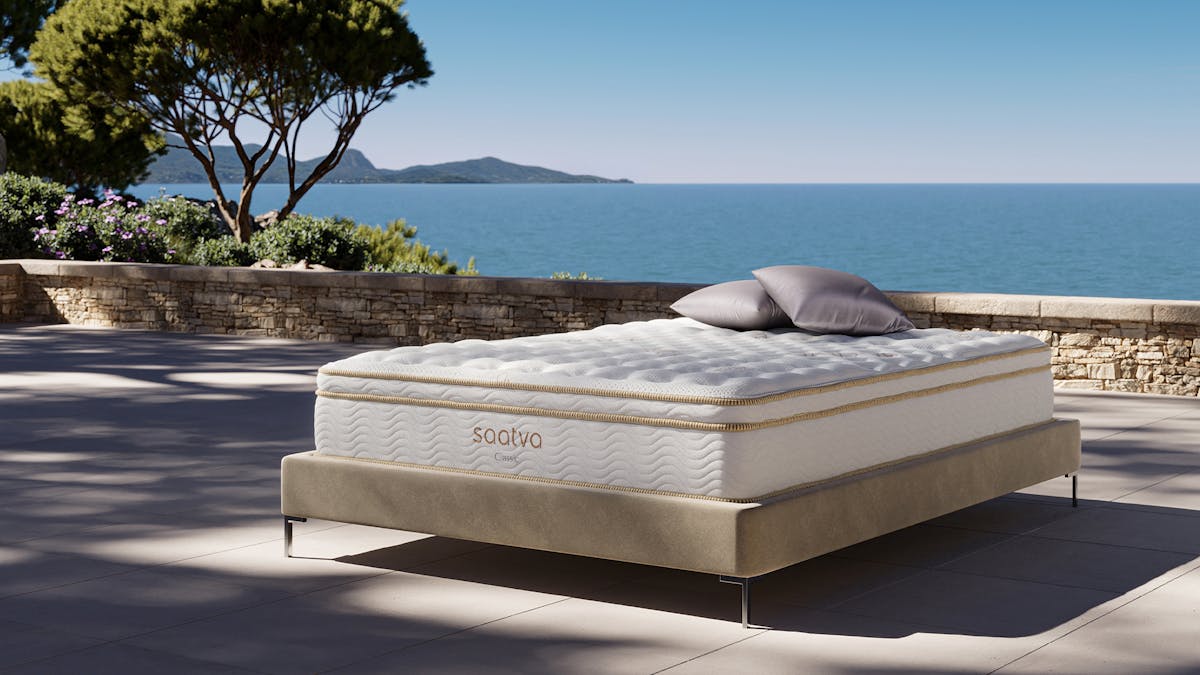
Saatva Latex Mattress Topper
9.0/10
- Talalay latex runs naturally cooler than both gel and standard memory foam
- Responsive, pressure-relieving feel without the stuck-in-mud sensation
- Organic cotton cover, GOLS-certified latex
- Fits hot sleepers and joint-pain sufferers equally well
- Premium price point above most foam toppers
- Latex feel won't appeal to sleepers who love deep foam contouring
Natural Talalay latex outperforms both gel foam and standard memory foam on heat dissipation while matching or beating both on pressure relief and durability. For anyone upgrading a too-firm or aging mattress, this is the version worth buying once.
Gel vs. memory foam topper: the real differences
Both types of topper start with the same base material: viscoelastic memory foam. The difference is what gets added to that foam during manufacturing. Standard memory foam uses the base formulation on its own. Gel memory foam incorporates either gel beads blended into the foam or liquid gel swirled through it before curing.
That small manufacturing difference produces a meaningful gap in one area, a modest gap in a second, and no real gap in a third:
- Temperature regulation: gel foam runs measurably cooler, particularly in the first half of the night. The gel absorbs body heat that would otherwise stay trapped in the foam matrix. The gap is real but narrows after a few hours when the gel reaches equilibrium.
- Feel and responsiveness: gel foam rebounds slightly faster. Standard memory foam has a slower, more enveloping feel that some sleepers love and others find suffocating. Neither is objectively better, it is a preference issue.
- Pressure relief and motion isolation: both perform nearly identically. The viscoelastic base does the work here, and a thin layer of gel does not materially change how the foam distributes weight.
Everything else, including off-gassing, durability, and firmness options, is driven by foam density and construction quality, not by whether gel is present.
Gel vs. memory foam topper: comparison table
| Feature | Gel memory foam topper | Standard memory foam topper |
|---|---|---|
| Cooling | Good to very good, dissipates heat actively | Fair, retains more body heat |
| Pressure relief | Excellent | Excellent |
| Motion isolation | Very good | Very good |
| Feel | Contouring, slightly quicker response | Deep contour, slower sink-and-release |
| Price range | Mid to upper mid ($80-$250 for 2-3 inches) | Budget to mid ($40-$180 for 2-3 inches) |
| Best for | Hot sleepers, warm climates, back/combo sleepers | Cold-room sleepers, side sleepers, tight budgets |
| Off-gassing | Present, dissipates in 24-72 hours | Present, dissipates in 24-72 hours |
| CertiPUR-US | Standard on reputable brands | Standard on reputable brands |
| Durability | 3-5 years typical at good density | 3-5 years typical at good density |
Which type should you choose?
The decision comes down to two variables: how hot you sleep, and how much you value deep contouring versus quicker response.
Choose gel memory foam if: you wake up sweating or sleeping on your back in a room without AC. The cooling advantage is worth the small price premium. Look for a topper with a gel swirl rather than gel beads alone, as swirl formulations distribute heat more evenly across the foam surface.
Choose standard memory foam if: your room is cool, you love the full enveloping hug of slow-response foam, or you are on a tight budget. A high-density (4 lb/ft3 or above) standard memory foam topper will outlast most budget gel options and provide superior pressure relief for side sleepers pressing a hip or shoulder into the surface.
Consider latex if neither fully fits: natural Talalay or Dunlop latex toppers run cooler than both foam types, respond faster, and last significantly longer (8-10 years versus 3-5 for foam). The price is higher, but the cost-per-year often works out comparably once you factor in replacement cycles.
Thickness matters more than gel content
A common mistake is spending energy on the gel question while ignoring topper thickness, which has a bigger impact on feel.
- 1 to 1.5 inches: minor adjustment, adds a small amount of softness to a very firm mattress. Does not meaningfully change sleep position support.
- 2 to 2.5 inches: the sweet spot for most sleepers. Enough to relieve pressure at the hips and shoulders without destabilizing spinal alignment.
- 3 to 4 inches: significant transformation, turns a firm mattress soft. Can cause alignment problems for back and stomach sleepers if the underlying mattress was already too soft.
For side sleepers with joint pain, a 3-inch high-density option is worth considering. For back sleepers trying to add a little cushion to a supportive mattress, 2 inches is usually the right call.
Density is the durability key
Foam density (measured in pounds per cubic foot) tells you more about longevity than any marketing language. Higher density means more material per unit of space, which means slower breakdown.
- Below 3 lb/ft3: budget foam that softens and develops body impressions within 12-18 months. Avoid for long-term use.
- 3 to 4 lb/ft3: standard quality, will last 3-4 years under normal use.
- 4 lb/ft3 and above: premium range, often reaches 5 years of consistent use. Look for this density in any topper above $150.
Most gel toppers do not prominently advertise density because many are in the 3 lb/ft3 range. Ask the brand directly or look for it in the spec sheet before buying.
Hot sleeper alternatives worth knowing
If heat retention is your primary concern, foam toppers (gel or otherwise) are not the ceiling of what is available. A few alternatives worth considering:
- Natural latex toppers: open-cell structure allows airflow that gel foam cannot replicate. Talalay-process latex is particularly breathable. The Saatva latex topper linked above is a reliable representative of this category.
- Wool toppers: regulate temperature through moisture wicking rather than active cooling. Work well in climates with humidity swings but do not provide the pressure relief of foam.
- Phase-change material (PCM) covers: some brands pair gel foam with a PCM cover that stores and releases heat at skin temperature. The effect is noticeable in the first 30-60 minutes of sleep.
Frequently asked questions
Is gel memory foam topper better than regular memory foam?
For hot sleepers, yes. Gel memory foam dissipates body heat more effectively, which makes a real difference in warm rooms or for people who run warm. For cold-room sleepers or people who love deep contouring, regular memory foam is equally good and usually cheaper.
How long does a memory foam topper last?
A high-density foam topper (4 lb/ft3 or above) typically lasts 4-5 years before developing significant body impressions. Budget foam below 3 lb/ft3 may show softening within 12-18 months. Latex toppers outlast both, often reaching 8-10 years.
Does gel memory foam off-gas less than regular memory foam?
No meaningful difference. Both release volatile organic compounds when first unpacked. The smell typically dissipates within 24-72 hours in a ventilated room. CertiPUR-US certification on either type indicates the foam has been tested for low VOC emissions.
Can a topper fix a mattress that is too firm?
A 2-3 inch high-density topper can significantly soften a too-firm mattress and add meaningful pressure relief at the shoulders and hips. It cannot fix structural issues like sagging or broken coils, and it will not add support to a mattress that is already too soft.
What thickness memory foam topper should I get for side sleeping?
Side sleepers generally benefit from 2-3 inches. The priority is pressure relief at the hip and shoulder, and thinner toppers do not provide enough material to cushion those contact points adequately. A 3-inch high-density option is the best choice for combination side sleepers with joint pain.
Are gel memory foam toppers worth the extra cost?
If you sleep hot, the premium is worth it. Gel toppers typically run $30-$70 more than equivalent standard foam options. For a hot sleeper, the cooling benefit over a 3-4 year lifespan makes that a reasonable investment. For sleepers who do not overheat, the extra spend delivers no practical benefit.
Gel memory foam wins on cooling, standard memory foam wins on price, and natural latex beats both on durability and breathability. Pick gel if you sleep hot, standard if your room is cool, and upgrade to a latex topper like the Saatva Latex Topper if you want a long-term solution that does not force the trade-off.
OUR PICK
Our pick that settles the debate: the Saatva Graphite Memory Foam Topper combines graphite cooling with memory-foam contour, per saatva.com.
If you buy through links on this page, we may earn a commission at no extra cost to you.