
 by
by Quick answer: According to “How Do Whales Sleep? They’re Always Half Awake (Literally),” a whale rests while remaining partly alert, balancing safety, movement, and oxygen intake rather than simply switching off.
- The article describes a humpback resting like a floating log at the surface.
- It also describes synchronized sleep within a whale pod.
- WhalePedia lists satellite tagging, acoustic monitoring, photo identification, and genetic analysis among the methods used to study whales.
Updated July 2026 · Reviewed for accuracy
A sleeping whale may look almost motionless, but that calm appearance doesn’t mean the animal has completely switched off. The cited article’s “half awake” description points to a form of rest shaped by life in the ocean. For me, the key is separating visible stillness from the continuing need to manage oxygen, movement, and safety.
The short answer: a whale remains partly alert
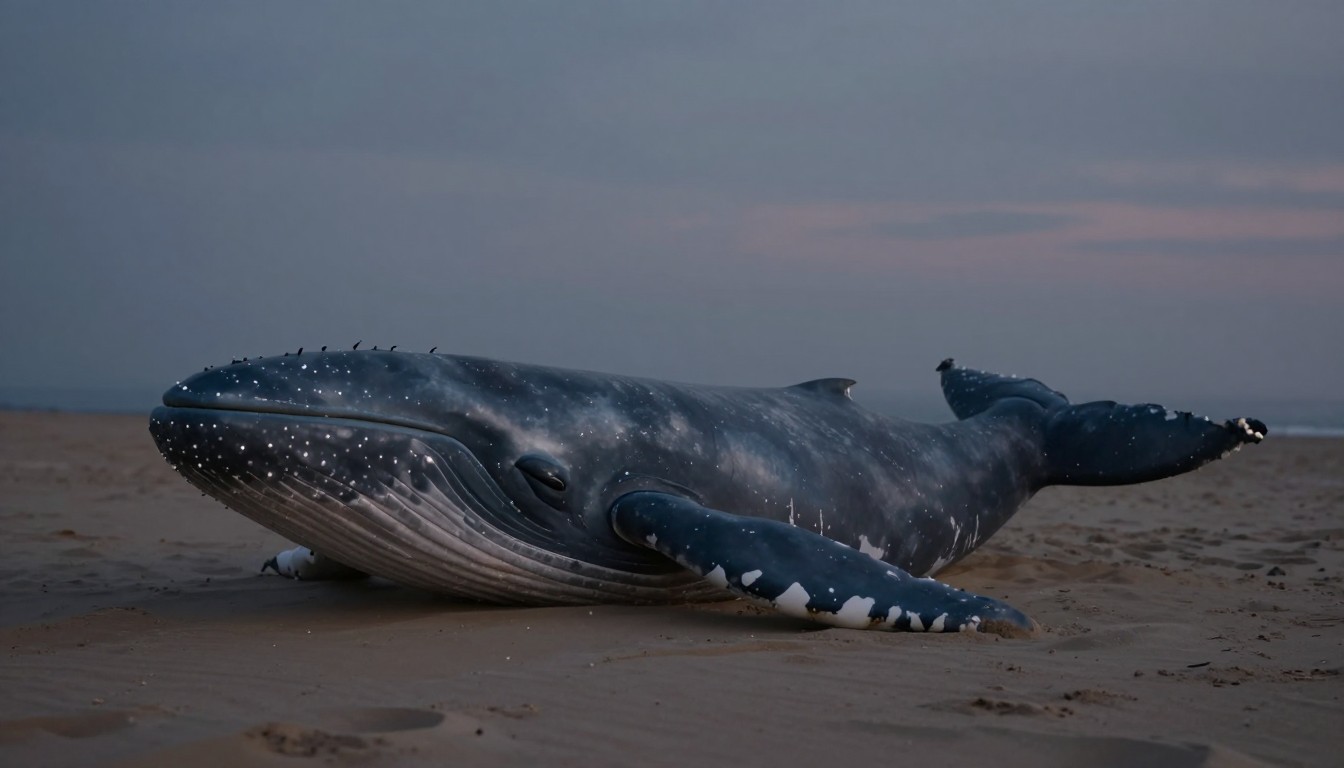
A log-like humpback at the surface is the clearest reported picture of whale sleep in the cited article. The whale can appear calm and still, yet its resting behavior remains adapted to an environment where oxygen intake and safety still matter.
The phrase “half awake” is useful because it rules out the familiar image of an animal becoming wholly unresponsive. It tells us that rest and alertness can overlap. It doesn’t, by itself, provide a detailed map of which brain systems are resting or active.
That distinction matters. A whale doesn’t leave the ocean to enter a separate sleeping environment. According to “How Do Whales Sleep? They’re Always Half Awake (Literally),” its resting behavior has to balance sleep with movement and oxygen intake in the same place where it lives.
I’d therefore answer the question in plain language: a whale sleeps by becoming calm and resting while retaining enough alertness to handle the demands of the ocean. That answer is less dramatic than saying whales never sleep, and more accurate than imagining ordinary human sleep transferred underwater.
The useful distinction: A whale can be resting without being completely disengaged. Surface calm describes what an observer sees; partial alertness explains why that calm can coexist with oxygen management and movement.
Why sleeping in the ocean changes the job
Oxygen intake remains part of the problem even while a whale rests. The cited “Half Awake” article specifically describes whale sleep as a balance involving oxygen, rather than a period in which every other demand disappears.
Movement is part of that balance too. This doesn’t mean every sleeping whale must travel continuously, and the cited account doesn’t give one universal movement pattern. It means that “asleep” shouldn’t automatically be read as “incapable of moving or managing position.”
Safety is the other stated constraint. The article doesn’t identify a single hazard or claim that every whale faces the same conditions during every rest period. Its narrower point is stronger: whale rest is adapted to preserve enough responsiveness for life in the ocean.
This is why the human bedroom comparison quickly breaks down. A person can focus on the comfort and support of a sleep surface, topics covered in our guide to whether a mattress affects sleep quality. A whale’s immediate challenge is different because rest has to work inside its marine environment.
Keep the categories separate:
- Human bedding questions concern the surface and setup used for sleep.
- Whale sleep concerns a resting strategy that still accommodates ocean life.
- Neither a mattress analogy nor the image of total unconsciousness fully explains the behavior described by the whale sources.
For readers interested in bedding mechanics rather than marine biology, our separate explainer covers how a Sleep Number bed works.
What a sleeping whale can look like
The cited article gives two concrete scenes: a humpback lying log-like at the surface and a pod resting in synchronization. Those examples show that whale sleep can be visible as either an individual posture or coordinated group behavior.
| Reported scene | What it supports | What it doesn’t prove |
|---|---|---|
| A humpback floating calmly at the surface | Rest can resemble a log-like surface posture. | That every whale species always sleeps at the surface. |
| Synchronized rest within a pod | Rest can be coordinated among multiple whales. | That every pod follows the same pattern on every occasion. |
The surface example is easy to misunderstand. “Log-floating” is a visual comparison, not a claim that the whale has become inert. The same article frames resting behavior around continued oxygen management, movement, and safety, so the posture has to be read in that wider context.
The pod example adds a social dimension. If whales can rest in synchronization, sleep isn’t necessarily a wholly isolated event. The cited account doesn’t provide a universal schedule or say that every whale sleeps beside other pod members, so I wouldn’t turn one reported pattern into a rule for every species.
Neither example supplies a fixed duration, depth, or timetable. Adding such details would create precision that the cited accounts don’t provide. The defensible takeaway is qualitative: whale rest can look quiet at the surface, and it can occur in a coordinated group pattern.
What to notice in footage or photographs
- Whether the whale is calm at the surface, matching the reported log-floating scene.
- Whether several whales appear to be resting in a synchronized pattern.
- Whether the description acknowledges that apparent stillness and partial alertness can coexist.
A single still image can suggest a resting posture, but it can’t establish the full behavior surrounding that moment.
What “half awake” actually tells us
“Half awake” appears in the title of the cited whale-sleep article, and it works best as a plain-English description of partial alertness. I wouldn’t treat it as a mathematical measurement or use it to invent a precise account of brain activity.
The phrase does tell us something important: sleep for a whale isn’t presented as an all-or-nothing switch. Rest can occur while the animal remains responsive to the practical demands named by the article, especially oxygen intake, movement, and safety.
That’s also why “whales don’t sleep” is the wrong summary of the material. The sources explicitly discuss sleep and resting behavior. What differs is the form that sleep takes in an animal spending its life in the ocean.
The opposite claim, that a whale becomes fully unaware in exactly the same way a human sleeper might appear to, goes too far as well. The cited account emphasizes continued alertness, but it doesn’t provide enough neurological detail to support claims about particular brain regions or exact levels of awareness.
My plain-English reading: “Half awake” means rest without total disengagement. It’s a description of how sleep and necessary ocean behavior overlap, not permission to attach unsupported neurological details.
How scientists study whale sleep
WhalePedia lists satellite tagging, acoustic monitoring, photo identification, and genetic analysis among the methods scientists use to study whales. Its whale-sleep FAQ also says the sleep question connects with several broader areas of whale research.
Those methods don’t all answer the same question. Satellite tagging can be considered alongside suspected changes in movement. Acoustic monitoring can provide a sound record to compare with visible behavior, while photo identification can help connect repeated observations to a particular whale.
Genetic analysis supplies a different kind of biological context. WhalePedia includes it in the wider research toolkit, but that doesn’t mean a genetic result is itself a direct reading of whether a whale is asleep at a particular moment.
This mixed-method approach makes sense to me because sleep is more than a posture. A calm whale at the surface gives observers a visible clue, but movement, sound, identity, and biological context can help researchers ask better questions about the behavior surrounding that scene.
What each listed method can contribute
- Satellite tagging: a way to examine movement around a suspected period of rest.
- Acoustic monitoring: a sound record that can be considered alongside observed behavior.
- Photo identification: a way to connect observations with an identified animal.
- Genetic analysis: biological context within the broader study of whales.
WhalePedia lists these as research methods, not as interchangeable sleep detectors. No single method should be stretched beyond what it can show.
Photo identification is especially useful for understanding why one dramatic image needs context. A photograph may capture the log-like posture described in the whale-sleep article, but identification can place that image within a larger set of observations about the animal.
Acoustic and movement records raise similarly careful questions. A change in sound or movement may be worth comparing with surface behavior, but the method names alone don’t justify a definite sleep diagnosis. Interpretation depends on how the records line up with observed resting behavior.
The disciplined approach is to combine clues without claiming more than they establish. That’s a much better foundation than treating every motionless whale as asleep or assuming that an unseen whale must be awake.
The bottom line
A calm, log-like humpback at the surface can be resting while still partly alert. A pod can also rest in synchronization, according to “How Do Whales Sleep? They’re Always Half Awake (Literally).” Both scenes fit the same central idea: whale sleep has to coexist with ocean life.
The best answer to “how does a whale sleep?” is therefore simple. It rests without fully abandoning the alertness needed to manage safety, movement, and oxygen intake. The cited examples show what that may look like, but they don’t establish one universal posture or schedule for every whale.
I’d remember the constraint rather than a catchy myth. Whales do sleep, but their rest is described as partly alert and adapted to the environment in which they live.
FAQ
Do whales fully switch off when they sleep?
The cited “Half Awake” article describes whales as remaining partly alert during rest. That supports a qualified no, but it doesn’t provide enough neurological detail to specify exactly which brain systems remain active.
Do whales sleep at the surface?
The same article describes a humpback resting calmly in a log-like position at the surface. That confirms surface rest as a reported pattern, but it doesn’t prove that every whale always sleeps in the same place or posture.
Can whales sleep together in a pod?
Yes, synchronized pod sleep is one of the scenes described in the cited article. It shows that whale rest can be coordinated, although the account doesn’t say that every pod rests this way on every occasion.
How does a sleeping whale manage oxygen?
The cited article says whale resting behavior is adapted to balance sleep with oxygen intake. It doesn’t provide a precise breathing sequence, so the careful answer is that oxygen management remains part of the whale’s resting strategy rather than stopping during sleep.
How do scientists know whether a whale is sleeping?
WhalePedia says scientists study whales through satellite tagging, acoustic monitoring, photo identification, and genetic analysis. Visible postures such as log-floating provide useful clues, while the listed methods can add movement, sound, identity, and biological context without making any single clue conclusive by itself.