
 by
by Quick answer: An ostrich can sleep while standing or sitting. Its rest includes REM cycles, and alertness remains part of its survival strategy in the wild, according to BrainBound.
- BrainBound identifies both standing and sitting sleep postures.
- The same overview describes REM cycles as part of ostrich sleep.
- It connects vigilant rest with survival in the wild.
Updated July 2026 · Reviewed for accuracy
An ostrich doesn’t have one fixed sleeping pose. BrainBound’s overview of sleeping ostrich habits describes a mix of standing rest, sitting sleep, REM cycles, and continued alertness.
My plain-spoken answer is that ostrich sleep is flexible and guarded. The bird can rest without looking deeply asleep, which is why a standing ostrich may be sleeping even when its posture suggests otherwise.
What Ostrich Sleep Actually Looks Like
Standing and sitting are both identified as sleeping postures in BrainBound’s discussion of ostrich habits. That’s the first point to understand, because neither posture tells the whole story by itself.
An upright ostrich may look fully awake to a casual observer. Yet standing appears within BrainBound’s description of ostrich rest, so an upright position doesn’t automatically rule out sleep. Posture tells you how the bird is holding itself, not precisely what is happening within its sleep cycle.
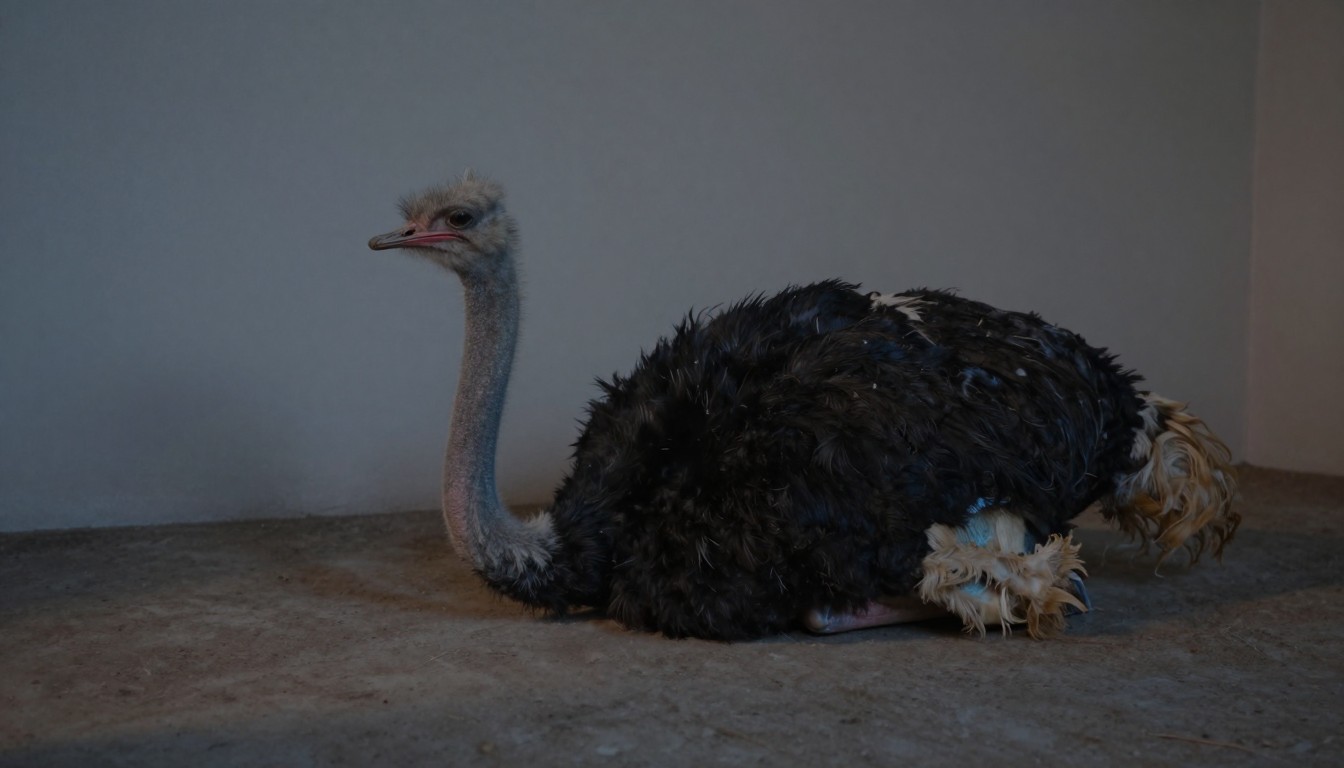
A sitting ostrich gives a more familiar visual signal of rest. Even then, BrainBound doesn’t establish that every sitting bird is asleep, that sitting always means deeper sleep, or that a particular sleep stage must follow. Those would be extra conclusions rather than facts established by the source.
The useful distinction
- Standing: compatible with the sleep and rest behavior described by BrainBound.
- Sitting: also identified as an ostrich sleeping posture.
- Sleep stage: posture alone doesn’t establish whether the bird is experiencing REM.
I’d describe this as posture-flexible sleep. The ostrich isn’t locked into the human-looking pattern of lying down and remaining in that position throughout a rest period. BrainBound’s overview instead presents sleep as behavior that can take more than one visible form.
That distinction helps explain why ostrich sleep can seem strange. People often expect sleep to be obvious from body position. With an ostrich, an upright pose may be part of rest, while a sitting pose may be part of sleep without revealing its exact depth or stage.
BrainBound doesn’t provide a fixed timetable for either posture. It also doesn’t establish that every ostrich follows an identical sequence. The sound answer is therefore qualitative: ostriches can sleep standing or sitting, but the cited material doesn’t justify an exact schedule for each position.
Standing Sleep Versus Sitting Sleep
The clearest documented difference is physical position. BrainBound names both standing and sitting, but it doesn’t assign a precise level of sleep to either posture.
| Posture | What the source supports | What not to assume |
|---|---|---|
| Standing | BrainBound includes standing positions in its account of ostrich sleep and vigilant rest. | That every upright ostrich is asleep, or that standing always corresponds to one particular sleep stage. |
| Sitting | BrainBound identifies sitting as another sleeping posture. | That sitting always means REM, deeper sleep, or complete loss of awareness. |
| Either posture | Both fit the broader picture of flexible, alert rest described by BrainBound. | An exact duration, sequence, or level of alertness based on posture alone. |
Standing sleep matters because it challenges the easy assumption that an upright bird must be awake. BrainBound’s account places standing within the wider subject of ostrich sleep, so visible uprightness isn’t enough to settle the question.
Sitting is easier for a human observer to recognize as rest. Still, familiar appearance isn’t proof of a particular sleep state. BrainBound mentions sitting postures and REM cycles, but it doesn’t explicitly say that REM occurs only while sitting.
The same caution applies in reverse. The existence of standing rest doesn’t mean ostriches avoid sitting, just as the existence of sitting sleep doesn’t make standing rest an error. The two descriptions complement one another.
My take: Use posture as the starting clue, not the final diagnosis. “Standing” and “sitting” describe what you can see. They don’t reveal an exact sleep stage without stronger observation and sourcing.
It’s also unwise to invent a rigid transition between the two positions. BrainBound doesn’t give a universal order in which standing and sitting must occur. A neat sequence may sound satisfying, but the cited description supports flexibility rather than a fixed routine.
REM Cycles and Vigilant Rest
REM cycles appear in BrainBound’s overview, while alertness is presented as part of the ostrich’s survival strategy. These are related pieces of the sleep picture, but they shouldn’t be collapsed into one unsupported claim.
The mention of REM tells us that the discussion concerns actual sleep behavior, not merely an animal standing still. It doesn’t tell us exactly how long REM lasts, how often it occurs, or which posture always accompanies it. BrainBound’s public description doesn’t establish those details.
“Vigilant rest” is best read plainly: alertness remains relevant while the ostrich rests. BrainBound frames that quality in terms of survival in the wild. I wouldn’t stretch that into saying an ostrich is fully awake throughout sleep, because that would erase the source’s separate reference to sleep and REM cycles.
A careful reading of the evidence
- REM cycles are part of the sleep behavior described by BrainBound.
- Vigilance is part of the broader survival context described by the same source.
- BrainBound doesn’t provide an exact posture-by-posture map of every sleep stage.
- It also doesn’t support a claim that an ostrich remains completely conscious during all sleep.
This middle ground is the most useful answer. Ostrich sleep isn’t simply “awake while standing” versus “asleep while sitting.” BrainBound’s overview points to a more nuanced pattern in which different postures, genuine sleep cycles, and alertness all matter.
That nuance is easily lost in dramatic descriptions. A catchy label may make the behavior sound mysterious, but it can hide the basic distinction between an observed posture and a confirmed sleep state. I’d stick with the simpler language: ostriches can rest upright, can sleep sitting, experience REM cycles, and retain an alert style of rest.
None of that gives us permission to assign precise timing or consciousness levels. BrainBound doesn’t supply those measurements in its overview, so exact claims would create certainty that the source doesn’t provide.
How to Read an Ostrich Sleep Photo or Video
A standing or sitting posture can both fit BrainBound’s account, so a single image can’t reliably settle whether an ostrich is awake, resting, or in REM. A photograph gives you a posture, not a complete sleep record.
If you’re looking at an ostrich image or clip, separate what is visible from what the caption claims. This keeps a straightforward observation from turning into an unsupported explanation.
- Name the visible posture. Is the ostrich standing or sitting? Both positions appear in BrainBound’s account of sleep.
- Avoid treating posture as proof. Standing doesn’t automatically mean awake, and sitting doesn’t establish a particular sleep stage.
- Check the stated context. A credible explanation should distinguish ordinary stillness, rest, sleep, and REM rather than using the terms interchangeably.
- Don’t assign REM from appearance alone. BrainBound mentions REM cycles, but its overview doesn’t give a simple visual rule for identifying them.
- Reject unsupported precision. Exact schedules, durations, and posture sequences need evidence beyond a photograph or an unreferenced caption.
A video offers more context than a still image because it shows change over time. Even so, movement or stillness alone doesn’t identify a precise sleep stage. Without an informed explanation, the safest description stays close to what is visible.
This is where many online captions overreach. “The ostrich is standing” is an observation. “The ostrich is experiencing a specific phase of sleep” is a separate claim that requires better support.
The same standard applies to sitting. A seated posture is consistent with BrainBound’s description of sleeping ostriches, but the posture doesn’t prove that the bird has entered REM or lost awareness of its surroundings.
A reliable caption stays modest: “This ostrich appears to be resting while standing” is more defensible than assigning a precise sleep stage from one visual moment.
My rule is simple: describe first, interpret second. BrainBound gives us a useful framework of standing rest, sitting sleep, REM cycles, and vigilance. It doesn’t turn every ostrich image into a complete account of the bird’s internal state.
The Bottom Line on Ostrich Sleep
BrainBound supports a narrow but useful answer: ostriches can sleep in standing and sitting positions, experience REM cycles, and combine rest with a degree of vigilance tied to survival in the wild.
What remains open is just as important. BrainBound’s overview doesn’t establish an exact sleep schedule, a fixed order of postures, a universal REM position, or a precise level of awareness during each part of rest. Those details shouldn’t be guessed.
What you can safely remember
- An ostrich doesn’t need to sit before its behavior can count as rest or sleep.
- Sitting is also a recognized sleeping posture in BrainBound’s account.
- REM is part of the picture, but posture alone doesn’t identify it.
- Vigilance helps explain why ostrich sleep may not look fully disengaged.
So, how does an ostrich sleep? Sometimes upright, sometimes sitting, with genuine sleep cycles occurring within a broader pattern of guarded rest. That answer is less dramatic than many online descriptions, but it stays within what BrainBound actually presents.
If your real question concerns your own rest, keep it separate from ostrich behavior. These human-focused guides examine whether a mattress affects sleep quality and ask whether magnesium helps you sleep.
FAQ
Do ostriches sleep standing up?
Yes. BrainBound includes standing positions in its overview of sleeping ostrich habits and vigilant rest. Standing isn’t their only sleeping posture, however, and an upright position alone doesn’t reveal the exact sleep stage.
Do ostriches sit down to sleep?
Yes. Sitting postures are also part of BrainBound’s description of ostrich sleep. The source doesn’t establish that every seated ostrich is asleep or that sitting always corresponds to REM.
Do ostriches experience REM sleep?
BrainBound’s overview specifically discusses REM cycles in ostriches. It doesn’t provide enough detail to assign REM to every standing or sitting pose, so posture shouldn’t be used as a precise REM indicator.
Are ostriches awake while they sleep?
BrainBound describes ostrich rest as vigilant and connects that alertness with survival in the wild. That doesn’t mean an ostrich is simply awake throughout sleep, especially because the same source also identifies REM cycles.
Why does ostrich sleep look unusual?
It can look unusual because sleep may occur in more than one posture, including standing and sitting, according to BrainBound. The continued emphasis on vigilance also makes ostrich rest appear less visibly disengaged than people may expect sleep to look.