
 by
by Quick answer: Usually yes, but only if "hard" means dense and supportive rather than thin and stiff. Under higher body weight, material density decides whether a topper holds up or flattens.
- Firmness is a feel rating. Density is what actually carries load, and the two are not the same thing.
- Latex and high-density memory foam resist long-term sagging far better than budget polyfoam or fiberfill.
- A topper adjusts how a mattress feels. It cannot rebuild a support core that has already collapsed.
Updated July 2026 · Reviewed for accuracy
Most of the "firm topper" advice aimed at heavier sleepers gets the physics backwards. A hard surface isn't what keeps your hips from sinking. Dense material is. I've spent years pulling apart foam layers and reading spec sheets, and the pattern is consistent: the toppers that survive under load are the heavy ones, not necessarily the stiff ones.
So the honest answer to the question is a qualified yes. Below is what "qualified" means, which materials earn their keep, and when a topper is the wrong purchase entirely.
"Hard" and "supportive" are not the same thing
Firmness describes the first impression your hand gets when you press down. Support describes what happens after your full body weight has been sitting on that surface for hours. Cheap foam can pass the hand test and still fail the hip test, because the initial resistance comes from surface tension in the foam skin, not from the material's ability to hold shape under sustained pressure.
Here's how that plays out. A thin, firm topper laid over a mattress compresses to nearly nothing under the heaviest part of your body, usually the hips and shoulders. You end up feeling the mattress underneath, not the topper. The topper is still technically "firm" everywhere your weight isn't concentrated, which is why the product can feel fine when you sit on the edge and wrong when you actually lie down.
Support comes from two properties working together: density, meaning how much material is packed into a given volume, and resilience, meaning how eagerly the material pushes back toward its original shape. Latex scores high on both. High-density memory foam scores high on density and low on resilience, which is why it feels slow and hugging. Convoluted egg-crate polyfoam scores low on both, which is why it's cheap.
The test I'd apply in a store: press with your fist, not your palm, and hold for a slow count. Palm pressure spreads load and makes almost anything feel supportive. Fist pressure concentrates it the way a hip does. If your knuckles reach the mattress underneath, that topper won't work for a heavier body.
What actually happens to a topper under higher body weight
Foam fails in a predictable order. The cell walls inside the material flex under load, recover when the load lifts, and gradually lose the ability to fully recover. More weight means more flex per cycle, so the same topper that lasts years under a lighter sleeper can develop a body impression noticeably faster under a heavier one. Nothing is defective about that topper. It was specified for a different load.
This is why I steer heavier shoppers away from thickness as the headline number and toward density instead. A thick, low-density topper gives you more material to compress, which can actually feel worse: you sink further before hitting resistance, and the sinking feels like a hammock. A thinner but genuinely dense layer resists earlier and holds the line.
The second failure mode is edge collapse. Toppers have no perimeter reinforcement, so they compress hardest wherever the load is concentrated near a boundary. Sitting on the side of the bed to put shoes on does more damage to a topper than a full night of sleeping does. Heavier sleepers who use the edge as a chair should expect the perimeter to break down first, whatever the material.
Materials, ranked by how they behave under load
I judge topper materials on four things: how well they carry concentrated weight, how they age, how they handle heat, and how much motion they pass through. Here's how the common options sort out.
| Material | Support under load | Aging | Heat |
|---|---|---|---|
| Natural latex | Strongest. Pushes back instead of collapsing. | Best in class for resisting body impressions. | Neutral, open cell structure breathes. |
| High-density memory foam | Good, but contours deeply before it resists. | Holds up when density is genuinely high. | Warmest unless gel or graphite infused. |
| High-density polyfoam | Decent, firmer feel, less hug. | Varies wildly by grade. Density is everything. | Cooler than memory foam. |
| Wool | Cushioning, not structural support. | Compresses over time, can be re-fluffed. | Excellent, regulates moisture well. |
| Fiberfill / down alternative | Poor. Flattens under concentrated weight. | Shortest useful life of the group. | Traps heat once compressed. |
| Egg-crate polyfoam | Weakest. The convolutions exist to save material. | Peaks crush and stay crushed. | Airflow is the one genuine advantage. |
If I had to pick one material for a heavier sleeper who wants a firmer surface, it's latex. It's the only common topper material that resists compression by springing back rather than by simply being stiff, and that difference is what separates a topper that still works next winter from one that has a permanent trough in it.
Wool is the interesting outlier. It won't add support, so treat it as a comfort and temperature layer rather than a fix for a sagging bed. If that's the job you're hiring it for, our wool mattress topper guide covers how the fill weight and ticking change the feel, and the wool topper breakdown goes deeper on construction quality.
Do heavier sleepers actually want a firmer topper?
Not automatically. The right answer depends on what's wrong with your current setup, and I see three distinct situations get confused with each other.
You sink and your hips drop below your shoulders. This is a support problem. A firm, dense topper helps a little, but the real cause is usually the mattress core. Read the section below before spending.
The mattress is supportive but the surface is punishing. Common on firm innersprings and budget hybrids. Here a topper genuinely solves the problem, and you want cushioning with density behind it, not extra firmness.
You feel like you're lying in a hole. Too much soft material stacked up. Add a firm latex or high-density layer, or remove the soft topper you already have.
Side sleepers at any body weight need the shoulder and hip to sink further than the waist, so a topper that's uniformly hard tends to create pressure points at exactly those two spots. Back and stomach sleepers benefit more from a firm surface, because the goal is keeping the midsection from dropping. Body weight amplifies whatever your position already demands, it doesn't override it.
One thing I'd flag: heavier sleepers often report running hot, and a dense memory foam topper is the single fastest way to make that worse. Dense foam holds heat because there's more material and less air in it. If you're temperature sensitive, that pushes you toward latex, wool, or a foam with graphite or gel worked into it.
When a topper is the wrong purchase
A topper sits on top. It changes the top few layers of feel and nothing below that. If your mattress has a visible dip you can see from across the room, or the support core has softened enough that you roll toward the middle, a topper laid over that dip will follow the dip. You'll pay for a new surface and keep the old geometry.
The check I use is simple. Strip the bed, lay a straight edge across the mattress, and look for daylight under it at the sleeping positions. If there's a clear valley, you need a mattress, not a topper. If the surface is flat and you simply dislike how it feels, a topper is the cheaper and smarter move.
Foundation matters more than most people expect at higher body weights. A slatted base with wide gaps lets the mattress sag between the slats, and a topper cannot correct a support failure that starts underneath the mattress. Tighter slat spacing or a solid platform fixes more than any comfort layer will.
Order of operations I'd follow: check the foundation first, then check the mattress for a genuine dip, then buy a topper. Doing it in reverse means you spend money on a topper that inherits every problem below it.
What I'd look for on the spec sheet
Shopping for a topper as a heavier sleeper is mostly an exercise in reading past the marketing copy. These are the details that actually predict how the thing performs.
- Density, stated in the specs. If a brand publishes it, that's a good sign. If a brand refuses to publish it and only sells you a firmness word, assume the density is unremarkable.
- Material honesty. "Latex blend" and "natural latex" are different products. So are "memory foam" and "gel memory foam layer over polyfoam." Look for the layer breakdown, not the headline.
- Cover construction and anchoring. Elastic corner straps slip under a heavier body that shifts position. A full fitted skirt holds position far better.
- Return terms. Firmness preference is nearly impossible to predict from a description, so a real sleep trial matters more than any review, mine included.
- Weight of the product itself. Shipping weight is a rough proxy for density when the brand won't publish the number. Heavy is usually a good sign here.
Among the graphite and gel-infused options built to keep dense foam from sleeping hot, the Saatva Graphite Topper is one worth putting on the comparison list, since graphite is added specifically to move heat out of high-density foam. Pricing sits toward the premium end of the topper market, so check the current price on the official site before deciding. For a broader look at how different toppers compare on feel and build, our mattress topper breakdown is a useful next read.
FAQ
Is a firm topper better than a soft one for a heavier person?
Only if the mattress underneath is already supportive and simply feels harsh, or if you sleep on your back or stomach and your midsection is dropping. Side sleepers usually do better with a dense topper that still allows the shoulder and hip to sink.
Will a topper stop me sinking into a sagging mattress?
No. A topper conforms to whatever shape is beneath it, so a dip in the mattress becomes a dip in the topper. Lay a straight edge across the bare mattress, and if you see a valley, replace the mattress instead.
How thick should a topper be for a heavier sleeper?
Thickness matters less than density. A dense layer resists compression sooner, while a thick low-density layer lets you sink further before anything pushes back. If you're choosing between thicker or denser at the same price, take denser.
Do toppers wear out faster under higher body weight?
Generally yes, because every compression cycle flexes the foam cell walls harder. Latex holds its shape longest, high-density foams come next, and fiberfill or egg-crate polyfoam flatten first. Rotating the topper end to end spreads the wear.
Which topper material sleeps coolest?
Latex and wool, because both allow airflow and don't trap body heat the way dense viscoelastic foam does. If you want memory foam's contouring without the heat, look for versions with graphite or gel worked into the foam rather than a gel layer printed on the surface.
ONE OPTION WORTH COMPARING
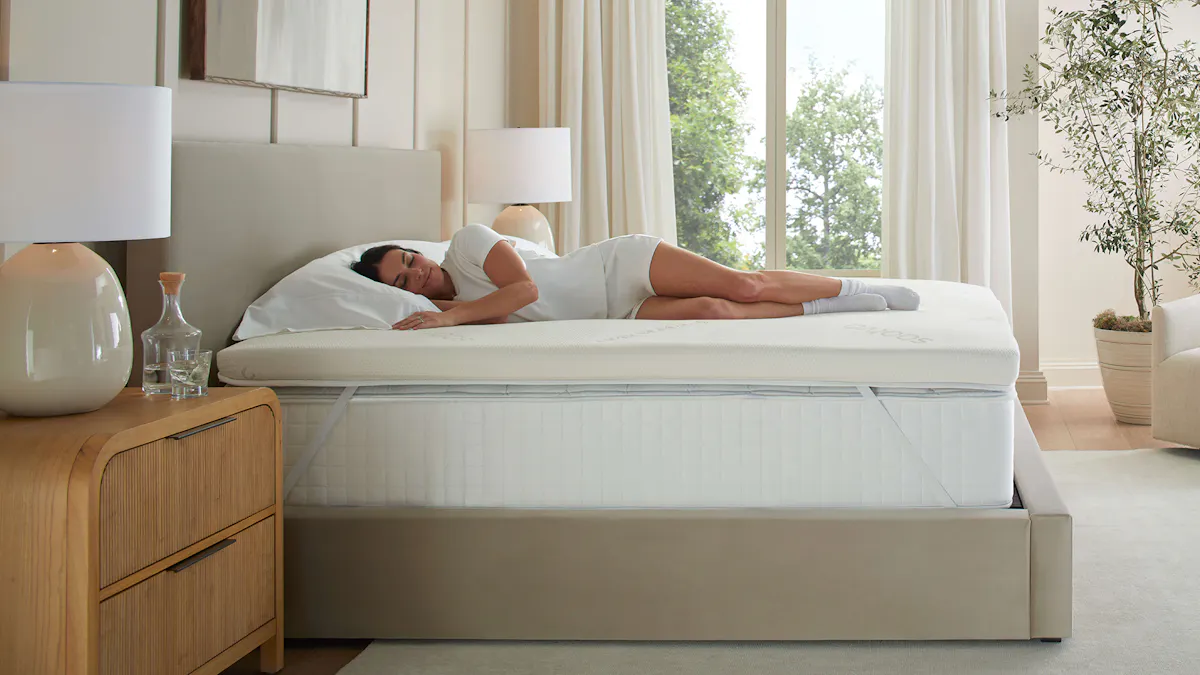
Shopping as well as reading? Here is one current option worth comparing: the Saatva Graphite Topper. Check today’s price, sizing and return terms on the official product page before you order.
Saatva Graphite Topper
- Graphite-infused memory foam, per saatva.com
- 180-night trial
- Secure anchor bands, fits deep mattresses
The bottom line
A hard topper is good for heavier sleepers when "hard" is a byproduct of density, and a bad buy when it's just a thin stiff slab that bottoms out under the hips. Latex earns the recommendation on construction alone, high-density foam works if the brand publishes the density and manages heat, and everything fiberfill or egg-crate is a short-term patch. Before you buy anything, check the foundation and check the mattress for a real dip. A topper is a surface fix, and it can only be as good as what's holding it up.