
 by
by Lull and Tuft & Needle are both budget all-foam beds that serve back and side sleepers reasonably well under $1,000. Tuft & Needle edges out Lull on cooling thanks to graphite crystals in its T&N Adaptive foam, while Lull wins on purchase protection with a 365-night trial versus T&N's 100 nights. Neither brand has a partner programme with MattressNut, so we have no financial reason to push one over the other. If you want the most honest recommendation: the Saatva Classic outperforms both in construction quality, edge support, and long-term durability at roughly $1,295 queen, with coil-on-coil hybrid construction and a lifetime warranty.
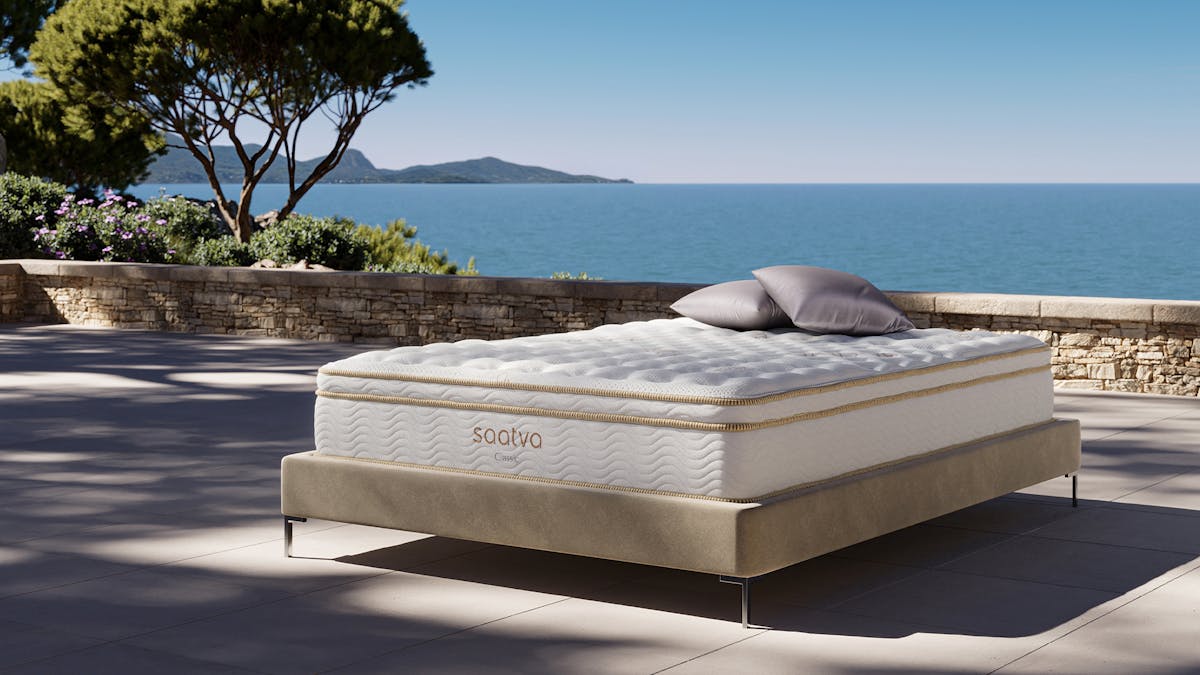
Saatva Classic
9.2/10
- Dual-coil construction with a reinforced lumbar zone pad
- Superior edge support and a genuine hotel-luxury feel
- Free white-glove delivery, setup and old-mattress removal
- 365-night trial, lifetime warranty, three firmness levels
- Ships flat rather than compressed-in-a-box, needs scheduled delivery
- $99 return fee applies during the trial
If you are comparing budget foam beds and wondering whether there is a meaningfully better option, the Saatva Classic is it. Coil-on-coil construction delivers the airflow and support that all-foam mattresses simply cannot match, and the lifetime warranty means you will not be shopping again in three years.
Lull vs Tuft & Needle: what actually differs
Both mattresses target the same shopper: someone who wants a decent foam bed delivered in a box for under $900. Both use a medium-firm feel rated roughly 6 out of 10, both work best for back and side sleepers in the 130 to 230 pound range, and both are CertiPUR-US certified. The differences that matter are in cooling technology, trial length, and warranty coverage.
Comparison table
| Lull Original | Tuft & Needle Original | |
|---|---|---|
| Type | All-foam (gel-infused memory foam) | All-foam (T&N Adaptive with graphite + gel) |
| Firmness | Medium-firm, ~6/10 | Medium-firm, ~6/10 |
| Height | 10 inches | 10 inches |
| Cooling | Gel-infused top layer, breathable cover | Graphite + gel Adaptive foam, open-cell base |
| Motion isolation | Good | Good |
| Edge support | Average (foam compression) | Average (foam compression) |
| Trial | 365 nights | 100 nights |
| Warranty | Lifetime | 10 years |
| Queen price (list) | ~$799 | ~$895 |
| Best for | Budget buyers, side sleepers, couples | Hot sleepers, responsive feel preferences |
Construction
The Lull Original uses a three-layer all-foam design. The top layer is gel-infused memory foam with an aerated structure meant to channel heat while contouring to pressure points. Below that sits a transitional foam for responsiveness, then a high-density support base to prevent sagging. The cover is breathable polyester.
Tuft & Needle's Original is simpler: two layers. The top is the proprietary T&N Adaptive foam, which is infused with cooling gel and heat-conducting graphite crystals. Below that is a dense support base with an open-cell structure for additional airflow. The result is a mattress that sleeps cooler than Lull in back-to-back testing, though neither matches the airflow of a coil hybrid.
Firmness and feel
Both land at medium-firm, but they feel different underfoot. Lull has a more traditional memory foam contour, meaning you sink in slightly before the foam responds. This suits side sleepers who want pressure relief at the shoulder and hip. T&N Adaptive foam is more responsive, with less sinkage and a slightly springy quality that makes it easier to shift positions. Back sleepers and those who prefer sleeping "on" the mattress rather than "in" it tend to prefer Tuft & Needle.
Neither mattress suits strict stomach sleepers at medium-firm, as both allow enough hip sink to pull the lumbar spine out of alignment over a full night.
Cooling
The graphite crystals in T&N Adaptive foam give it a measurable cooling advantage. Graphite is a good thermal conductor, meaning it actively wicks heat away from the body rather than simply slowing its absorption the way standard gel does. Lull's gel-infused layer performs better than a traditional memory foam, but Tuft & Needle stays cooler over the course of a full night for most sleepers.
Both still perform below a coil hybrid on temperature regulation, because open coils circulate air through the mattress in a way that foam simply cannot replicate.
Edge support and motion isolation
Edge support is average on both. Foam compression at the perimeter means the usable sleep surface is slightly smaller than the listed dimensions, and sitting on the edge of either mattress produces noticeable soft-down. If you regularly sit on the edge to get dressed or share the bed with a partner and need the full width, this is a genuine limitation.
Motion isolation is good on both, which is a genuine strength of all-foam construction. Partner movement transfers less across foam than across coils, making either mattress a reasonable pick for couples with different sleep schedules.
Trial and warranty
This is where Lull wins clearly. A 365-night trial is long enough to evaluate the mattress across seasons and seasonal body changes. Tuft & Needle's 100-night trial is the industry standard, but it is genuinely shorter and means you have less runway to decide. Lull also offers a lifetime warranty; Tuft & Needle covers 10 years. For a budget mattress where durability at the 5 to 7 year mark is an open question, the longer trial and warranty are meaningful protections.
Price and value
Lull lists at roughly $799 for a queen before frequent 40 to 50 percent promotions, which can bring the effective price below $500. Tuft & Needle's Original lists at around $895 queen with occasional promotions. At list price, Lull is the better value given the longer trial and lifetime warranty. At promotional prices, both become compelling budget options.
Neither brand provides the construction quality of a coil hybrid at this price range. Foam cores at the $600 to $900 mark develop body impressions faster than pocketed coils, and both Lull and T&N have consistent owner reviews noting this by year three or four for heavier sleepers.
Who should choose each
Choose Lull if you want the longest possible trial to evaluate fit, prefer a traditional contouring memory foam feel, or weigh under 200 pounds and sleep on your side.
Choose Tuft & Needle if you sleep hot and want the cooling advantage graphite provides, prefer a more responsive feel that lets you move without fighting the foam, or predominantly sleep on your back.
Consider the Saatva Classic if durability past five years matters, you want real edge support, you value white-glove delivery and setup, or you simply want a premium hybrid that will outlast both options and back it up with a lifetime warranty.
Saatva Classic
9.2/10
- Coil-on-coil hybrid with reinforced lumbar zone: genuine durability advantage
- Strong edge support from edge-to-edge coils
- Three firmness options (Soft, Luxury Firm, Firm)
- White-glove delivery: setup included, old mattress removed
- 365-night trial and lifetime warranty
- $1,295 queen is a meaningful step up from Lull or T&N
- $99 return fee if you return during the trial
The Saatva Classic is the benchmark here. If you are spending over $1,000 on a mattress, it should outlast both Lull and T&N by several years and provide the edge support, airflow, and purchase protections that budget foam beds cannot offer.
No sponsor in this fight — and no winner worth crowning
We said it plainly above: neither brand pays us, so there’s no thumb on this scale. Graphite-cooled T&N against Lull’s year-long trial is a fair budget scrap — and at promotional prices both become defensible. Defensible is the ceiling here.
Full transparency in the other direction too: the Saatva Classic is a partner — and it’s also simply a different class of construction: coil-on-coil innerspring, plush euro top, white-glove delivery. If « defensible budget foam » isn’t the phrase you want describing your next decade of sleep, look at the Classic’s price today.
Frequently asked questions
Is Lull or Tuft & Needle better for hot sleepers?
Tuft & Needle. The graphite crystals in T&N Adaptive foam conduct heat more actively than Lull's gel-infused layer. Both outperform traditional memory foam, but Tuft & Needle is the cooler option of the two.
Which has the better trial period?
Lull offers 365 nights, which is one of the longest trials in the industry. Tuft & Needle offers 100 nights. If maximizing your evaluation window matters, Lull wins on this point.
Are Lull and Tuft & Needle good for back pain?
Both work reasonably well for non-specific back pain at medium-firm. They support neutral spinal alignment for back and side sleepers in the 130 to 230 pound range. Neither has the zoned lumbar reinforcement of a premium hybrid like the Saatva Classic, so for chronic or acute back pain, a mattress with active lumbar zoning is worth the additional investment.
How long do Lull and Tuft & Needle mattresses last?
Both typically hold up well for around five to seven years under light to average use. Heavier sleepers (over 200 pounds) may see body impressions develop sooner. Lull's lifetime warranty provides better coverage than T&N's 10-year warranty, though the foam core itself is the limiting factor regardless of what the warranty states.
Is Saatva worth the extra cost over Lull or Tuft & Needle?
For most buyers who plan to keep their mattress for more than five years, yes. Coil-on-coil construction outlasts foam cores, edge support is genuinely better, and white-glove delivery removes the setup hassle. At $1,295 queen, the Saatva Classic is roughly $400 to $500 more than list price on either budget brand, but you are paying for a structurally different product.
For cooling, choose Tuft & Needle. For the longest trial, choose Lull. For genuine long-term quality, the Saatva Classic outperforms both with coil-on-coil construction, a 365-night trial, and a lifetime warranty.